

Abbott Reports RMB 9 Billion in Q1 CGM Sales as Domestic Brands Surge During 618 Shopping Festival

Abbott
Diagnostic and pharmaceutical product manufacturers

Sibionics
Medical Device R&D and Manufacturing Company
CGM (Continuous Glucose Monitoring System) possesses three major attributes: medical, innovative, and repeat consumption. CGM products have a strong consumer attribute, and June 18th is often an important consumption period for consumers to stock up, as well as a promotional opportunity that domestic companies cannot afford to miss.
The key period of 618 coincides with the marketing promotion phase of newly approved CGM products from Yuwell and Sinocare. Yuwell Medical's high-performance CGM CT15 series was approved for market launch in March; Sinocare's CGM product, Sinocare Aikang, which adopts the third-generation direct electron transfer technology, also went on sale at the end of April.
Major Sales Meet Key Product Approvals: Intense Competition in China's CGM Market. According to pricing across major e-commerce channels during the 618 period, domestically produced CGMs have dropped to around 230 yuan, while Abbott and Sibionics remain firm above 300 yuan.
How did Chinese companies perform at the end of 618? As the domestic CGM industry grows stronger, more challenges will emerge. When CGM production capacity reaches a million-level scale, how will the mass production capabilities and product stability of CGM products impact the production capacity of Chinese companies? With these questions in mind, VCBeat (WeChat ID: vcbeat) conducted interviews and analysis.
CGM Products Have a Large Patient Population Base, High Repurchase Rate, and Continuous Coverage by Health Insurance in Europe and the U.S., Leading to Rapid Growth in the Global CGM Market Driven by Companies like Abbott and Dexcom. According to Abbott's financial report, Abbott's Q1 CGM sales alone reached approximately 9 billion RMB.
Abbott's strongest sales growth in Q1 2023 came from its medical device division. In Q1 2023, Abbott's medical device business generated $3.9 billion in revenue, an 8.5% increase compared to the previous quarter. More than a third of these sales were contributed by the diabetes care division, which generated approximately $1.3 billion in revenue, nearly all from Abbott's FreeStyle Libre continuous glucose monitoring system. In the U.S. market, sales of the FreeStyle Libre series grew by 50%.
Dexcom, the second-largest participant in the global CGM market, reported revenue of $740 million in the first three months of this year, an 18% increase year-over-year; total sales in the U.S. market reached $526 million, a 16% year-over-year growth.
Looking at the domestic market in China, it has been more than a year since the emergence of domestically produced 14-day calibration-free CGM products. Chinese companies have made significant strides in the CGM market. How have the various domestic companies performed in the market?
During this year's 618 period, according to Shenzhen Sibionics Co., Ltd.: As of June 20, the total order value of Sibionics' CGM product across all channels in Q2 2023 exceeded 100 million yuan, continuing to lead among domestically produced CGM brands in China.
Sanuo's CGM product "Sanuo Aikan," which adopts the third-generation technology route, was approved for marketing at the end of March this year and launched in April. The Q1 2023 performance of Sanuo Biotech does not yet include CGM sales data. Sanuo Biotech expects the overall production capacity of CGM in 2023 to reach 2-3 million sets, with an estimated annual revenue exceeding 150 million yuan.
MicroTech's annual report data shows that in 2022, the AiDEX Continuous Glucose Monitoring System began commercialization, with both offline hospital and online e-commerce channels advancing simultaneously. In 2022, MicroTech’s CGM product sales reached 33.84 million yuan, with sales revenue increasing by 758% year-on-year, accounting for 20% of total revenue.
From the market landscape, what is the current market share of domestically produced enterprises and Abbott?
VCBeat learned from the CGM sales channel that Abbott's products still dominate the market. Abbott has been deeply involved in the market for many years, with more mature products, a larger user base, and relatively fewer after-sales issues.
The market advantage established by Abbott may be difficult to close in a short period of time, but for domestically produced enterprises in China, the CGM market is growing at an annual rate of over 30%. This market has room for multiple participants. In addition to the substitution of domestically produced products, the growth expectations for these enterprises are largely driven by opportunities to increase penetration rates and unlock new incremental markets.
Opening up the incremental market requires Chinese companies to expand their production capacity. When production reaches a million-level scale, the requirements for cost control, production stability, and consistency become even higher.
What Are the Difficulties in the Production Process of CGM Products?
Senior Vice President of Shenzhen Sibionics Co., Ltd. stated: "Electrochemical glucose sensors are divided into first-generation, second-generation, and third-generation sensors based on different electron mediators. For CGM products, the manufacturing processes of these three generations of sensors include three major technological steps: electrode substrate preparation, sensing layer preparation, and membrane layer preparation. These three steps involve various potential variables such as chemical materials, environmental control, and key equipment parameters. How to control these variables to achieve stability and consistency in sensor preparation, and to achieve consistent performance characterization through equipment, is the main challenge in CGM product manufacturing."
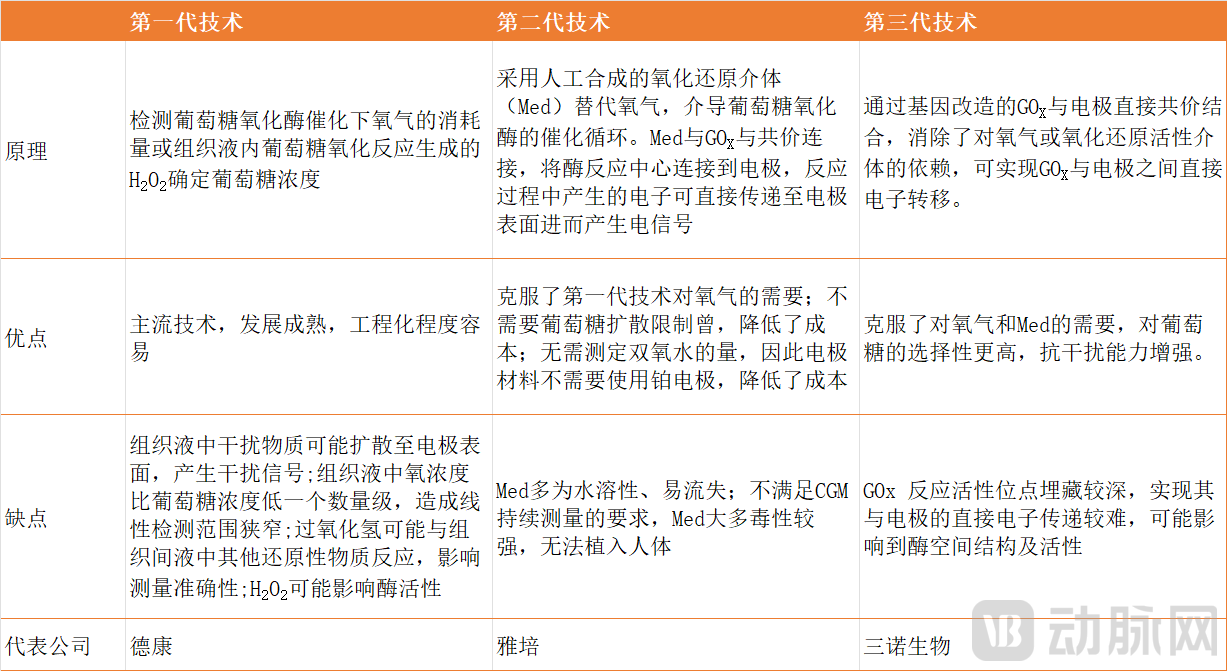
It is worth emphasizing that the product performance of the three technical routes of CGM itself does not have generational advantages or disadvantages. Each route has its own characteristics in terms of performance, manufacturing process, and cost. The process difficulties encountered during the production of products from different technical routes also vary.
Taking Dexcom as an example, the first-generation technology route adopted by Dexcom uses oxygen as an electron mediator. However, due to the influence of oxygen content and diffusion speed in interstitial fluid, the detection speed and accuracy of the first-generation technology are constrained. But in fact, in terms of accuracy, Dexcom's products are not inferior to Abbott’s second-generation technology. Moreover, among type 1 diabetes patients who experience significant blood glucose fluctuations and require high accuracy, Dexcom has more advantages.
The performance advantages of Dexcom are mainly attributed to Dexcom Precision's electrode substrate preparation technology and in-depth research on the membrane system, which enables it to exhibit excellent performance even under hypoxic conditions in the body. However, compared with second-generation sensors, it has certain disadvantages in terms of manufacturing cost and mass production scale, requiring the overcoming of more technical challenges to achieve lower costs and larger-scale production.
The senior vice president of Shenzhen Sibionics Co., Ltd. pointed out: "CGM, from sensor design, to product performance, and then to mass production processes, is a complex system that requires the integration of each company's technical expertise to comprehensively assess and adopt different technological approaches, achieving more reliable product performance with lower costs and more accessible mass production techniques."
Companies adopting the third-generation technology route also need to address their own process challenges. Sinocare, a company in China, utilizes the third-generation direct electron transfer technology route, which boasts advantages such as low potential, no reliance on oxygen, minimal interference, good stability, and high accuracy, with an MARD value of 8.71%.
An industry insider stated: "The third generation has eliminated the reliance on oxygen and Med, which theoretically makes it more accurate and stable. However, this also brings some new issues, including enzyme stability and lifespan."
Currently, Sinocare also faces challenges in process stability. Sinocare adopts online direct sales as its sales method, and the reason for choosing this method is that online direct sales can gather extensive user feedback to further optimize the product. Offline sales will be launched only after the product process becomes stable.
Therefore, for CGM products made in China, the next development trend does not lie in the iteration of technical routes, but in improving process stability and product consistency, refining the products to perfection within the chosen technical route.
Senior Vice President of Shenzhen Sibionics Co., Ltd. stated: "The National Medical Products Administration (NMPA) recently released a new draft guidance for the registration review of Continuous Glucose Monitoring (CGM) systems for public comment. The new guidance sets higher requirements for accuracy, safety, and other aspects, with a more comprehensive evaluation framework. It also places greater demands on companies regarding the fundamental design logic of sensor technology, performance assessment, and large-scale manufacturing processes. Shenzhen Sibionics will continue to invest in the research of fundamental sensor technologies, further solidify its technical foundation, and bring CGM products refined to perfection to diabetes patients and users through technological innovation."
From BGM to CGM, CGM has brought a digital revolution to blood glucose management. Blood glucose monitoring continues to evolve towards non-invasive, portable, and precise directions, and the optimization potential within coin-sized CGM products remains significant. In the future, in which directions will CGM products continue to develop?
Firstly, for in-hospital use scenarios, the greatest room for improvement lies in accuracy—reducing or even eliminating the difference between CGM data and venous blood glucose values.
The principle of electrochemistry is to achieve continuous blood glucose measurement by detecting the glucose concentration in liquids through a series of electrochemical reactions; currently, mainstream products indirectly reflect the relationship between glucose concentration in interstitial fluid and other body fluids and blood by measuring the glucose concentration in interstitial fluid.
There is a difference between the glucose values in interstitial fluid and those in blood. Additionally, in clinical applications, CGM values tend to be lower overall, which can be corrected through algorithms or correlation coefficients. The alignment between the measured interstitial fluid glucose values and actual blood glucose levels needs further improvement. Enhancing accuracy is a necessary condition for adapting to artificial pancreas products.
Another core direction in the development of CGM products is their integration with insulin pumps and algorithms to form an artificial pancreas system.The artificial pancreas combines a continuous glucose monitor and an insulin pump into a closed-loop system, designed to fully manage the process of adjusting and delivering insulin doses throughout the day without any manual input from the user.
In this direction, Abbott and Medtronic are accelerating their layout.
In May this year, Abbott's Freestyle Libre 2 and 3 received FDA approval for integration into automated insulin delivery systems. Abbott's CGM, Ypsomed's insulin pump, and CamDiab's algorithm together form a hybrid closed-loop system.
Medtronic is also a major force in promoting the development of artificial pancreas. Medtronic is developing a groundbreaking artificial pancreas system, which is expected to automatically calculate the amount of insulin injected during meals without requiring users to input the insulin injection amount.
To build an artificial pancreas system, Medtronic has recently made significant acquisitions to enhance its technical capabilities. In May this year, Medtronic completed the acquisition of South Korean company EOFLOW for $738 million. EOFLOW's main product is the EOPatch wearable insulin pump. EOFLOW is also developing an artificial pancreas product.
The core direction of CGM product optimization also includes enhancing the user experience in multiple aspects. In terms of performance, it aims to improve timeliness by providing early warnings for high and low blood glucose events through real-time blood glucose trend analysis, as well as refining hypoglycemia warning/alarm functions. In terms of size, it seeks to explore smaller wearable designs to reduce the burden on users. Regarding cost, continuous improvements in technology and manufacturing processes aim to lower production costs, reducing the financial burden on patients. Additionally, efforts are being made to extend the usage duration of individual products, with the current mainstream sensors typically lasting around 15 days.
Among the companies developing continuous glucose monitoring systems, tech giants like Apple are also present. As the saying goes, "Different fields require different expertise." Medical device companies such as Abbott and Medtronic focus more on the precise blood glucose monitoring needs of diabetic patients, while tech companies pay attention to the self-monitoring demands of the general consumer population. Therefore, non-invasive blood glucose monitoring, which is less intrusive, easy to operate, and cost-effective, has become the primary technological approach adopted by tech companies.
Previously, Bloomberg reported that Apple was also developing non-invasive continuous glucose monitoring technology. However, this technology is unlikely to hit the market in the short term. Apple still needs to refine its algorithms and sensors to miniaturize and integrate them into the Apple Watch, a process that could take another three to seven years.
Huawei launched a smartwatch with a high blood sugar risk assessment study in its Huawei WATCH 4 series, which was released in May. The Huawei watch does not provide precise blood glucose values but offers a high blood sugar risk assessment report, generating prompts for three risk levels: high, medium, and low.
The accuracy of non-invasive blood glucose monitoring still needs to be verified (especially as it cannot摆脱 individual differences or changes in physiological states), and currently, non-invasive blood glucose meters cannot be used for clinical diabetes screening, diagnosis, or treatment decisions.
Compared with the European and American markets that cover diverse patient groups, the extensive coverage of CGM by medical insurance payments, and the high recognition from the physician network, China's CGM industry has only taken the first step. The CGM market is vast, but to truly develop this market, domestic enterprises need to continuously deepen their efforts in satisfying diverse patient groups, expanding medical insurance payments, and enhancing the recognition of the physician network.
Reference: https://www.fiercebiotech.com/medtech/modified-abbott-cgm-sensors-score-fda-nod-use-automated-insulin-delivery-systems
Diabetes Mellitus Powerhouse: Rapid Development of CGM, Quick Overview of Product Structure, Technical Classification, and Barriers | CGM | Diabetes | Glucose | Sensor | Blood Sugar | Concentration | Patients | Monitoring | - HealthCare (cn-healthcare.com)
CICC: CGM in the Pharmaceutical Industry — The Digital Revolution of Blood Glucose Health Management
Abbott sees 10% bump in Q1 non-COVID organic sales (fiercebiotech.com)