

Women's Health Market Surges: Three High-Growth Sub-Sectors Emerge as Key IPO Drivers

BioTrack Capital
Healthcare Investment Institutions

YuanBio Venture Capital
Venture Capital Institution

Giant Biogene
Skin Care Product R&D Developer

Medlander
Developer of Intelligent Pelvic Floor Rehabilitation Diagnosis and Treatment System Products

Jinbo
Collagen Product Developer

MARATHON VENTURE PARTNERS
Early-stage venture capital institution

Beauty Farm
Integrated Medical and Health Service Provider

Heranova Lifesciences
Integrated Innovative Solutions Provider for Women's Health Issues

Northern Light Venture Capital
Venture Capital Firms
The once-niche women's health market has emerged as a surprising powerhouse.
According to VCBeat's observation,In recent years, a wave of entrepreneurship has emerged in the field of women's health., including the founder of diabetes digital health management giant Livongo and the vice president of DingTalk, who have personally entered the entrepreneurial arena. They have respectively built FemTec Health, a one-stop platform for women's full lifecycle health and beauty solutions, and Yisheng Jiankang, a women’s health management platform. In this field, a group of emerging companies such as Oova, Heranova Lifesciences, Kindbody, Tia, and Teal Health have also emerged, all of which have recently secured financing.
Not only that, but the women's health market has also attracted star companies such as Huawei, Abbott, Organon (a former subsidiary of Merck), Celreph, and Weimai to make strategic moves. In the secondary market, just in the past year, companies like Medlander, Giant Biogene, and Shanghai Beauty Farm MEDICAL & HEALTH Industry Co., Ltd. have successively gone public. Additionally, Jinbo's listing on the Beijing Stock Exchange has been approved, and it is about to undergo an IPO.
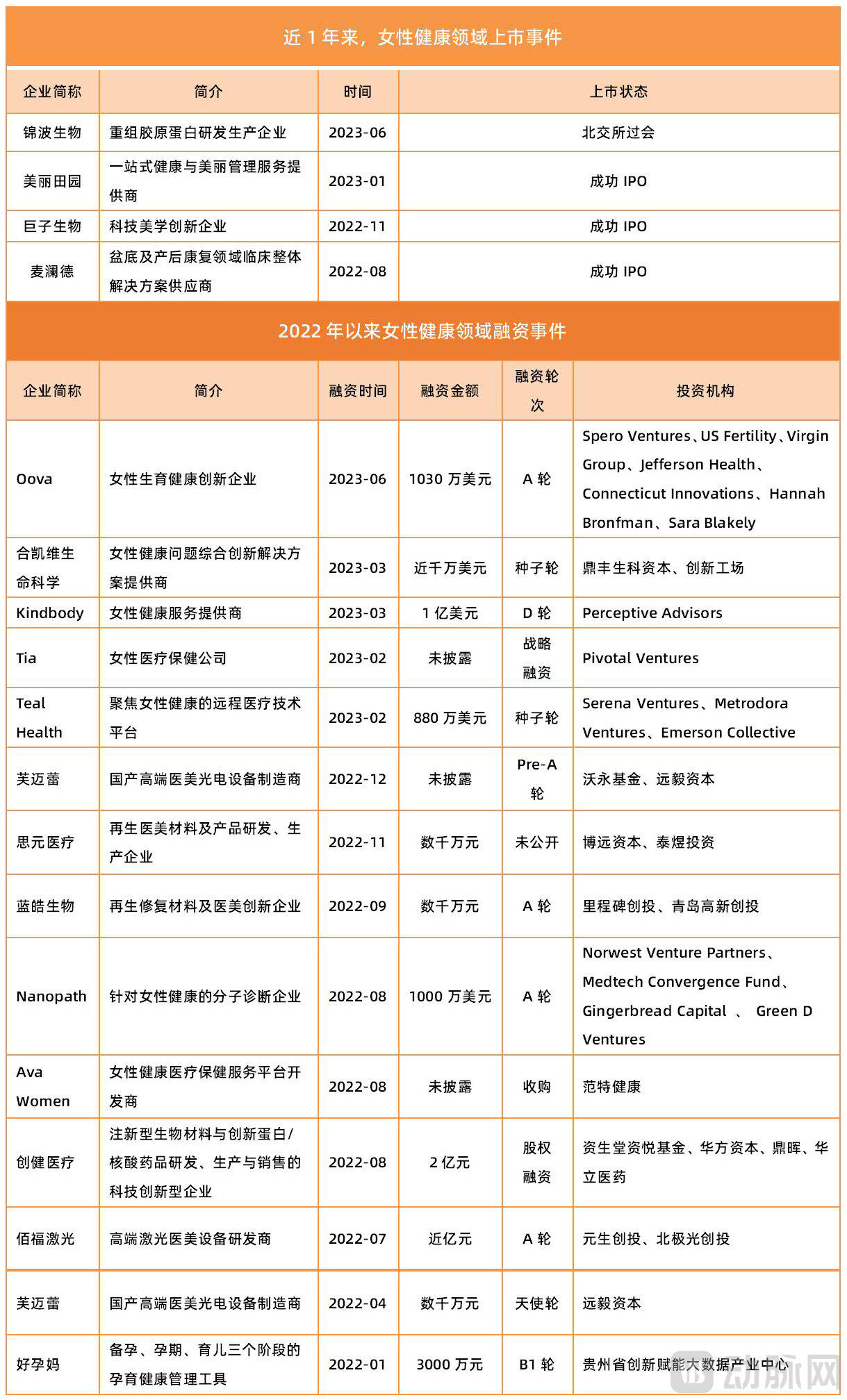
(Source: VCBeat Database, Tianyancha VCBeat Chart)
For a time, businesses related to women's health became the "hot commodity" in the industry.At the "2023 Future Healthcare Fund Partners Summit," Liu Yang, founding partner of CapitalDing, stated, "Winning over women secures a 10 trillion yuan consumer healthcare market."
There is no doubt that the women's health market is rapidly advancing.
In the field of women's health, which细分赛道have the most爆发potential? Where are the new investment opportunities? To answer these questions, VCBeat sought to gain insights by interviewing industry professionals and organizing relevant information.
Women's health is a huge market.
According to predictions by Acumen Research & Consulting, from a global perspective,The overall market size of women's health reached 25.3 billion US dollars (approximately 183.5 billion RMB) in 2021.It is expected to expand to 97.3 billion US dollars (approximately 705.7 billion RMB) by 2030, with a compound annual growth rate of over 16% during the 2022-2030 period, showing rapid growth.
"Abundant water doesn't necessarily mean big fish."The market pattern for women's health is currently highly fragmented."The business directions focused on by each company vary greatly." Chen Ke, Vice President of Investment at a dollar fund, told VCBeat, "Menstrual management, anti-aging, and others are relatively mature tracks in the women's health sector, but these only represent a small part of the overall market. There is still much untapped potential in the field of women's health."
Against this backdrop, how to find new investment opportunities? After interviewing with multiple industry experts, VCBeat believes that managing the entire life cycle of women's health may reveal more possibilities for future innovation.
“From infancy to adolescence, pregnancy, childbirth, menopause, and old age, women experience hormonal changes in their bodies., which will bring quite a few challenges in both psychological and physiological aspects."This includes menstrual disorders, pelvic floor dysfunction, infertility, sterility, depression, etc." The founder of a service agency specializing in infertility and sterility stated that women need to take care of and maintain their physical and mental health at all stages of life, making the concept of "full life cycle health management" increasingly popular in the field of women's health.
Currently, the industry mainstream is to focus on a single point of breakthrough in one link of the entire life cycle of women's health, such as assisted reproduction, pregnancy management, postpartum recovery, maternal and infant care, and other popular directions. Meanwhile, some entrepreneurs have also begun to attempt extending towards full life cycle management.
The policy end is also adapting to this trend. In September 2021, the State Council issued the "Outline for the Development of Chinese Women (2021-2030)," which set "women having access to good health and hygiene services throughout their entire life cycle" as one of the main goals. It calls for attention to women's health needs and ensures that women receive high-quality, efficient, and affordable medical and health care services.
However, in the process of communicating with industry professionals and reviewing public reports, VCBeat discovered that there isn't a particularly clear definition in the market regarding the comprehensive health management of women throughout their entire life cycle. Each company has some differences in their logic when explaining this concept. Generally speaking, the core revolves around various stages of women's development, deploying corresponding business strategies based on their needs.
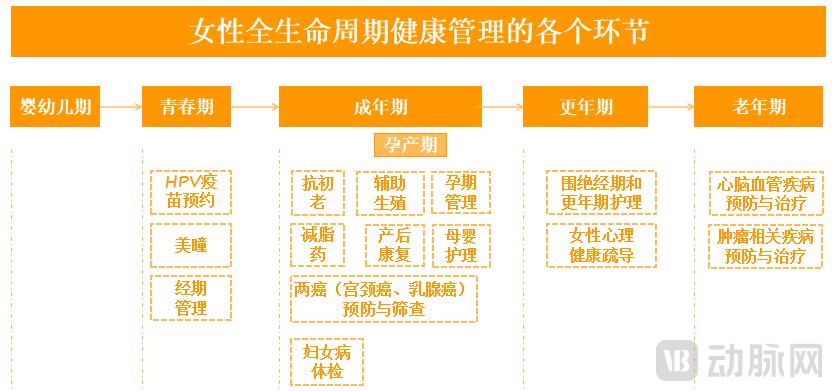
(Illustration of Each Stage in the Female Full Life Cycle, Drawn by VCBeat)
In VCBeat's rough division, the comprehensive health management throughout a woman’s entire life cycle is roughly divided into five stages: infancy, puberty, adulthood, menopause, and old age. Among these, adulthood includes the pregnancy and childbirth period, which has drawn particular attention from the industry and is actively being developed by many enterprises.
"The number of women in China now exceeds 688 million, accounting for 48.7% of the total population," said Chen Ke, Vice President of Investment at the aforementioned dollar fund.A large population base means that most细分赛道of women's health have sufficient market space to accommodate two or more unicorns and listed companies.
Taking the HPV vaccine as an example, there are three listed companies in China that are involved in its research, development, and production: Zhifei Biological Products, Wantai Biological Pharmacy, and Walvax Biotechnology. In terms of HPV vaccine reservation services, companies like AliHealth, Baidu Health, JD Health, and Pinduoduo have also become involved.
Taking menstrual cycle management as another example, a large number of app projects have emerged in the market, such as Aunt Flo Menstrual Assistant, Meiyou, Femometer, Girl’s Calendar, Loban Menstrual Assistant, and Goddess Planner, leading to fierce competition.
It can be seen that there are many opportunities in each细分赛道 of women's health. However, several industry insiders have also indicated that the current growth potential varies across each细分赛道. For instance, menstrual management was once favored by capital, but due to challenges such as difficulties in后期商业化落地, its growth has gradually slowed.
Which细分赛道currently have relatively high growth potential? VCBeat, based on interviews with industry professionals, analyzed market growth rates, penetration rate increases, and compared industry financing data over the past three years, and believes that the three single-point赛道 of assisted reproduction, anti-aging, and weight-loss drugs are rapidly emerging.
In the entire process of health management throughout a woman's life cycle, the entrepreneurial opportunities during pregnancy and childbirth are the most abundant. Among these, as a highly popular track in this phase,The Assisted Reproductive Track is Taking Off。
The Most Significant Event Recently: Assisted Reproductive Technology Opens the Door to Medical Insurance - Starting from July 1st, 16 therapeutic assisted reproductive technology items, including ovulation induction tests, oocyte retrieval, artificial insemination, and embryo transfer procedures, have been included in Beijing's basic medical insurance and will be reimbursed as Class A outpatient services.
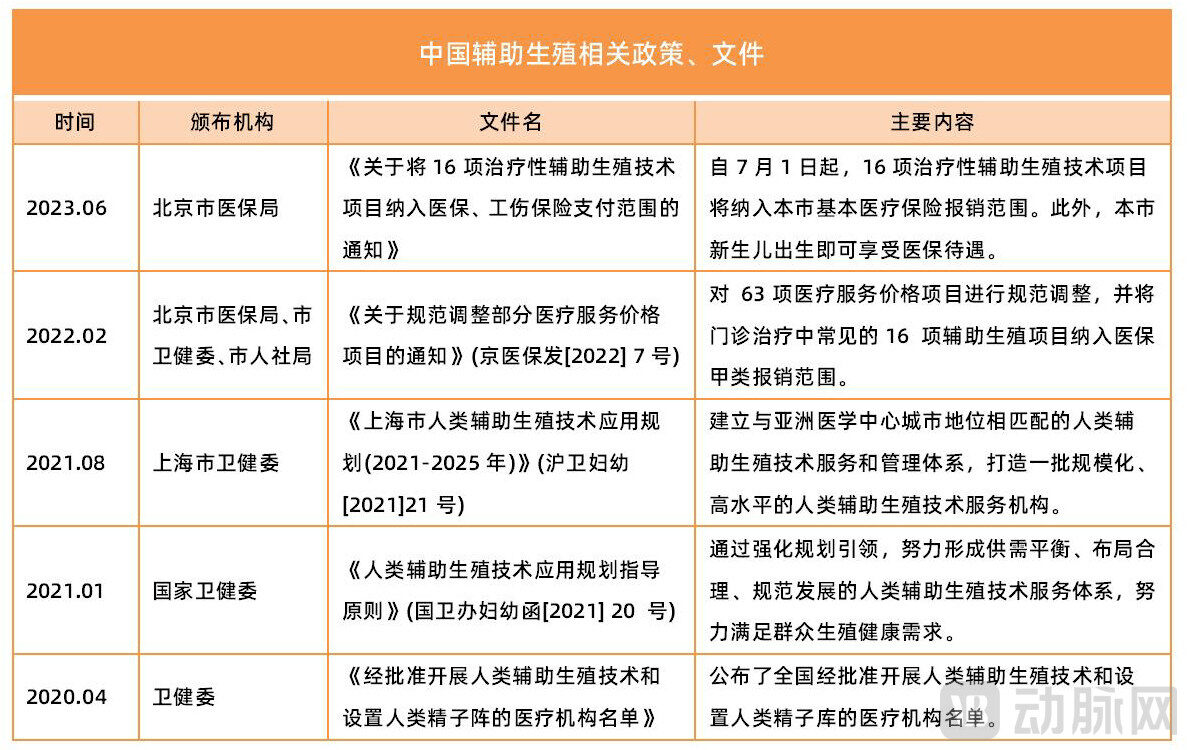
(Data from official government websites, compiled by VCBeat)
"The demand for assisted reproductive technology in the market is substantial, but the high cost per customer has been hindering its continued penetration into broader populations. By including it in the scope of medical insurance payments, Beijing's recent move can alleviate patients' financial burdens, thereby reaching more people in need," said Chen Ke. He noted that China’s ART industry has a market penetration rate of less than 8%, far below the 30% level seen in Europe and America, indicating significant growth opportunities.
How large is the market size? According to Frost & Sullivan's forecast, the scale of the assisted reproductive services market will grow at a compound annual growth rate of 14.5% from 2020 to 2025, reaching 85.43 billion yuan, already approaching the 100-billion-yuan market threshold.
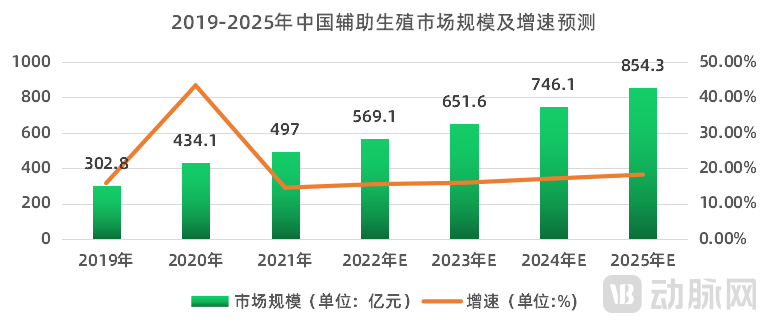
(Data source: "2023-2028 China Assisted Reproductive Services Investment Planning and Forecast Report" Chart by VCBeat)
Facing the high growth of the market, numerous enterprises and capital have entered the arena. According to incomplete statistics from the VCBeat database, since the announcement of the three-child policy on May 31, 2021, more than 20 assisted reproductive enterprises in China's primary market have secured financing, with top-tier capital firms such as Sequoia China, IDG, Dachen Capital, and TusStar all placing their bets.
"China now has nearly 600 approved assisted reproductive institutions, but a supply gap still exists. Moreover, the issuance of assisted reproductive licenses has slowed down, and the application requirements have become increasingly stringent, giving institutions that already possess licenses a first-mover advantage." Chen Ke believes that licensed institutions, especially those with PGD (third-generation IVF) service qualifications, will be the first to enjoy this wave of benefits.
Besides, there are considerable opportunities for China-produced alternatives in the upstream equipment sector of assisted reproductive technology (mainly including high-value consumables such as embryo freezing/thawing solutions, embryo culture media, and PGT reagents). In the past, medical devices involved in the assisted reproductive treatment process were almost monopolized by foreign companies like Vitrolife and William A. CooK. However, with policy support for China-produced substitutes, products from some innovative companies are being approved at an accelerated pace.
VCBeat statistics show that, as of now, more than 20 domestically produced Class III ART medical device products have been approved in China, coming from 10 local companies including Viton Biotech, Ruibai Biotech, and Dongyun Medical.
Next is the anti-aging track.At present, women's awareness of anti-aging is steadily increasing, and the demand continues to grow. According to research data from Beautiful Repair Big Data, over 95% of people aged 18-35 show signs of early aging, with the most concentrated period being between 26-30 years old. The emergence of early aging is accompanied by various skin problems: more than 60% experience enlarged pores and dullness, while about 30% exhibit wrinkles (both dynamic and static).
To combat early aging, women flock to related products and are willing to pay for them. Currently, the categories for anti-early aging are extensive, including injectables, cosmetics, beauty devices, pharmaceuticals, health supplements, and more.
From the market perspective, in addition to anti-aging skincare products such as facial creams, eye creams, and essence lotions, the popularity of minimally invasive medical aesthetics has risen rapidly in recent years. How fast is the growth? According to Frost & Sullivan, the non-surgical market size in China grew by 28.8% year-on-year in 2020. Moreover, in terms of market share, the non-surgical market accounted for up to 52% of the total in 2021. In the future, with the increase and upgrading of minimally invasive aesthetic product categories, the non-surgical market in China is expected to expand further. It is projected that by 2030, the non-surgical market will account for 65% of the total market size in China.
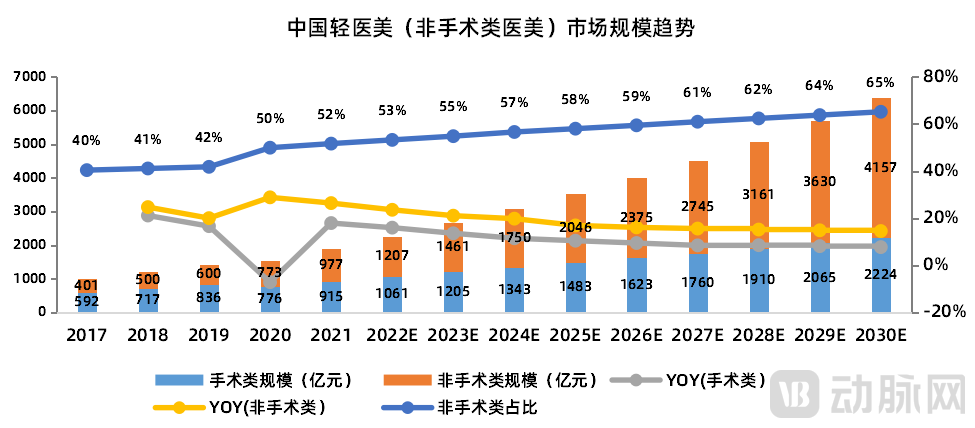
(Source: Frost & Sullivan, Chart by VCBeat)
Specifically, light medical aesthetics refers to non-surgical medical beauty procedures, which are generally divided into two categories: injection and photoelectric, based on different principles.
The core components of injectable products mainly have four functions: filling, inhibition, care, and fat dissolution. The research and development of core components for medical aesthetic products are crucial for companies to build competitive barriers. Currently, the main core components of facial injectable products on the market include hyaluronic acid, botulinum toxin, collagen, and regenerative ingredients.
Photoelectric medical beauty includes categories such as laser, intense pulsed light, radiofrequency, focused ultrasound, and cryolipolysis. The mainstream laser equipment manufacturers include American Cynosure, American Candela, Israeli Alma, American Lumenis, and European Star, etc. Currently, the competitive landscape is dominated by foreign capital.
Jinbo Biotech, which is about to go public, is a leading company in the light medical aesthetics field. Its main business focuses on the R&D, production, and sales of various medical devices and functional skincare products, centered around recombinant collagen protein products and anti-HPV bio-protein products. As one of the commonly used materials for anti-aging, collagen has gained extraordinary popularity. Giant Biogene, another major player in this field, successfully went public in November last year.
In addition to light medical aesthetics, breakthroughs in gene editing, cell therapy, brain-computer interfaces, artificial intelligence, regenerative medicine, and anti-aging mechanisms will enable more possibilities for anti-early aging products.
Next is the fat reduction track.As an important method for women to manage their body shape, fat reduction has always received special attention. In the field of fat reduction, weight management, weight loss drugs, and digital weight loss therapies are currently popular.
For instance, in the field of weight management, Yijiankang recently filed its prospectus, and Keep is set to go public on the Hong Kong Stock Exchange on July 12. Clearly, weight management is proving to be a lucrative business, gradually supporting more listed companies. However, unlike the need for active fat reduction, the more "passive" weight loss drug market is becoming highly sought-after.
This year, following Novo Nordisk's application in China to add a weight loss indication for its GLP-1 class drug Semaglutide, Eli Lilly also entered the Chinese market. The company announced positive results from the Phase III clinical trial in China for its investigational drug Tirzepatide, intended for obese or overweight adult patients. According to the clinical data of Tirzepatide released by Eli Lilly, the maximum weight loss achieved by patients was up to 7.2 kilograms, with a maximum weight reduction exceeding 20%. This has attracted numerous women seeking fat reduction, indicating an ultra-high imaginative future market space.
In the field of digital weight loss therapy, many companies have emerged in China in recent years. However, most of these companies focus on areas such as body shaping, exercise, and dietary therapy. Their products mainly aim to popularize weight loss knowledge and promote self-management for weight loss, covering categories like weight loss knowledge, weight loss plans, weight loss guidance, self-management tools, incentive mechanisms, weight loss communities, weight loss information, e-commerce, and weight loss consultation. There are relatively few companies that offer comprehensive weight loss solutions backed by evidence-based medicine.
From the above, we can see that the three major tracks of assisted reproduction, anti-aging, and fat reduction are rising strongly, but this does not mean there are no opportunities in other tracks.
On the contrary, against the backdrop of the overall expansion of the women's health market, each细分赛道 has the potential to produce leading enterprises.
Women's health issues are receiving more attention, bringing broad opportunities to the industry.
But as the two sides of a coin, starting a business in the women's health sector is not as simple as imagined, and there are still many difficulties at this stage. On the one hand, women's health awareness in China still needs improvement; on the other hand, 95% of China's women's health industry focuses on reproductive or maternal and child care, and new细分 tracks need to be explored and deepened.
In response to this, VCBeat, in conjunction with interviews of industry professionals, offers two suggestions.
First, under the premise of stabilizing the business focus, broaden towards the entire life cycle of women.Due to advancements in medical technology and rising consumption levels, women's needs in healthcare are gradually changing, and they are expressing more new demands for specialized healthcare services. For instance, modern women increasingly focus on self-fulfillment and self-improvement, emphasizing that consumption is for "self-pleasure" rather than pleasing others. They pursue multi-layered, diversified, and personalized health consumption experiences, such as prevention and screening for the two types of cancer, Traditional Chinese Medicine constitution conditioning, remote data monitoring during pregnancy, postpartum rehabilitation, psychological counseling, genetic testing, and more. Therefore, building a refined, personalized, professional, scientific, and efficient experiential scenario around whole-life-cycle health management will become the focal point for the future development of women’s health enterprises.
Taking the evolution of the venture capital market in the United States in recent years as an example, a previous survey by VCBeat found that financing for startups focused on women's perimenopause has doubled compared to four years ago. Many startups have entered the fields of breast cancer, cervical cancer, women's cardiovascular diseases, and polycystic ovary syndrome, providing solutions for every stage of women’s entire life cycle.
In China, an increasing number of companies are moving in this direction. For example, Weimai has collaborated with nearly 500 public hospitals across the country to jointly create a healthcare service system centered around the entire life cycle of women, providing them with one-stop services that integrate online and offline, in-hospital and out-of-hospital, single visits to cycles, random to dedicated, and manual to intelligent care.
For instance, in March this year, Heranova Lifesciences, which secured financing, is advancing the launch of non-invasive molecular diagnostics for endometriosis, innovative products for pregnancy and childbirth diagnosis and treatment, and other obstetrics and gynecology drugs. It is also collaborating with global partners to expand solutions for other key obstetrics and gynecology indications, thereby realizing a comprehensive women's health solution that includes diagnostics, therapeutic drugs, medical devices, and digital platforms.
Second, strengthen the application of digital technology in women's health scenarios, making technology the underlying support of the platform.The application of digital technology can bring higher efficiency to the industry and enable whole-life-cycle health management to have data support and truly take off. For example, Marani, a women's health company in the United States, uses ECG technology to create wearable heart devices to monitor the conditions of pregnant women and fetuses during pregnancy and childbirth. Another example is Qvin, which tests menstrual blood through women's menstrual products to provide monitoring and information on women's health conditions, such as hormone levels, diabetes risk, and HPV testing.
In other words, innovation business layouts based on digitalization throughout the entire life cycle of women's health can bring greater room for imagination to companies.
It can be foreseen that as new companies and solutions continue to emerge, the future of the women's health sector will tell a more compelling story.