

Neuro-Music Therapeutics Startup LingHuiEr Secures RMB 8 Million in Angel Funding for Music-Synchronized Brain-Computer Interface Solutions

Linghuier
Developer of Wearable Smart Products and Solutions
Text | Hu Xiangyun
Editor | Hai Ruojing
36Kr has learned that the brain-computer interface company Linghuier has initiated an angel round of financing worth 8 million yuan, mainly for the expansion of the R&D team and product functions, as well as market promotion and other tasks.
Linghuier was founded in November 2022, focusing on the development of brain-computer interface devices, high-precision EEG modules, and other technologies. It is supported and incubated by the technical team of the Institute of Semiconductors of the Chinese Academy of Sciences (CAS) and the Brain-Computer Fusion Intelligence Technology Research Institute of Jiangsu Industrial Technology Research Institute. The founder of the company, Chen Hongda, is from CAS.Semiconductor Research InstituteResearcher, Professor at the University of the Chinese Academy of Sciences, and recipient of the special government allowance from the State Council.
Music is the port through which Linghuier bridges brain-computer interface technology and its products. In fact, music therapy emerged in the United States as early as the 1940s. In recent years, with healthcare concepts in China gradually shifting towards a balance of humanistic care and medical science, various music therapy methods—such as software and smart hardware—have been increasingly applied in areas like mental illness, psychological treatment, and emotional regulation. According to data from iMedia Consulting, over 65% of young people aged 26-30 are willing to pay for healing music.
Linghuier's technical director, Zhong Hui, told 36Kr that the team has precisely targeted this market space where "science and art converge." The company currently covers both consumer and professional-grade brain-computer interface product development. In terms of form, consumer-grade products focus on wearable devices such as EEG smart music headphones and music meditation systems; professional-grade products add a transcranial electrical stimulation module on this basis.
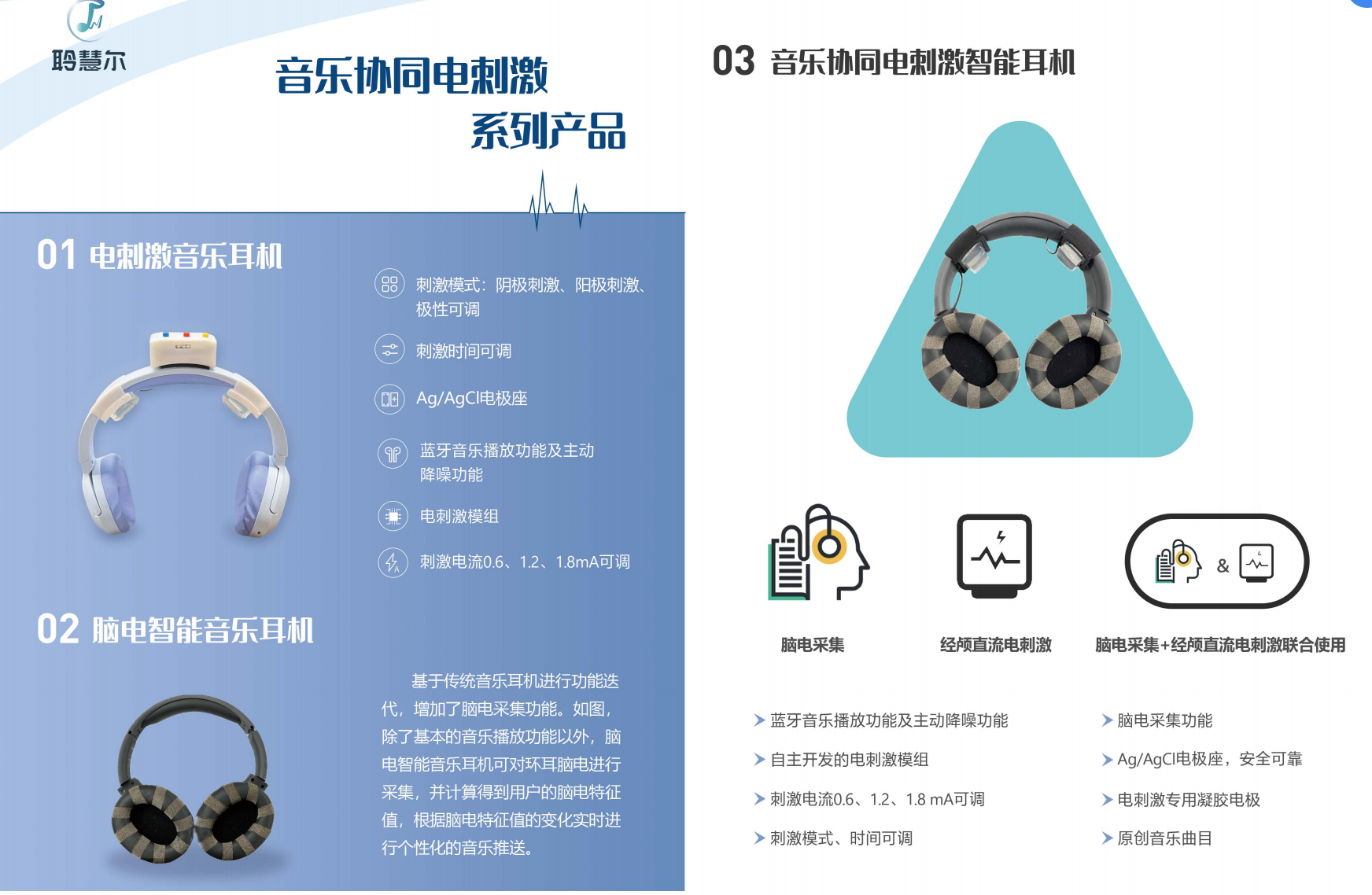
Illustration: Linghuier Product Schematic
Specifically, Linghuier's music-coordinated electrical stimulation psychological detection and intervention system consists of three parts: an EEG module, a music playback module, and a transcranial electrical stimulation module. By collecting the energy amplitude of different frequency bands in the user's EEG, extracting features, and using relevant algorithms to assess the user's current state, it then applies specific music and electrical stimulation to achieve purposes such as soothing emotions and improving sleep quality.
36Kr has learned that the application of transcranial electrical stimulation in the treatment field is actually relatively mature. The principle is to use a constant, low-intensity direct current of 0-2mA to regulate neuronal activity in the cerebral cortex. In this context, Linghuier's technical advantage actually lies in the fact that the hardware technologies supporting the operation of this system product, such as the electrostimulation integrated circuit chip and hardware modules, are all independently developed by the company.
Taking chips as an example, according to Zhong Hui's introduction, in fact, there were no dedicated electrical stimulation chips in the past when transcranial electrical stimulation products were being developed both in China and internationally. "Our chip is specifically designed to address this need. The consumer-grade chip has already completed the tape-out process and can primarily output transcranial direct current stimulation; another instrument-grade electrical stimulation chip aims to output transcranial direct current stimulation, transcranial alternating current stimulation, and transcranial random noise stimulation, among others, and is currently in the second round of tape-out."
Regarding the adaptation standard between music and EEG signals, on the one hand, the Linghuier team has professional music engineers who have produced nearly 20 original tracks. They have also re-selected and edited classical music tracks without copyright restrictions, annotating them based on inherent musical attributes such as rhythm, tonality, and tempo. On the other hand, the company has collected emotional questionnaires from 6,000 participants for 200 pieces of music, subjectively scoring them based on musical pleasantness, arousal, tension, and likability to select appropriate tracks for intelligent recommendations.
"Compared with other products on the market, we are not only focusing on pure neural regulation in the rehabilitation field, but also building a closed-loop system that integrates detection and intervention, providing customized solutions for different rehabilitation treatment needs." 36Kr learned that Linghuier's products have currently started clinical validation in three hospitals.
In terms of business model, in addition to the aforementioned product development, Linghuier also provides commissioned development services for brain-computer interface technology in the fields of smart living, healthcare, and consumer electronics. "We have currently reached a cooperation with a university to assist in building a smart health and wellness center and related work."