

Merck's $10.8 Billion Bet on IBD: Who Will Win the Next-Generation Therapeutics Race?
Takeda
Biopharmaceutical Manufacturer

Prometheus Biosciences
Biopharmaceutical Manufacturer
Roivant Sciences
Biopharmaceutical Company

AbbVie
Innovative Drug Developer

Johnson & Johnson
Healthcare Product Manufacturers, Health Service Providers
In April this year, Merck announced that it would acquire for $10.8 billionBiotechnology company Prometheus Biosciences (hereinafter referred to as Prometheus), acquiring its ulcerative colitis (UC), Crohn's disease (CD), and other autoimmune candidate drugs to enhance the product pipeline in the immunology field. The transaction was completed in June this year.
Prometheus Biosciences, Inc. was founded in 2016 as a clinical-stage biotechnology company primarily focused on autoimmune diseases. The company’s lead candidate drug, PRA023, is a humanized monoclonal antibody (mAb) targeting tumor necrosis factor (TNF)-like ligand 1A (TL1A).
PRA023 Demonstrates Efficacy in Two Randomized, Double-Blind Phase II Clinical Trials for Ulcerative Colitis and Crohn's Disease: At Week 12, 26.5% of Patients in the PRA023 Group Achieved the Primary Endpoint of Clinical Remission, Compared to 1.5% in the Control Group.This clinical remission rate is higher than that of commonly used drugs currently on the market for treating ulcerative colitis, showing BIC potential.
As numerous startups face a financing winter and are on the brink of困境, Prometheus Biosciences, with a Phase II drug, has prompted Merck to make a significant investment. This wealth-creating myth will become a beacon for pharmaceutical companies, attracting more enterprises to flock towards the IBD field, which holds immense market potential.
Inflammatory Bowel Disease (IBD) is a chronic condition of the gastrointestinal tract, divided into Crohn's Disease (CD) and Ulcerative Colitis (UC). Common symptoms include severe diarrhea, fatigue, etc., which greatly affect patients' quality of life and require effective, ongoing treatment.
More importantly,IBD has an extremely widespread impact, with approximately 6 to 8 million patients with inflammatory bowel disease globally.The incidence rates already published in certain regions of China are very close to the cumulative incidence range in Western countries (e.g., the incidence rate of ulcerative colitis is 6-11/105). In recent years, the number of IBD patients in China has been continuously increasing, and it is expected that the market size for IBD drug treatments in China will maintain a steady growth trend over the next five years. (Source: 2022 CICC Innovative Drug Frontier Series Research Report)
Unfortunately, due to the complex etiology of IBD and the unclear pathogenesis, it may be related to various factors such as genetics, environment, intestinal microecology, and intestinal immunity. This has led to a lack of effective cures for the disease. The main treatment method currently available is medication, with the primary categories including aminosalicylates, corticosteroids, immunosuppressants, antibiotics, and biologics.
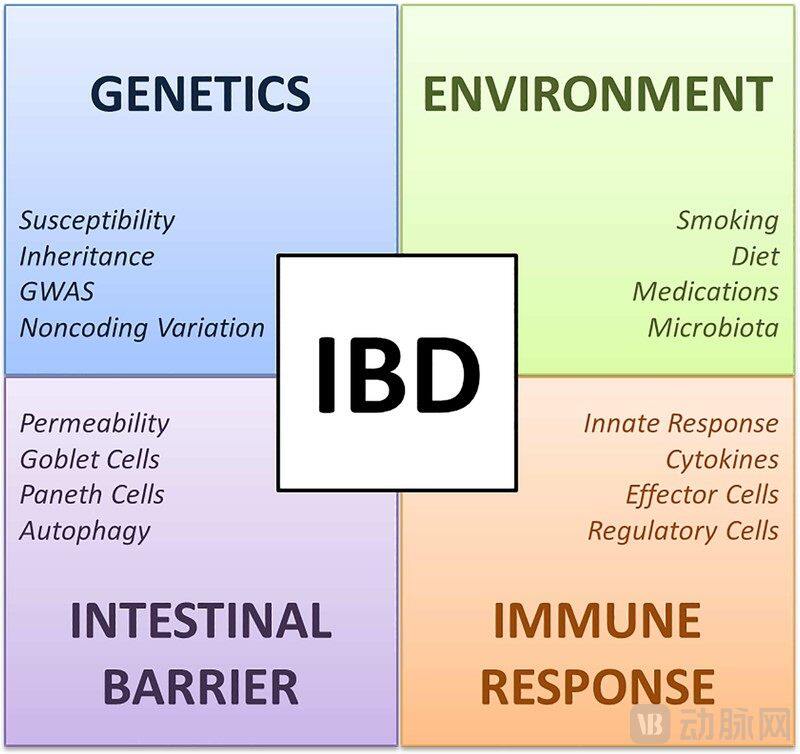
▲ IBD Inducing Factors Source: Mechanisms of Disease: Inflammatory Bowel Diseases
According to the 2022 CICC Innovative Drug Frontier Series Research Report,Currently, the global market for IBD is approximately 18 billion US dollars.It is expected to grow globally to approximately USD 49 billion by 2030.Biologics are the mainstream products in the current IBD drug market and are approved for moderate to severe IBD patients who do not respond to conventional treatments. Currently, there are only four major types of biologics approved for marketing: Infliximab, Adalimumab, Ustekinumab, and Vedolizumab. These four treatment options account for 75% of the global IBD market revenue.
Since the advent of biologic therapies represented by adalimumab as a new treatment option for IBD patients, their quality of life has greatly improved. However, current therapies still have issues. According toThe IBD Immunology Review released by the National Institutes of Health (NIH),Approximately one-third of patients do not respond to biologic therapies, and about half of those who initially respond effectively will experience "secondary loss of response," similar to the "drug resistance" phenomenon seen with antibiotics.
The huge market potential and unmet clinical needs both highlight the importance of continuing to develop new therapies for IBD. In this field, leading MNCs have launched a new round of intense competition, while emerging biotechs are also seeking differentiated competitive paths and have made significant progress. Even new modalities are beginning to emerge.It can be said that the industry is experiencing a new atmosphere.
The remarkable efficacy of the first tumor necrosis factor antibody treatment administered to a CD patient in 1992 ushered in a new era in IBD treatment, as well as the fastest development and approval program in history, prompting major pharmaceutical companies such as Johnson & Johnson, Eli Lilly, and Pfizer to enter the field.
When it comes to IBD, the first company that comes to mind is undoubtedly AbbVie. Although various biologics have been launched in the market, AbbVie's anti-TNF drug, adalimumab, remains the best-selling drug in the industry, with global sales exceeding $20 billion in 2021, capturing 40% of the biologics market share.
The competition in the IBD field is becoming increasingly fierce, but past successes have not stopped AbbVie from continuing its exploration in the IBD field.This time, it has set its sights on the IL-23 antibody.IL-23 is a cytokine associated with inflammation and is considered to be related to many chronic immune diseases.
Company | Product | Target | Indications (UC) Progress | Indications (CD) Progress |
AbbVie | Skyrizi | IL-23p19 | IIIPeriod | Approved for Marketing |
AbbVie | Rinvoq | JAK | Approved for Marketing | IIIPeriod |
Takeda Pharmaceutical Company Limited | Entyvio | α4β7 | Approved for Marketing | Approved for Marketing |
Johnson & Johnson | Stelara | IL-12/IL-23 | Approved for Marketing | Approved for Marketing |
Bristol-Myers Squibb | Zeposa | S1P1 | Approved for Marketing | IIIPeriod |
Eli Lilly and Company | mirikizumab | IL-23p19 | CRL | IIIPeriod |
Pfizer | Etrasimod | S1P1 | Halt Development | IIIPeriod |
▲ IBD Track Competition Landscape
In March this year,AbbVie Announces Positive Topline Results from Phase 3 Induction Study of Skyrizi (risankizumab) in Adults with Moderate to Severe Active Ulcerative ColitisRisankizumab is a humanized, IgG1 subtype monoclonal antibody that selectively antagonizes IL-23 by binding to the p19 subunit of IL-23.
Clinical results show that risankizumab met the primary endpoint of clinical remission at week 12 as well as all secondary endpoints. In fact, for Skyrizi, the positive readout in UC does not come as a surprise, as the IL-23 inhibitor already received FDA approval for CD indication in June last year.
Currently, Skyrizi has received three FDA-approved indications, including CD, moderate to severe plaque psoriasis, and active psoriatic arthritis in adults. In an investor update report released in April, AbbVie stated that it expects to submit an application for Skyrizi to treat UC this year, with potential approval expected in 2024. Additionally, AbbVie forecasts that...In 2025, Skyrizi is expected to generate approximately $25 billion in sales for IBD indications.
In the leading market for IBD treatment, AbbVie, Johnson & Johnson, and Takeda are in a tripartite standoff, ushering in a new round of competition.
In the 12-week induction study of the Skyrizi Phase III clinical trial, 20.3% of patients receiving Skyrizi achieved clinical remission, compared to 6.2% of patients receiving placebo. Additionally, 64.3% of Skyrizi users showed a clinical response, versus 35.7% in the control group.
In contrast, Johnson & Johnson's IL-12/23 dual inhibitor Stelara achieved a remission rate of 19% and an efficacy rate of 58% at week 8 in the induction study. Takeda's Entyvio triggered a response in 39% of patients with prior anti-TNF treatment by week 6 in its clinical trial.
This means that AbbVie can compete with other biologics such as Johnson & Johnson's Stelara and Takeda's Entyvio, as well as small molecule JAK inhibitors including AbbVie's own Rinvq and Bristol-Myers Squibb's Zeposa, which are S1P modulators.
Across the global IBD market, aside from AbbVie's adalimumab, Takeda's vedolizumab has shown the most impressive commercial performance. In 2020, this drug accounted for 27% of the global IBD biologics market, second only to adalimumab (40%). Vedolizumab targets the α4β7 integrin highly expressed on gut T cells, thus offering a gut-specific advantage.
In addition to these three "top-tier" companies, a group of pharmaceutical enterprises is also accelerating the development process of their drug pipelines.
Protagonist Therapeutics' small molecule inhibitor PN-943, targeting α4β7, is currently in Phase II clinical trials for moderate to severe UC, with completion expected in 2023.Previously, Janssen, a subsidiary of Johnson & Johnson, also reached a nearly $1 billion collaboration with Protagonist.Johnson & Johnson obtains the global exclusive rights for the development and commercialization of the latter's oral IL-23 receptor antagonist. The JNJ-77242113 (original code: PN-235) has received an implied permission for a clinical trial and is currently conducting Phase II clinical research overseas.
In May, the latest announcement on the CDE official website,Eli Lilly and CompanySubmitted a supplemental application for the IL-23p19 inhibitor mirikizumab. On April 13, Eli Lilly announced that it had received a rejection from the FDA regarding the biologics license application for mirikizumab for the treatment of UC. Eli Lilly emphasized that the FDA has no concerns about the drug's clinical data or safety. However, this presents a certain level of market entry risk for mirikizumab and may impact the review process for its market approval in China. If mirikizumab is successfully approved in the future, it will become the first anti-IL23p19 antibody for the treatment of UC patients.
PfizerIt is also actively laying out its pipeline. In December 2022, Pfizer announced that the FDA had accepted the NDA for its selective S1P receptor modulator Etrasimod.The FDA is expected to make an approval decision in the second half of 2023.
Pfizer's Etrasimod was developed by Arena. In 2022, Pfizer acquired Arena for $6.7 billion. Subsequently, both induction and maintenance Phase III clinical trial data showed that Etrasimod met the primary and all key secondary endpoints for patients with moderately to severely active UC who had previously failed or were intolerant to conventional, biologic, or JAK therapies. Meanwhile, Pfizer/Arena is also actively advancing Phase II/III clinical trials for CD. Due to a follow-up period of up to 274 weeks, full completion is expected by 2029.
In addition to well-established pharmaceutical companies with strong capabilities, many emerging biotechs also want a piece of the pie in the face of IBD's vast commercial market.
Company | Product | Target | Progress |
Roivant | RVT-3101 | TL1A | UC IIIPeriod |
Spyre | SYP001 | α4β7 | Preclinical |
Spyre | SYP002 | TL1A | Preclinical |
Celsius | CEL383 | TREM1 | Preclinical |
▲ Progress of Startups in the IBD Field
Notably, Spyre, a company spun off from its parent company Paragon Therapeutics, was recently acquired by Apogee BioTherapeutics through a stock swap transaction. This acquisition granted Apogee two leading projects from Spyre's pipeline targeting IBD: SPY001 and SPY002, which are expected to enter clinical trials in 2024. Prior to the acquisition, Aeglea's stock had plummeted by 98.7%, leaving its total market value at less than $7 million. Following the announcement of the acquisition, Aeglea opened with a surge exceeding 700% and eventually closed with a 330% increase.
The target of SYP001 is α4β7 integrin, the same target as Takeda's vedolizumab (Entyvio).Spyre stated that compared to vedolizumab, which is currently administered every two weeks, the goal for SYP001 is to achieve dosing every two months or quarterly.
The target of SYP002 is the recently popular TL1A, with three monoclonal antibody drugs targeting this point already under development by Merck (acquired through the purchase of Prometheus), Roivant Sciences, and Teva.
In the TL1A monoclonal antibody field, aside from Prometheus, which has recently drawn significant attention due to its acquisition at a sky-high price,Roivant SciencesIt is also a highly competitive company, with clinical trial results that are even comparable to those of Prometheus.
Roivant's lead candidate drug RVT-3101, initially developed by Pfizer, can modulate the levels of various inflammatory and fibrotic biomarkers.Recently, Roivant announced positive long-term results from its Phase IIb clinical trial for the treatment of patients with ulcerative colitis.Analysis of patient samples obtained in clinical trials showed that patients receiving the expected dose of treatment in Phase III clinical trials reached a clinical remission rate of 36% at 56 weeks, further improved from 29% at 14 weeks. The proportion of patients achieving endoscopic improvement reached 50% at 56 weeks, also significantly increased from 36% at 14 weeks.
These data show that RVT-3101 has the potential to become a "first-in-class" and "best-in-class" anti-TL1A antibody.
As is well known, in traditional drug development, companies usually start with targets and mechanisms identified and validated in preclinical research. However, a growing number of startups are applying machine learning (ML) to rich clinical and molecular datasets without following predefined hypotheses.
CelsiusIt is a company aimed at leveraging its human tissue-based platform to develop precision medicines for cancer and autoimmune disease patients. Celsius Therapeutics utilizes its proprietary SCOPE platform to analyze single-cell transcriptomic data from diverse patient populations, identifying how certain genes in specific cell types correlate with particular phenotypes. This analysis revealed a protein called TREM1, which can selectively suppress inflammation in IBD without broadly compromising immune function. This protein has now become the company’s primary target, and an anti-TREM1 antibody is Celsius’ first candidate drug for treating IBD.
On March 24, 2022, Celsius Therapeutics announced that it had secured $83 million in Series B financing to advance the clinical trial development of the IBD precision medicine CEL383.
In addition to several therapies that have been widely applied, new therapies are also gradually being developed. Due to the close relationship between gut microbiota and inflammatory bowel disease,By transplanting beneficial gut bacteria into patients through microbiome drugs, the microbial imbalance in the intestinal ecosystem of IBD patients can be corrected to treat IBD.This method is theoretically feasible, but no effective results have been achieved yet. Currently, many companies have set their sights on this yet-to-be-developed track.
Company | Product | Indications | Progress |
Microba | MAP 315 | UC | IPeriod |
Exeliom | EXL01 | CD | IPeriod |
▲ Advances in Novel Microbial Immunotherapy for IBD
Microba Life SciencesOne of the companies that has performed notably in this approach is Microba. On June 27, Microba announced that the first patient had been dosed in the Phase 1 clinical trial of its live biotherapeutic product MAP 315 for the treatment of IBD, marking the entry of the company’s drug development into the clinical stage. MAP 315 is an oral capsule containing lyophilized bacterial powder, with strains belonging to the normal flora of healthy individuals but absent in IBD patients.
Microba Plans to Use the Drug for UC Treatment; In Vivo and In Vitro Studies Show MAP 315 Promotes Intestinal Epithelial Function Recovery and Mucosal Healing. The Phase I Clinical Trial is a Randomized, Double-blind, Placebo-controlled Study Designed to Evaluate the Safety, Tolerability, and Pharmacokinetics of MAP 315 in Healthy Adults. Results from this Clinical Trial are Expected by December 2023.
Exeliom BiosciencesExeliom, one of the few companies to reach the clinical stage, is a French microbiome company that recently initiated Phase I clinical trials for EXL01. EXL01 is a candidate drug derived from *Faecalibacterium prausnitzii* for the treatment of Crohn's disease (CD). *Faecalibacterium prausnitzii* is one of the most important bacteria in the human gut microbiome and is considered a next-generation probiotic with significant potential. It exhibits various probiotic effects, such as maintaining intestinal homeostasis and anti-inflammatory properties.
Unlike many other companies in the microbiome field, Exeliom is not developing products within the framework of probiotic modulation but is instead following the approach of small-molecule drug development. This means that it must not only identify its drug candidates but also elucidate their relevant mechanisms of action.
Exeliom's CD clinical trial for EXL01 is the first step in exploring the role of *Faecalibacterium prausnitzii* across a range of indications. The company plans to conduct a Phase II trial for UC after completing the CD trial and will continue to investigate its potential in more indications in the future.
Undoubtedly, a new door for IBD therapy has been opened, entering a new chapter based on microbiome immunotherapy.
Currently, most of the inflammatory bowel disease drugs in China are imported from multinational pharmaceutical companies. However, over time, domestic pharmaceutical companies' R&D pipelines are rapidly catching up, with the potential to meet the long-term medication needs of a large patient population. Everest Medicines and Pfizer have reached a collaboration to actively introduce Pfizer's investigational selective S1P receptor modulator, Etrasimod. Everest Medicines now holds the exclusive rights for the development, manufacturing, and commercialization of this drug in Greater China and South Korea. After the completion of clinical trials, Everest Medicines is expected to bring Etrasimod to more patients with moderate to severe ulcerative colitis (UC) as soon as possible.
In addition, domestic pharmaceutical companies such as Sinovac, Zhengdatianqing, Hengrui Medicine, Huadong Medicine, and LinkMed are also actively expanding into IBD-related fields. They have conducted multiple clinical studies, including those on UC, providing assurance for the long-term development of IBD treatment. Hengrui Medicine's SHR0302 is a highly selective JAK1 inhibitor that exerts anti-inflammatory and immunosuppressive biological effects by inhibiting JAK1 signaling. It has been approved for several clinical trial studies in China, with UC research already in Phase III clinical trials, and clinical trials for CD entering Phase II.
Also progressing rapidly is LNK01003, an orally administered small-molecule JAK inhibitor with gut-restricted properties independently developed by LinkMed Pharmaceuticals. It is intended for the treatment of UC and related conditions, demonstrating favorable PK characteristics and tolerability in single and multiple ascending dose trials in healthy subjects. Currently, a Phase II clinical study evaluating the efficacy and safety of LNK01003 in patients with active ulcerative colitis is underway.
Merck's $10.8 Billion Acquisition of Prometheus Biosciences, Inc. is Set to Become One of the Landmark Events in the Industry’s Efforts to Tackle IBD. However, who will ultimately dominate the IBD market remains to be seen, and we will continue to monitor the situation.
Reference Article:
Immunology of Inflammatory Bowel Disease: Molecular Mechanisms and Therapeutics,National Library of Medicine
AbbVie's Skyrizi aces ulcerative colitis study en route to new IBD showdown with J&J, Takeda,FIERCE Pharma
Spyre, a new biotech spinout, launches via merger with Aeglea,BioPharma Dive
Microba Commences Phase I Clinical Trial for IBD Therapeutic,Business Wire
Pfizer Announces Positive Top-Line Results for Phase 3 Trial of Etrasimod in Ulcerative Colitis Patients,BioSpace
Celsius Nets $83M to Bring Precision IBD Treatment to Trial,BioSpace
The 100 Billion IBD Market Sounds the Charge: Amino Observation
Express | Ulcerative Colitis Remission Rate Increases Over 3 Times! AbbVie's IL-23 Antibody Announces Positive Phase 3 Data,WuXi AppTec