

SCG Cell Therapy's First-in-Class Bispecific Antibodies Overcome Fundamental Barriers to Functional Cure of Hepatitis B, Winning EASL Best Presentation Award

SCG
Innovative Immunotherapy Developer

University of Hamburg
The University of Hamburg is a comprehensive university. It was founded on March 28, 1919, evolving from the earlier Allgemeines Vorlesungswesen (General Lecture System), the Hamburgisches Kolonialinstitut (Hamburg Colonial Institute), and the Akademisches Gymnasium (Academic High School). Despite its relatively short history, the university has been joined by six Nobel laureates and a distinguished body of scholars. The main campus of the University of Hamburg is located in the central district of Rotherbaum, with affiliated institutions and research centers distributed throughout the city. The institution is ranked among the top 200 universities worldwide.

Technical University of Munich
Technical University of Munich (TUM) is one of the best universities in Europe, with 15 faculties, 41,375 students, and 566 professors. Third-party research funding amounts to €331 million. The university has 17 Nobel laureates.
ShanghaiJuly 12, 2023PR Newswire -- At the recently concluded 2023 European Association for the Study of the Liver (EASL) annual meeting, SCG, in collaboration with researchers from the University Medical Center Hamburg-Eppendorf and the Technical University of Munich in Germany, presented a preclinical study on their world-first bispecific antibodies (Anti-HBs×CD3 and Anti-HBs×CD28). The study stood out among over 2,000 reports and was awarded the Best Presentation Award at EASL 2023.
The study showed that dual humanized mice infected with hepatitis B virus (HBV), after receiving a short-term combination treatment of Anti-HBs×CD3 and Anti-HBs×CD28 bispecific antibodies, effectively activated human lymphocytes and exhibited strong in vivo antiviral immune activity. All virological serological markers, including HBV DNA, surface antigen (HBsAg), and e antigen (HBeAg), as well as intrahepatic HBV pregenomic RNA (pgRNA) and covalently closed circular DNA (cccDNA), were significantly reduced, indicating effective clearance of infected hepatocytes. The findings demonstrate the substantial potential of this bispecific antibody combination to achieve functional cure of hepatitis B.
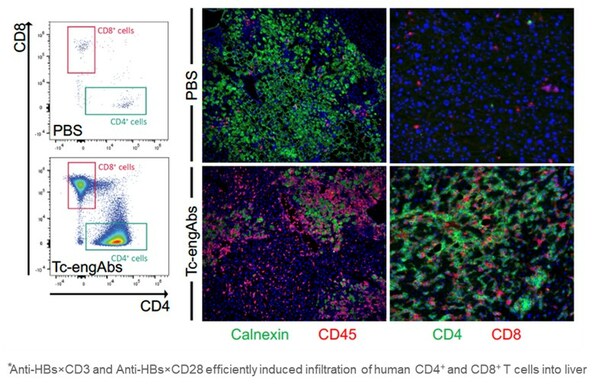
Ulrike Protzer, Professor at the Institute of Virology of the Technical University of Munich/Helmholtz Zentrum München, Germany, and founder of SCG, stated: "The bispecific antibodies Anti-HBs×CD3 and Anti-HBs×CD28 effectively redirect T cells specifically to infected hepatocytes within the liver, triggering direct cytotoxic activity of T cells against HBV-infected cells, as well as non-cytolytic viral clearance mediated by cytokines secreted from T cells. This mechanism is crucial for achieving a truly sustainable cure for hepatitis B. The research team observed in humanized mouse models that the combination of bispecific antibodies efficiently mobilizes both CD8+ and CD4+ T cells, inducing potent antiviral immune responses and clearance effects, fully demonstrating the core mechanisms required for a hepatitis B cure."
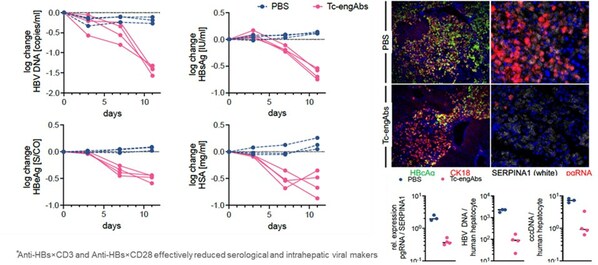
Reconstructing HBV-specific immune responses is the key to achieving a functional cure. To optimize localized T-cell redirection and activation, SCG has designed two novel bispecific antibodies (Anti-HBs×CD3 and Anti-HBs×CD28), which act as T-cell "engagers" that bridge HBV-infected hepatocytes with T cells expressing CD3 and CD28. At the same time, the dual combination of CD3 and CD28 provides the two signals required for full T-cell activation. The initial "recognition" signal (first signal) is initiated when T cells recognize foreign antigens through their T-cell receptor/CD3 complex; CD28, as the most potent co-stimulatory receptor, delivers the "co-stimulatory" signal (second signal) necessary to complete the activation of cytotoxic T cells. Additionally, Anti-HBs×CD3 and Anti-HBs×CD28 can also target free HBsAg, exerting their potent neutralizing antibody activity to simultaneously clear HBV virions and HBsAg subviral particles from peripheral blood, breaking immune tolerance.
Dr. Ke Zhang, Chief Scientific Officer of SCG Cell Therapy Pte. Ltd., stated: "High titers of HBsAg in patients significantly suppress and impair HBV-specific antiviral immune responses, leading to immune tolerance. Our bispecific antibody combination effectively targets and clears peripheral blood HBsAg, intranuclear cccDNA reservoirs, and permanently integrated HBV DNA fragments, regardless of the patient's baseline levels, thereby completely removing the fundamental barrier to functional cure of hepatitis B."
Hepatitis B infection is the most common liver infectious disease, with nearly 300 million people chronically infected globally. More than 25% of these patients will eventually develop liver cancer, causing approximately 820,000 deaths annually. China bears a significant burden of hepatitis B, with over 86 million infected individuals, leading to around 400,000 liver cancer deaths each year. Despite the nationwide implementation of preventive vaccines in China, there are still over 1 million new hepatitis B infections annually. The large existing and increasing numbers highlight the heavy burden of hepatitis B, and there remains a lack of effective curative therapies.
Mr. Wang Shuli, CEO of SCG Cell Therapy Pte. Ltd., stated that the significant effect and breakthrough results of SCG's pioneering dual-antibody combination in driving T cells to completely eliminate HBV infection marks a milestone step towards conquering hepatitis B. SCG Cell Therapy will accelerate product development and clinical progress to benefit more patients with hepatitis B as soon as possible and achieve the "HBV Zero" plan.