Global First-in-Class Oral TYK2 Allosteric Inhibitor Deucravacitinib Showcased at WCD, Nears China Approval
Bristol-Myers Squibb
Biopharmaceutical and Nutritional Product R&D and Sales
Psoriasis, commonly known as "牛皮癣 (niupixuan)", is a common chronic inflammatory skin disease prone to recurrence. Currently, there are approximately 7 million patients in China who are deeply troubled by this condition.
In recent years, with the continuous increase in the number of psoriasis patients in China, the market scale has also gradually expanded: according to data from the "Psoriasis Drug Industry Market Research Report,"In 2016, the sales of psoriasis drugs in China were 2.08 billion yuan, and it is expected to reach 20.87 billion yuan by 2025, with a rapidly growing market.
The huge attraction of the billion-dollar market has led to the development of multiple new psoriasis drugs worldwide. At the recently held 25th World Congress of Dermatology (WCD), two new oral psoriasis drugs have made encouraging progress.
The World's First Oral TYK2 Allosteric Inhibitor
Debut at the 25th WCD Conference
According to the data, Deucravacitinib (BMS-986165), developed by Bristol-Myers Squibb as the world's first oral TYK2 allosteric inhibitor, has been approved in the United States and Europe, and has also reached the stage of marketing application in China.
At the WCD conference, BMS announced the results of the Phase 3 clinical trial of Deucravacitinib for psoriasis conducted at multiple centers in Asia, with a majority of participants being Chinese.
Clinical results show that, after 16 weeks of treatment with Deucravacitinib (6mg, oral, once daily), 68.8% of patients with moderate to severe plaque psoriasis achieved PASI75, and 38.2% achieved PASI90. The drug's efficacy can be sustained up to Week 52. Additionally, the drug demonstrated significant clinical benefits in treating difficult-to-treat areas such as the scalp.
The overall safety of the drug is good, with common adverse reactions including respiratory tract infections and symptoms such as pharyngitis. Currently, the drug has submitted an application for marketing authorization as an imported drug to the CDE on June 2, 2023.
In addition, an oral IL-23R antagonist peptide drug, JNJ-2113, was showcased at the WCD conference.
JNJ-2113 is an orally administered peptide drug targeting IL-23R, jointly developed by Janssen Biotech and Protagonist Therapeutics. Clinical data shows that JNJ-2113 has achieved the primary endpoint of the trial.
The study results showed that, after 16 weeks of JNJ-2113 treatment, the PASI75 (Psoriasis Area and Severity Index improvement of at least 75%) was 37.2% for a daily dose of 25 mg; 51.2% for twice daily doses of 25 mg; 58.1% for a daily dose of 50 mg; 65.1% for a daily dose of 100 mg; and 78.6% for twice daily doses of 100 mg.
The results of PASI90 and PASI100 also reached the secondary endpoints of the trial. The following figure shows the results of this Phase 2b clinical trial.
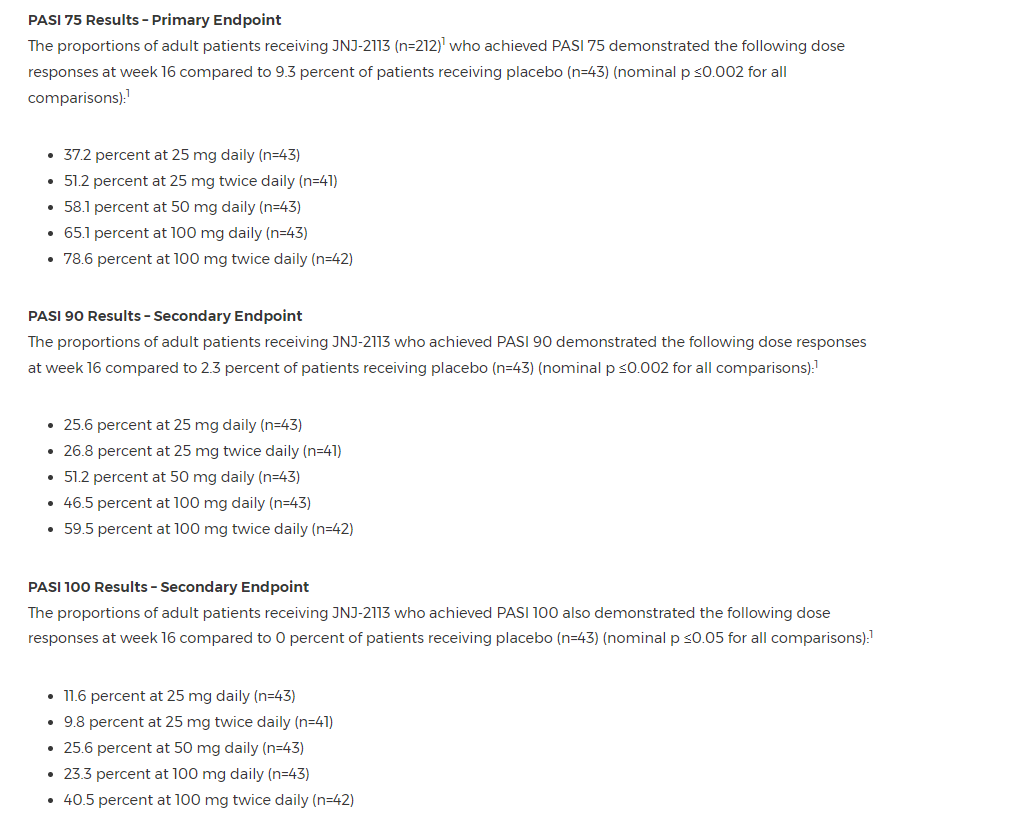
Figure 1 JNJ-2113 Phase 3 Clinical Trial Data
Image source: Reference 1
In terms of safety, the incidence of adverse events in the JNJ-77242113 treatment group was similar to that in the placebo group, with no dose-dependent trend observed.
Compared with some monoclonal antibody injectable drugs, JNJ-2113 has a relatively lower PASI75 response rate, but JNJ-2113 is an oral medication, which can greatly enhance patient tolerance.This is similar to oral semaglutide versus injectable semaglutide. Although the oral form is slightly less effective, some patients, due to a fear of injections, still prefer to choose the oral product.
The R&D Status of Psoriasis Drugs in China:
Crowded IL17A Target
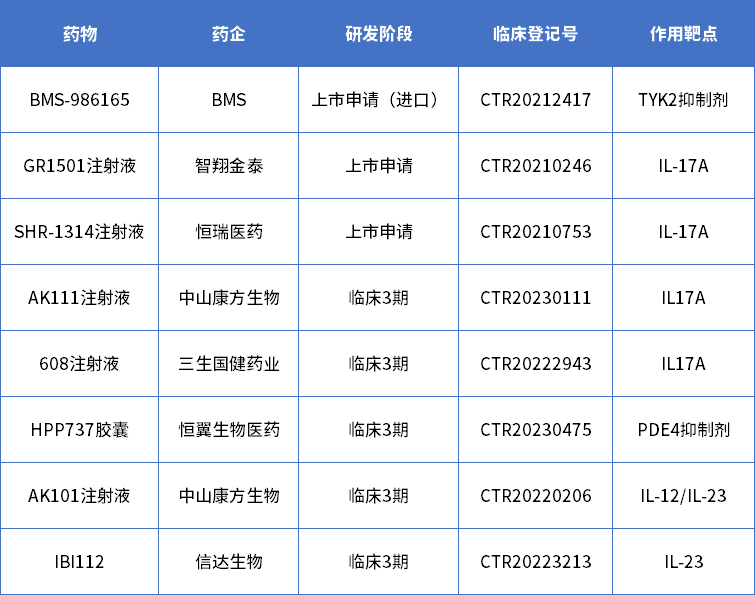
Currently, there are multiple drugs in China that are in Phase 3 clinical trials or beyond. The table below lists the new psoriasis treatments in China that are in Phase 3 or higher, as queried by the author from the chinadrugtrials website.
Table 1 Global Research Status of Psoriasis Drugs in China
Data source: chinadrugtrials
IL17A is the hottest target for psoriasis drugs in China, with four drugs currently in the application stage for marketing and Phase III clinical research.
ZhiXiang JinTai's GR1501 Injection (Seraliximab) submitted its marketing application on March 25, 2023, as the first IL-17A targeted monoclonal antibody drug in China for the treatment of psoriasis; Hengrui Medicine's SHR-1314 Injection (Funaqizumab Injection) also submitted its marketing application on April 27, 2023.
How promising are the prospects for psoriasis drugs if approved? A comprehensive evaluation is needed in terms of price, efficacy, and other aspects.
Taking IL-17A target drugs as an example, according to the data from Pharma Intelligence, there are only two IL-17A target drugs that have been marketed in China: Novartis' Secukinumab and Eli Lilly's Ixekizumab. Both drugs are covered by medical insurance, and currently, no domestically produced drugs have been approved for marketing.
The latest National Medical Insurance price for Secukinumab is 870 RMB per dose, with the first-year cost being 27,840 RMB and subsequent years costing approximately 20,000 RMB annually. The latest National Medical Insurance price for Ixekizumab is 1,218 RMB per dose, with the annual cost also nearing 20,000 RMB. Due to the high cost, only a small number of patients use these two drugs.
Based on this estimation, the annual cost of GR1501 Injection and SHR-1314 Injection should not exceed 20,000 yuan after being included in the medical insurance to maintain a price advantage; otherwise, they will lose their competitive edge.
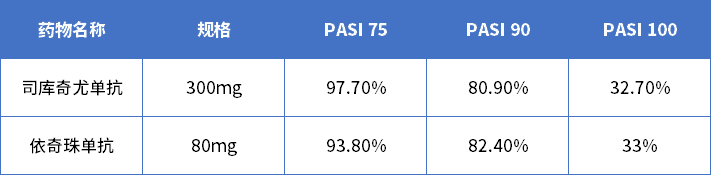
In terms of efficacy, Table 2 below shows the Phase 3 clinical data of the two currently imported IL-17A target drugs. The PASI75 of Secukinumab Injection at 12 weeks can reach 97.7%, while the PASI75 of Ixekizumab Injection can reach 93.8%.
Table 2: Phase 3 Clinical Data of Two Drugs
Data source: References 6, 7
GR1501 Injection and SHR-1314 Injection still need to solidify their efficacy foundation to catch up.
Overall, although antibody drugs targeting IL-17A are one of the most effective treatments for psoriasis currently available, in a limited market, if the competition becomes too crowded, future price wars could be fierce. In China, multiple companies have already entered this field, and the competition for the psoriasis drug market is expected to be extremely intense.
References:
[1]https://www.prnewswire.com/news-releases/janssen-announces-positive-topline-results-for-jnj-2113a-novel-first-and-only-oral-il-23-receptor-antagonist-peptide-in-development-for-moderate-to-severe-plaque-psoriasis-301869349.html
[2] Guidelines for Primary Diagnosis and Treatment of Psoriasis (2022)
[3] Market Research Report on Psoriasis Drug Industry
[4] Huachuang Securities
[5]Deucravacitinib,anOral,Selective,AllostericTyrosineKinase2(TYK2)Inhibitor,inAsianPatientsWithModeratetoSeverePsoriasis:MaintenanceofImprovementsinPatient-ReportedOutcomes.
[6]https://mp.weixin.qq.com/s/7gApryvcnc9sOIFA3RXZSA
[7]https://mp.weixin.qq.com/s/mJHQ_k0987H3N41WSbgf5A

Editor: Pea Shooter
Disclaimer: The views expressed in this article are solely those of the author and do not represent the position of Pharma Intelligence Network. We welcome discussions and additional insights in the comment section; for reprints, please be sure to credit the author and source. If there are any issues related to the content, copyright, or other aspects of the work, please leave a message on this platform, and we will address it promptly.