

Johnson & Johnson Reports Strong Q2 MedTech Performance, Beats Revenue Expectations and Raises Full-Year Guidance

Johnson & Johnson
Healthcare Product Manufacturers, Health Service Providers
Intelligent Finance APP learned on Thursday, before the U.S. stock market opened, that Johnson & Johnson (JNJ.US), a large blue-chip stock in the U.S. market and a giant in medical technology and healthcare, announced its second-quarter revenue and adjusted earnings both exceeded Wall Street analysts' expectations. The company raised its full-year performance forecast across the board, mainly due to a significant increase in sales of its medical technology business. Performance data showed that Johnson & Johnson's Q2 revenue was $25.53 billion, surpassing analysts' expected $24.62 billion, representing a year-on-year increase of 6.3%; Adjusted earnings per share under Non-GAAP standards for the second quarter were $2.80, compared to analysts' expected $2.62.
Johnson & Johnson's medical technology division mainly provides surgical, orthopedic, and vision devices. The company is benefiting from a rebound in demand for non-urgent surgeries among elderly patients, who postponed these procedures during the pandemic. Health insurers such as UnitedHealth Group and Elevance Health have noticed a significant increase in demand.
After the earnings report was released, Johnson & Johnson's shares once rose over 2% in pre-market trading on Thursday. However, the company’s stock performance this year has lagged far behind the seven major U.S. tech giants, with its share price falling approximately 8% year-to-date, reducing its market value to about $412 billion. Nevertheless, the "big blue chip" Johnson & Johnson still holds significant weight in the S&P 500 Index and maintains a certain degree of influence on the overall trend of the U.S. stock market.
Generally speaking, Johnson & Johnson's financial performance is considered by the market as a bellwether for the entire healthcare industry. The company reported a 6.3% increase in sales for the second quarter compared to the same period last year. The healthcare giant announced a GAAP net profit of $5.14 billion for the second quarter, or $1.96 per share. This is compared to a net profit of $4.8 billion, or $1.80 per share, for the same period last year. Excluding certain items, adjusted earnings per share under Non-GAAP rules were $2.80.
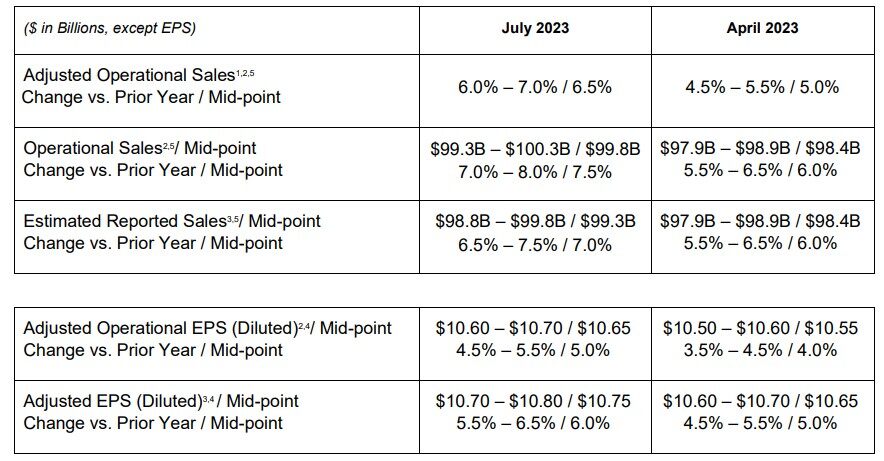
In terms of the full-year performance expectations currently focused on by the market, Johnson & Johnson now expects its total sales for the full year to be in the range of $98.8 billion to $99.8 billion, which is about $1 billion higher than the range expected in April; the company has raised its adjusted earnings per share guidance for 2023 from the previous range of $10.60 to $10.70 to a new range of $10.70 to $10.80.
In terms of细分业绩, the company's Q2 medical device business sales increased to $7.79 billion, representing a 12.9% growth compared to the second quarter of 2022. Johnson & Johnson stated that the acquisition of cardiovascular medical technology company Abiomed in December last year drove this growth.
Johnson & Johnson reported Q2 pharmaceutical sales of $13.73 billion, representing a year-over-year increase of over 3%. Excluding COVID-19 vaccine sales, the pharmaceutical segment's revenue was $13.45 billion. In addition to medical technology and healthcare technology, Johnson & Johnson is also focused on developing drugs for various disease areas.
The company stated that this growth trend was strongly driven by the sales of Darzalex (a biologic for treating multiple myeloma), Erleada (a drug for treating prostate cancer), and Stelara (a blockbuster drug used to treat various immune-mediated inflammatory diseases). Later this year, Johnson & Johnson will lose patent protection for Stelara.
However, part of the sales growth in the pharmaceuticals business was offset by a decline in sales of the arthritis drug Remicade, which faces competition from biosimilars — lower-cost drugs that are almost identical in structure.
Johnson & Johnson Releases Quarterly Earnings Amid Investor Anxiety Over Thousands of Lawsuits Alleging Its Talcum Powder Products Were Contaminated with Carcinogenic Asbestos, Leading to Ovarian Cancer and Several Deaths.
These products, such as Johnson & Johnson's namesake baby powder, now belong to Kenvue, but Johnson & Johnson will assume all talc-related liabilities arising in the United States and Canada.
Johnson & Johnson's consumer health business was spun off into an independent company named Kenvue in early May (mid-quarter). Johnson & Johnson continues to hold nearly 90% of Kenvue's shares and plans to distribute them to shareholders later this year. Johnson & Johnson stated that the business (consumer health) achieved sales of $4.01 billion in the second quarter, representing a 5.4% increase from the same period last year.
In April this year, LTL Management, a subsidiary of Johnson & Johnson, filed for bankruptcy in New Jersey, proposing to pay nearly $9 billion to settle over 38,000 lawsuits and prevent new cases from arising. This is the company’s second attempt to resolve talcum powder claims in bankruptcy court, after a federal appeals court rejected its request.
In the bankruptcy proceedings, most lawsuits have been halted. Johnson & Johnson continues to deny the allegations and claims that its talcum powder products are not carcinogenic.