

IVIEW Therapeutics Pioneers Novel Eyelid Wipe Therapy IVW-1001 for Dry Eye Disease Affecting 385 Million Globally

iView Therapeutics
Ophthalmic Innovative Drug Developer
On June 30, 2023, Bausch+Lomb (hereinafter referred to as B+L) announced the acquisition of Xiidra (lifitegrast) and other ophthalmic assets from Novartis for $1.75 billion. Shortly after receiving FDA approval for Miebo, B+L acquired Xiidra, indicating that the market for branded prescription dry eye treatments remains active.
In fact, B+L is building a complete product portfolio for dry eye disease. In addition to Meibo and Xiidra, they also acquired Blink artificial tears from Johnson & Johnson. Meibo is suitable for patients with evaporative/meibomian gland dysfunction, Xiidra is suitable for patients with more inflammation and tear deficiency, and Blink artificial tears are currently the most common means of relieving dry eye disease. This series of layouts once again proves that dry eye disease is not just a single disease, but a condition composed of one or more complications, each of which must be treated individually to achieve acceptable clinical outcomes.
Dry Eye Disease (DED), also known as Dry Eye Syndrome (DES), Keratoconjunctivitis Sicca (KCS), and Dry Keratitis, is a multifactorial and progressive disorder caused by abnormalities in the tear film of the ocular surface and inflammation of the ocular surface.
It is estimated that dry eye disease affects approximately 385 million people globally, accounting for over 5% of the global population (Gayton, 2009). Generally, the prevalence of dry eye disease increases with age (Bron et al., 2017). In the United States, it is estimated that more than 3.2 million women and 1.7 million men aged 50 and above suffer from dry eye disease, with the number of affected individuals projected to increase by 40% by 2030 (Schaumberg et al., 2009; Schaumberg et al., 2013).
However, recent studies have found that the age of onset of dry eye disease is decreasing. The widespread use of mobile phones, handheld computers, and reading devices has led to an increasing prevalence among younger populations. Moreover, glaucoma eye drops containing benzalkonium chloride preservatives may also cause side effects that exacerbate dry eye symptoms. This impact cannot be underestimated, as the global number of glaucoma patients is expected to approach 80 million people with the aging population (Quigley and Broman, 2006).
Growth Plus Reports estimates that the dry eye disease market is expected to grow at a compound annual growth rate of over 5%, reaching a global market value of USD 8.92 billion by 2030, driven by advancements in innovative drug technologies for dry eye disease, the development of new diagnostic tools, and the increasing burden of dry eye disease.
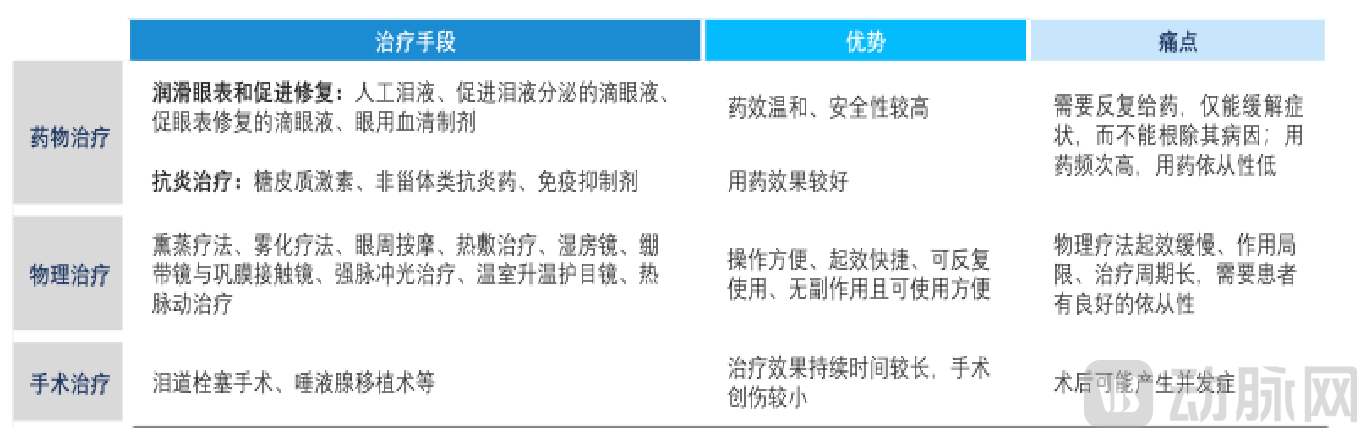
Treatment Options for Dry Eye Syndrome (Image Source: iView Therapeutics)
The treatment of dry eye syndrome requires matching treatment plans according to different classifications and stages of the disease. Current drug therapies include replenishing artificial tears, local use of glucocorticoid eye drops and ointments, local use of immunosuppressants, drugs that stimulate tear gland secretion, or surgical treatment. Among these, artificial tears are the most commonly used accompanying treatment. Since most artificial tears fall under the OTC category, people can purchase them directly from pharmacies, which often leads to an oversight regarding the severity of dry eye syndrome.
In fact, we still lack a prescription drug that can address this type of multifactorial disease and quickly take effect for the majority of patients.
According to statistics from VCBeat, there are currently over 45 companies worldwide developing drugs for the treatment of dry eye disease, exploring more than 50 types of treatments for dry eye disease. However, since dry eye disease is a multifactorial ocular surface disorder, only some patients respond effectively to the products currently on the market.
Worldwide, pharmaceutical companies' attention to the dry eye syndrome field originated in the 1990s. In 1995, the Sante Pharmaceutical (Santen Pharmaceutical) developed Eusol B Eye Drops were approved for marketing, and their high sales quickly drove the development of the dry eye market, making dry eye an independent subfield carved out from the ophthalmology field.
In the following decade, ophthalmic giants such as Alcon/Novartis and Bausch + Lomb joined the competition to optimize the ingredients and formulations of artificial tears, launching next-generation products. Among them, Systane, an early tetrahydrozoline hydrochloride eye drop developed by Alcon, remained dominant, almost monopolizing the European dry eye market in 2017. Meanwhile, the U.S. market formed a "tripod" pattern due to the continuous emergence of drugs with novel mechanisms of action.
In 2002, Restasis, a 0.05% cyclosporine formulation developed by Allergan (now AbbVie), was approved for marketing in the U.S. with a slight advantage in clinical trials, breaking the deadlock of no effective drugs for moderate to severe dry eye disease. As a first-line treatment for this indication and the only therapeutic option at the time, cyclosporine became the mainstream product in the U.S. dry eye market due to its unique immunosuppressive mechanism. At its sales peak, Restasis generated over $1.4 billion in annual revenue for Allergan. Subsequently, another anti-inflammatory small molecule drug, Xiidra, developed by Shire, entered the market in 2016. With the advantage of faster onset, Xiidra quickly captured market share from Restasis.
Recently, a new therapeutic target for dry eye disease (DED) has emerged — TRPM8 receptor agonists. Evidence from clinical studies indicates that local TRPM8 activation can stimulate lacrimal gland function, reducing ocular discomfort in DED patients and increasing tear secretion.
Currently, only two companies globally, Alcon and iView Therapeutics (hereinafter referred to as: iView Therapeutics), are conducting research and development on this new target drug. The active ingredient in Alcon's AR-15512 eye drops is a proprietary small-molecule selective agonist of the transient receptor potential melastatin 8 (TRPM8) thermoreceptor, which is currently in Phase III development for the treatment of dry eye disease.
iView Therapeutics' IVW-1001 is a highly potent and selective TRPM8 agonist that, after topical application, increases neural activity and transmits a cooling and refreshing sensation to the central nervous system via the ophthalmic branch (V1) of the trigeminal nerve. The signal further stimulates lacrimal gland tear secretion through brainstem output to enhance ocular surface hydration. Additionally, the cooling sensation itself reduces ocular discomfort and pain, alleviating symptoms of dry eye disease.
Unlike traditional eye drops, IVW-1001 is administered by wiping it on the eyelid area, allowing the drug to effectively penetrate through the dermal surface into the eyelid and ultimately reach the channel position in the ocular surface tissue (cornea). This novel method of administration provides the innovative drug with more diverse and differentiated advantages.
First, it avoids the inherent problem of eye drops, where only a small portion of the drug enters the tissue while most is drained through the nasolacrimal duct within a minute. By comparison, eyelid administration creates conditions for sustained drug release, allowing the medication to act on the eye for a longer duration, thereby reducing the frequency of administration (expected to require only twice daily dosing) and improving convenience. Additionally, this method of administration is a better alternative to traditional eye drops for elderly patients, those with limited hand dexterity, contact lens wearers, and individuals who need to wear false eyelashes or apply makeup during the day. More importantly, according to research by iView Therapeutics, the target corresponding to this drug is more abundant beneath the lower eyelid in humans, making slow penetration through the eyelid a more direct and precise route of administration.
Data from the proof-of-concept (POC) clinical trial conducted in South Korea showed that IVW-1001 took effect within a week of administration, rapidly promoting tear secretion from the lacrimal glands, thereby providing direct symptomatic treatment and significantly improving patient symptoms. The company aims to initiate a Phase I/II clinical trial for dry eye disease patients in early 2024.
iView Therapeutics Inc. was founded in Pennsylvania, USA, at the end of 2015 by Dr. Bo Liang and Dr. John J. Baldwin, veterans of the pharmaceutical industry, with the aim of improving patients' vision through the development of innovative ophthalmic therapies.
Dr. Liang Bo once served as a senior scientist at Pharmacopeia. In 2006, he co-founded CLS Pharmaceuticals in New York, USA, with two ophthalmologists. Their innovative eye drug was acquired by Shire for $300 million in cash in 2015. Dr. John J. Baldwin developed numerous innovative drugs during his 30-year tenure at Merck, including Trusopt for glaucoma treatment, as well as Cosopt and Pepcid AC. He is also the founder of WuXi AppTec and Hua Medicine in Shanghai and is an innovative drug development expert inducted into the American Chemical Society’s Medicinal Chemistry Hall of Fame.
iView Therapeutics has established full-time innovative drug research and development teams in both the United States and China. It operates a 10,000-square-foot research center in New Jersey, USA, and nearly 1,000 square meters of research facilities in Hengqin, Zhuhai, China. The company’s ophthalmic drug development advisory team comprises experts with over 25 years of experience in ophthalmic drug development from major pharmaceutical companies such as Novartis, Pfizer, GSK, and Alcon. Additionally, the company has formed a Scientific Advisory Board (SAB) consisting of renowned pharmaceutical experts, scientists, and ophthalmologists from institutions like the NIH, Stanford University, Duke University, UC Berkeley, Columbia University, and Merck.
At the same time, iView Therapeutics has established innovative research centers in collaboration with the Department of Ophthalmology at UNC Chapel Hill, the School of Pharmacy at Fudan University, and the Medical College at Hunan Normal University, among others. It also hosts a postdoctoral workstation branch specializing in "drug delivery technology for eye drops to the posterior segment of the eye." The company’s self-built clinical team covers positions such as Chief Medical Officer, Medical Director, Clinical Application, CRA, and Clinical Statistics, enabling higher quality and more efficient cooperation with clinical CROs to carry out relevant clinical trials in China.
For the iView Therapeutics team, which has rich overseas clinical experience and FDA communication experience, entering the Chinese market offers certain foundational advantages but also presents many unique challenges to overcome. On one hand, the startup cycle for clinical trials in China is longer, with more reviewing institutions involved. On the other hand, unlike in Europe and the U.S., the treatment of dry eye disease in China still relies on artificial tears. The domestic market lacks drugs for treating moderate to severe dry eye disease. More importantly, both patients and doctors have relatively limited understanding of dry eye disease, and awareness of using prescription drugs to prevent disease progression remains relatively weak.
How to enable patients with dry eye syndrome to shift from purchasing OTC drugs to accepting prescription drug treatment on a large scale? Dr. Liang Bo, co-founder, chairman, and CEO of iView Therapeutics, believes that inclusion in medical insurance will be the most effective way to reverse this situation. Therefore, strengthening communication with relevant departments and regulatory agencies, and promoting market education through successful medical insurance negotiations, will be one of the future efforts of iView Therapeutics.
Although ophthalmology is a specialized field in the pharmaceuticals industry, it covers a wide range of diseases with a high patient base. Additionally, with the increasing use of electronic products and the social phenomenon of an aging population, the trend of growth in ophthalmic diseases is steadily rising.
In the past six years, only seven new ophthalmic drugs have been launched in China, all of which were imported products. The clinical demand for ophthalmic therapeutic drugs is far from being met. Therefore, the ophthalmic drug industry urgently needs innovative solutions with better efficacy to fill the market demand for such drugs. In the past two to three years, both domestic and international institutions have increased investment in the research and development of innovative ophthalmic drugs and broadened the approach to ophthalmic treatments. This includes small-molecule drugs, different therapeutic mechanisms, gene therapies, and antibody-based drugs. Additionally, the development of various innovative ocular drug delivery systems has overcome the limitations of traditional ocular drug administration and demonstrated promising market prospects.
In the future, iView Therapeutics will focus on accelerating the clinical development of its existing product pipeline while speeding up the innovation of new products, aiming to enter into collaborations with larger companies and advance towards commercialization. The company’s IVIEW-1201 Phase II clinical trials for treating viral conjunctivitis and bacterial conjunctivitis are expected to be completed by the end of 2023. With the support of clinical data, the company will move forward with Phase III clinical trials in 2024 while simultaneously expanding related business development activities. IVW-1001, an innovative compound for treating dry eye disease, will undergo Phase IIa clinical trials in 2024 to verify its safety and efficacy. Additionally, the company will concurrently develop an innovative compound for treating myopia (with plans to submit a PIND application to the FDA in 2024) and an innovative gene therapy for glaucoma (set to initiate IIT clinical trials in the first half of 2024).
iView Therapeutics aims to become a globally competitive biotechnology company focused on the development of innovative ophthalmic drugs and therapies. Leveraging the team's advantages in both China and the U.S., the company will continue to expand overseas market collaborations, including co-development, commercial licensing, and License out deals, while accelerating the commercialization process in the Chinese market.