

Harvard-Trained Doctor Secures Over $100M to Build Dual Platforms in Neuromodulation and Endovascular Brain-Computer Interfaces
AMYGDALA NEURO
Developer of Neuroregulation and Brain-Computer Interface Technologies and Products
2023 marks the 50th anniversary of the term "brain-computer interface (BCI)." After 15 years of scientific validation, 15 years of academic research, and 20 years of technological development, brain-computer interfaces have entered a critical period of technology transformation. China has also elevated brain-computer interfaces to a national strategic level.
According to research estimates by McKinsey & Company, the potential market size of brain-computer interfaces applied in the global medical field is expected to reach 40 billion US dollars between 2030 and 2040, including 15 billion US dollars for serious medical applications and 25 billion US dollars for consumer medical applications.
Under the support of national policies and contemporary issues, capital has also frequently entered the BCI field. According to public data compiled by VCBeat, as of the time of writing,In 2023, there were 10 financing events in the brain-computer interface field. Among them, AMYGDALA NEURO led the pack in the first half of the year with a financing amount exceeding 100 million yuan.。
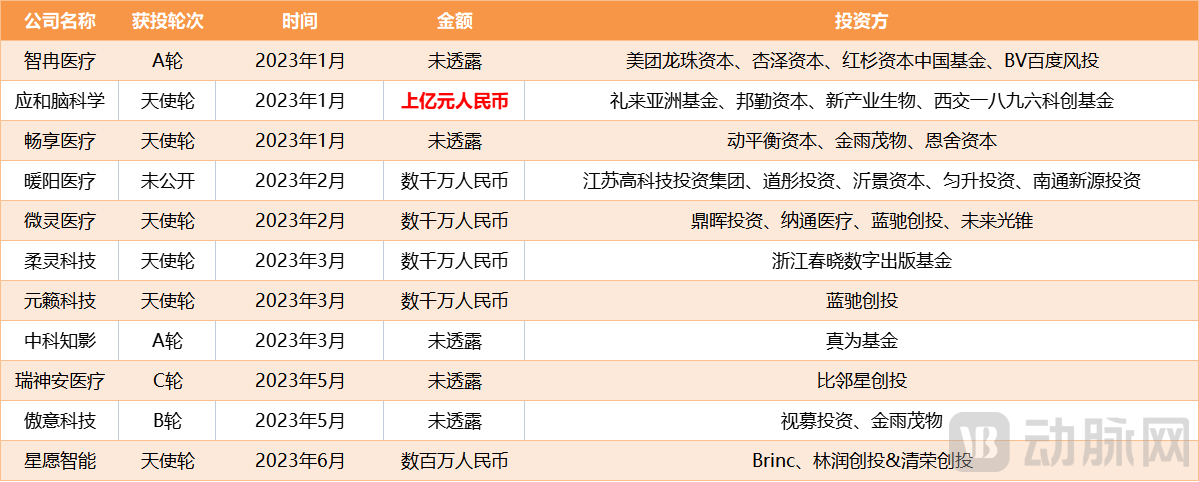
2023 Brain-Computer Interface Financing Information in China
Data source: VCBeat, organized and produced by VCBeat
The phenomenon of capital flowing into brain science and companies like AMYGDALA NEURO, which specialize in brain science medical devices, reflects humanity's relentless pursuit to deeply explore the understanding of nature and itself. Brain-computer interfaces and more brain science medical devices are among the most effective means to explore the brain.
The brain weighs only about 1.5 kilograms, yet it is the source of all human intelligence. What makes the human brain so special? How can we effectively decode its "language"? How should external information be written into the brain? With years of continuous exploration, how do we regulate emotions? Can mental illnesses be cured? And even further, can our memories be rewritten?
Scientists have been continuously exploring in the field of brain science. Especially due to the urgent need for artificial intelligence development and the prevention and treatment of brain diseases, both the state and society have higher expectations for brain science. Against this background,VCBeat interviewed Dr. Ruilin Zhao, founder and CEO of AMYGDALA NEURO, to discuss cutting-edge issues such as the development of China's brain-computer interface market and the key challenges in the research and development of medical devices for brain science.
Before he actually started doing it, Zhaoruilin couldn't believe that brain signals could be read through blood vessels.
Despite RuiLin Zhao's extensive academic and technical experience in multiple fields such as neuroscience, his educational background remains impressive even among the many overseas returnee founders in the medical device industry. However, when facing brain science—the "ultimate frontier" of life sciences—he can only broaden the boundaries of imagination through practical innovation.
Ruilin Zhao graduated from the young scholars program in Biomedical Engineering at Xi'an Jiaotong University in 1986. After graduation, he chose to further his studies in the United States, obtaining a Master’s degree in Electrical Engineering and Computer Science from MIT. He later earned a Ph.D. in Medical Engineering and Medical Physics from the Harvard-MIT Program in Health Sciences and Technology, and an MBA from the Wharton School of the University of Pennsylvania.
In addition to a multidisciplinary top-tier educational background, RuiLin Zhao also has extensive experience in management operations and commercial team leadership. RuiLin Zhao joined in 2014.Gene Sequencing Giant Illumina(NASDAQ:ILMN),Serve as Global Vice President and General Manager of Greater China, responsible for formulating and implementing Illumina's strategies in China,Hong Kong Special Administrative RegionOverall strategy for sales, after-sales support, and marketing in Taiwan, China.
And before that, he also served asOrbusneich, Vice President of FinanceMinimally Invasive MedicalVice President of Business Development and General Manager of the Greater Vascular Division, among other senior executive positions in leading healthcare companies.
In addition to being a senior executive of multinational corporations, Rui Lin Zhao also held an important position as an investment partner at ChenDe Capital. His experience as an investor helped him better understand the operations of the capital market as well as corporate management and operations. In the process of supporting entrepreneurs' growth, he also had to think more about what problems and pain points enterprises and products could solve, and where the market opportunities and growth potential lie.
To develop and integrate cutting-edge global medical technologies and empower the innovation path of China's medical device industry, Zhao Ruilin founded Enable Medical in 2020 and became its CEO. The company has accumulated mature technologies and product experience in fields such as structural heart disease and peripheral vascular intervention. Upon recognizing the enormous opportunities within the brain science sector, Zhao Ruilin incubated AMYGDALA NEURO within Enable Medical, which focuses on neuromodulation and invasive brain-computer interfaces.
"Invasive brain-computer interfaces once seemed to me like scratching an itch through a boot, but when our team actually began animal trials, we realized the significant advantages of invasive brain-computer interfaces in signal reading and technical implementation.", Zhao Ruilin said in an interview.
AMYGDALA NEURO currently has an interdisciplinary team covering mechanics, electronics, software, chips, systems, and scientists, with rich experience and technical problem-solving capabilities in the field of active medical devices.
Currently, the company's main technical pipelines in the field of brain science medical devices are primarily two:They are the neuromodulation technology platform and the invasive brain-computer interface platform.
Brain-computer interface refers to the creation of a connection pathway for information exchange between the brain of an organic life form and a device with processing or computing capabilities, enabling information exchange and control. The human brain consists of nearly 100 billion neurons, 500 trillion synapses, and various complex factors such as neurotransmitters composed of amino acids, peptides, and proteins.
It is precisely because of this that it is particularly difficult to knock on this door.
From a technical perspective, brain-computer interfaces are roughly divided into three categories: invasive, non-invasive, and interventional.
Neuralink, founded and funded by Elon Musk, garners global attention every few months due to its clinical trials on invasive brain-computer interfaces.
However, this enthusiasm does not stem from the technology itself but rather from discussions about experimental safety. Although Neuralink received FDA approval for human trials in May 2023, the technology is still in its early stages. In addition to the need for improved precision in data collection, the long-term safety of invasive surgeries and device wearability remains uncertain.
Although non-invasive brain-computer interface technology does not need to focus on safety issues, the obstruction of the skull can lead to signal attenuation and electric field dispersion blur effects, reducing signal resolution. This makes it difficult for the device to pinpoint the brain region or individual neurons responsible for the signal discharge, rendering the information ineffective or the data difficult for the device to precisely control.
Based on the existing market pain points, Zhao Ruilin introduced to VCBeat that AMYGDALA NEURO has taken a different approach, relying on the mature vascular stent technology and neuromodulation technology of Yingmai Medical, focusing on the development of interventional brain-computer interface technology.
Invasive brain-computer interfaces implant stent electrodes through minimally invasive surgery to directly capture signals from corresponding brain regions inside the skull. This method does not require craniotomy, but the quality of the EEG signals received is higher than that of non-invasive brain-computer interfaces that work through the skull. Several companies in and outside China have already started animal experiments and human trials using this technical approach.
Since 2016, Musk has invested more than $300 million of his own money into Neuralink. However, a former FDA official predicted that Neuralink's brain-computer interface device is still about 5 to 10 years away from commercialization.
In 2023, the capital market, tightening its belt, has developed a more mature understanding and realistic expectations regarding companies' R&D pathways and commercialization cycles for brain-computer interfaces—namely, whether the enterprises and their products can possess self-sustaining and risk-resisting capabilities, and whether the commercialization pathway is clear.
AMYGDALA NEURO, founded just a year ago, has already reached an internationally leading level in the field of intravascular stent electrode brain-computer interfaces. The R&D team has overcome key technical barriers in multiple areas, such as autonomous system design, electrode design, chip design, signal acquisition and decoding, closed-loop algorithms, and CT and MRI compatibility. Additionally, several products under development are about to enter clinical trials.
Currently, the company has the following three major advantages in terms of R&D pathways and practical applications:
First,AMYGDALA NEURO's invasive brain-computer interface is achieved through a minimally invasive approach, creating a small puncture in the blood vessel, and using a minimally invasive surgery similar to heart stent placement to realize the brain-machine connection.Compared with craniotomy for electrode placement, this procedure has developed over more than a decade and possesses a high level of maturity and safety. For instance, interventional thrombectomy in the field of stroke treatment can serve as one of the methods for placing vascular interventional electrodes.
Secondly, AMYGDALA NEURO detects brain signals and provides neural stimulation by attaching electrodes to vascular stents, achieving closed-loop therapy that traditional brain-computer interfaces struggle to accomplish.And vascular stents are the foundation of this technology platform. Backed by Yingmai Medical, AMYGDALA NEURO has accumulated an industry-leading technology implementation base in both interventional stents and neuromodulation technology.
Finally, brain-computer interface is an interactive process, which not only needs to read brain signals but also needs to intervene and treat. However, it is difficult to "read" signals, and the clinical implementation of "writing" signals is even more challenging.AMYGDALA NEURO's first neuromodulation product for future commercialization focuses on Deep Brain Stimulation (DBS), utilizing the "reading" and "writing" of brain signals to treat related diseases.
In the CCTV documentary "Surgery Over Two Centuries," a doctor implanted a micron-level electrode into the brain nucleus of a Parkinson's patient. The moment the stimulator with the implanted electrode was turned on, the Parkinson's tremor that had plagued the patient for 14 years disappeared.
This is DBS. Currently, the main indications for DBS include Parkinson's disease, dystonia, and essential tremor.AMYGDALA NEURO's next-generation DBS product under development features sensing capabilities and a closed-loop algorithm, which can directly measure pathological brain activity and provide adaptive, adjustable stimulation based on the signals read to treat neurological and psychiatric disorders associated with abnormal brain electrical functions.
In the future, AMYGDALA NEURO will also further expand the application of minimally invasive implantable therapies, such as interventional brain-computer interface products, in the treatment of movement disorders and neuropsychiatric diseases, based on the company's brain signal reading and writing technology platform in the field of neuromodulation.
Looking at the global invasive brain-computer interface market, Synchron, which is invested in by Bill Gates and Jeff Bezos, also uses invasive brain-computer interface technology. The company's product has received FDA Breakthrough Device Designation and has preliminarily demonstrated safe and effective results in human trials.
According to Zhao Ruilin, although the same neural intervention-based technical pathway is adopted, the design pathway of AMYGDALA NEURO is completely different. The company’s invasive brain-computer interface device not only has fully independent intellectual property rights but also achieves region-specific stimulation for different brain areas while maintaining the same signal acquisition accuracy. Moreover, this product has leading advantages such as lower cost and longer battery life.
According to the "Overall Vision and Key Technology Research Report on Brain-Computer Interfaces (2022)" released by the China Academy of Information and Communications Technology, the technologies of neural remodeling, neural substitution, and neural regulation in brain-computer interfaces are expected to have a market potential worth dozens of trillions.Driven by the joint efforts of major research forces and brain-computer interface enterprises, China's brain-computer interface technology has entered the international leading ranks, and interventional brain-computer interfaces may be the first to be applied in the medical field, achieving commercialization.
As the research deepens, Zhao Ruilin also found that there are still some "bottleneck" key issues unresolved in the development of interventional brain-computer interfaces. Such as the long-term safety and effectiveness of implanted electrodes, the long-term stability of brain signal transmission, and how to place electrodes when there are no large blood vessels near the lesioned brain area that meet the interventional conditions.
"But 'if we are going to do it, we will do the best globally,'" Zhao Ruilin said in an interview. As an innovative medical device company based in China with a global outlook, AMYGDALA NEURO is also actively seeking domestic and international cooperation. In March this year, Benjamin Pless, a global expert in implantable medical devices, officially joined AMYGDALA NEURO's Global Scientific Advisory Board.
Benjamin Pless graduated from MIT, holds over 140 U.S. patents, and has more than 25 years of experience in the development and clinical translation of implantable medical devices. He has served as president or on the board of directors at several well-known implantable medical device companies.
At the end of the interview, RuiLin Zhao said,"AMYGDALA NEURO's neuromodulation and invasive brain-computer interface technologies have reached an internationally leading level. The addition of Benjamin Pless will accelerate the practical application of AMYGDALA NEURO’s neuromodulation and invasive brain-computer interface technologies. The brain-computer interface is one of the fields where China is most likely to achieve 'leapfrog development.' In the future, the company will actively integrate into the China Brain Project, continue to be guided by clinical needs, challenge the unknown through practice, and use the power of technology to improve human health."
References:
1. AMYGDALA NEURO Completes Over 100 Million Yuan in Angel Financing, Accelerating the Implementation of Innovative Brain Science Medical Devices
2. Entrepreneurship from an Investor's Perspective: Zhao Ruilin on the Medical Device Industry – Limited Value in Single-Product Ventures, Building a Platform is Key to Success