

AbbVie Reports Strong Q2 2023 Earnings Despite Humira Decline, Driven by Skyrizi and Rinvoq Growth

AbbVie
Innovative Drug Developer
On July 27, AbbVie released its financial report for the second quarter of 2023. The data showed that the company's total revenue in the second quarter was $13.865 billion, a year-on-year decrease of 4.9%. The global revenue from the immunology sector was $6.813 billion, a year-on-year decrease of 5.5%.
Despite a 25.2% year-over-year decrease in revenue from Humira,But Skyrizi (risankizumab), which is considered the successor to Humira, saw its global net revenue increase by 50.4% year-over-year, generating $1.885 billion.Global net revenue of oral JAK1 inhibitor Rinvoq (upadacitinib) increased by 55.1% year-over-year, reaching $918 million.
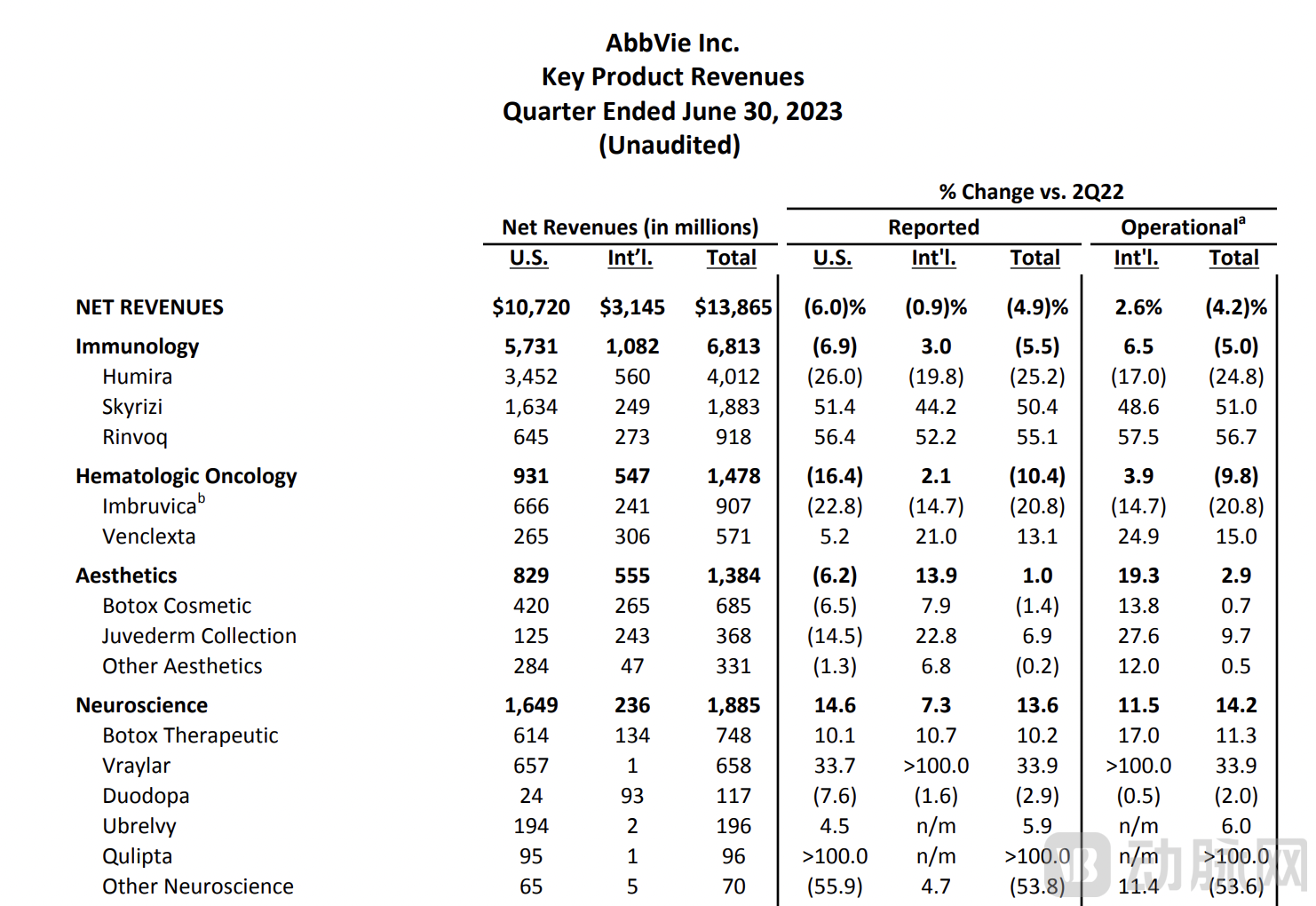
Revenue in the neuroscience field continued to grow, with global net income reaching $1.885 billion, a year-over-year increase of 13.6%.Revenue from the multi-functional atypical antipsychotic Vraylar (cariprazine) was $658 million, representing a year-over-year increase of 33.9%.New Oral Migraine Drug Qulipta Sales Surge to $9.6 Billion,This is thanks to the FDA approval for the expanded indication of Qulipta for the preventive treatment of chronic migraine, making Qulipta the first and only orally administered CGRP receptor antagonist approved for the prevention of both episodic and chronic migraine.
AbbVie CEO Richard A. Gonzalez continued to describe the company's second-quarter performance as "better than expected." Compared to Q1, more companies have joined the battle for Humira's market share.But in fact, "losing the drug king" is no longer as critical for AbbVie. While maximizing its exclusive strategy, AbbVie is constantly exploring new growth curves.A Review of AbbVie's Assets and Their Latest Status Reveals the Company May Be Advancing Toward Becoming the World's Top Pharmaceutical Enterprise.
Humira Price War Has Begun
At the end of January 2023, Amgen announced that its Humira biosimilar, Amjevita, had officially entered the U.S. market. This signifies that Humira has officially reached its patent cliff, and moving forward, Humira will no longer be AbbVie's primary source of revenue. As AbbVie's flagship drug for many years, Humira has generated $208 billion globally for the company.
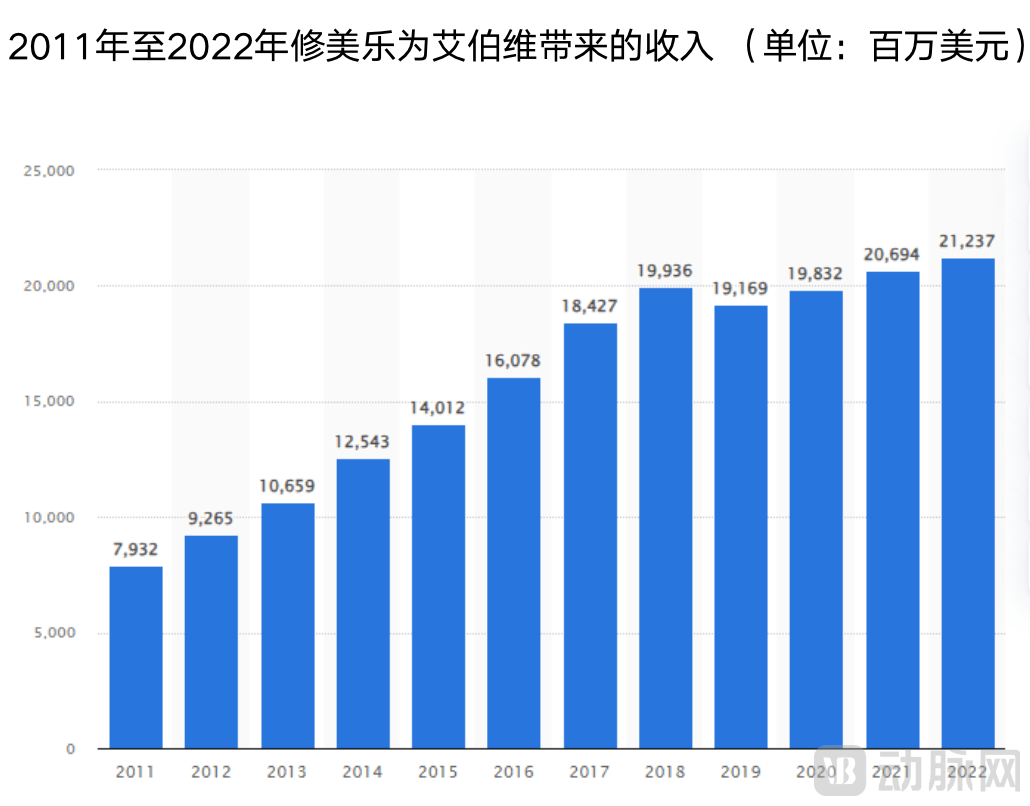
Some argue that in the face of the upcoming wave of generic drugs, AbbVie can still enjoy a period of user base benefits due to its large customer base. According to reports, patients with certain specific medical insurance do not have to pay much for Humira (up to $100 per month), so these patients may be unwilling to switch from Humira to generics in the short term. Therefore, Humira's revenue will not quickly drop to zero. However, as generics become widely available in the future, there is still a possibility of a cliff-like decline for Humira.
In 2023, several adalimumab biosimilars are expected to hit the market. Among the many generic products gearing up for competition, Boehringer Ingelheim's Cyltezo is the first FDA-approved interchangeable biosimilar to adalimumab, meaning that without a change in prescription, Cyltezo can replace Humira. Industry experts predict this could directly impact Humira’s existing market share.
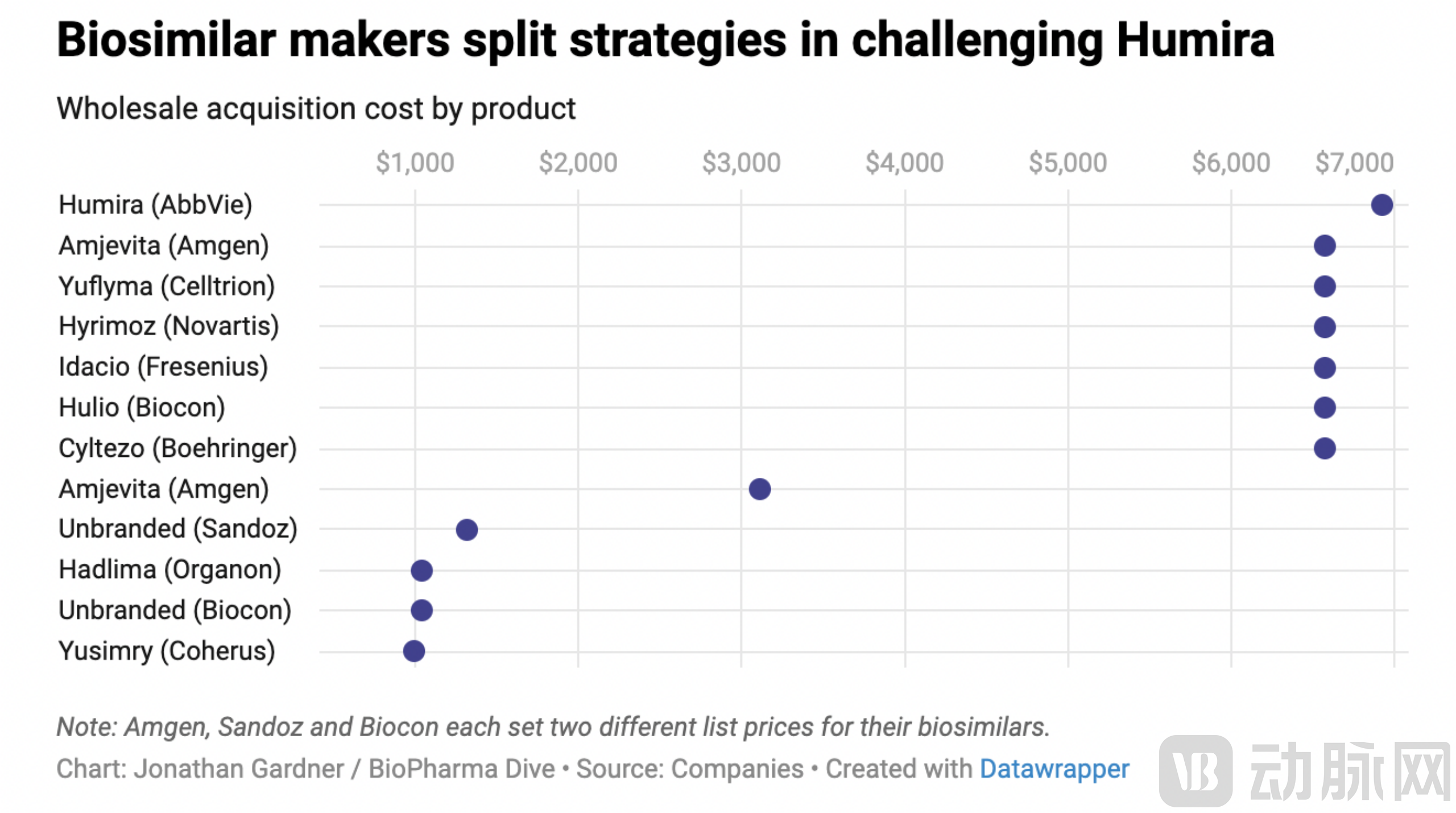
Moreover, when a large number of generic drugs flood the market, price competition will also accelerate the decline of Humira. However, from the current pricing, discounts set by Amgen's Amjevita, Boehringer Ingelheim's Cyltezo, Mylan's Hulio, and Sandoz's Hyrimoz are only 5%. They are betting on closed-door negotiations with insurance company intermediaries to reach rebate agreements sufficient to secure coverage. But Amgen, Mylan, and Sandoz have simultaneously launched high-priced and low-priced products to cater to different types of healthcare buyers.
The Coherus version of Humira, which was originally scheduled to launch in July at a price of $995 (85% lower than Humira), later dropped its price to $569. At such a low price, Humira can hardly compete. Richard A. Gonzalez, CEO of AbbVie, admitted that Humira's revenue is expected to drop by 37% this year.
Skyrizi and Rinvoq Take the Baton, the Former Recently Submitted for Marketing Approval in China
AbbVie has built a patent wall for Humira in the past few years. During this extended period of protection, Skyrizi (risankizumab, now renamed as Rilzabrutinib, referred to by its former name in this article) and Rinvoq (upadacitinib) have grown stronger and become qualified successor drugs.
Especially Risankizumab, in competition with Johnson & Johnson's second-generation inhibitor Guselkumab, surpassed Guselkumab last year with sales of $5.165 billion due to equivalent efficacy and fewer administrations (four times a year).
AbbVie is currently accelerating the expansion of indications for these two autoimmune drugs. In the United States, risankizumab has been approved for the treatment of Crohn's disease, severe rheumatoid arthritis, active psoriatic arthritis, moderate to severe ulcerative colitis, ankylosing spondylitis, non-radiographic axial spondyloarthritis, and moderate to severe atopic dermatitis. Risankizumab has also been authorized for the treatment of plaque psoriasis, active psoriatic arthritis, moderate to severe Crohn's disease, and ulcerative colitis.
It is worth mentioning that Risankizumab applied for marketing authorization in China on July 6. Risankizumab has registered seven clinical studies in China, intended for treating adult active psoriatic arthritis, moderate to severe ulcerative colitis in adolescents aged 16 and above as well as adults, and Crohn's disease.Among them, two Phase III studies and one Phase I study for the treatment of Crohn's disease have been completed. Previously, Johnson & Johnson's Guselkumab was approved for marketing in China in 2019 and entered the medical insurance this year, priced at 4,571 yuan/vial (original price 28,000 yuan/vial). If Risankizumab also chooses to reduce its price to enter the medical insurance in the future, it will not only be a strong competitor in China's autoimmune market but also bring new revenue growth points for AbbVie.
AbbVie's proactive exclusivity strategy has bought time for upadacitinib and risankizumab, and the successful commercial progress ensures that they will maintain a certain market share in the coming years.Revenue forecasts for AbbVie's immunology sector indicate that sales of Risankizumab and Upadacitinib are expected to reach $7.4 billion and $3.7 billion, respectively, in 2023. The combined revenue of these two drugs is projected to hit $17.5 billion by 2025, with sales anticipated to exceed $21 billion by 2027.This means that the compound annual growth rates (CAGR) of risankizumab and upadacitinib will be 26.6% and 43.8%, respectively, from 2023 to 2025, and 9.1% and 9.5%, respectively, from 2025 to 2027.
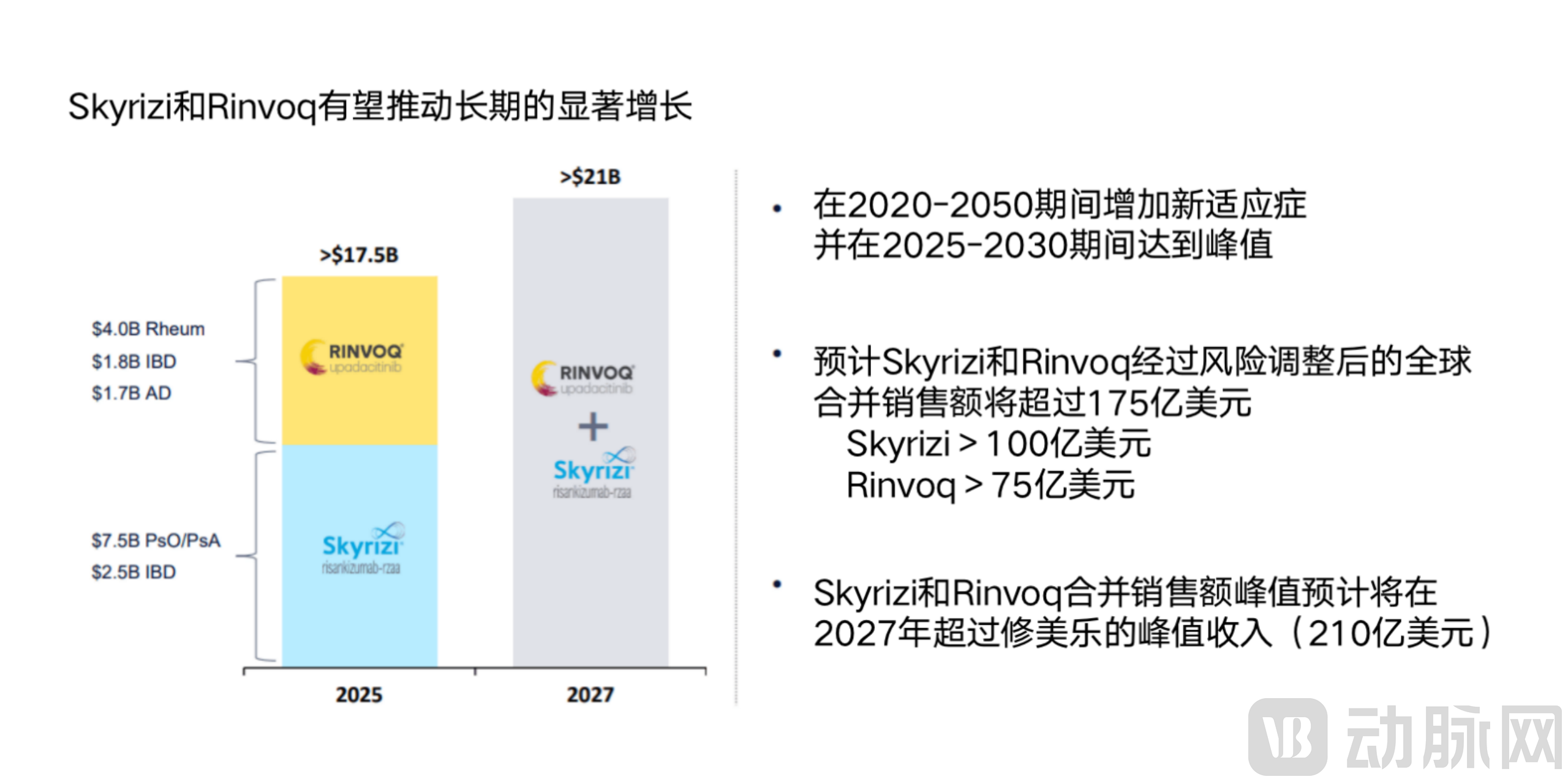
But these two drugs cannot fully offset the revenue loss caused by the decline in Humira sales within a year. Richard A. Gonzalez summarized: "The company has spent years preparing to fend off competition and is well-prepared. Following the entry of Humira biosimilars into the market in 2023, we expect a rapid return to growth in 2024 and high single-digit growth from 2025 to 2030."
More Pipeline Reviews: Oncology, Neuroscience, and Ophthalmology Blossoming in Multiple Areas
However, even with the rapid sales growth of Risankizumab and Upadacitinib, the compound annual growth rate of total revenue in the immunology field is only 2.7%. This will not affect AbbVie's future business development. To avoid the performance fluctuations caused by the expiration of Humira's patent, AbbVie has long started exploring and laying out plans in other fields.
The oncology field may become one of AbbVie's future business pillars.
As early as 2015, AbbVie spent $21 billion to acquire Pharmacyclics, obtaining Imbruvica (ibrutinib), a new targeted anticancer drug that is a BTK inhibitor. Imbruvica and Venclexta (venetoclax), the world's only marketed Bcl-2 inhibitor, are the cornerstones of AbbVie's hematological oncology portfolio. In 2021, Imbruvica achieved sales of $7.607 billion. In 2022, AbbVie’s anticancer drugs generated $6.577 billion in sales. Venclexta has maintained robust growth in recent years, with its sales surpassing $2 billion for the first time in 2022, making it one of AbbVie’s key growth drivers.
In addition to its existing oncology products, AbbVie is also expanding its pipeline in the oncology field. The development of new drugs will serve as a reserve resource to continuously empower AbbVie, and all pipelines have now entered Phase III clinical trials.

AbbVie's Oncology Pipeline Highlights
Richard A. Gonzalez believes that these drugs under research may become "products worth nearly $6 billion."
In addition, AbbVie has also set its sights on the huge potential of the solid tumor market. Solid tumor projects such as the anti-GARP antibody ABBV-151 and the PTK7 ADC ABBV-647 have achieved positive data. It is expected that in the next few years, more than a dozen early-stage oncology projects will obtain proof-of-concept data.
Another field that will shoulder significant responsibilities in the future is neuroscience. In this field, drugs for the treatment and prevention of migraines hold promising prospects.
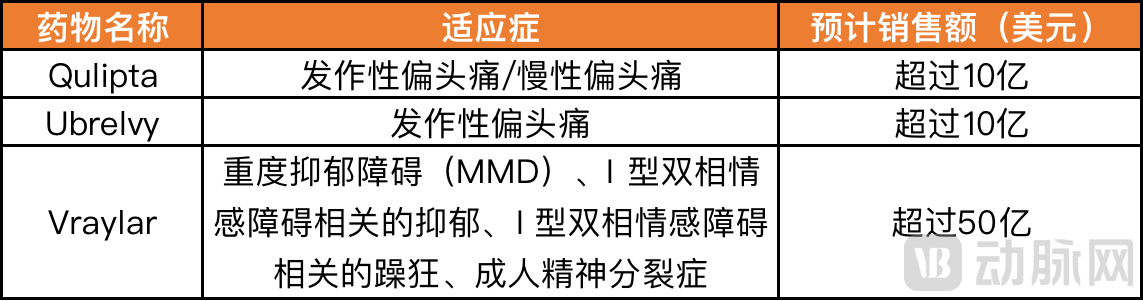
AbbVie's Neuroscience Portfolio
Qulipta is currently the only drug that treats both episodic migraine and chronic migraine, while Ubrelvy "provides rapid and sustained relief for episodic migraine." Vraylar is AbbVie's key drug in the field of neuroscience, which AbbVie describes as "a versatile atypical antipsychotic with significant efficacy for a variety of symptoms, having minimal impact on weight, lipids, and fasting blood glucose." The drug has been approved for four indications, and AbbVie predicts its peak sales will exceed $5 billion.
Finding blue ocean markets that have not yet become crowded is equally a key strategy for future long-term development. Therefore, AbbVie's business portfolio includes not only its strong areas in immunology, oncology, and neuroscience but also encompasses ophthalmology and medical aesthetics.
An important product in AbbVie's ophthalmology pipeline is Vuity, which received FDA approval in October 2021 for the treatment of presbyopia, becoming the first eye drop specifically designed to treat presbyopia. In September of the same year, AbbVie partnered with Regenxbio to co-develop RGX-314, a gene therapy for ophthalmic conditions, targeting wet age-related macular degeneration (wAMD), diabetic retinopathy (DR), and other chronic retinal diseases.
In the field of medical aesthetics, AbbVie acquired Allergan in 2020, bringing Allergan's blockbuster medical aesthetic products Botox and Juvederm into its portfolio. Botox is an injectable Type A botulinum toxin product and also the product with the largest share of the global botulinum toxin market. Its global market share once reached as high as 86% and currently remains above 65%.
Back to the Peak in 2028?
Losing the absolute advantage in the autoimmune field may pose some challenges to the company in the next two years, but Humira's descent from its pedestal does not mean the company is heading into decline. On the contrary, as AbbVie gradually reduces its reliance on the immunology sector, AbbVie will become a pharmaceutical enterprise with even stronger comprehensive capabilities.
Previously, analysts from Evaluate believed that AbbVie would become the world's top pharmaceutical company with $65.7 billion in sales by 2028.Oncology and neuroscience will become AbbVie's two major growth drivers. The challenges posed by generic drugs and the emergence of new product pipelines will accelerate AbbVie's innovation and iteration. By pursuing multi-faceted development in oncology, neuroscience, medical aesthetics, ophthalmology, and other fields, whether AbbVie can recreate the glory of its blockbuster drug era still requires time to answer.
References:
1. https://seekingalpha.com/article/4617891-abbvie-dancing-on-humiras-grave