

Rui Vision Secures Hundreds of Millions RMB in Series A+ Financing to Advance Clinical Trials for Myopia Control Products

MetaVision
Provider of Vision Health Management Services for Children and Adolescents

Sinovation Ventures
Technology-Focused Venture Capital Firm

BlueRun Ventures China
Venture Capital Institution
36Kr has learned that "MetaVision"Recently completed a billion-yuan A+ round of financing, led by Innovation Works,BotaneeFollow-on investment, with existing shareholders Yaojin Capital and BlueRun Ventures China continuing to increase their investment. This round of financing will be used to conduct multi-center GCP clinical trials and registration certifications for multiple products across China.
At present, myopia has become a common eye health issue. According to data from the National Health Commission of China, the overall myopia rate among children and adolescents in China was 52.6% in 2021, with a particularly high incidence during the two critical transition periods of entering primary school and entering middle school. Controlling and slowing the progression of myopia has become an essential need for many children and their parents.
Currently, there are not many clinically proven methods to slow the progression of myopia. Orthokeratology lenses (OK lenses), defocus eyeglasses, low-concentration atropine, and similar products have been verified to some extent as means to delay myopia progression. Without intervention, children’s myopia can increase by up to 100 degrees annually. In real clinical practice, even when following medical advice in using these methods, it may still not be possible to fully, safely, and effectively control or slow the progression of myopia. Breaking away from conventional thinking and further improving myopia prevention and control methods with new technologies is the challenge that MetaVision aims to address.
"Actually, 'extensive outdoor activities' are a very effective method for myopia prevention and control, meaning engaging in outdoor activities and looking into the distance for 2-4 hours every day," said Yao Jun, founder and chairman of MetaVision. Many doctors recommend this solution to parents, but considering children's demand for studying and using their eyes, very few can follow the doctor’s advice.
Therefore, in the early stage of entrepreneurship, MetaVision attempted to move the behavior of "outdoor gazing" into home scenarios, utilizing AR and digital technology to develop its core product, the "Far-Screen Light Display," in an effort to change children's reading and writing patterns with the aim of slowing down the rapid progression of myopia.
According to Yao Jun, before designing the "Far Screen" product, they referred to similar methodological attempts in the industry. One is the "Print pushing" method invented by Todd Becker, an engineer graduated from Stanford University in the United States; the other is a technique by Japanese company Kubota Vision, which projects images in front of the peripheral retina of myopic individuals, aiming to control the rapid progression of myopia.
Summarizing beneficial attempts in the industry, Yao Jun and the team summarized the core principles of delaying the development of myopia into "solar spectrum, distant viewing, and optical defocus," and attempted to implement relevant methods in an evidence-based and standardized manner into their products.
First, through AR technology, the act of looking into the distance outdoors is brought into the home setting. "The application of the distant image light screen does not require a long physical distance; with a display, imaging at a distance of 4 meters or more can be achieved."
Second, there are differences in energy, spectrum, and other aspects between outdoor sunlight and household light sources. The intensity of sunlight can stimulate the activity of ocular cells, thereby increasing choroidal thickness. We have developed an AR display screen, hoping that the incident light spectrum can be close to the solar spectrum and incorporate potentially effective components of sunlight. In the future, we will also add the missing spectrum from indoor light sources."
Third, the electronic implementation of optical defocus has been achieved. Optical defocus refers to moving the focal point projected behind the retina onto or in front of the retina, while correcting central retinal vision to reduce the risk of axial elongation and slow down the onset and progression of myopia. This method has been validated in the application of myopia defocus glasses. MetaVision’s distant light screen product incorporates optical defocus lenses, and the related technologies applied in the new product are expected to achieve personalized prevention and control.
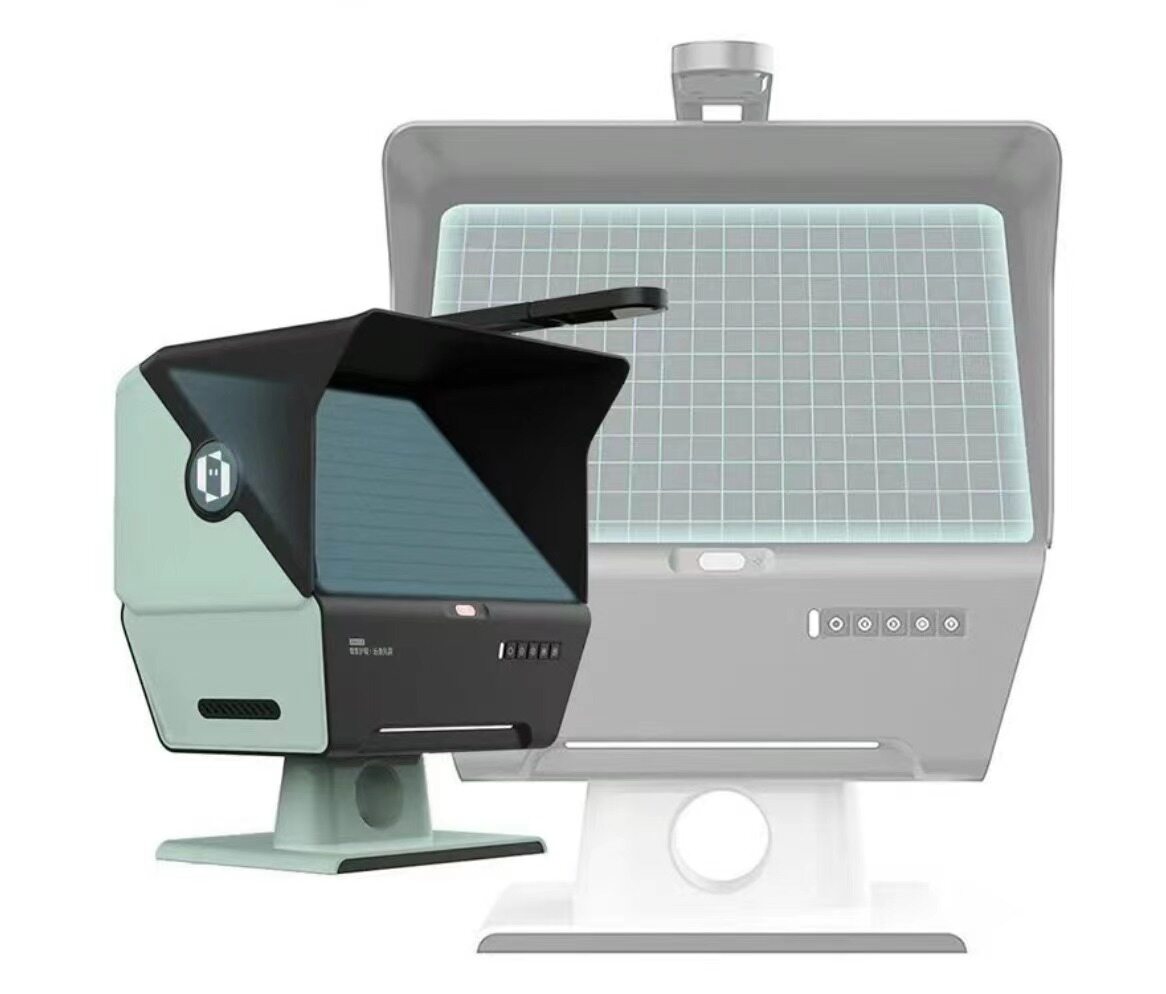
MetaVision Long-Distance Light Screen Product
As a medical-grade device designed to delay the progression of myopia, MetaVision has collaborated with Professor Wang Ningli's team from Beijing Tongren Hospital. Since November 2020, they have conducted six phases of pilot research experiments. Relevant experiments have shown that: continuous use of the distant light screen for four hours increases choroidal thickness by 26um.
It is reported that the MetaVision's far-field light screen products have been sold through channels such as ophthalmic hospitals and optometry centers, accumulating nearly ten thousand real-world application cases. "In the mid-term trial, some experts used our device in combination with the Hoya NewDefy myopia defocus glasses, achieving the following results: within 6-12 months, the average monthly axial length growth was less than 0.02 millimeters, approximately 0.00."8 millimeters"Obviously superior to single myopia control products." Yao Jun introduced to 36Kr.
MetaVision's products have been or will be conducting clinical trials at top-tier hospitals such as Tongren Hospital, the Pediatric Research Institute, Tianjin Eye Hospital, and Huaxi Hospital. Multi-center clinical trials will also support the subsequent approval of Class III medical devices.
"In terms of industry barriers, medical-grade products involve a lot of know-how, such as defocus amount and defocus area—only the correct parameters can effectively slow down myopia. The same principle applies to the act of looking into the distance; improper ways of doing so might worsen myopia," Yao Jun told 36Kr. In addition to hardware devices, MetaVision is also developing digital therapeutic software for myopia, simulating optical defocus through digital signals, thereby thickening the choroid, controlling the rapid growth of the eye axis, and managing as well as slowing down the progression of myopia.
MetaVision's distant image light screen products can be used in conjunction with orthokeratology lenses and frame defocus glasses, with the aim of achieving better therapeutic effects. Therefore, in terms of channel and market expansion, MetaVision chooses to cooperate with channel agents of orthokeratology lenses and frame defocus glasses through the "strong brand, strong channel" collaboration method to quickly enter the market. After the completion of this round of financing, "MetaVision will attract more professional R&D talents, increase R&D investment, and accelerate the scaled development of MetaVision's distant image light screen and digital treatment products as well as the expansion into international overseas markets."