

Ophthalmic Industry at a Turning Point: Capital and Giants Enter the Arena as the 'Optometric Battle' Begins

Huaxia Eye
Large Ophthalmology Medical Service Provider

He Eye
Ophthalmology Medical Service Provider

Aier Eye Hospital
Ophthalmology Medical Chain Institution
The ophthalmology industry is entering a moment of great change.
Over the past year, whether it's OptoVision raising 1.5 billion yuan in a private placement to expand its optometry terminal market (eye clinics and optometry centers), or Aier Eye Hospital Group announcing at the shareholders' meeting its plan to "build 1,000 optometry clinics," as well as Huaxia Eye’s plan to construct 200 new optometry centers,All of which indicate the industry giants' emphasis on the optometry market.。
On the capital side,Investment institutions have also shown great investment enthusiasm.Recently, a group of institutions, including Innovation Works, Temasek, Jingtuo Investment, BlueRun Ventures, Clearpool Capital, Ruimixi Capital, Taikang Life, and Yaogold Capital, have spent real money. Companies such as Beijing Beitong Eye Hospital Management Co., Ltd., Rui Shi Technology, Aier Eye, and NovaSight have secured financing.
There is no doubt that a "major battle" around the optometry business has officially begun.
“Optometry is a rare细分领域 in consumer-level healthcare that is easy to standardize, scale, and capitalize, with significant market growth potential."Senior investor in the medical industry, Cai Wenxin, told VCBeat that optometry services are relatively mature in the United States, with eight chain optometry institutions having over 500 clinics each. In contrast, the total number of optometry service providers in China is still less than 3,000."
This means that new unicorn companies could emerge in the field of optometry services, or ophthalmology giants might recreate another "Aier Eye" or "Huaxia Eye" by expanding into this business.
Why Is the Optometry Business So Hot? What Strategic Considerations Do Companies Have? How Are They Implementing These in Practice? How Will the Industry Evolve in the Future? To answer these questions, VCBeat seeks to uncover the answers by interviewing industry professionals and organizing relevant information.
In the expansion of optometry services, ophthalmology giants are "pushing forward with great speed."
By the middle of this year, Chen Bang, Chairman of Aier Eye Hospital Group Co., Ltd., emphasized at the shareholders' meeting: "We have been exploring an optometry clinic model that fits the company's development. So far, our model has been very successful and can be replicated on a large scale."The target of the first phase is set at 1,000."It will continue to develop as the situation demands in the future." Once this statement was made, optometry outpatient services attracted widespread attention in the industry.
Not only Aier Eye, but industry giants including He Eye and Huaxia Eye are also making rapid progress in optometry services. For instance, Su Qingcan, Chairman of Huaxia Eye, mentioned in early April this year,Huaxia Eye aims to manage 200 chain optometry centers in the next five years., with a focus on cities with larger populations, more developed economies, and stronger consumer spending power; at its earnings presentation in May this year, He Eye also indicatedPlan to establish about 30 new optometry centers。
The upstream sector of ophthalmology is also making efforts in the optometry business. For instance, OcuScience has currently deployed more than 200 optometry terminals and plans to establish 1,300 optometry centers; Aier Medical's reach has also extended into this area, with its participating investment in JiongJiong Eye already operational, primarily focusing on youth myopia prevention and control, as well as medical optometry and eyeglass fitting services.
Behind the Frequent Launch of 'Hundred-store' and 'Thousand-store' Plans, Why Do Optometry Clinics Receive So Much Attention from Ophthalmology Giants? It’s Important to Know That Optometry Business Has Always Been a Key Sector in the Ophthalmology Industry.
It should be mentioned here that there are three main ways to layout optometric services: the first is the optometry clinic, optometric center, or medical optometry and eyewear fitting center within the hospital; the second is the off-site optometric center, staffed with professional optometrists; and the third is the off-site optometry clinic or practice, which requires obtaining a Medical Institution Practice License.
At present, it is a critical period for ophthalmology giants to focus on developing outpatient optical clinics or centers outside of hospitals.
On the one hand, it is due to the high explosiveness of the optometry business.According to data from the National Health Commission and the National Bureau of Statistics, in 2022, there were over 700 million people in China suffering from refractive errors, accounting for nearly 50% of the national population; nearly 360 million people had dry eye syndrome, making up close to 30% of the national population. In addition, visual fatigue, strabismus, amblyopia, and other optometric health issues are also widespread. This immense demand has created a vast blue ocean market. Consultancy firm CIC predicts,China's Medical Optometry Market Size to Reach 50 Billion Yuan by 2025, with a CAGR (Compound Annual Growth Rate) of 14.6% from 2020 to 2025.
In terms of business, ophthalmology giants have quickly followed suit. According to the annual reports disclosed by major listed companies, in 2022, optometry service projects accounted for 23.5%, 36.7%, 15.10%, 9.30%, and 12.27% of the revenue of Aier Eye, He Eye, PureVision Eye, C-MER Eye, and Huaxia Eye respectively, becoming an important revenue support and growth driver.
Proportion of Optical Business Revenue in Total Revenue for Some Listed Companies
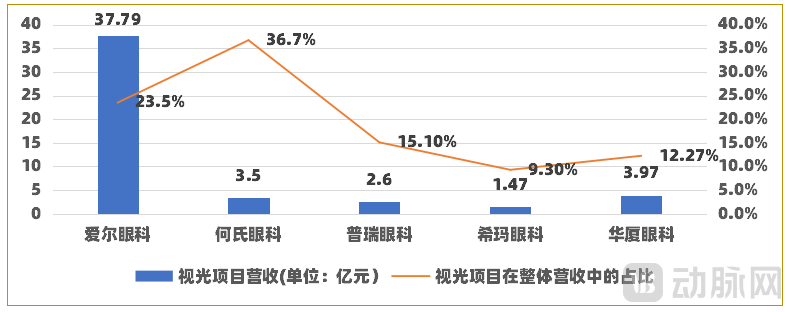 (VCBeat Chart Based on Public Information)
More importantly, thanks to the relaxation of the clinic registration system and the continuous policy support for the eye health industry, optometry centers and eye clinics are rapidly gaining momentum., becoming the "outpost" for ophthalmology giants to quickly reach more users with eye health issues.

(VCBeat Chart Based on Public Information)
"In the past, ophthalmic consumption mainly included two types of services: serious medical services in hospitals and optometry and eyeglass fitting services in optical shops. The former is for 'medical treatment,' while the latter is for 'fitting glasses.' There was a lack of institutions in between to provide users with better optometric and ophthalmic medical services," said Cai Wenxin, a senior investor in the medical industry.
Specifically, in the past, ophthalmology hospitals would spin off related businesses to extend into the vision correction field by establishing optometry and eyewear centers. However, the problem was the inability to provide systematic optometric medical services. On the other hand, optical shops, lacking medical qualifications, were unable to perform hospital-exclusive examinations such as cycloplegic refraction. Consequently, the market urgently needed professional optometric institutions with relevant qualifications.
Optometry clinics perfectly address this issue by using medical methods to correct vision problems such as myopia, hyperopia, strabismus, and amblyopia. They undertake tasks including basic diagnosis, eye health monitoring, mobile referrals, prevention, correction, and rehabilitation, forming a beneficial complement to ophthalmology hospitals that mainly focus on surgery.
For example, Huaxia Eye has opened multiple optometry centers in several core business districts within the same city to achieve coverage and aggregation of key urban populations, thereby expanding the audience for optometry services. At the same time, the optometry centers can provide basic eye examinations, and for patients with further medical needs, they can channel them to the hospital.
In Aier Eye's vision, the establishment of optometry clinics is a crucial step in creating a one-hour eye health treatment circle. Taking Aier Eye's layout in Gansu as an example, Lanzhou Aier Optometry Clinic relies on the medical resources of Aier Eye Hospital Group Co., Ltd., Lanzhou Aier Eye Hospital, and Gansu Aier Optometry Hospital. Leveraging Aier Eye's "one city, two hospitals, multiple clinics" model and an eye health ecosystem comprising over a hundred medical consortium alliance units, it provides high-quality eye health services reachable within one hour to residents in the local urban areas.
In addition, as a non-medical insurance service, optometric services such as refractive projects do not rely on medical insurance. However, diagnostic and treatment services under subspecialties like cataract, fundus, and ocular surface need to be settled through medical insurance. Affected by the medical insurance cost-control policies, the revenue growth of these services has generally slowed down, facing certain income growth pressure in the short term.
In summary, it can be seen that,The optometry market, driven by huge demand and policy support, is gaining momentum. The astute ophthalmology giants are certainly not missing the golden opportunity for industry development, as they have launched plans to open hundreds or even thousands of stores.
As more and more participants join, the optometry field has also reached a turning point.
A major battle centered around the optometry business is "erupting."
The entry of ophthalmology giants has led toThe rapid increase in optometry clinics has impacted traditional eyewear retail businesses.The reason is that, in addition to diagnosing and treating strabismus and amblyopia and screening for eye health issues, optometry clinics also focus significantly on refraction and eyeglass fitting, which creates direct competition with eyewear retail businesses.
"Compared with eyewear retail enterprises,Optometry clinics have greater advantages in terms of qualifications, professional talent, workflow, products, and more."Veteran of the ophthalmology industry, Guan Xiaolin, told VCBeat that ophthalmology hospitals and optometry clinics can also channel traffic to each other, sharing doctors and equipment. The emergence of optometry clinics could be said to have delivered a devastating blow to eyewear retail businesses."
According to the "2021 China Eyeglass Lenses Industry White Paper" released by iResearch, 60.8% of consumers have less trust in the professional services such as optometry and eyewear fitting provided by eyeglass retail stores compared to eye hospitals and optometry clinics.
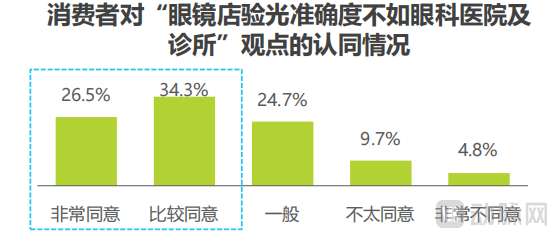
(Source: iResearch Consulting's "2021 China Eyeglass Lenses Industry White Paper")
In such a situation,Traditional eyewear retail enterprises have to seek transformation and upgrading, starting to extend towards optometry centers and ophthalmic clinics, shifting from merely selling glasses and related products to providing users with comprehensive optometric solutions.
For example, as a leading company in the eyewear retail sector, Chiba Eyewear strategically acquired a controlling stake in Chongqing Taiheng Eye Hospital in December 2021. This move has created a one-stop ophthalmic and optometric service terminal "driven by Taiheng Eye Hospital, connected through Chiba Taiheng Eye (Optometry) Clinics, and reaching customers through Chiba Eyewear retail stores." It establishes a tiered diagnosis and treatment model that integrates professional fitting at eyewear retail stores, initial consultations at clinics, referral of complex and surgical cases to hospitals, and collaboration between different levels of care.
Of course,Optometry clinics, caught in the "intermediate zone" between ophthalmic hospitals and eyewear retail enterprises, are currently facing certain challenges.: Unlike the high level of recognition that eyewear retail businesses have already established in users' minds, optometry clinics are still in the early stages of development. Therefore, they require higher market education costs to ensure that users choose them when eye health-related issues arise.
"The threshold for establishing an optometry clinic is relatively low. Taking Shanghai as an example, the cost of hardware facilities and equipment is around 4 million yuan, but the operating costs are very high," said Guan Xiaolin, a veteran in the ophthalmology industry.The proportion of labor and site costs is the highest."Ophthalmologists need to earn more than 250,000 yuan a year, and technicians need to earn over 150,000 yuan annually. As a result, many clinics, in order to save costs, do not hire their own doctors but instead invite doctors from public hospitals to provide consultations on an irregular basis."
On the other hand, customer flow is also unstable. Since the main recipients of optometric services are adolescents, most users only have time to visit on weekends. This time period has become the most intense moment for marketing and customer acquisition in the industry.
“Whether it is ophthalmic hospitals or eyewear retail enterprises, they all feel the urgency to intensify their optometry clinic businesses."Veteran of the ophthalmology industry, Guan Xiaolin, stated that every participant needs to quickly establish a presence and solidify their position under the new circumstances."
In addition to the active deployment of traditional ophthalmic hospitals and eyewear retail enterprises, some emerging companies are also rising in the optometry field and have developed their own unique characteristics.
For example, founded in 2018Beitong Pediatric Ophthalmology, which focuses on the direction of children and adolescent optometry services.Providing services such as myopia prevention and screening for teenagers, medical optometry, visual function training, dry eye examination and care, children's strabismus and amblyopia screening, and orthokeratology lens fitting. Currently, it has opened 9 directly operated specialized ophthalmology clinics and outpatient departments in Shanghai, with several more outpatient departments in preparation.
Currently, Beijing Beitong Eye Hospital Management Co., Ltd. has completed three rounds of financing: the angel round in 2019 funded by Daotong Investment, the Series A round in 2020 jointly invested by Yijing Capital and Xingnaher Capital, and the Series B round in 2022 exclusively funded by Taikang Insurance.
Such as the one founded in 2014,Meishi Meijing, starting from the development of an optometry clinic information system, has gradually opened nearly 10 chain optometry institutions in Shanghai, Beijing, Hefei, and other places.In terms of standardized operations, Meishijingmei has developed a "Guidance Manual for the Construction and Operation Management of Optometry Clinics," which covers eight major business management modules including optometry center construction, new media operations, copywriting, and more.
In order to better carry out market education, Meishimeijing has also built a "medical-education integration" model, establishing the Shanghai Meishimeijing Eye Center in Shanghai. By constructing eye science museums, visual game activity areas, time-space tunnels, and other eye health science popularization and visual experience spaces, it provides users with immersive visual health education.
Clearly, China's optometry industry has discovered some new possibilities, and the market landscape is being reshaped. However, the industry is still in its infancy, with a long way to go, requiring continuous innovation and accumulation from all parties involved.
Eye health issues are receiving more attention, bringing broad opportunities to the industry.
However, as the two sides of a coin,The layout and entrepreneurship in the field of optometry and optics are not as simple as imagined, and there are still many difficulties at this stage.
For instance, there is still a shortage of professional talent. According to a report by iResearch, in Europe and America, there is one optometrist for every 10,000 people, whereas in China, there is approximately one optometrist for every 50,000 to 60,000 people. Additionally, the industry is still not standardized, with fierce market competition, and phenomena such as excessive marketing and price wars exist.
In response to this, VCBeat, in conjunction with interviews of industry professionals, has four recommendations.
First, while solidifying the core business, expand into the full life cycle of eye health.Ophthalmic services have undergone certain market education over the past few years. The concept of eye care has gradually gained popularity, and people are increasingly paying attention to the protection of eye health throughout the entire life cycle.
Therefore, for optometry clinics, it is necessary to establish a full life cycle business layout for all age groups and improve the compliance of children and adolescents through diversified service models. This includes refined operation of optometry services across all links, from online consultation and offline diagnosis to online follow-up visits, to provide better experiences and treatment outcomes.
Second, strengthen the application of new technologies and equipment in the optometry field, making technology the underlying support for business operations and team management.With the continuous advancement and application of technology, ophthalmic optometry institutions are constantly launching and introducing new technologies and products, including digital vision screening devices, genetic testing, intelligent ciliary muscle training instruments, 3D training screens, etc. Users are also increasingly opting for convenient mobile payment and online store payments.
3. Emphasize the cultivation of optometric talents and promote the integration of vocational education with industrial development., and establish technical standards and qualification certification mechanisms for the industry, creating a professional technical talent academic education and training mechanism.
Fourth, there are still a large number of unmet clinical and consumer demands in the optometry market, requiring optometry clinics to pay more attention to innovative applications in this area.For instance, the orthokeratology lens (OK lens) market currently has a relatively low penetration rate, making it an incremental market worth investing in.
It is foreseeable that, with the continuous influx of innovative enterprises, high-quality solutions, and capital, the future optometry and optical field will bring more, newer, and sexier stories to the ophthalmology industry.