

Natural Bacterium Delftia tsuruhatensis TC1 Shows Promise in Blocking Malaria Transmission by Mosquitoes

GSK
Pharmaceutical R&D Manufacturer

Johns Hopkins University
Johns Hopkins University (JHU) is a world-leading research-intensive teaching university.
▎Edited by the WuXi AppTec content team
Over the past century, there hasn't been much change in the control interventions for malaria, and insecticides have remained the primary preventive measure.. However, as mosquitoes and the malaria parasite gradually develop resistance, there is an urgent need for new prevention strategies.Recently, researchers from the Johns Hopkins University School of Public Health and GSK have uncovered a potential new approach to prevent malaria:A naturally occurring bacterium and its secreted chemicals can inhibit the development of malaria parasites in mosquitoes, thereby preventing the transmission of malaria parasites through mosquito bites.. This method has obvious advantages: not only is it low in technical content and easy to replicate, but it also does not require the use of genetically modified technology.
Currently, this research has been published in the prestigious academic journal "Science," and the authors stated, this method can be perfectly combined with existing effective malaria control strategies.。
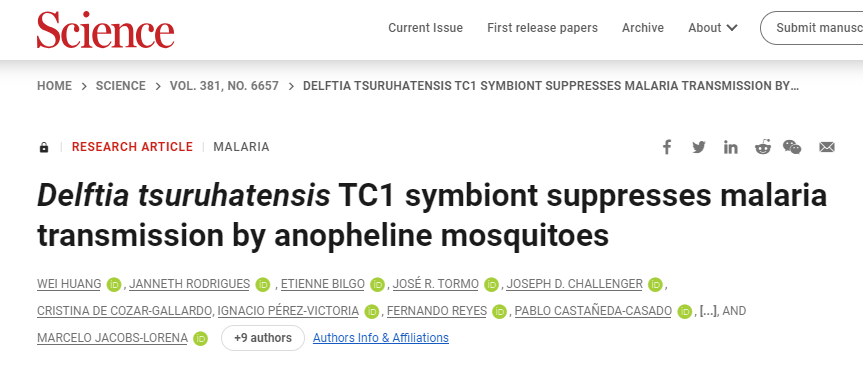
This research began with an unexpected discovery. At the time, researchers from GSK were studying antimalarial drugs when they accidentally noticed that one type of mosquito population used for drug testing was gradually developing resistance to infection by Plasmodium falciparum — the parasite responsible for the majority of malaria-related deaths. After analysis, the researchers foundThese mosquitoes resistant to Plasmodium infection all contain a natural bacterium named Delftia tsuruhatensis (referred to as TC1).,If mosquitoes carry TC1, the development of malaria parasites in the body will be affected.
To explore the principle behind this phenomenon, researchers from GSK collaborated with scholars from Johns Hopkins University on subsequent studies. First, they fed mosquitoes blood infected with TC1 and *Plasmodium falciparum*. After 22 hours, when the researchers dissected the mosquitoes, they noticed very few ookinetes of *Plasmodium falciparum* inside the mosquitoes, which meansThis bacterium suppresses the development of malaria parasites at a very early stage.。
Image Source: 123RF
Next, a researcher found that,If the supernatant of bacterial culture is used to feed mosquitoes, the development of Plasmodium will also be inhibited.. This indicatesThe supernatant contains inhibitors that suppress the malaria parasite, and it is likely that the bacteria function by secreting these inhibitors to attack the malaria parasite.Subsequently, the researchers further isolated and analyzed the active components in the supernatant, eventually identifying a compound named harmane. At high doses, it can act as a potent neurotoxin. Further experiments showedThere is a negative correlation between the levels of harmane or TC1 in the blood fed to mosquitoes and the formation of Plasmodium falciparum ookinetes.
Not only that, but when the researchers applied harmane to a glass dish and let mosquitoes sit on the dish for an hour before feeding them blood infected with malaria parasites, they foundThe development of malaria parasites in mosquitoes sitting on plates coated with harmane was severely impaired.. This result meansHarmane can penetrate the mosquito's cuticle (the exterior of mosquito legs) and inhibit the development of Plasmodium.
To translate laboratory results into practical applications, researchers conducted two field tests in Burkina Faso, Africa: one involved placing cotton balls soaked in a suspension containing sugar and TC1 overnight in mosquito habitats, while the other entailed rearing mosquito larvae in water containing TC1 until they reached adulthood.In the cotton ball experiment, about 75% of the mosquitoes absorbed the bacteria, and all adult mosquitoes raised in an environment containing TC1 bacteria were colonized by this bacterium.

Image Source: 123RF
In another set of experiments, researchers captured mosquitoes from the nearby environment and left them in an area containing the aforementioned soaked cotton balls. They then fed them blood from local patients infected with *Plasmodium falciparum*. These mosquitoes were able to suppress the malaria parasite with an efficacy rate of approximately 74%.
The research results show that,In places where malaria is prevalent, this bacterium has the potential to be widely used like pesticides.Insecticides have long been used as a malaria control strategy, but mosquitoes often develop resistance to them. Researchers pointed out, TC1 can reduce the possibility of mosquitoes developing resistance.First, TC1 does not directly kill mosquitoes—it only prevents the growth of parasites that cause malaria within the mosquitoes. Moreover, there are far fewer parasites in mosquitoes than in humans, making it less likely for them to develop methods to overcome the bacteria.
Nevertheless, the idea of releasing TC1 into the environment has raised some concerns, such as its impact on the ecosystem and what effects this bacterium might have on humans?

Image Source: 123RF
The researchers pointed out in the paper,The TC1 strain naturally exists in many different ecosystems, including freshwater, saltwater, soil, and other insect species. A product based on this bacterium has already been sold as a soybean soil additive, which supports its potential for safe environmental release.Researchers are currently investigating the persistence and spread of this bacterium in the natural breeding sites of mosquitoes, and conducting studies to understand its impact on non-target organisms such as bees.
As for the impact of this bacterium on humans, it has been reported as an opportunistic pathogen in hospital settings, causing severe symptoms in immunocompromised individuals with underlying health conditions. However, when used as a pesticide, it is unlikely to be transmitted to humans, at least not by mosquitoes—experiments have shown,When mosquitoes carrying TC1 bite mice, they do not transmit the bacteria to the mice because their saliva does not contain the bacteria.。
In addition, the study shows,If this approach is combined with measures such as distributing mosquito nets, clinical cases of malaria can be further reduced by 15%.. This means that, with the help of this strategy, we can save more lives. However, one thing must be made clear:Relying solely on this method cannot completely eradicate malaria. To combat this disease more effectively, we need to employ a combination of strategies, including insecticides, vaccines, and drug treatments.。

Image Source: 123RF
The exciting part of this method is that it utilizes a type of natural bacteria widely distributed in nature. Compared with other methods that require genetic modification of mosquitoes or bacteria, this bacterium can be field-tested in a shorter time. GSK stated that after determining the final product configuration, the research team will further study its safety for humans and the environment. GSK will provide support in terms of the therapy's safety, efficacy, and scaled production. However, the company also pointed out that the final product development is best completed by a third party.