

Huanxin Medical Files IPO Prospectus Following China's First Balloon-Occlusion Microcatheter Approval
CardioCycle
Innovative Medical Device Developer
Interventional treatment started relatively late in China but has developed rapidly, deeply penetrating into the treatment of diseases such as cardiovascular and cerebrovascular conditions, and is now recognized alongside traditional surgery and internal medicine as one of the three pillar disciplines.
According to the treatment system, interventional therapy can be divided into cardiac intervention, tumor intervention, neurointervention, etc., and according to the intervention approach, it can be divided into vascular intervention and non-vascular intervention. In 2021, the market size of vascular intervention alone in China exceeded 40 billion RMB, making interventional therapy a fiercely competitive field that has received significant attention and favor from the capital market.
As a startup, CardioCycle Technology (Suzhou) Co., Ltd. has been targeting interventional therapy and laying out in sub-sectors such as cardiac intervention and vascular intervention since its establishment in 2021.
July 20, 2023CardioCycle's OccluFar Seal® Balloon Occlusion Microcatheter, a device for tumor interventional therapy, has obtained the NMPA Class III medical device registration certificate. It ranks first in China and among the top three globally, filling a domestic gap.。
According to the latest statistics from GLOBOCAN,In 2020, there were approximately 906,000 new cases of liver cancer globally, with about 410,000 new cases in China., accounting for nearly half of the global total, China is known as a "liver cancer superpower." Radical resection is the most important treatment method for early-stage and some advanced liver cancers.But the recurrence rate 5 years after hepatectomy is as high as 50%~70%.。
Driven by market demand and the limitations of treatment options, a growing number of new therapies have emerged in recent years, providing liver cancer patients with more treatment alternatives. Current methods for treating liver cancer include: surgical resection, liver transplantation, ablation therapy, interventional therapy, radiation therapy, chemotherapy, targeted therapy, immunotherapy, and more.
The NCCN Cancer Treatment Guidelines in the United States indicate that interventional therapy has been recognized as the preferred treatment for intermediate and advanced liver cancer. Compared with surgery and systemic drug therapy, liver cancer interventional therapy features smaller incisions, higher drug efficacy, and direct delivery of drugs to liver lesions. Vascular interventional therapy is the main approach for liver cancer interventional treatment.Main treatment methods include Hepatic Artery Infusion Chemotherapy (HAIC) and Transarterial Chemoembolization (TACE).。
HAIC involves the infusion of chemotherapy drugs through a catheter, prolonging and maintaining the perfusion of the drugs. This increases the local drug concentration and the tumor's uptake of the drugs, thereby minimizing the systemic toxicity of the chemotherapy drugs as much as possible.
TACE was initially developed as a treatment method for hepatic artery embolization. After years of development, TACE has been widely used in clinical practice and has become one of the gold standards for liver cancer treatment. TACE can be understood as a combination therapy of "catheter + embolic agent." A catheter is selectively or super-selectively inserted into the tumor-feeding target artery, followed by the injection of embolic agents to occlude the target artery, which induces ischemic necrosis of the tumor tissue.
According to different embolic agents, TACE is divided into conventional TACE (cTACE) and drug-eluting bead TACE (DEB-TACE). Both cTACE and DEB-TACE require microcatheter super-selective technology to deliver the embolic agent to the target position, but the microcatheter cannot solve problems such as ectopic embolization and insufficient embolization caused by the reflux of embolic agents.
Balloon-Occluded Transarterial Chemoembolization (B-TACE) has emerged. The operator super-selectively delivers a balloon-occluded microcatheter to the target tumor vessel position, temporarily blocking/sealing the vessel while injecting embolic agents.Compared with ordinary microcatheters, balloon microcatheters show better effects in embolization filling volume, postoperative tumor response rate, and postoperative survival rate.。
OccluFar封游® Balloon Occlusion Microcatheter consists of a double-layer tube body, balloon, hub, and strain relief sleeve. It has the delivery function of a traditional microcatheter as well as the occlusion function of a balloon catheter.Can be used for TACE "delivery + occlusion", Marshall ethanol ablation occlusion, neurointerventional "delivery + occlusion", small vessel occlusion, etc.。
The inner layer of the catheter is made of polytetrafluoroethylene, facilitating the delivery of other instruments, contrast media, and/or embolic materials. The distal end of the catheter has two radiopaque markers, which are beneficial for observation and positioning under fluoroscopy. Its distal surface is also coated with a hydrophilic coating, which, when wetted, enhances the lubricity of the catheter and effectively reduces friction between the catheter, other instruments, and blood vessels.
 OccluFar® Balloon Occlusion Microcatheter
Advance the catheter coaxially along the steerable micro guidewire into the tortuous distal vasculature. Once the desired location is reached, inflate the balloon to allow for controlled and selective infusion of diagnostic, embolic, or therapeutic agents into the target vessel through the balloon microcatheter lumen.
OccluFar® Balloon Occlusion Microcatheter has the following design features:
1、Excellent sealing effect:The balloon is a compliant balloon, with a maximum diameter of up to 6mm. It inflates to better conform to the vascular shape and can be expanded according to the size of the target vessel, avoiding damage to the vessel wall. At the same time, it can also block proximal blood flow, reducing the escape of emboli;
2、Good Instrument CompatibilityOccluFar封游® has a smaller outer diameter and larger inner lumen, with an outer diameter OD/2.7F (0.9mm) and inner diameter ID/0.02" (0.51mm), providing better compatibility for device delivery, enhancing super-selective effects to access complex hepatic carcinoma lesion vessels.
3、Excellent tip flexibility: The tip is designed with a soft end to avoid vascular injury;
4、Excellent support and pushability: The tungsten wire braided design of the tube enhances support and pushability, providing a stable instrument pathway;
5、Precision Positioning: Dual-marker design for precise positioning during surgery, accurate judgment of balloon position, and enhanced surgical safety.
Clinical data from preclinical animal experiments of OccluFar® show that,Compared with ordinary microcatheters, OccluFar® has the advantages of increased microsphere injection volume, reduced injection time for embolic agents, and no reflux. Compared with other balloon-occlusion microcatheters already on the market, the advantages of OccluFar® lie in its "delivery + occlusion" integration and broader indications.。
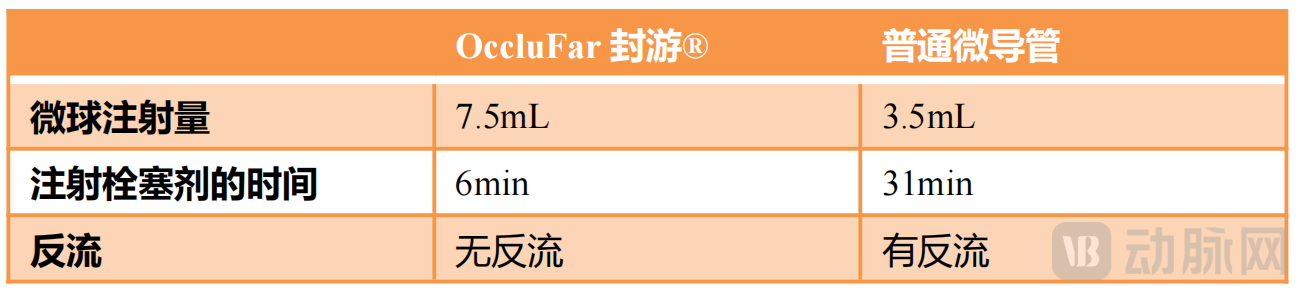
Comparison between OccluFar and Ordinary Microcatheters
What is the寓意of the name "封游"?
"Swim" in Chinese generally refers to moving in water, but it also conveys a sense of composure, flexibility, and stability. "Intervention" involves inserting devices into human blood vessels. Thus, "swim" can be understood as a figurative expression of "intervention," and "SealSwim" represents "occlusion." Besides "SealSwim," other products from CardioCycle also have concise and highly meaningful names. "RadialSwim" indicates its use in the radial artery, "FlexSwim" shows its ability to control bending, and "DeepSwim" signifies its capacity to reach deep areas.
The naming of the product itself is rich in meaning, and the use of Chinese characters for the product name demonstrates that CardioCycle is a local Chinese company.
CardioCycle, founded by core engineers of medical devices and clinical experts, integrates research and development, production, and sales, covering fields such as cardiac intervention and pan-vascular intervention. Compared with other China-produced enterprises such as Hengrui and Peijia, the two-year-old CardioCycle is still in its infancy but has already embarked on its own path of innovation.
"For a startup, it needs to compete in technology, manpower, and resources. We are lagging behind in many aspects. The reason why we can develop at such a speed is mainly due to the technical gap we created in the early stage, innovating to solve market pain points, which is also a crucial factor for the survival of small enterprises," said Cao Gangyi, founder and chairman of CardioCycle.
In order to promote project innovation and accelerate product marketization, CardioCycle has established production and research centers in Suzhou and Ireland respectively.
Ireland: A New Hub for Global Medical Device Innovation and Manufacturing
CardioCycle will innovate and develop后期products with the hardware support of iHub; leverage Ireland's strong CDMO capabilities for rapid experimentation and iteration to ensure the落地of technology; and utilize Ireland's role as a bridgehead in Europe to pave the way for product expansion abroad in the coming years.
CardioCycle currently has more than ten projects progressing simultaneously. In 2023, CardioCycle will receive two Class III medical device registration certificates. It is expected that between 2024 and 2025, a total of 9 to 10 medical device registration certificates will be approved, along with the addition of 3 to 5 new medical device R&D projects.
"When talking about the company's future plans, Cao Gangyi said, 'Whether based on the current macro environment or the company's own position, self-sustaining is crucial for a business. Therefore, in the short term, we aim to achieve self-sustaining and create good sales performance; in the long term, we will focus on interventional treatment, delve into technology, and continuously deliver innovative and scarce products, ultimately pushing our products to obtain CE and FDA approvals.'"