

Multiple Cell Therapies for Autoimmune Diseases Enter Clinical Trials; Radiopharmaceutical Achieves Up to 91% Reduction in Tumor Cells in Cerebrospinal Fluid
ImmPACT Bio
T Cell Therapy Developer

FDA
U.S. Food and Drug Administration
▎Edited by the WuXi AppTec content team
Focus of This Issue
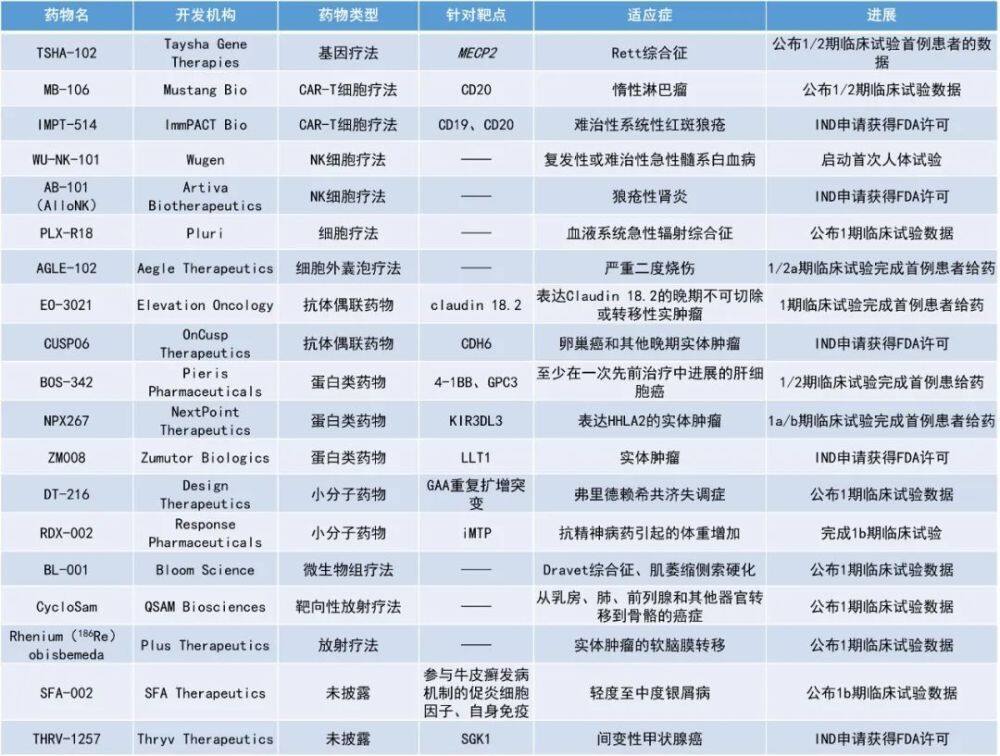
1. Autologous CAR-T cell therapy MB-106 targeting CD20 shows positive efficacy in relapsed/refractory indolent non-Hodgkin lymphoma (NHL) patients, with 3 out of 4 patients achieving complete remission.
2. Early clinical data of SFA-002, an oral candidate therapy for psoriasis, shows impressive results, with effects seen within 6 weeks and 85% of patients achieving over 50% improvement in the Psoriasis Area and Severity Index (PASI).
3. After 28 days of treatment with the radiopharmaceutical Rhenium (186Re) obisbemeda in patients with leptomeningeal metastases from solid tumors, the tumor cell count in the cerebrospinal fluid of one patient decreased by 91% compared to the pre-treatment level (with an average decrease of 53% across all patients), and the median overall survival (OS) of the patients was 10 months.
Organized by the WuXi AppTec content team
MB-106: Announcement of Phase 1/2 Clinical Trial Data
Mustang Bio Announces Data from Phase 1/2 Clinical Trial of MB-106, its Autologous CAR-T Cell Therapy Targeting CD20, in Relapsed or Refractory B-cell NHL and Chronic Lymphocytic Leukemia (CLL)All four patients with relapsed/refractory indolent NHL achieved remission. Two patients with follicular lymphoma obtained complete remission confirmed by PET-CT and bone marrow examination, one of whom had previously received CD19-targeted CAR-T therapy. One patient with Waldenström's macroglobulinemia (WM), who had undergone nine prior lines of therapy, achieved metabolic complete remission as shown by PET-CT. One patient with a variant form of hairy cell leukemia, who had been heavily reliant on blood transfusions, experienced sustained disease stability post-treatment, with reduced lesions in the bone marrow and no longer required transfusions, maintaining this state for over six months.
SFA-002: Announcement of Phase 1b Clinical Trial Data
SFA Therapeutics Announces Positive Results from Phase 1b Clinical Trial of Oral Candidate Therapy SFA-002This therapy provides immunomodulatory effects by downregulating the levels of pro-inflammatory cytokines involved in the pathogenesis of psoriasis (including TNF-α, IL-23, IL-12, IL-17, and INF-γ) and by downregulating autoimmunity.
The results announced this time show,Among 14 evaluable subjects (including 6 who participated in a 3-month extension study), 85% of patients achieved PASI improvement of over 50%, 71% achieved PASI improvement of over 75%, and 2 subjects reached 100% PASI improvement (i.e., complete clearance).In addition, the SFA-002 treatment began to take effect within 6 weeks, and patients with scalp psoriasis and palmoplantar psoriasis also achieved clinically meaningful therapeutic effects. In terms of safety, no related adverse events or toxic reactions were observed during the treatment period and follow-up, and no rebound effect was observed.
Rhenium (186Re) obisbemeda:Announce Phase 1 Clinical Trial Data
Plus Therapeutics Presents Positive Early Data for Radiopharmaceutical Rhenium (186Re) Obisbemeda in Treating Leptomeningeal Metastases from Solid TumorsAfter 28 days of treatment, the tumor cell count in the cerebrospinal fluid decreased by 91% compared to the pre-treatment level (with an average reduction of 53% across all patients). Currently, 5 out of 10 patients remain alive, with a median OS of 10 months.No dose-limiting toxicity was observed in terms of safety. The majority of adverse reactions were mild (Grade 1, 58.7%) or moderate (Grade 2, 24%), and most were unrelated to the treatment.
IMPT-514: IND Application Granted FDA Approval
IMPT-514 is a CD19/CD20-targeted CAR-T cell therapy developed by ImmPACT Bio, featuring a potent bispecific CAR and 4-1BB co-stimulatory domain, aimed at treating active refractory systemic lupus erythematosus.In preclinical studies, IMPT-514 was efficiently manufactured from patients with lupus nephritis and systemic lupus erythematosus, demonstrating potent autologous B-cell depletion capacity and a moderate cytokine profile.Recently, the IND application for this therapy has been approved by the U.S. FDA.
AB-101 (AlloNK): IND Application Granted FDA Approval
AB-101 is an investigational natural killer (NK) cell therapy developed by Artiva Biotherapeutics. It is derived from umbilical cord blood, non-genetically modified, cryopreserved, and allogeneic, enhancing antibody-dependent cell cytotoxicity. Recently, the IND application for this therapy has been approved by the U.S. FDA for use in combination with rituximab to treat systemic lupus erythematosus in patients with active lupus nephritis.The approval of this IND application marks the first time that an allogeneic, off-the-shelf NK or CAR-T cell therapy has been authorized to enter clinical trials in the field of autoimmune diseases.
PLX-R18: Phase 1 Clinical Trial Data Released
Pluri Announces Positive Phase 1 Clinical Trial Data for PLX-R18 in Acute Radiation Syndrome (ARS) Following Hematopoietic Cell Transplantation (HCT). Patients may continue to experience low/reduced blood cell levels after HCT.PLX-R18 cells can secrete a large amount of hematopoietic factors, promoting the regeneration, maturation, and differentiation of hematopoietic cells, and stimulating their migration to peripheral blood.In addition, PLX-R18 is an off-the-shelf product with no risk of graft-versus-host disease, thereby reducing the need for blood transfusions. Previously, PLX-R18 was granted orphan drug designation by the U.S. FDA for the treatment of patients with engraftment failure, incomplete hematopoietic recovery following HCT, and ARS.
The results of the Phase 1 clinical trial announced this time show,Patients whose hematopoietic function had not fully recovered after HCT showed increased blood cell counts and reduced transfusion needs for up to 12 months after receiving PLX-R18.In addition, PLX-R18 was well-tolerated and exhibited a high level of safety.
CUSP06: IND Application Granted FDA Approval
CUSP06 is an antibody-drug conjugate (ADC) for which OnCusp Therapeutics has obtained exclusive global (excluding China) development and commercialization rights from Multitude Therapeutics. CDH6 is overexpressed in various cancers, including ovarian cancer, renal cancer, uterine cancer, thyroid cancer, lung cancer, and cholangiocarcinoma.CUSP06 consists of a proprietary antibody with high CDH6 binding affinity, a protease-cleavable linker, and an exatecan payload (a clinically validated, potent topoisomerase-1 inhibitor).Its linker is specifically designed to complement the exatecan payload, resulting in a highly stable and homogeneous ADC. Exatecan is a weak substrate of the drug efflux pump BCRP/P-gp, which is responsible for chemotherapy resistance in many therapies.Preclinical data show that this linker/payload has a stronger "bystander effect" compared to similar ADCs.The upcoming Phase 1 dose-escalation trial will evaluate the safety and tolerability of CUSP06 and determine the maximum tolerated dose and/or recommended dose for expansion studies in patients with platinum-resistant/refractory ovarian cancer and other advanced solid tumors.
ZM008: IND Application Granted FDA Approval
ZM008 is a full-length human IgG1 monoclonal antibody developed by Zumutor Biologics that targets the LLT1 antigen on the surface of various tumor cells. The interaction between LLT1 and CD161 leads to an immunosuppressive state in the tumor microenvironment, allowing tumor cells to evade the human immune system.ZM008 can disrupt the interaction between LLT1 and CD161, reversing a "cold" or low-immune-response tumor microenvironment into a "hot" or high-immune-response tumor microenvironment, enabling activated immune cells to recognize and kill tumor cells.Previously, the anti-tumor effect of ZM008 has been confirmed in humanized mouse xenograft models and in vitro platforms, where the in vitro platform used biopsy tissues from lung cancer and bladder cancer patients and was tested in the presence of autologous human peripheral blood mononuclear cells (PBMC).
DT-216: Announcement of Phase 1 Clinical Trial Data
Design Therapeutics Announces Early Clinical Data for DT-216, a Small Molecule Candidate for the Treatment of Friedreich's Ataxia (FA). FA is a multisystem degenerative disease caused by mutations with GAA repeat expansions in the FXN gene, which encodes frataxin. This leads to reduced transcription of the FXN gene, significantly lowering frataxin protein levels, resulting in mitochondrial and cellular dysfunction, and progressively causing neurological damage and movement difficulties in patients.DT-216 is designed to specifically target GAA repeat expansion mutations, clear the transcription mechanism, and restore the production of functional native FXN mRNA.
The results announced this time show,In the 300 mg cohort, FA patients showed an average 30% increase in FXN mRNA levels compared to baseline two days after dosing in the third week, which was significant compared to placebo (p
There was a trend toward increased FXN mRNA levels 7 days after dosing. A significant dose-response relationship was observed between DT-216 and muscle FXN mRNA expression (p
CycloSam: Phase 1 Clinical Trial Data Released
QSAM Biosciences Announces Safety and Efficacy Data from Early Clinical Trials of CycloSam (Samarium-153-DOTMP), a Targeted Radiotherapy for Breast Cancer, Lung Cancer, Prostate Cancer, and Other Cancers Metastasized to BoneCycloSam combines low specific activity samarium-153 with a chelating agent DOTMP that targets areas of high bone turnover, aimed at treating primary and secondary bone cancer.
The results announced this time show that in the first three patients (representing the first group of subjects) who received the lowest radiation dose (0.5 mCi/kg), CycloSam demonstrated good safety. Throughout the treatment period, no serious adverse events occurred in any of the three patients, and their red blood cell, white blood cell, and platelet counts all remained within normal ranges, with only minor decreases that recovered quickly.In 3 patients, the SUV scores (a biomarker measuring the metabolic rate of tumor cells) of 4 bone tumors in one patient significantly decreased by 56%-64%, indicating that the metabolic activity of cancer cells was reduced by about half. RECIST scores showed that at the 4-month follow-up, the tumor sizes of 2 patients did not worsen, and in one patient, one lesion shrank by 53% while another lesion completely regressed.In terms of pain relief, two patients experienced significant pain reduction within a week after treatment, and their mobility also improved. This condition has lasted for about six months. Another patient had moderate pain relief. The company plans to complete the treatment of the third group of patients by the end of this year and finish the Phase 1 clinical trial in the first quarter of 2024.