

Billions in Capital Flow Into Kidney Care as Global Players Target a Trillion-Dollar CKD Market
Fresenius Medical Care
Dialysis treatment services and dialysis product suppliers

Medtronic
Chronic Disease Medical Device and Therapy Developer
The development trend of the global kidney health market, worth billions, is undergoing a transformation.
The market size in the field of kidney health is enormous. In the past, the main battleground for mining gold was end-stage renal disease (ESRD), with dialysis treatment giving rise to the three major dialysis giants: Fresenius Medical Care, Davita, and Baxter.
Now, both dialysis giants and globally leading venture capital institutions are focusing on earlier stages of chronic kidney disease (CKD).
Multiple Companies Focusing on Chronic Kidney Disease Secure Significant Financing. Renal tech company Monogram Health raises $375 million, renal disease care company Somatus secures $325 million in Series E financing, with a valuation exceeding $2.5 billion.
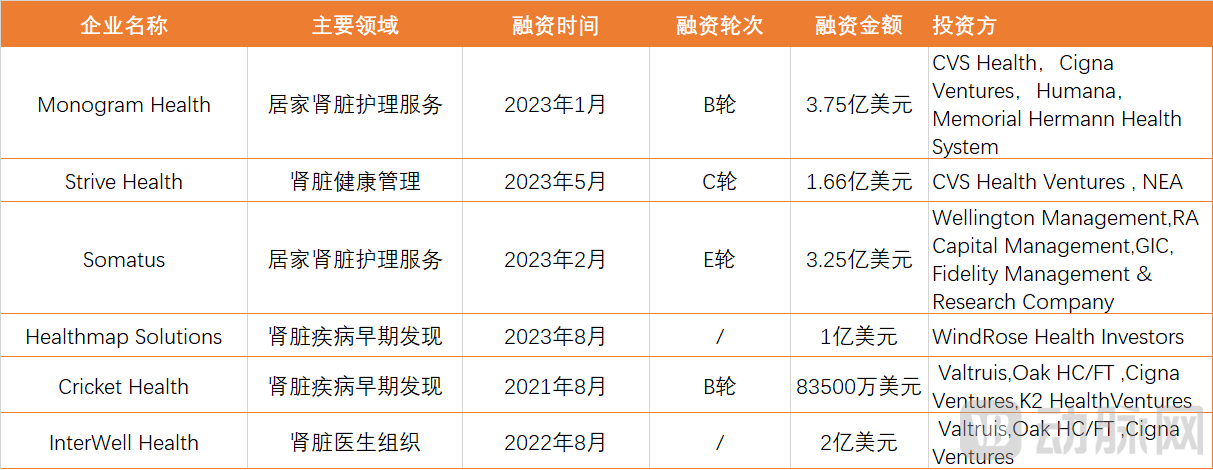
Overseas Kidney Care Sector Related Financing
The list of institutions that continue to bet on this field includes CVS, a US pharmaceutical insurance giant, as well as several well-known institutions such as Google Capital (G Capital) and TPG Capital.
Even giants in the dialysis field such as Fresenius and Davita have to face this heated trend and start transforming by collaborating with other companies to establish new ventures.
Why Has the Overseas Chronic Kidney Disease Management Become So Popular? The number of patients with chronic kidney disease in China is similar to that of diabetes patients, but currently, most kidney disease treatments in China are concentrated in the later-stage hemodialysis field. Can the business models that are popular in overseas markets be implemented in China's CKD untapped market?
Why Are Global Capitals Betting on Kidney Disease Health Management?
One major reason is that insurance cost control provides fertile ground for the growth of chronic disease management in kidney diseases.Global health insurance faces the challenge of cost control. A significant amount of health insurance funds are spent on kidney diseases each year. In the U.S., the annual treatment cost for kidney diseases exceeds 130 billion USD, with the majority spent on dialysis treatments. Payers and health systems in the U.S. are seeking partners capable of reducing overall expenses.
How can kidney health management help control medical insurance costs?The principle is to delay the time for CKD patients to enter the dialysis stage by managing them. The majority of all CKD patients have normal or mildly decreased renal function. If these patients are effectively managed over the long term to delay the time before entering the dialysis stage, it will greatly save healthcare resources.
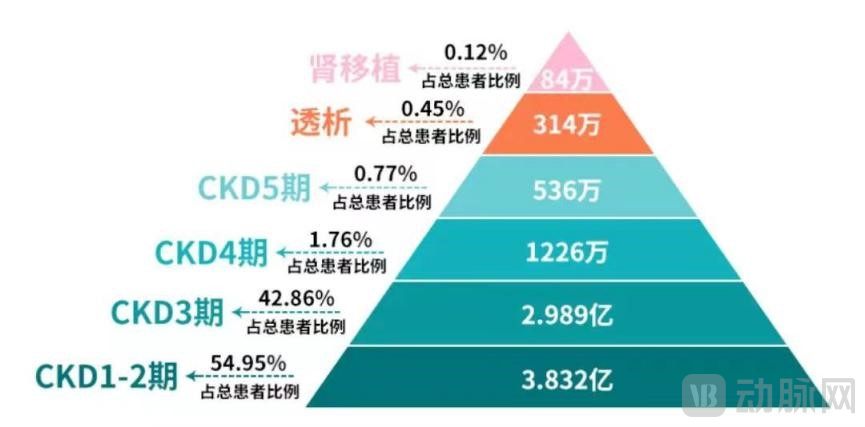
Essentially, patients with kidney disease also have a strong demand for health management.When chronic kidney disease occurs, the kidneys are damaged and cannot effectively filter the blood. Chronic kidney disease is defined as an abnormality in kidney structure or function that persists for more than three months and negatively impacts health. Chronic kidney disease is divided into five stages based on the degree of kidney damage and functional impairment, with varying levels of severity. In the first stage, there is mild kidney disease, while in the fifth stage, the kidneys have ceased to function. It is primarily categorized into two types: CKD (Chronic Kidney Disease) and ESRD (End-Stage Renal Disease).
An industry insider stated: "Whether it is CKD or ESRD, there is a need for enhanced care. Kidney disease, similar to diabetes, is heavily influenced by diet and exercise. Patients require ongoing professional guidance even when at home. Patients with kidney disease also need early warning systems; if they wait until symptoms appear before seeking medical attention, irreversible damage to the kidneys often occurs."
For example, patients with kidney disease who also have hypertension or diabetes need to strictly control their blood pressure and blood sugar. Patients with kidney disease need to control their intake of sodium, potassium, and calcium to prevent metabolic disorders.
The number of patients with chronic kidney disease is huge, among which about 1% will enter the end stage each year. In the dialysis market, giants have emerged in both services and dialysis products. However, at the stage of chronic kidney disease, it remains an untapped market, and the management of early-stage CKD patients is even more of a blank.
Urgent insurance payments + strong patient demand +空白市场 provide diverse survival and development opportunities for kidney disease health technology companies.
Companies overseas that have secured financing are adopting different approaches to enter the field of kidney disease health management.
In this promising early-stage market, companies like Monogram Health, Somatus, and Healthmap have secured hundreds of millions of dollars in funding, helping to manage tens of thousands of patients.
The business model of these kidney health management companies is not difficult to understand. Similar to Livongo, a diabetes chronic disease management company, they serve C-end users well and help B-end clients save money.
In 2020, Livongo was acquired by Teladoc for a staggering $18.5 billion. Could the future of the renal disease field give rise to another Livongo? VCBeat analyzed the characteristics of key enterprises in renal health management.
Somatus provides integrated care for patients with or at risk of kidney disease, primarily focusing on home-based care to slow disease progression, improve quality of life, and reduce overall care costs.Dialysis treatment methods are divided into peritoneal dialysis and hemodialysis. Peritoneal dialysis can be performed at home. Somatus provides home care services, with medical staff directly visiting patients' homes to guide dialysis treatment. Meanwhile, Somatus also owns a data-driven technology platform to help coordinate and monitor care.
In the past, patients might receive a detailed care plan from their doctors, but once they return home, it is difficult to fully adhere to the plan. The home-based care services provided by Somatus can address this issue.
In February 2022, Somatus raised $325 million in its latest round of financing, led by Wellington Management, with participation from RA Capital Management, GIC, Fidelity Management & Research Company, and other leading investment institutions.
Another company, Strive Health, has secured investments from Google's venture capital arm and CVS with its kidney disease prediction technology.Strive Health Provides Chronic Disease Management Services Through a Digital Platform, Establishing a Chronic Disease Service System for Kidney Diseases to Help Doctors Manage Patients. Strive Health integrates patient data from various systems with chronic kidney disease and end-stage renal disease into one platform. The technology is designed to identify disease progression and predict the patient's condition.
Strive Health raised $140 million in its Series B financing round from CapitalG, an investment fund under Google. In the Series C round, it secured $160 million led by CVS, a major American pharmacy and insurance giant.
CVS also invested in another kidney health technology platform, Monogram Health.
Monogram Health's business is more like a combination of the first two companies. Monogram Health provides its members with a range of kidney care services, including predictive algorithms to identify high-risk members. It also offers home and virtual care provided by the Monogram clinical team, medication management technology, personalized care pathways, clinical decision support software, remote patient monitoring capabilities, and tools.
In January 2023, Monogram Health secured $375 million in funding from companies including CVS Health, Cigna Ventures, and Human.
Currently, there are multiple companies in the United States focusing on kidney disease health management, with fierce competition. It is believed that the market will see consolidation in the future.
Companies competing with startups in kidney disease health management also include giants such as Fresenius Medical Care, Davita, and Medtronic.
Fresenius Medical Care is known as the global leader in hemodialysis, as it dominates both the global dialysis products and services markets. In the dialysis products sector, Fresenius Medical Care leads the global blood dialysis products market, while Baxter dominates the peritoneal dialysis products market. In the services sector, Fresenius Medical Care and DaVita are the two giants in dialysis clinics, collectively owning over 70% of dialysis centers in the U.S., balancing each other's influence. Dialysis services account for the majority of Fresenius Medical Care’s revenue, with dialysis services contributing 79.48% of total revenue in 2022.
Among them, Fresenius Medical Care has "acquired" two startups: InterWell Health, a kidney doctor organization-based entity, and Cricket Health, a technology-driven patient care platform. The three companies jointly established a value-based kidney care company. The new company will operate under the InterWell Health brand with a valuation of $2.4 billion (approximately RMB 15.2647 billion).
Cricket Health, founded in 2015, has cumulatively raised $110 million in financing prior to this. Cricket Health has developed a predictive analytics model that stratifies patient risk and identifies patients with stage 3b or higher chronic kidney disease with 96% accuracy. The identified patients are then assigned a care team consisting of a nurse, a pharmacist, a social worker, a dietitian, and a trained peer mentor. InterWell Health is a platform organization for kidney specialists.
The purpose of the collaboration among the three companies is to interact with patients through an internet platform, providing them with continuous professional care, thereby improving clinical outcomes for patients with kidney diseases and reducing healthcare costs.
Fresenius Medical Care announced a potential total market size of $170 billion for the new company, primarily expanding into the CKD (Chronic Kidney Disease) stages 3 to 5 market, driving growth in the population requiring mid-to-late stage chronic kidney disease care, and accelerating the transformation of renal care.
Fresenius Medical Care's Transformation Focuses on CKD Care Market
According to the financial report data of Fresenius Medical Care, in the first half of 2023, Fresenius Medical Care's revenue was 9.529 billion euros, a year-on-year increase of 2%; net profit was 227 million euros, a year-on-year decrease of 26%.
Fresenius Medical Care's competitors are also struggling. In 2022, Baxter Renal Care's revenue was $3.75 billion, with acute therapies including CRRT (Continuous Renal Replacement Therapy) and ICU life support, declining by 4% and 10% respectively compared to 2021. DaVita's annual revenue in 2022 was $11.61 billion, a decrease of 0.08% from 2021.
The growth of the dialysis businesses of the three giants has slowed down, largely due to the impact of the COVID-19 pandemic.According to Fresenius Medical Care's financial report, the excess mortality rate brought by the COVID-19 pandemic has put pressure on the dialysis business.
The number of end-stage patients is decreasing, and more patients are choosing to undergo dialysis at home, which has brought a significant impact on dialysis service providers like Fresenius Medical Care and Davita.
After the dialysis market gradually encounters a ceiling, dialysis giants have begun to expand into the home market and the early-stage chronic kidney disease market.
Davita Collaborates with Medtronic to Establish Mozarc Medical, a Kidney Technology Company
New Company Focuses on Developing Home Treatment Products for Kidney Diseases, Aiming to Make Dialysis More Accessible and Eliminate the Need for Patients to Visit Clinics Three Times a Week.
Mozarc Medical is developing new home dialysis treatment products. Medtronic provides technology, and Davita offers clinical insights and knowledge.
As the proportion of home dialysis in global dialysis treatment increases, Medtronic and Davita are expected to bring new home dialysis technologies.
In fact, the population of kidney disease patients in China is also large. According to the global CKD survey published in THE LANCET in 2020, China has 130 million CKD patients, and the country's medical insurance policy is also facing the challenge of medical cost control. The awareness rate of CKD among Chinese adults is only 10%, with 85% of patients being in the early stages of CKD (Stage I & II), where intervention is still possible.
The potential population for hemodialysis is large, with long cycles and frequent sessions, and the proportion and amount of medical insurance reimbursement are relatively high. The current fixed standard for hemodialysis patients is 400-500 yuan per session, with a reimbursement rate of 85% to 90%.
According to the data from Academician Chen Meixiang's speech "Measures for Promoting High-Quality Development of Kidney Disease Diagnosis and Treatment in a New Era": In 2022, the number of peritoneal dialysis patients in China reached 140,500, and the number of hemodialysis patients was 844,000. The age at which patients first undergo dialysis has increased by six years, potentially reducing national medical insurance expenditure by 90 billion yuan.
The solution to the high cost of dialysis in China is centralized bulk procurement. Provincial joint procurement has been carried out for consumables such as hemodialysis (filtration) machines, extracorporeal circulation tubing for blood purification devices, arteriovenous fistula puncture needles, and hemodialysis concentrates.
Although the challenge of medical insurance cost control has been addressed, the healthcare needs of CKD patients remain. In fact, some medical institutions in China recognized the importance of kidney disease health management at an early stage.
West China Hospital of Sichuan University established a Chronic Kidney Disease (CKD) Management Center as early as 2011. The center aims to systematically and comprehensively manage CKD patients through multidisciplinary collaboration and integration, and to slow down disease progression to the greatest extent while improving patients' quality of life. To this end, it was the first in China to launch a patient-centered follow-up program for CKD patients.
Can overseas kidney disease health management models be implemented in China?
In terms of financing, the domestic market is far less active than overseas. Currently, two companies, Senmei Medical and Kaideni Medical Technology, have received funding.
Zhang Jing, founder of Senmei Healthcare, stated: "In China, the system is based on public hospitals and medical insurance payments. Due to institutional management requirements, it is not possible to delegate nursing services to third parties. In the United States, commercial insurance payments drive organizations like Somatus to directly send healthcare professionals to patients' homes. There are significant systemic differences, making the business model impossible to replicate."
The digital health management approach of Monogram Health and Strive Health is to help doctors improve efficiency and manage more patients, their approach is similar to that of Senmei. However, faced with a large group of CKD patients, the number of nephrology specialists in China is extremely limited, which poses an obstacle to widely conducting CKD patient education."
"Whether it is the deployment of third-party care personnel or improving the efficiency of chronic disease management in hospitals, both rely heavily on the scale of professional staff. Under the current system and technology, it is very difficult to address the healthcare needs of CKD patients on a large scale. Enterprises also struggle to establish a viable business model. Therefore, we have transformed professional-driven chronic disease management services into technical solutions, incubating them into prescribable digital therapies that rely less on professionals, approved as medical devices. However, this path also has challenges. As a globally innovative product in this field, China’s regulatory approval process is cautious, and all parties need to further explore."
China and the U.S. markets have the same demand, a large group of patients with chronic kidney disease, and high healthcare expenditure, but they also have different healthcare systems and payment systems. Domestic companies need to explore new paths.