

NEJM Study: Roche's ADC Polivy Reduces Death Risk by 72% in Specific DLBCL Patients

Roche
Oncology Drug Research, Development, and Manufacturing
▎Edited by the WuXi AppTec content team
Polivy, an antibody-drug conjugate (ADC) developed by Roche, received approval this year.FDA Approval, in combination with rituximab, cyclophosphamide, doxorubicin, and prednisone, for the first-line treatment of patients with diffuse large B-cell lymphoma (DLBCL). The press release noted that the Polivy combination is the first new therapy approved by the FDA for first-line treatment of DLBCL in nearly 20 years. Recently, researchers from Stanford University and the University of North Carolina published an article in The New England Journal of Medicine, indicating that Polivy is particularly effective for specific DLBCL patients. This finding suggests that a precision medicine approach should be adopted when using the Polivy combination to treat DLBCL.
DLBCL is an aggressive and difficult-to-treat disease, and it is the most common type of non-Hodgkin lymphoma.Polivy is a "first-in-class" anti-CD79b antibody-drug conjugate.CD79b protein is specifically expressed in most B cells. Polivy binds to CD79b on the surface of cancer cells and delivers anticancer drugs into the cells, destroying these B cells while minimizing the impact on normal cells.
The authors of the NEJM article analyzed results from multiple clinical trials, showing that Polivy, as a single agent or as part of a combination therapy, demonstrated varying efficacy in treating patients with DLBCL across different subtypes.When lymphoma originates from activated B-cells (ABC), Polivy shows significant efficacy, whereas when lymphoma originates from germinal center B-cells (GCB), the efficacy of Polivy is not obvious.
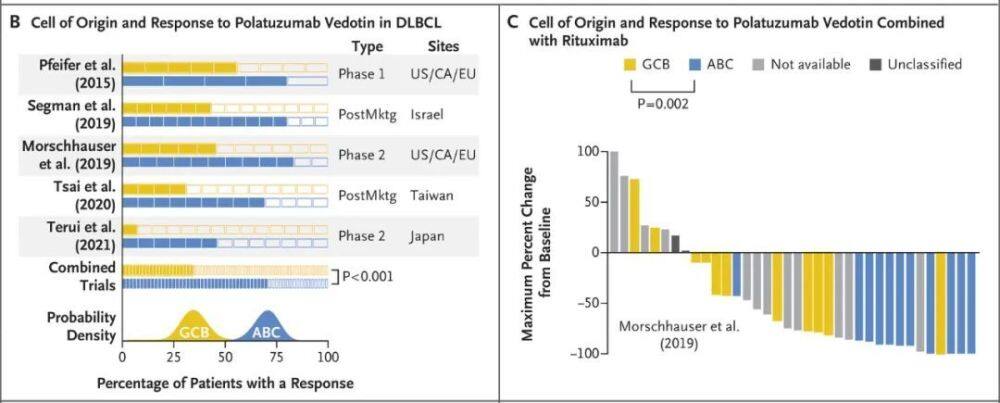
▲ In multiple clinical trials, Polivy demonstrated greater efficacy in ABC-subtype DLBCL compared to GCB-subtype DLBCL (Image source: Reference [1]).
In the POLARIX clinical trial, which supported the approval of Polivy combination as a first-line therapy, researchers observed the same phenomenon.Patients with the ABC subtype who received Polivy combination therapy had a 66% reduction in the risk of disease progression and death (HR=0.34, 95% CI, 0.13-0.85) and a 72% reduction in the risk of death (HR=0.27, 95% CI, 0.06-1.26) compared to those receiving active control therapy.For patients with the GCB subtype, the Polivy combination did not demonstrate significant efficacy compared to the active control.
Researchers pointed out that the efficacy differences of Polivy among different subtypes of DLBCL patients were very consistent and significant. The impact of different subtypes on efficacy exceeded the influence of RAS mutations as predictive biomarkers in predicting the efficacy of targeted EGFR antibodies in patients with advanced colon cancer.This means that when using Polivy to treat previously untreated DLBCL patients, a strategy of precision treatment based on the patient's tumor subtype should be adopted.