

Mateside Secures Nearly RMB 1 Billion in Series A Funding to Expand Global Footprint in Home Rehabilitation Medical Devices

Sunnyou
Intelligent Rehabilitation Equipment R&D and Manufacturer
36Kr has learned that the home rehabilitation medical device brandMaideste(Madesite) has completed its first round of financing worth nearly 100 million RMB, with investments from Hangzhou Yuanning Huizhi Investment Management Partnership (General Partnership), Shanghai SAIC Hengxu Investment Management Co., Ltd., and Sunnyou. This round of financing will be used for product development, supply chain construction, and channel expansion, strengthening its advantages and competitiveness in the home-use rehabilitation medical device field.
Medest was founded in 2013, with its headquarters in Hangzhou. It is a company that integrates research, production, and sales, adopting the "1+4+N" business development model. This means focusing on "home-use rehabilitation medical devices" as the core direction, covering four major fields: "rehabilitation care, mobility aids, rehabilitation training, and physical therapy," while exploring technological innovation and applications in "digital intelligent health care." The company now has a team of nearly 500 people. In 2019, Medest invested in building a smart manufacturing plant, which covers an area of 83 mu and has an annual production capacity of 120,000 sets of care beds, wheelchairs, and intelligent anti-decubitus mattresses.
As China's population aging brings irreversible challenges, the development and application of intelligent and age-friendly technologies have been proven to be an inevitable trend in the home-based health care market. The innovation and upgrading in the field of home rehabilitation medical devices, with clearer scenarios and more specific demands, will also quickly come into the public eye. Meddest is a brand enterprise specializing in home rehabilitation medical devices, founded in 2013. When discussing the background of its establishment, the company’s CEOLiu Zhikuo stated that the company was born out of the support from the rehabilitation industry circle in Hengshui, Hebei, the family's previous background in production and manufacturing, his personal accumulation in areas such as internet e-commerce, and insights into the rapid growth of industry demand.The reason for the name "Medest" is, according toLiu Zhikuo said"Based on the company's long-term development, we planned to go global early on and focus more on international appeal."
Notably, the company only secured its first round of financing in its tenth year of development. Liu Zhikuo explained that the company had consistently generated substantial revenue and maintained self-sustaining capabilities. However, as the company is now focusing on expanding into European and American markets, its need for capital has increased significantly compared to before. "We aim to establish our own DTC brand overseas, which means the entire cycle from raw material procurement, self-production, shipping, warehousing logistics, to cash recovery will take four months, whereas domestically it usually takes just one month. More funds are required to support our overseas operations. Additionally, considering an IPO in the coming years, we also need backing from the capital markets."Considering the current downturn in China's economy, companies with capital support will have more leeway.
As of now, the company has nearly 300 SKUs, among which there are several blockbuster products, such as electric care beds, anti-decubitus mattresses, and electric wheelchairs. It is reported that the e-commerce sales of the first two products have long ranked in the top three in the market; additionally, overseas, products like electric wheelchairs and hand-pushed mobility scooters for the elderly are also popular.The company has established multiple product production lines, including care beds, wheelchairs, air mattresses, and nebulizers, all of which are independently developed and produced.
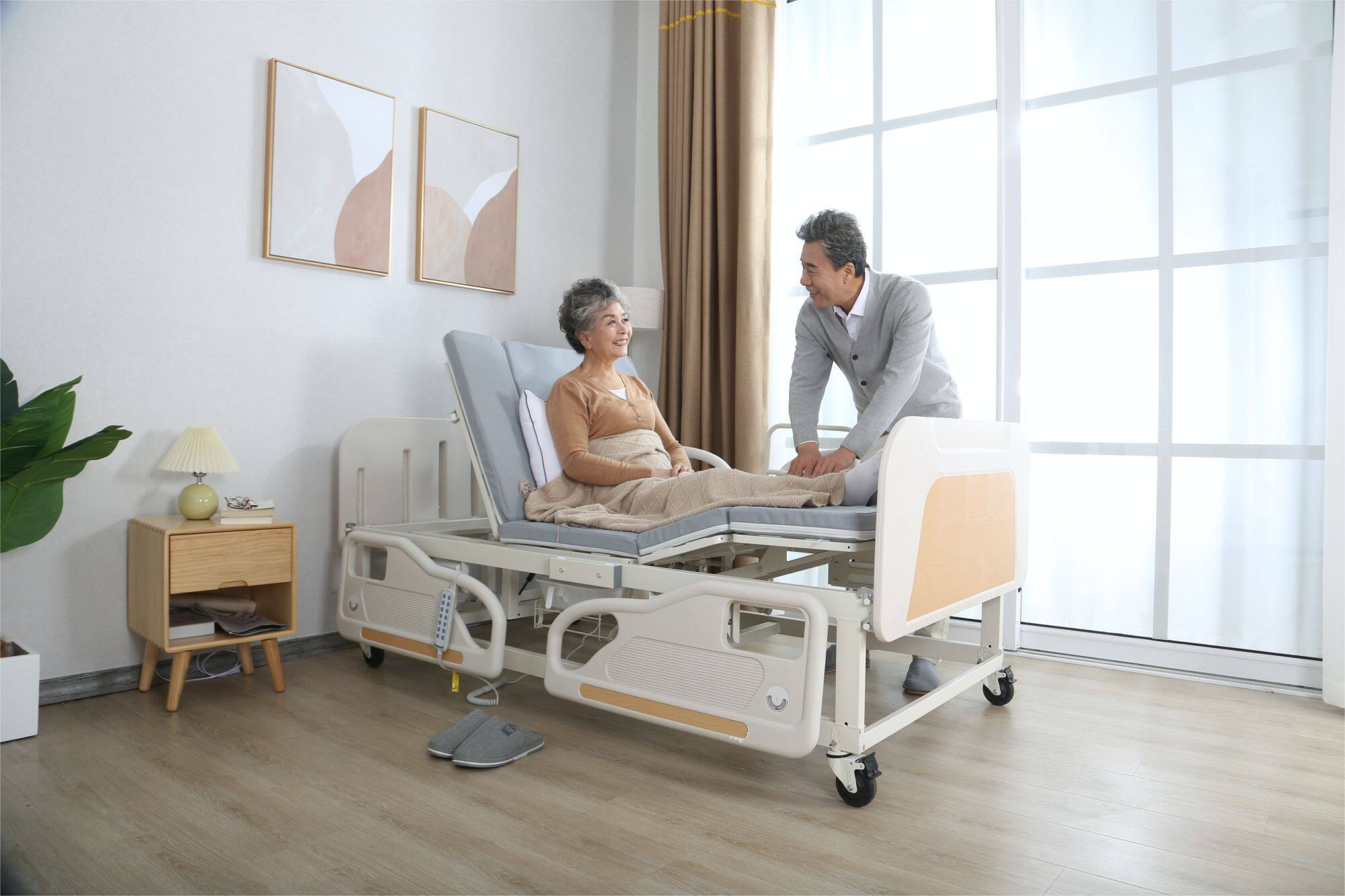
Medest Nursing Bed Products
Liu Zhikuo stated that Maideste is currently still aA purely market-driven company, with e-commerce (accounting for 55%) and private nursing homes (covering nearly 800 facilities) as the main channels. The company's annual revenue maintains a growth rate of 30% or more, and it is expected to reach 400 million RMB in revenue this year.
36Kr has also noticed that, with the increasing attention and quality improvement in elderly care from the state and consumers, more and more brands are entering the category of home medical devices. Among them, home rehabilitation medical devices have become a key focus. Typical examples include ST-DOMUS, known for its care bed brand; Yuwell and Hubang, known for their manual wheelchair brands; Medestech and Cofoe, known for their electric care bed brands; and Medestech and Yingluohua, known for their electric wheelchair brands.
Liu Zhikuo stated that, in contrast, the core competitiveness of Medest lies in being one of the few domestic rehabilitation medical device brands in China that can achieve a closed loop in product positioning, R&D, production, sales, and brand management—basically only Yuyue Medical and Medest. "Therefore, the valuation logic of the company is also similar to that of Yuyue," he believes.There is still a large growth space for home rehabilitation medical devices in China.The current elderly population in China is completely mismatched with the current scale of rehabilitation healthcare —— if the industry penetration rate were to be benchmarked against the United States, it would be equivalent to not even entering the field; but"With the increase in awareness among the elderly about the use of rehabilitation aids, this market still has massive growth potential, and it’s no exaggeration to say it could reach trillions."
Moreover, he emphasized that although rehabilitation assistive devices are not a technology-driven high-end manufacturing industry, the sector does have significant barriers: First, it is an industry driven by application innovation, which demands high product capability; second, it requires a strongly empowering brand as well as long-term accumulation.