AstraZeneca Submits IND Applications in China for Two Novel Oncology Agents: FRα-Targeted ADC AZD5335 and Selective PARP1 Inhibitor AZD5305

AstraZeneca
Biopharmaceutical Manufacturer
Recently, according to the CDE official website, the clinical applications of two Class 1 new drugs from AstraZeneca have been accepted. They are the FRαADC new drug AZD5335 and the PARP1 inhibitor AZD5305.
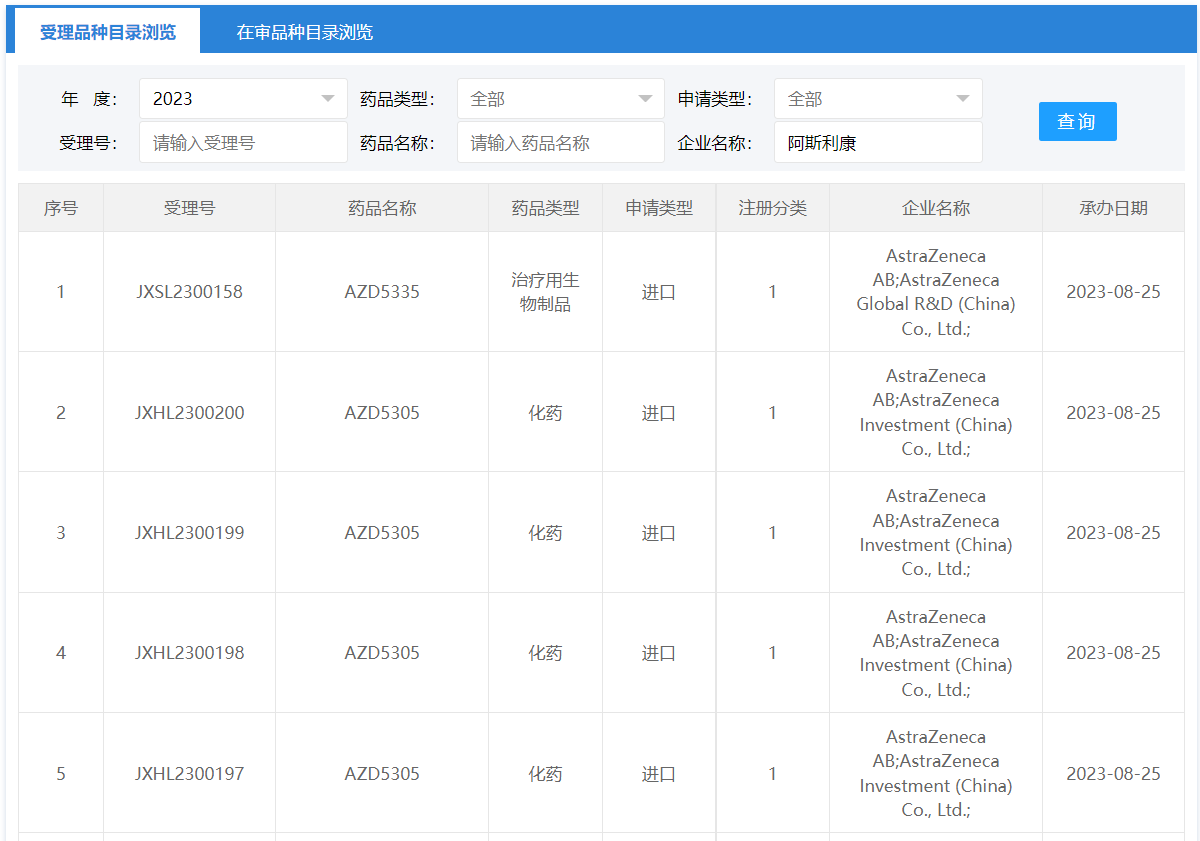
Source of the image: CDE official website
AZD5335
AstraZeneca has deeply entered the ADC field.
At the end of July, according to AstraZeneca's 2023 semi-annual report, its key HER2 ADC drugEnhertu (DS-8201) Sales Reach $1.169 Billion, increasing threefold year-on-year. At this year's ASCO meeting, AstraZeneca and Daiichi Sankyo announced two sets of clinical results. The phase II DESTINY-PanTumor02 trial aims to evaluate the efficacy and safety of Enhertu in patients with locally advanced, unresectable, or metastatic previously treated HER2-expressing solid tumors not eligible for curative treatment. The results showed that DS-8201 has shown some efficacy in biliary tract cancer, bladder cancer, cervical cancer, endometrial cancer, ovarian cancer, pancreatic cancer, and rare cancers.
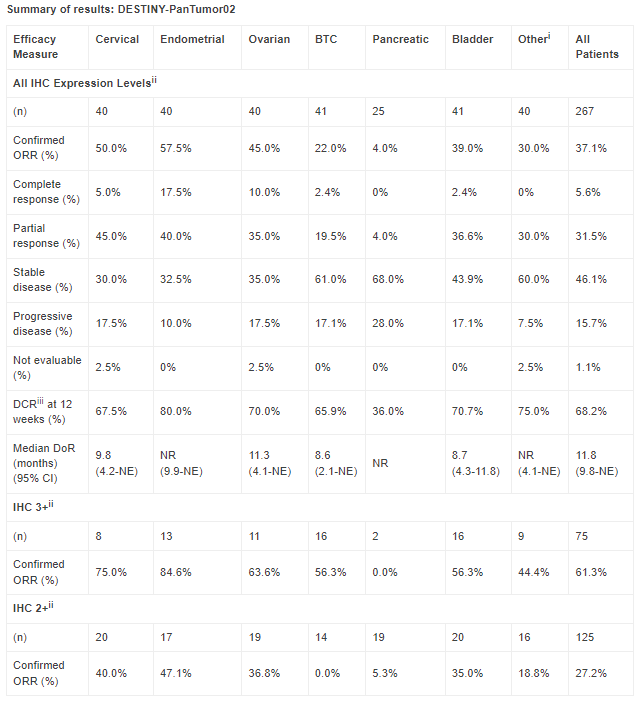

Image Source: AstraZeneca Official Website
As the indications expand, it may only be a matter of time before Enhertu becomes a $10 billion product.
At the same time, AstraZeneca is actively advancing other ADC products in its pipeline. AZD5335 is AstraZeneca's third self-developed ADC. It is reported that this drug is composed of an FRα antibody conjugated with a TOP1i payload (AZ14170132), with a DAR value of 8.
At this year's AACR conference, AstraZeneca disclosed the research data of AZD5335 for the first time in the form of a Late Breaking Poster (LBP): AZD5335 (2.5mg/kg, IV, SD) demonstrated 75%-94% tumor growth inhibition (TGI) in ovarian cancer cell line xenografts (CDX); in 14 out of 17 (82%) patient-derived xenograft models (PDX) of ovarian cancer evaluated, the median best tumor shrinkage was >30%. At the same or higher doses, AZD5335 showed superior preclinical activity compared to FRα-targeted ADCs with microtubule inhibitor (MTI) payloads in two PDX models with low to moderate FRα expression.
AZD5305
AZD5305 is AstraZeneca's second PARP1 selective inhibitor, which was first filed for clinical trials in China in 2021. In 2022, AZD5305 launched clinical trials in China, conducting an international multicenter Phase I/IIa clinical trial in patients with advanced malignant tumors to evaluate the safety and efficacy of AZD5305 in dose-escalation monotherapy and in combination with anticancer drugs.
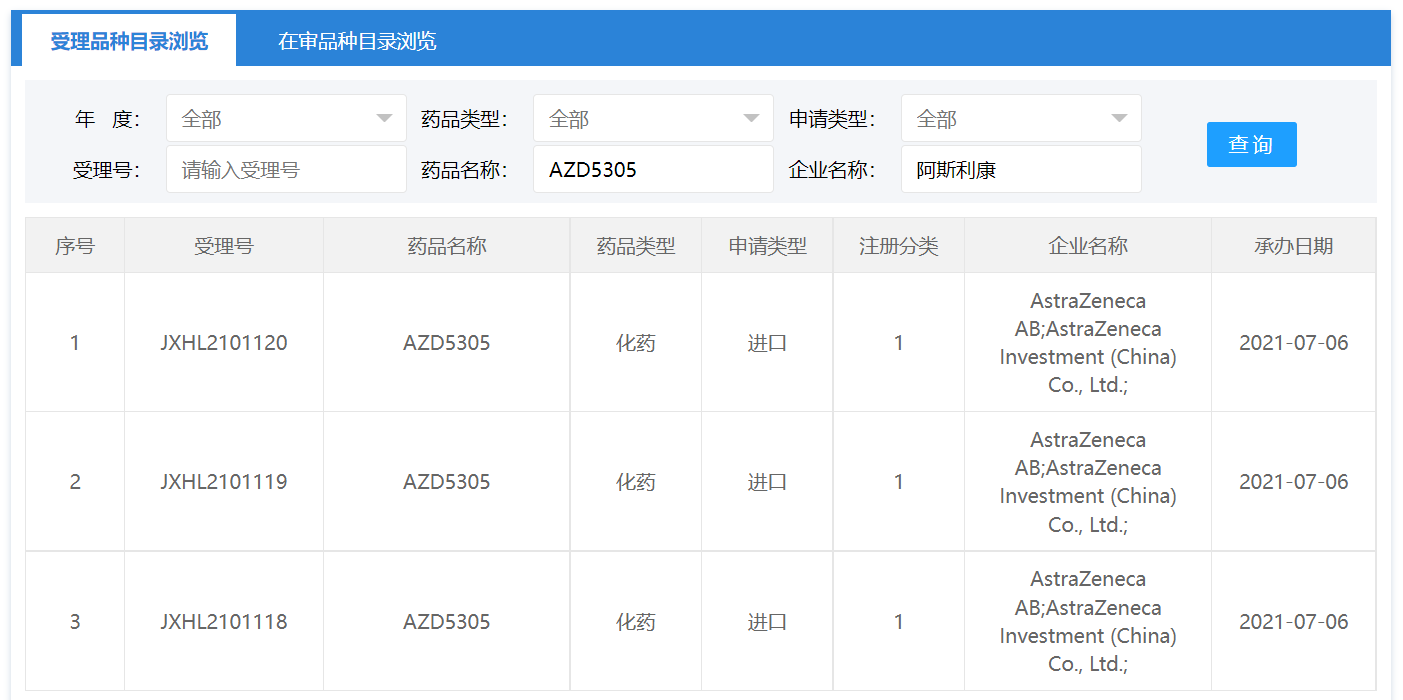
Source of the image: CDE official website
AstraZeneca already possesses several PARP inhibitors. The world's first PARP inhibitor, Olaparib, was developed by AstraZeneca. Since its approval and market launch in 2014, its sales have surged, reaching $2.638 billion globally in 2022. However, Olaparib has certain side effects, and its compound patent will expire in March 2024.
AZD5305, as AstraZeneca's second PARP1 selective inhibitor, is expected to overcome the side effects of olaparib and become its "successor." Relevant studies have shown that, compared with first-generation PARP inhibitors, AZD5305 demonstrates better tolerability in patients with ovarian cancer, HER2-negative breast cancer, pancreatic cancer, and prostate cancer who have BRCA1/2, PALB2, and RAD51C mutations.
At the same time, AstraZeneca is actively expanding the indications for olaparib and has introduced the new brain-penetrant PARP1 inhibitor AZD9574.
Summary
In the first half of 2023, AstraZeneca's revenue in China reached $3.043 billion, a year-on-year increase of 9%. In its financial report, AstraZeneca also predicted that three new drugs would achieve new progress in China. Under the condition of accelerated innovation, AstraZeneca is expected to achieve more breakthroughs in the second half of the year.

Editor: Mu Mian
Disclaimer: This article is an integrated content and does not represent the views of this platform. If it involves issues related to the content, copyright, and other problems, please leave a message on this platform, and we will handle it at the first time.