

Staircase Medical Files IPO Prospectus: Pioneering Full-Stack Invasive Brain-Computer Interface Solutions

StairMed
Developer of Implantable Brain-Computer Interface Technology
Brain-computer interfaces have become a hot topic at the forefront of global technology due to their unlimited imaginative potential.
In May 2023, Zhao Zhiguo, Chief Engineer of the Ministry of Industry and Information Technology, stated in a public forum that "brain-computer interfaces will be regarded as an important direction for fostering future industrial development." He also noted that China has already formed a complete brain-computer interface industry chain covering the foundational, technical, and application layers, with healthcare, education, industry, and entertainment sectors expected to be the first to see practical applications.
The once "slow-moving" track has entered a period of technological explosion, with various new paradigms, algorithms, and devices emerging one after another, drawing frequent capital investment. Whether it's the surge of multiple listed companies in the secondary market that are involved in brain science, or the active investment and financing transactions in the primary market, all point to one focus: Brain-computer interface technology is about to enter the transformation stage and achieve industrialization.
Among the emerging brain-computer interface companies, there is an innovative company that gained several hundred million RMB in financing from angel round to Series A in a very short time after its debut. This company is Shanghai StairMed Technology Co., Ltd. (hereinafter referred to as StairMed).
As a pioneer in the new generation of invasive brain-computer interfaces, why is StairMed favored by the capital market? How does the company address the safety concerns of invasive brain-computer interfaces? And how does it promote the practical application of brain-computer interface technology?
VCBeat brought questions to Dr. Li Xue, co-founder of StairMed, for a conversation.
"All of StairMed's work is built on an original theoretical model, the inverted pyramid model," Dr. Li Xue introduced to VCBeat. "The inverted pyramid model is divided into four layers, with the neural interface at the very bottom."

Inverted Pyramid Model
Photo provided by the interviewee
Neural interfaces are the most critical devices for recording or controlling the electrophysiological activities of brain neurons, also known as brain electrodes, which are mainly divided into three types: invasive, non-invasive, and interventional.
Among them, invasive electrodes have obvious advantages because they can directly collect the most original and clearest EEG signals. Stability and high throughput are two basic requirements for efficient neural interfaces and also the main bottlenecks of current technology.
First, stability represents a long service life and reliable performance. In this regard, StairMed uses polymer as the substrate material and, through advanced micro-nano processing technology, reduces the electrode size to the cellular level, achieving the most flexible and smallest cross-sectional area implantable brain electrode currently available.
Shanghai StairMed Technology Co., Ltd.'s self-developed HNE (Hyperflexible Neural Electrodes) ultra-flexible micro-nano electrodesWhen it comes to safety issues, it is inevitably compared with Neuralink, founded by Musk, which has been in discussions with the U.S. FDA regarding preliminary human trials for over two years.StairMed, until this year it was successfully approved. During this period, 6 of Neuralink's 8 founders have left.
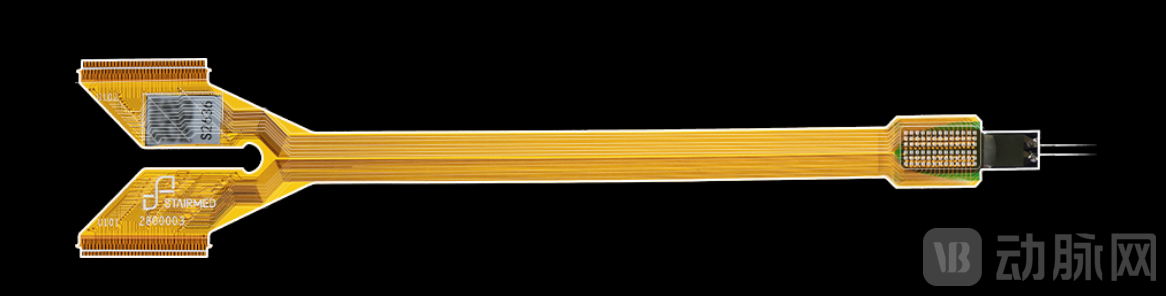
HNE Ultra-Flexible Micro-Nano Electrode
Photo provided by the interviewee
According to Dr. Li Xue, the cross-sectional area of the HNE ultra-flexible micro-nano electrode is approximately 1/7 to 1/10 that of Neuralink's, and it is also smaller than the soma of a single neuron.
Due to the extremely small size of StairMed's HNE ultra-flexible micro-nano electrodes, the flexibility (bending stress) of HNE is two to three orders of magnitude lower than that of Neuralink's electrodes.The force required to bend the HNE ultra-flexible micro-nano electrode is approximately equal to the magnitude of the interaction force between cells.
Therefore, cells can hardly "sense" the presence of peripheral nerve electrodes, and almost no immune scarring occurs. Moreover, the bidirectional sensitivity of the electrode has been enhanced to the single-neuron level, achieving refined stimulation control with neuronal resolution.
Secondly, high throughput means that the neural interface can extract more neuronal signals from a wider range of brain regions in a shorter period of time. It also implies the ability to decode high-dimensional and complex neural information with greater precision, as well as write information into the brain through electrical stimulation at higher densities.
In response, StairMed has enhanced the acquisition performance of its HNE ultra-flexible micro-nano electrodes, enabling up to 2048 channels of synchronized signal acquisition. Meanwhile, the company's self-developed miniature acquisition system achieves distributed measurement of large-scale neural signals across multiple brain regions, with stable signal measurement lasting over 300 days.
As more innovative companies exploring brain-computer interfaces emerge, various technological products are gradually moving towards practical applications. Investment institutions and the market are no longer satisfied with just "tasting the novelty."But instead, they placed their expectations and bets on enterprises with greater commercial potential and strength. This is also an important reason why StairMed was able to quickly secure two rounds of financing worth hundreds of millions.
The implantation surgery for invasive brain-computer interfaces involves a small operational range and high anastomosis difficulty. In addition to the extremely high requirements for the size, stability, and safety of the miniature implant itself, it also presents a significant challenge for the surgical operator.Therefore, in order to implant electrodes into the deep brain more safely and efficiently, StairMed has developed AUFEIS, the first flexible electrode implantation surgical robot in China.
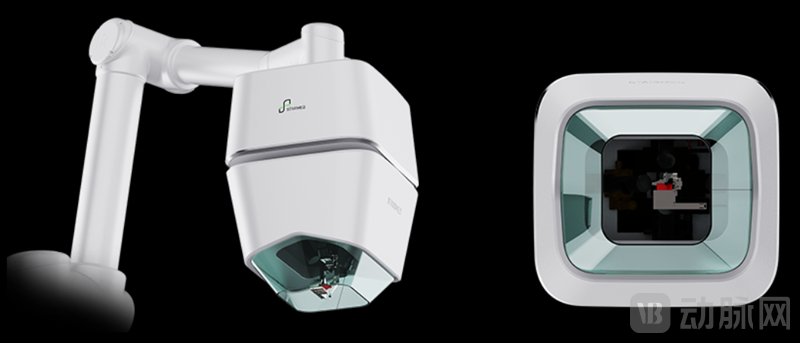
AUFEIS Implant Surgery Robotic System
Photo provided by the interviewee
AUFEIS can not only improve surgical accuracy, shorten operation time, but also enhance the quality and safety of surgery. It is suitable for both scientific research and medical application scenarios. From a medium- to long-term perspective, the integration of AUFEIS can accelerate the animal testing of StairMed and future human trials, as well as increase the product turnover efficiency and popularity after successful clinical application.
Based on the technical product foundation of the second layer of the inverted pyramid, StairMed's layout in the third layer of brain science medical device products is more diversified, mainly divided into the following three-step plan.
The first step is brain-controlled functional products, such as neural prosthetics, brain-controlled mouse and keyboard, etc.; the second step is neuromodulation products, which are devices for treating diseases in specific brain regions, such as deep brain stimulators for Parkinson's disease, and prediction and regulation devices for epilepsy, etc.; the third step is to use bidirectional closed-loop implantable brain-computer interfaces to restore perception, such as artificial retinas and cochlear implants.
In the brain-computer interface research market,StairMed's Self-Developed HNE Ultra-Flexible Micro-Nano Electrode Achieves Commercialization`, becoming the first high-throughput flexible electrode in China and even internationally to achieve commercial mass production delivery and complete large-scale implantation.`The effectiveness and safety of this electrode have been validated in mice, rats, and non-human primates, providing a technologically advanced and performance-stable neural interface tool for research in the field of brain neuroscience, marking a solid step forward in addressing the neural interface at the bottom level of the inverted pyramid model.
In addition to the HNE ultra-flexible micro-nano electrode, StairMed's full-stack neuro-electrophysiological solution also includes the StairPlex high-throughput neural signal acquisition system and the AUFEIS portable implant device. This represents the second layer of the inverted pyramid model—using engineering methods to address technical transformation challenges, which directly impacts the third layer of the inverted pyramid—clinical accessibility.
In 2023, in the medical field, StairMed collaborated with clinical medical institutions to complete four flexible electrode-brain-computer interface implant surgeries, successfully acquiring electrical signals and verifying the safety and effectiveness of flexible electrodes during surgery.
At the same time, StairMed's wireless implantable brain signal acquisition device has also successfully completed large animal experiments and achieved significant progress. The experiment successfully recorded single-cell level discharge activity and verified the safety and effectiveness of the entire system in large animal experimental applications.
Finally, we have reached the top of the inverted pyramid model — the field of neuroscience's understanding of brain-computer interfaces and the brain."The Apex" not only guides humanity in expanding the understanding of ourselves and the depth and breadth of exploring the scientific frontier, but also harbors tremendous potential for industrial transformation and development, becoming an important force driving the Fourth Industrial Revolution to advance further.
As the frontier exploration of brain-computer interfaces accelerates and deepens, there is a growing sense of urgency and expectation for its development both within and outside the industry. To "grow together with the industry, advance human progress and technological evolution, and become an enduring enterprise after the market's trials," StairMed has introduced the "Open Stair" (OPENSTAIRS) ecosystem.
"StairMed" highly integrates basic scientific research, product technology development, and clinical applications, providing infrastructure for a broader range of products and applications. With an open attitude, it collaborates with numerous experts, researchers, entrepreneurs, and various professionals in the fields of neuroscience and brain-computer interfaces to jointly create the future of the industry.
Dr. Li Xue told VCBeat that she and founder Dr. Zhao Zhengtuo are currently working at a well-known scientific research institute in China. They are researchers in the field of neuroscience and have rich research experience.
Dr. Li Xue graduated from Huazhong University of Science and Technology with a Bachelor's degree in Biomedical Engineering. From 2016 to 2020, she studied at the Cockrell School of Engineering, University of Texas at Austin, and the School of Electrical and Computer Engineering at Rice University, where she obtained Master's and Doctoral degrees in Engineering from both institutions.
Since returning to China in 2020, Li Xue has been serving as the head of a research group at the institute, with related work published in high-level academic journals such as Nature BME, Biomaterials, Science Advances, Advanced Science, Nano Letters, and Neuron.
The founder, Zhao Zhengtuo, is a "young" post-90s doctoral supervisor. He graduated with a bachelor's degree in Energy Power Engineering and Automation from Xi'an Jiaotong University, then went to the United States for further studies. He successively obtained a master’s degree in Mechanical Engineering from the University of Michigan-Dearborn and a Ph.D. in Biomedical Engineering from the University of Texas at Austin.
Recently, the value of this "open ladder" ecosystem was validated at an academic exhibition.
On July 28, 2023, StairMed made its first public appearance at the 16th National Academic Conference of the Chinese Neuroscience Society and the 2nd China-Japan-Korea International Conference (CNS 2023 & The CJK-2nd) with a full-stack neuro-electrophysiological solution.
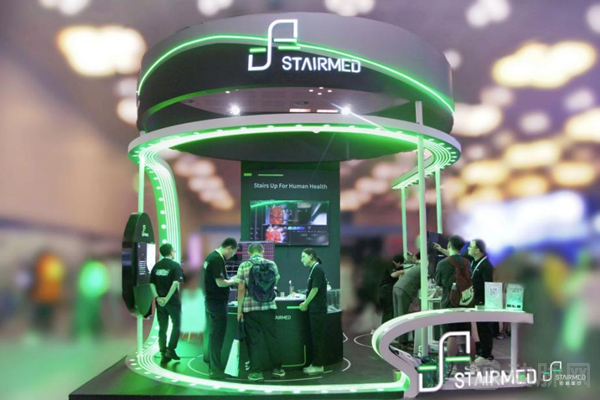
StairMed Booth
Photo provided by the interviewee
During the exhibition, nearly a hundred research groups from related fields had in-depth exchanges with StairMed, and nearly 2,000 researchers left their contact information. This reflects StairMed's professional expertise in the field of neuroscience, as well as its innovative position and leading advantage in brain science research.
Dr. Li Xue concluded the interview by saying that StairMed will aim for the stars while keeping its feet on the ground, enhancing the technical strength of its products and continuously providing more powerful invasive brain-computer interface series products to different research teams, clinical research institutions, and even medical organizations.
References:
1. Under the spotlight, how should the frontier exploration and transformation of brain-computer interface proceed? - VCBeat
2. Musk's Wild Neuralink Clinical Trial Rejected, Is the Industry Moving Away from the "Great Leap Forward"? - VCBeat
3. Neural electrodes are 200 times thinner than a hair strand, "StairMed" aims to develop a brain-computer interface "Windows system" - HaiRuo Mirror