

GeneVita Biotech's Proprietary AAV Manufacturing Platform Significantly Reduces Production Costs and Enhances Patient Accessibility

Jinweike Biotechnology
AAV Gene Therapy New Drug Developer
Gene therapy involves directly or indirectly introducing a target gene into host cells via a vector. By employing treatment strategies such as gene replacement, gene addition, or gene intervention to modify individual gene expression, it aims to correct or compensate for diseases caused by defective or abnormal genes, thereby achieving the goal of curing the disease.
Advances in gene therapy have provided new approaches for the treatment of many diseases and brought hope to countless patients. Currently, more than 40 gene therapy drugs have been launched globally for the treatment of cancer, genetic disorders, and more.
The key step in gene therapy lies in effectively delivering the target gene to the target tissue or cells through a delivery vector; therefore, the use of safe and efficient gene delivery vectors is particularly important. AAV vectors have become star carriers in the field of gene therapy due to their advantages such as long-term expression, low immunogenicity, and high tissue specificity.
The design and commercialization of AAV gene therapy drugs have high technical barriers. How to enhance drug safety, efficacy, and patient accessibility, reduce costs, and expand commercial production capacity is a major challenge for AAV gene therapy drugs.
Chengdu Jinweike Biotechnology Co., Ltd. (hereinafter referred to as "Jinweike"), established in December 2017, is a biotechnology company focused on the research and development of AAV gene therapy drugs. It has completed pre-A round financing amounting to tens of millions of RMB so far.

(Yang Yang, Co-founder and CEO of Jinweike Biotechnology)
Yang Yang, Co-founder and CEO of Chengdu Jinweike Biotechnology Co., Ltd. Researcher at the State Key Laboratory of Biotherapy, West China Hospital, Sichuan University, doctoral supervisor, postdoctoral fellow at the University of Pennsylvania, and recipient of the National Science Fund for Distinguished Young Scholars. He has long been committed to research on gene editing and gene therapy for genetic diseases, including: development of targeted AAV gene delivery technology, fundamental research on AAV gene therapy and gene editing applications, and clinical translation of AAV gene therapy drugs. He has published over 60 SCI papers in journals such as Nature Biotechnology, Blood, and Science Advances, and applied for 8 domestic and international invention patents (4 authorized). As the principal investigator, he has undertaken major national projects including the National Major Scientific and Technological Special Project for "Significant New Drug Development," the Joint Fund Project of the National Natural Science Foundation, and Sichuan Province's major scientific and technological special projects.
In 2016, researcher Yang Yang completed postdoctoral research work at the laboratory of Professor James M. Wilson, a pioneer in gene therapy at the University of Pennsylvania, and returned to China. He established the AAV gene therapy technology platform at the State Key Laboratory of Biotherapy at Sichuan University. By the end of 2016, Sichuan University introduced a series of policies to encourage the transformation of scientific and technological achievements. Under the leadership of Academician Wei Yuquan, researcher Yang Yang implemented the transformation of the AAV gene therapy research results from the State Key Laboratory of Biotherapy, and co-founded Chengdu Jinweike Biotechnology Co., Ltd.
The R&D team of Jinweike Biotechnology comes from well-known pharmaceutical companies, research institutions, and universities both in China and abroad. The team members cover professionals in AAV new drug development, CMC process preparation, and quality research. More than 35% of the team members have over 10 years of industry experience, and over 90% have a bachelor's degree or higher.
Jinweike Biotechnology also invited Professor Lili Wang, a senior AAV scientist from the University of Pennsylvania, to serve as a scientific advisor, maintaining an internationally leading perspective in AAV research and development.
Jinweike Biotechnology adheres to the clinical needs as the guide, relying on its proprietary core technology platform, to develop AAV gene therapy products for ophthalmology, genetic metabolism, and neuromuscular diseases. Currently, Jinweike Biotechnology has established a research and development production base that integrates AAV gene drug research, pilot production, and quality control.
Although AAV is a star vector in gene therapy, its clinical application still faces some limitations. To address the pain points of AAV vector clinical applications, Jinweike Biotechnology has independently developed four core original technologies: "AAV Gene Expression Cassette Design Technology, Gene Editing Technology, Large Gene Delivery Technology, and AAV Capsid Modification Technology," establishing a complete technical chain for AAV gene therapy research and development.
AAV Gene Expression Cassette Design Technology —— Enhancing Efficacy and Safety
Jinweike's gene expression cassette design technology can achieve more efficient tissue-specific expression with a lower effective dosing level, enhancing the efficacy and safety of AAV gene therapy. It has currently completed drug screening validation for over 20 disease models.
Large Gene Delivery Technology - Breaking Through the Gene Capacity Limit Challenge
The full-length of the AAV genome is approximately 4.7kb, with limited gene capacity. Jinweike Biotechnology has developed an efficient dual-AAV vector technology that enables high-efficiency expression of "oversized" genes through protein trans-splicing, further expanding the scope of indications and clinical applications. The related findings were published as a cover paper in the journal *Human Gene Therapy*.
AAV-CRISPR/Cas9 Gene Editing Technology——Achieving Precise Gene Editing and Integration, Expanding Indications
Jinweike Biotechnology's self-developed AAV-CRISPR/Cas9 gene editing technology has been published in journals such as *Nature Biotechnology*, *Science Advances*, and *Blood*, and has received patent authorization. Using this gene editing technology, precise and efficient gene targeting and integration can be achieved, resulting in stable and long-lasting therapeutic effects. This also broadens the prospects for AAV gene therapy indications, applicable to both common and rare diseases, especially for treating children with genetic metabolic disorders.
AAV Capsid Modification Technology —— Enhancing Tissue Targeting
Both immunogenicity and tissue targeting depend on the AAV capsid. Enhancing tissue targeting by reshuffling DNA, displaying random peptides, or AI-designed modifications of the AAV capsid is a key developmental direction in current AAV gene therapy. Chengdu Jinweike Biotechnology Co., Ltd. has made early strategic arrangements in this area, stockpiling several core technologies. Based on CMC process development, Jinweike Biotechnology has scaled up the production of AAV libraries and is currently conducting library screening in non-human primates.
AAV Gene Therapy: One of the Most Promising Fields in Gene Treatment Sees Continuous Growth in Industry and Market Enthusiasm. The production of AAV vectors faces numerous process barriers, technical barriers, and talent barriers. As a result, many biotech companies outsource vector supply issues to CDMOs in the early stages. However, Jinweike Biotechnology has taken a different approach, focusing on the development of AAV vector production technology from the very beginning.
Yang Yang mentioned, "Jinweike Biotechnology believes that as a gene therapy company, mastering the AAV production capability is a core competitiveness for the enterprise. Controlling the production cost of viral vectors is key to reasonable pricing of terminal products during the commercialization phase. Scaling up and upgrading the AAV production process not only meets the demand for usage volume but also considers product quality and cost control."
Scalable production is a bottleneck affecting the large-scale application of AAV products and one of the main reasons for their high cost.
In September 2020, Jinweike Biotechnology 3000m2The AAV new drug R&D platform has been put into operation, including GMP-level AAV preparation workshop, plasmid preparation workshop, quality research platform, and drug development platform, which can efficiently bridge the early product development, IIT research, and clinical research.
"Transitioning from laboratory preparation to scaled production is not a simple linear increment." Commonly used production processes in laboratory settings, such as adherent culture systems and ultracentrifugation purification techniques, are difficult to apply in scaled production. Therefore, the scaled production of AAV viral vectors faces a series of challenges, including difficulties in process scaling, purification complexities, and poor stability.
In response, Jinweike Biotechnology continuously refines and optimizes its AAV production and preparation process system. From the research of plasmid packaging systems and production processes, the screening of suspension cell lines and fermentation processes, to the critical process parameters of viral packaging and purification, the entire process is independently innovatively designed. Meanwhile, Jinweike Biotechnology adheres to the highest global quality regulatory standards and strictly follows GMP guidelines for process control.
The two-plasmid system + suspension cell production process with independent innovation has significantly reduced production costs. The CMC process is stable and easy to scale up, offering very clear advantages during both the clinical and commercialization stages. Currently, the AAV production process has been validated in two IIT clinical studies (involving over 150 patients), demonstrating 100% safety.
Simplified and flexible production platforms help significantly reduce costs and extend product scalability. Strict cost control and increased accessibility are central to Jinweike Biotechnology's AAV drug development process.
Administration completed in 15 minutes, discharge possible within 1 day.The first patient in the IIT study of Jinweike Biotechnology's JWK001 received dosing on June 7 at Huaxi Hospital. During the more than two months of follow-up, the patient demonstrated good postoperative recovery, significant improvement in fundus condition, noticeable enhancement in vision, and no inflammatory response or other adverse reactions.
JWK001 is the first AAV gene therapy drug launched by Jinweike Biotechnology, targeting ophthalmic indications such as nAMD (neovascular age-related macular degeneration) and DR (diabetic retinopathy).
The total number of nAMD patients in China exceeds 6 million, with an annual compound growth rate of approximately 8.1%. Currently, the internationally recognized treatments for nAMD are mainly protein-based drugs that target vascular endothelial growth factor (VEGF), such as ranibizumab, aflibercept, and conbercept. Existing anti-VEGF therapies require long-term, frequent intravitreal injections, which result in poor patient compliance and carry the risk of accelerating disease progression and inducing intraocular inflammation.
In the field of ophthalmic genetic diseases, gene therapy has significant advantages:
1- The pathogenesis is clear, gene drug development is relatively simple, and the target is precise;
2- Less drug demand and relatively low treatment cost;
3-Blood-eye barrier makes the eyeball an immune-privileged area with relatively fewer side effects;
4-Vitreous and subretinal injection technology is mature, with high efficiency of carriers entering target cells;
5- Administering the drug to a single eye, with the pair of eyeballs serving as mutual controls, facilitates clinical research;
6-One treatment has long-lasting effects, eliminating the need for patients to take medication repeatedly.
Jinweike's R&D team designed an innovative multi-target gene expression cassette for JWK001, increasing coverage for patients insensitive to single-target treatments and enhancing drug efficacy. Additionally, using Jinweike's patented technology, the expression of JWK001's anti-VEGF protein was increased approximately 19-fold. Administered via subretinal injection, it enables sustained and efficient expression of VEGF-neutralizing proteins. Preclinical studies show that JWK001 has a lower effective dose and improved safety.
Apart from JWK001, Jinweike Biotechnology continues its development strategy of "being guided by clinical needs, simultaneously addressing rare and common diseases, and adopting both local and systemic drug delivery," with a rich pipeline covering rare ophthalmic diseases, systemic rare diseases, common ophthalmic diseases, and systemic common diseases.
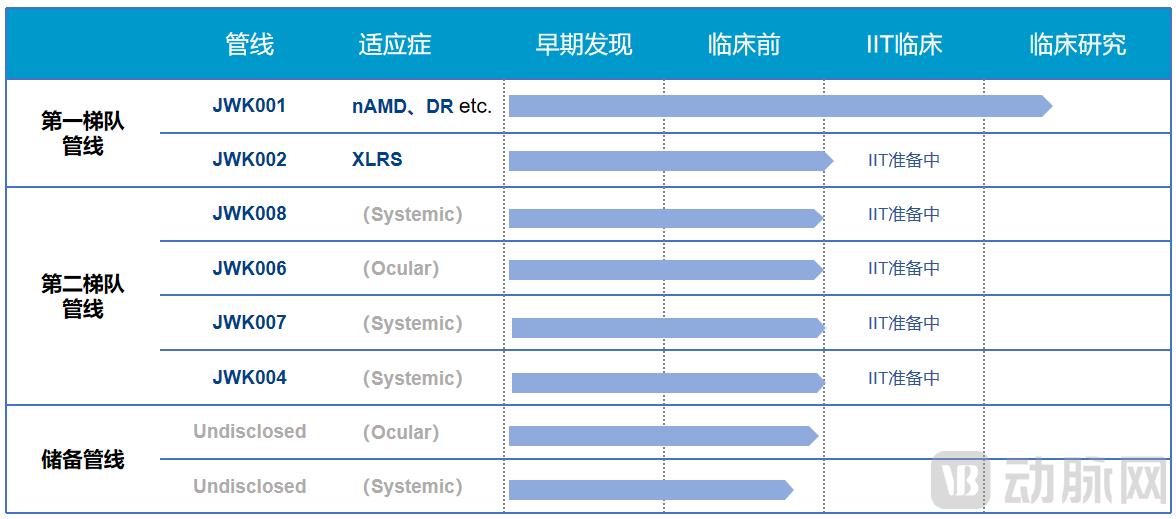
(Jinweike Pipeline Distribution)
At the same time, Jinweike Biotechnology, based on abundant clinical resources, introduces clinical teams to participate deeply in the early stages of drug development. They conduct early research on druggability and safety for diseases with urgent clinical needs, improving the efficiency of product clinical translation.
"IIT research not only enables patients to have access to medication but also advances the preliminary validation of clinical products," Yang Yang mentioned. Currently, Jinweike Biotechnology is collaborating with the clinical team at Huaxi Hospital to advance IIT research and has obtained four IIT approvals. JWK001 has already submitted a Pre-IND, and an official IND submission will be made within the year. JWK001 is also China's first AAV gene therapy project using a two-plasmid system process for IND application.
Starting from ophthalmic diseases, Jinweike Biotechnology will continue to enhance AAV gene technology and CMC processes, accelerate the clinical application of AAV gene drugs, and achieve the accessibility of AAV gene therapy drugs—developing gene therapies that are affordable and effective for patients.