

Merck's China-originated ADC Sac-TMT gains momentum with $700M Blackstone deal

MSD
Pharmaceutical R&D and Manufacturer
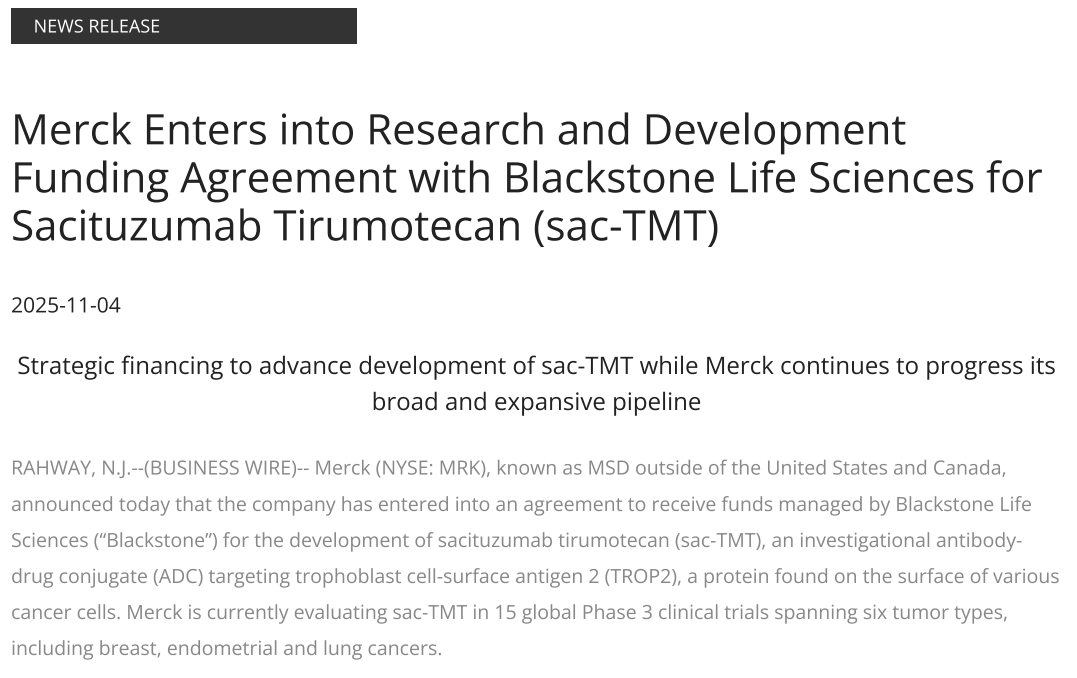
On November 4, Merck (NYSE: MRK), known as MSD outside of the United States and Canada, initiated an uncommon strategic financing arrangement for sacituzumab tirumotecan (sac-TMT), licensed from Kelun-Biotech, securing $700 million from Blackstone to support the global development of this product throughout 2026. Under the agreement, Merck will retain full decision-making authority and control over the development, manufacturing, and commercialization of sac-TMT, while granting Blackstone certain future royalty rights on the product's sales in exchange for this funding.
A closer examination of the strategic rationale behind this financing deal reveals Merck's significant commitment to sac-TMT. As a key ADC asset licensed from Kelun-Biotech to Merck in 2022, sac-TMT has long been a focus of industry attention. Over recent years, Merck has consistently strengthened its presence in the ADC field, securing collaborations worth tens of billions of dollars with companies including Kelun-Biotech and Daiichi Sankyo. With the approaching patent cliff for Keytruda, Merck's determination to advance its ADC portfolio has intensified. However, progress across its broader ADC pipeline has faced challenges, exemplified by the failure of HER3-DXd to meet key endpoints in a global Phase III trial, leading to the withdrawal of its marketing application.
In contrast, sac-TMT has demonstrated strong momentum across multiple fronts. Not only was it the first to gain approval in China, but it recently featured prominently at the ESMO Congress with two Late-Breaking Abstracts (including one in the prestigious Presidential Symposium) and five posters, making it one of the Chinese innovative drugs with the most significant presentations. It has shown breakthrough efficacy in areas such as non-small cell lung cancer (NSCLC). Notably, the combination regimen of sac-TMT and Keytruda has overcome therapeutic limitations of Keytruda in areas like prostate cancer, further demonstrating its strong combination potential and establishing itself as a critical asset within Merck's ADC strategy.
Merck has currently initiated 15 global Phase III clinical trials for sac-TMT across lung cancer, breast cancer, gastric cancer, and gynecological cancers. This targeted financing elevates the company's commitment to the asset to a new level. Caroline Litchfield, Chief Financial Officer of Merck, stated: "This agreement positions Merck to harness the potential of sac-TMT, a promising ADC candidate targeting TROP2, while we continue to advance our broad and expansive pipeline."
According to information presented at Merck's 2025 ASCO Investor Briefing, a concentrated series of Phase III trial data readouts for sac-TMT is expected between 2027 and 2029. These key data releases will further validate the significant global potential of sac-TMT and solidify its core position within Merck's worldwide pipeline.

While Blackstone's capital injection may appear straightforward, it reflects the firm's astute perspective within the biopharmaceutical sector. Reviewing Blackstone's previous investments in biopharma—particularly its strategic funding that helped advance the siRNA therapy inclisiran (which later became a core asset in Novartis' pipeline and is projected to reach blockbuster sales status this year)—reveals a pattern of precise and forward-looking capital deployment. The collaboration with Merck similarly demonstrates Blackstone's deep conviction in sac-TMT's potential and its willingness to accelerate global development through financial support.
With Merck's robust commitment, this China-originated innovative drug is rapidly advancing toward global market penetration, poised to become a cornerstone therapy in oncology worldwide. Its substantial market potential is highly promising.
Source: PharmNote