

Over 20 Top-Tier VCs Enter the Fray as the Medical Ultrasound Sector Ignites

Hyus Meditec
Developer of High-Frequency Medical Ultrasound Technologies and Products

Yunion Healthcare Ventures
Venture Capital Institutions Focused on Equity Investment

TINGSN
Developer of Cardiac Interventional Treatment Devices

CARDIOACC
Developer of Cardiovascular Interventional Imaging Medical Devices

Mindray
Medical Device R&D Manufacturer
As a large market with up to 20 billion annual inspections, the medical ultrasound track has matured after decades of development. Companies that have entered the medical ultrasound field, such as Mindray, Kaile Medical, and Xiangsheng Medical, have been listed for many years.
However, recently, VCBeat has observed that the medical ultrasound track is being reignited.
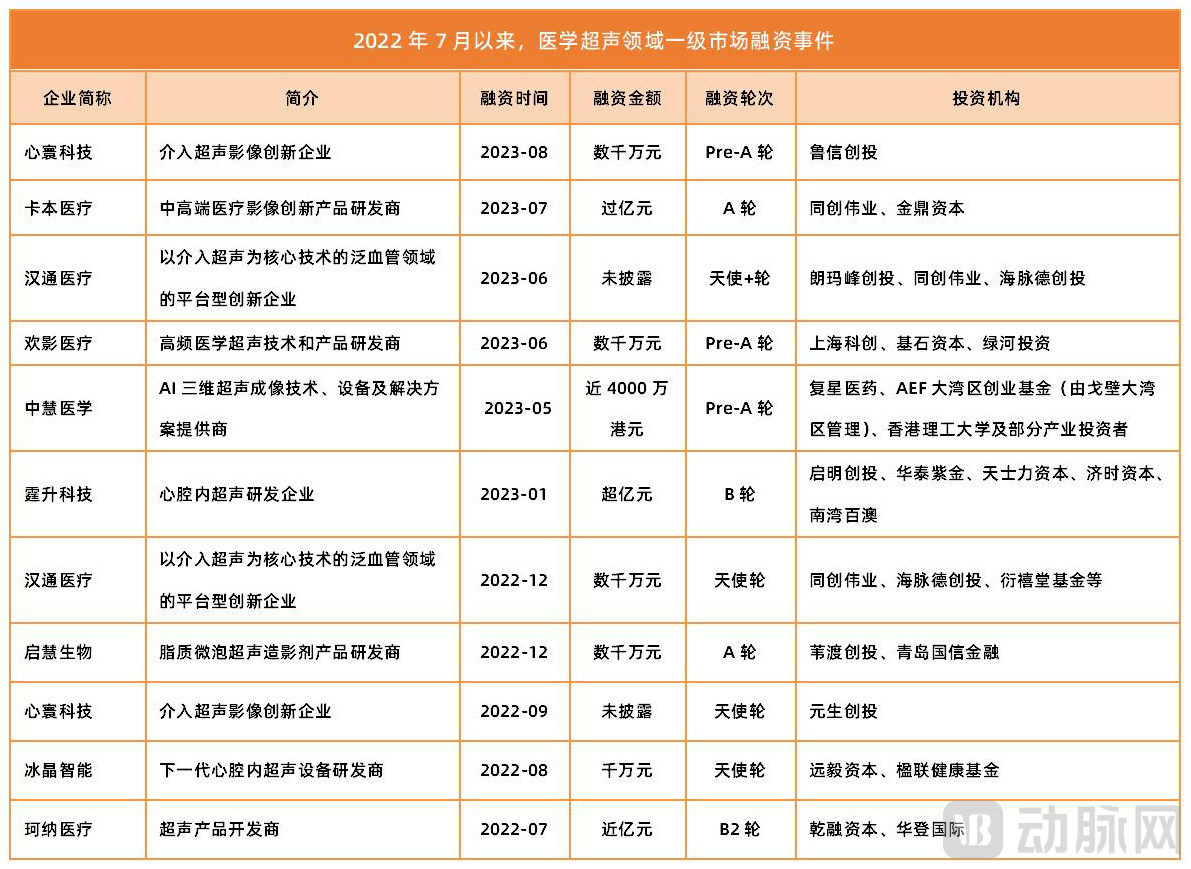
A glimpse of the热度 can be seen from the data.In the past year, the medical ultrasound track has attracted more than 20 well-known VCs to enter the market and make bets.This includes top-tier institutions such as JINDING CAPITAL, Beijing Langma Feng VC LTD., Qiming Venture Capital, Shanghai Sci-Tech Innovation, Tasly Capital Holding (Beijing) Co., Ltd., Shenzhen CO-WIN Venture CAPITAL Investment Limited, Yunion Healthcare Ventures, YuanSheng Ventures, YuanYi Capital, Luxin Venture Capital, and more, with over 10 companies securing financing.
Notably, from May to August this year alone, ZHONGHUI Medical, HUANYING Medical, HANTONG Medical, Kaben (Shenzhen) Medical Technology Co., Ltd., and CARDIOACC successively secured tens of millions, or even hundreds of millions, in financing.The medical ultrasound track has shown a dense trend of one financing per month, appearing particularly hot in the current sluggish investment environment.
(Data source: VCBeat database, Qichacha)
“The medical ultrasound track has reached a critical point of technological iteration, gradually moving from ultrasound products primarily used for diagnosis in the past to products that assist in treatment and directly serve as therapeutic tools. At the same time, there is still room for import substitution in the mid-range diagnostic market for medical ultrasound products, and significant market potential and investment opportunities remain in the high-end market.”Yang Zhenjun, managing partner of Haoyue Capital, told VCBeat.
For a time, ultrasound-related businesses became the "darling" of the industry, attracting a large amount of capital and companies. This influx provided the industry with new ideas, new products, and innovative solutions.
There is no doubt that the medical ultrasound track is being ignited under the combined efforts of the industry.
Why Is Medical Ultrasound So Popular?
Firstly, as one of the four major imaging equipment (CT, MRI, X-ray machines, and medical ultrasound) in China with the largest number of installations, the highest number of examinations, the highest safety factor, the fastest examination results, and the best cost-performance ratio as an image analysis and diagnostic tool,Medical ultrasound has always been an essential device in hospitals at all levels, thus maintaining a decent market stock and growth rate.
(Classification reference: "Fundamentals of Ultrasound Medicine" VCBeat mapping)
"Medical ultrasound is widely used in clinical applications, whether in visceral systems, cardiovascular systems, or urinary systems, there is room for the application of medical ultrasound equipment," Guo Xiang, a senior professional in the medical device industry, told VCBeat. "Because of this, the medical ultrasound equipment market is very mature and has high recognition."Currently, despite the industry competition has been very fierce,China's medical ultrasound equipment market still has considerable growth space.”
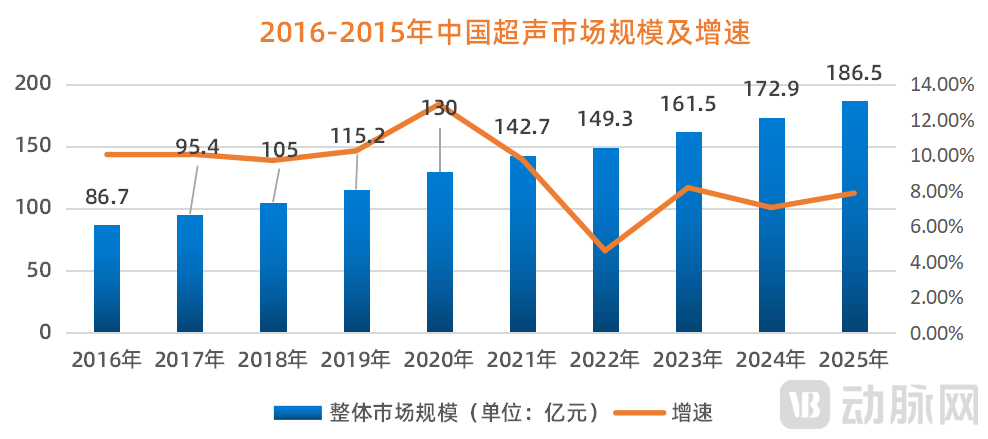
According to data from Frost & Sullivan, the market size of China's medical ultrasound equipment increased from 8.67 billion yuan in 2016 to 12.7 billion yuan in 2020, with an annual compound growth rate of 10%. From 2021 to 2025, the market size is expected to grow from 13.97 billion yuan to 18.65 billion yuan, with an annual compound growth rate of 7.5%.
(Data source: Frost&Sullivan VCBeat chart)
In addition to having a considerable market stock and increment,The average gross profit margin of around 60% for medical ultrasound equipment is another important reason why manufacturers of medical imaging devices are eager to lay out related production lines.
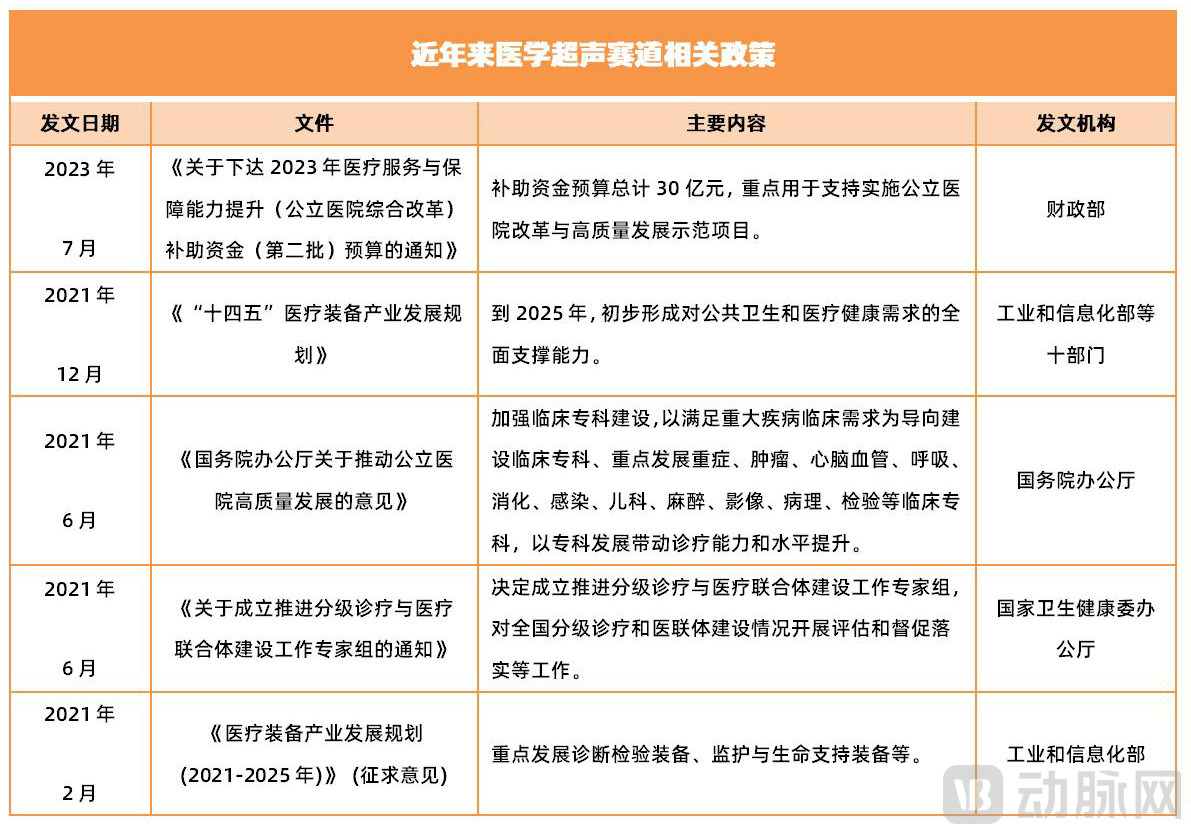
On the policy front, the continuous promotion of policies such as domestic substitution and hierarchical medical treatment has further contributed to the iteration and renewal of the medical ultrasound equipment market. For instance, the document "Guidelines for the Examination and Approval of Imported Products in Government Procurement (2021 Edition)" explicitly specifies the proportion of domestically produced medical devices and instruments that government/public institutions must procure: portable color ultrasound diagnostic equipment, color Doppler ultrasound diagnostic equipment, automatic breast ultrasound diagnostic equipment, and others are required to be 100% domestically produced, while color Doppler ultrasound diagnostic equipment (with surgical positioning guidance or cardiac ultrasound) must have a domestic share of 50%. From this perspective, there is significant room for domestic substitution.
(VCBeat Chart Based on Public Information)
"Ultrasound diagnosis, as a common method for chronic disease screening, can help detect the incidence of chronic diseases in advance."The general trend of aging in China will also inevitably drive the continuous growth in demand for medical ultrasound equipment."Guo Xiang, a senior professional in the medical device industry, said."
It is precisely due to the aforementioned factors that the medical ultrasound sector has attracted numerous players, leading to consistently fierce competition. This has resulted in more solutions and products emerging amidst the intense rivalry. Among these, two major opportunities are gradually surfacing, becoming hotspots of interest for companies or investment institutions in the current medical ultrasound space.
New Opportunity 1: The Strong Momentum of Domestic Substitution, the High-End Market Awaits a Breakthrough
Amid the wave of domestic substitution, the medical ultrasound track is entering a new period of opportunity.
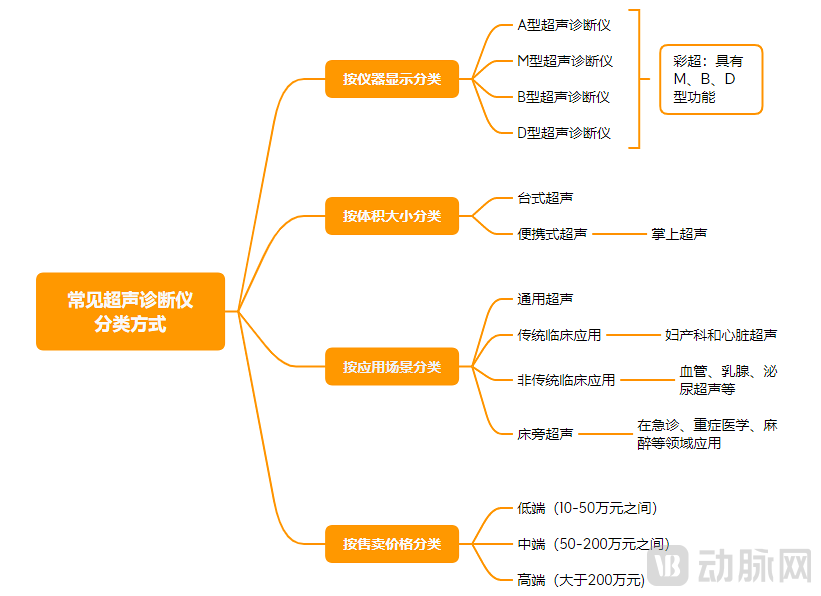
Multiple industry insiders pointed out to VCBeat,Medical ultrasound can be roughly divided into three major categories: low-end, mid-end, and high-end.: The low-end mainly includes general-purpose full-body ultrasound equipment, the mid-range mainly includes full-body ultrasound and superficial vascular ultrasound equipment, and the high-end mainly includes cardiac ultrasound and gynecological 4D ultrasound equipment.
In terms of price range, the general price range for low-end ultrasound is between 100,000 and 500,000 yuan, mid-range ultrasound is generally between 500,000 and 2 million yuan, and high-end products are generally above 2 million yuan.
In the three directions of high, medium, and low-end markets, a large number of companies have already entered the field. In the high-end market, imported equipment currently holds a monopoly, with core enterprises being multinational giants such as Philips and GE; in the mid-range and low-end markets, the main players are China-produced enterprises like Mindray, Sonoscape, VINNO, and Shantou Ultrasound.
“Through more than a decade of development, domestically produced enterprises have basically completed the replacement of imported products in the mid-to-low-end market of medical ultrasound."Guo Xiang, a senior professional in the medical device industry, stated that due to the product iteration of ultrasound equipment, low-end products are gradually being phased out. In recent years, the mid-range market has been encroaching on the space of the low-end market, leading to an increasingly higher industry concentration."
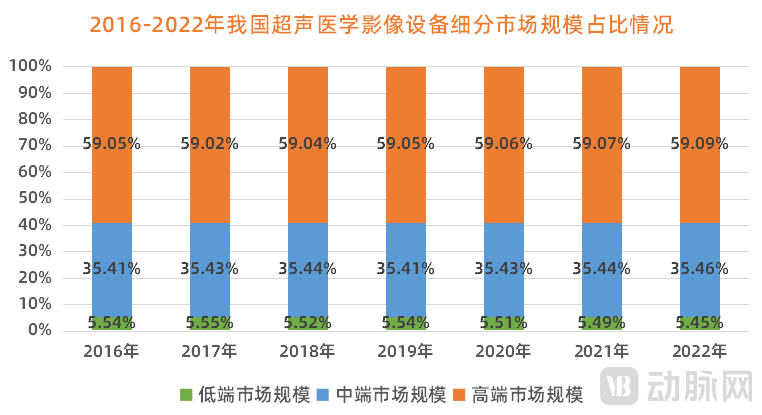
(Data source: Frost&Sullivan, VCBeat Chart)
In the high-end market, domestically produced enterprises are also gradually making efforts, and are currently in the initial stage.For example, on December 30, 2022, Mindray released its all-new high-end ultrasound system, the Resona R9 Platinum. Based on this product, Mindray proposed for the first time the concept of multi-parameter ultrasound, which involves using different ultrasound imaging technologies to obtain more parameters and explore more possibilities for diagnostic and treatment solutions. Another example is Sonoscape, which has successively launched high-end ultrasound products such as the S60 Pro and P60 series.
However,In the field of ultra-high-end medical ultrasound equipment priced above 2.5 million yuan, there are few Chinese-produced enterprises.In terms of total market value, high-end ultrasound accounts for more than 50% of the entire market share.
This means that the high-end and even ultra-high-end markets will be the core areas of competition in the future medical ultrasound track. If domestic companies can achieve breakthroughs, there is still considerable growth potential in the future.
Technical barriers are the key to standing firm in the high-end medical ultrasound equipment field.
Medical ultrasound equipment mainly consists of six parts: oscillator, transmitter, transducer, echo information processing system, display, and scan generator. Among them,The transducer is a difficult point in the research and development of high-end ultrasound equipment., This device is mainly used in ultrasound probes and serves to generate ultrasonic pulses, receive wave pulse signals formed by the target, convert them into electrical signals, and send them to the echo information processing system for processing of the ultrasonic echo information. Given all other factors remain constant, the higher the transducer frequency, the more accurate the image obtained tends to be.
In addition,Breakthroughs in software and some complex functions are also crucial., such as shear wave elastography and contrast imaging, which can provide users with more quantitative diagnostic information and lead to better diagnostic outcomes.
In line with the above direction, innovative enterprises in China are actively deploying in high-end fields.
In August, just received financingCARDIOACCFor example, this company is committed to building a core technology platform for ultrasound intervention and focuses on advanced active cardiovascular interventional imaging, natural orifice interventional imaging, and advanced diagnostic methods. Based on the current progress of product development, CARDIOACC's world's thinnest 7.5F 2D ICE is about to enter the registration clinical stage, and significant breakthroughs have been achieved in the development of 4D ICE.
Such as the Pre-A round financing completed in June this yearHuan Ying MedicalThe company focuses on intracardiac ultrasound, and its products can independently complete the research and development and production of key transducers and active interventional catheters with 100% autonomy, eliminating reliance on external procurement of core components. It has established a complete Class 10,000 cleanroom workshop and production system, ensuring supply chain security, controllable costs, and stable mass production capabilities to the greatest extent.
Completed over 100 million yuan in B-round financing in January this yearTINGSNSince 2019, TINGSN has invested substantial funds and human resources into the research and development of intracardiac echocardiography products. The company has continuously improved the overall product performance and achieved semi-automated mass production. Currently, TINGSN has established a nearly 4,800-square-meter R&D and manufacturing center, equipped with high-end precision R&D testing equipment and semi-automated production facilities. The cumulative R&D investment in 2D intracardiac echocardiography products and related technologies has reached nearly 200 million yuan. Meanwhile, TINGSN is also accelerating the development of its 4D intracardiac echocardiography products.
It can be found that in the high-end medical ultrasound field, an increasing number of domestically innovative companies will bring new possibilities to the industry.
New Opportunity 2: Technology-Driven Transformation – Expanding into the New Blue Ocean from Diagnosis to Adjunctive Therapy
"In the field of diagnostics, quite a few companies are making strategic moves, and the competition has already become fierce," said Guo Xiang, a senior professional in the medical device industry.At present, with the iteration and upgrading of technology, many enterprises have begun to focus on and invest efforts in the auxiliary treatment field.”
Specifically, the application of medical ultrasound equipment in auxiliary treatment mainly includes ultrasound-guided puncture biopsy and cyst fluid aspiration, as well as ultrasound-guided ablation therapy for solid lesions using radiofrequency, microwave, and laser technologies.
Having completed two rounds of financing within a yearKaben MedicalFor example, the multimodal imaging fusion system VENUS, a product under this company, intuitively displays 3D and 2D organ anatomy by fusing static CT/MR sequences with real-time dynamic ultrasound. It assists doctors in locating lesions, planning puncture paths, quickly guiding precise establishment of interventional channels, and performing targeted biopsies, enhancing the efficiency of doctors.
In addition, Kaben Medical's VENUS has customized corresponding organ-specific programs—PCNL, MRI-TRUS—with an APP-style operation and visual guidance. This not only significantly reduces the learning curve for young doctors but also provides precise, efficient, and safe assistance for clinical puncture procedures, successfully creating a high-barrier, comprehensive underlying technology platform.
For example, within the same year, completing two rounds of financingHantong MedicalFocusing on the field of pan-vascular technology with interventional ultrasound as its core, the company has achieved breakthroughs in multiple high-end "bottleneck" technologies. It has fully self-developed key components such as transducers, catheters, mainframes, and algorithms, making it one of the few enterprises both domestically and internationally to fully master the core technologies of interventional ultrasound throughout the entire process, while also possessing a cost advantage.
Specifically, the "Renal Artery Ultrasound Ablation System (uRDN)" independently developed by Hantong Medical optimizes the acoustic field output range and achieves more stable ablation effects. Currently, the uRDN product has been submitted for registration inspection. Meanwhile, Hantong Medical has expanded its product lines based on the ultrasound platform, which are also being gradually carried out.
Secured Pre-A round financing this MayZHONGHUI MEDICALPioneered the ultrasound scoliosis evaluation system, which mainly provides orthopedic, rehabilitation, and sports medicine physicians with a radiation-free and safe scoliosis evaluation solution that matches the precision of X-rays. It now holds 19 world-first and leading technologies as well as more than 100 patents, and has obtained medical device certifications from the EU, Australia, and mainland China.
To date, the Zhonghui Medical Imaging research team has collaborated with internationally renowned hospitals and universities on research initiatives. They have published over 20 scientific papers in top-tier international journals in the fields of orthopedics and kinematics, ultrasound, machine vision, and pattern recognition, verifying the accuracy and reliability of 3D ultrasound technology. The Scolioscan® Ultrasound Scoliosis Assessment System has been clinically tested and validated, showing a 94.64% linear correlation between the ultrasound UCA angle and the X-ray Cobb angle. The system has also won multiple innovation awards both domestically and internationally.
“Capital is quite optimistic about the ultrasound direction that leans towards adjuvant therapy. When making investment judgments, factors such as the team, R&D, and innovation capabilities are all very important."Yang Zhenjun, Managing Partner of Haoyue Capital, stated, 'For example, whether the ultrasound probe has advantages in real-time performance, accuracy, and precision, whether the learning cost for doctors is high, and whether it can innovatively address clinical pain points, etc.'"
In summary, with the continuous innovation of technology, the medical ultrasound sector is not only advancing towards high-end applications in the diagnostic field but also gradually expanding into the new blue ocean of auxiliary treatment.
In the process of continuous innovation and iteration in the billion-dollar medical ultrasound market, VCBeat, combined with the opinions of multiple interviewees, has found that two major trends in the industry have begun to emerge.
First, the embedded application of AI technology will drive the continued penetration of medical ultrasound devices and alleviate the supply-demand imbalance caused by the shortage of ultrasound doctors.China has a high demand for medical ultrasound diagnostic equipment. In 2020, the number of ultrasound examinations in China was approximately 2 billion. Unlike radiology imaging, ultrasound imaging requires the acquisition of dynamic images from different sections for real-time diagnosis. The process of image acquisition and diagnosis heavily relies on the doctor's experience. However, there is a shortage of ultrasound specialists in China, creating an urgent need for the integration of AI technology to lower the threshold for ultrasound use.
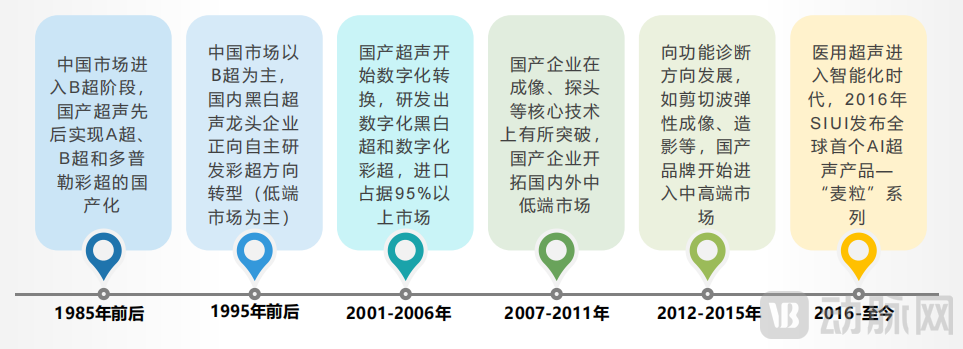
(Development History of Chinese Medical Ultrasound Diagnosis Image Source: "2022 China Medical Ultrasound Report")
Second, the combination of ultrasound with other devices for joint diagnosis has become an important direction.For instance, the combined diagnosis of ultrasound and CT can achieve better results in the diagnosis of renal cysts, spinal surgery, and thyroid calcified lesions; another example is the combination of ultrasound and MRI, which enables the application research of multi-modal functional magnetic resonance imaging in high-intensity focused ultrasound ablation of uterine fibroids, among others.
In the evolution of trends, the development of the medical ultrasound market will continue to be on the rise. It should be noted that the industry needs to develop in a more positive direction, continuously providing patients with better clinical experiences and outcomes.
Of course, this is not an easy path, and the road ahead will inevitably be muddy and winding. But for the entrepreneurs who are committed to this field, facing challenges head-on is the norm. In this norm, innovative companies have taken one crucial step after another.
It is the small accumulation of every step by innovators that has become the cornerstone for the industry's giant leap forward.