

Hengrui initiates new Phase III trial for cancer combination therapy

AstraZeneca
Pharmaceutical Technology Research and Development Provider
On November 3, the Chinese clinical trials registry website showed that Hengrui Pharmaceuticals has registered a Phase III clinical study. This trial will compare the combination of SHR-8068, adebrelimab, and platinum-based chemotherapy against durvalumab combined with platinum-based chemotherapy for the first-line treatment of advanced biliary tract cancer (BTC).
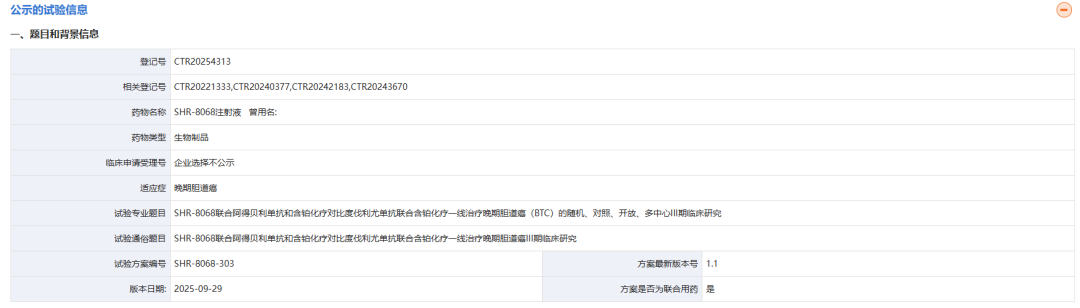
This is a randomized, open-label, controlled, multicenter Phase III study designed to evaluate the efficacy and safety of SHR-8068 in combination with adebrelimab and platinum-based chemotherapy versus tislelizumab plus platinum-based chemotherapy as first-line treatment for advanced BTC patients, based on PFS (Progression-Free Survival) and OS (Overall Survival) assessed by a Blinded Independent Central Review (BICR). The trial plans to enroll 604 participants in China, with OS as the primary endpoint.
Adebrelimab injection is a humanized anti-PD-L1 monoclonal antibody independently developed by Hengrui. It received regulatory approval in 2023 for use in combination with carboplatin and etoposide as first-line treatment for patients with extensive-stage small cell lung cancer (ES-SCLC).
SHR-8068 (CS1002) is a fully human anti-CTLA-4 monoclonal antibody that Hengrui in-licensed from CStone Pharmaceuticals for up to approximately 1.3 billion RMB. It functions by enhancing anti-tumor immune responses. Prior to this, Hengrui had already initiated two Phase III clinical trials for this drug; the current study represents the third Phase III trial:
In September 2025, a trial of SHR-8068 combined with adebrelimab and platinum-based chemotherapy versus tislelizumab combined with platinum-based chemotherapy for the first-line treatment of locally advanced or metastatic non-small cell lung cancer (NSCLC) with negative PD-L1 expression.
In September 2024, a trial of SHR-8068 combined with adebrelimab and bevacizumab versus sintilimab combined with bevacizumab for the first-line treatment of advanced hepatocellular carcinoma (HCC).
Durvalumab is a PD-L1 monoclonal antibody developed by AstraZeneca. It works by blocking the interaction of PD-L1 with PD-1 and CD80, thereby inhibiting the tumor's immune evasion strategy and restoring suppressed immune responses.
Since its first approval in 2017, durvalumab has demonstrated consistent sales growth. In 2024, the drug achieved global sales of $4.717 billion, representing a year-on-year increase of 11.33%, ranking among the top three revenue-generating products within AstraZeneca's portfolio of 14 blockbuster drugs.