Click to follow and get more exciting content!
Recently, the leader in gene therapy for ophthalmic diseases in ChinaNeurophthTechnology Co., Ltd. announced the completion of nearlyCNY 700 Million C+ Round FinancingThis round of financing was led by Yangtze River CMB, in collaboration with three state-owned enterprises—Optics Valley Financial Holdings, Wuhan Hi-Tech, and Optics Valley Health Investment—and joined by Guangzhou Financial Holdings. Renowned investment institutions such as SDIC Venture Capital, Paradise Silicon Valley, and Yangtze River Industrial Investment also participated in the investment. The proceeds from the C+ round of financing will be used to continuously advance clinical trials of core products, enhance the company's R&D capabilities, and expand the product pipeline. In 2023, Neurophth's core product NR082 (rAAV2-ND4) became the first gene therapy drug in China to complete patient enrollment for Phase III clinical trials and completed the enrollment of the first patient in the U.S. Phase I/II clinical trial.AAV vectors can deliver healthy gene copies to patients' cells, and their application potential has been extensively validated.The promising application prospects of AAV gene therapy in the rare disease field have attracted a large number of pharmaceutical companies. Since 2010, China's domestic AAV gene therapy enterprises have sprung up like mushrooms. The development of the AAV gene therapy industry is now an inevitable trend.AAV VectorIs the field of gene therapy
One of the most commonly used viral vectors
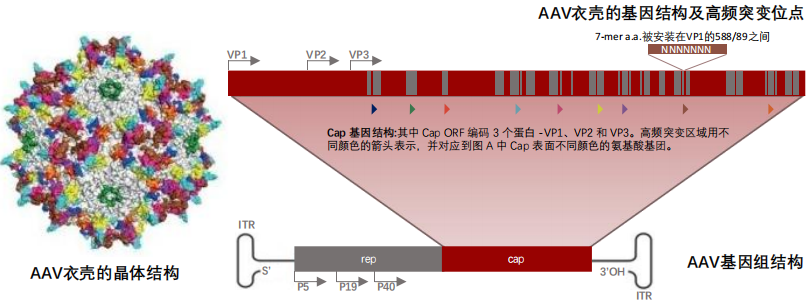
Adeno-associated virus vectors can deliver healthy gene copies to patients' cells, and their application potential has been extensively validated. AAV belongs to the Parvoviridae family and consists of a non-enveloped icosahedral protein capsid with a diameter of approximately 26nm and a single-stranded DNA genome of about 4.7kb.The wild-type AAV genome contains three genes: Rep, Cap, and aap.Among them, the Rep gene encodes four proteins required for viral genome replication and packaging (Rep78, Rep68, Rep52, and Rep40), and Cap expresses the viral capsid proteins (VP1/VP2/VP3). At both ends of the AAV genome, there are two "T"-shaped inverted terminal repeats (ITR). AAV particles can infect both dividing and non-dividing cells through a multi-step process: AAV binds to host cell surface receptors, forms endosomes, undergoes cytoplasmic transport, is transported to the nucleus, the virus uncoats, single-stranded DNA replicates into transcriptionally active double-stranded DNA, and circular DNA that can persist in the nucleus is formed through ITR recombination.Schematic Diagram of AAV Genome Structure and Capsid (Cap) High-Frequency Mutation Sites
The Advantages of AAV as a Gene Therapy Vector
1. It does not cause any human diseases and mainly exists in the form of an episome.
Many patients with debilitating diseases have been treated with AAV gene therapy without observing significant adverse events, highlighting the safety of these treatments. Particularly, the "gene replacement" strategy has shown a high success rate in monogenic disease cases. The risk of insertional mutagenesis has been reduced or avoided by producing safer (lentiviral) vectors. It is currently unknown for wild-type AAV to cause diseases in vivo, and after removing most AAV genomic elements, further safety of recombinant AAV gene delivery in vivo can be ensured.
2、Low immunogenicity (Safe)
Gene therapy using AAV vectors has demonstrated safety and long-term efficacy in a series of trials targeting organs. The risk of immune response has been reduced by using adjuvant immunomodulatory drugs. AAV induces a very mild immune response in the body, further supporting its apparent lack of pathogenicity during the gene delivery process.
3、Single treatment, stable expression, long-term efficacy
AAV-Mediated Protein Therapeutic Gene Delivery Provides Long-Lasting Pharmacological Effects, Potentially Allowing Single-Dose Administration for the Entire Treatment. This is Particularly Important for Neurological and Ocular Diseases That May Require Multiple Doses. Evidence Already Shows the Use of AAV Vectors in Treating Various CNS Disorders and Spinal Muscular Atrophy. AAV Has Become a Promising Platform for Protein Therapeutic Gene Delivery Starting from a Functional Copy of the SMN1 Gene, Which is Incorporated into the AAV9 Vector, Administered Intravenously, and Integrated into the Genome of Spinal Motor Neurons, Leading to Therapeutic Transcription of SMN1 and Expression of SMN Protein, Slowing Disease Progression.Indications Distribution of AAV Gene Therapy Products
According to Cortellis 2022 data,Currently, there are 152 AAV therapies in development for ophthalmic diseases, 252 for neurological disorders, 170 for metabolic diseases, 65 for skeletal muscle conditions, and 46 for blood disorders.。
The main global hot targets of AAV include F9, F8, GBA, CFTR, RHO, SMN1, PAH, FXN, GAA, Dystrophin, RPE65, etc. According to Cortellis 2022 data, large multinational pharmaceutical companies such as Pfizer, Roche, Novartis, Janssen, and AbbVie have all laid out AAV gene therapy. There are over 100 pipelines in the fields of neurology, metabolism, and ophthalmology, which are key areas for the application of AAV vector therapy.Of the two marketed drugs, one is for neurological disorders and the other is for ophthalmic diseases.。
Market Landscape of China's AAV Gene Therapy Industry
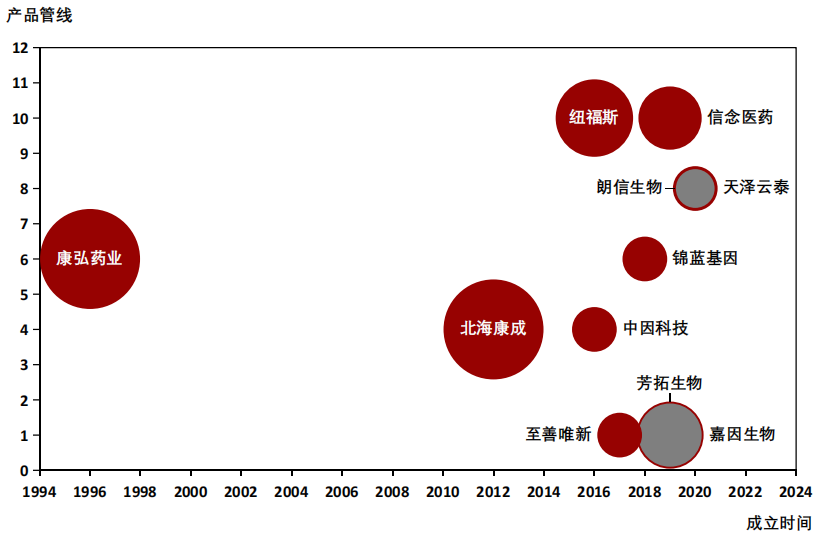
China's AAV gene therapy industry has started later than other countries overseas in terms of marketed products and R&D pipelines.Overall, it has presented a "hundred schools of thought contending" trend.The development of the AAV gene therapy industry is an inevitable trend.From 2010 to the present, AAV gene therapy companies in China have emerged in large numbers. Among the selected companies, only Kanghong Pharmaceuticals, which has a layout in AAV gene therapy, was established earlier than 2010. It is not difficult to see from the bubble chart that companies which entered the AAV gene therapy field slightly earlier also tend to be in the later stages of financing compared to other companies, and some have completed their IPO.In terms of the number of product pipelines, Neurophth and Belief BioMed have become industry leaders. The coming period will be crucial for competition among many AAV companies. Gaining clinical approval and being the first to market will undoubtedly be key for companies to stand out in this new "golden track" of AAV gene therapy. The competitive landscape of the industry will also change due to these factors.
No. 1 Entrepreneurs Club is an open platform for exchange and cooperation initiated by the founders of SIMBAY PARK (Free Trade Zone No. 1) enterprises. It aims to unite independent innovation companies within the SIMBAY ecosystem, gather industry elites and resources, and build a platform connecting government and enterprises, technology & regulations, business management, and resource matchmaking, providing substantial support for members' entrepreneurial endeavors and company development. Relying on the advantageous resources of the SIMBAY ecosystem, the club focuses on entrepreneurs within the SIMBAY ecosystem, creating three major service sectors: "Enterprise·Home," "Career·Support," and "Startup·Win," making entrepreneurship and innovation easier.