

Hesicare secures tens of millions in Series A for software-hardware-AI integration in chronic disease management

Hesicare
Chronic Disease Auxiliary Diagnosis and Treatment Platform Developer

Hygeia Capital
Healthcare Investment Company

BIO-TOWN CAPITAL
Integrated Financial Services Institution
Hesicare, a Chengdu-based company specializing in chronic disease management and AI-assisted diagnosis and treatment, recently announced the completion of a tens of millions of yuan Series A funding round. This round was led by Huaige Capital, with participation from Guosheng Capital and Chengdu Hi-tech Innovation Investment (CDHT Investment).
Founded in November 2020, Hesicare specializes in digital transformation and intelligent upgrading within the chronic disease management sector. The proceeds will be primarily used to deepen Hesicare's integrated system comprising three core pillars: the chronic disease management software platform, the hardware and reagent platform, and the data AI platform, while expanding deployments in hospitals and community settings. Additionally, the funds will accelerate the development of its AI-assisted diagnosis and treatment system for diabetes, promoting the large-scale implementation of AI diagnostics within real-world clinical scenarios.
Hesicare began with its Diabetes Management System (DMS) as the core starting point and has progressively built a comprehensive chronic disease management product matrix covering "hospital-community-household" scenarios. Currently, the DMS has been deployed across all 31 provinces in China, serving over 2,200 hospitals. It achieves integrated in-hospital and out-hospital management with regional coverage across medical consortia, establishing a leading position in the hospital glucose management market.
The DMS integrates and analyzes data from fingertip blood glucose monitoring (BGM), continuous glucose monitoring (CGM), insulin usage, oral medications, biochemical tests, and glucose events. It enables unified management of BGM, CGM, and insulin pumps within a single system, fully supporting the digital transformation of hospital glucose management. Its professionalism and applicability have gained widespread recognition within the industry.
Due to its excellent clinical performance, Hesicare has become the exclusive or preferred partner for glucose management systems for multiple global leading glucose medical product enterprises, including Roche, Johnson & Johnson, Abbott, Bayer, Medtronic, and Yuwell. The system has been deployed and utilized in thousands of hospitals across China.
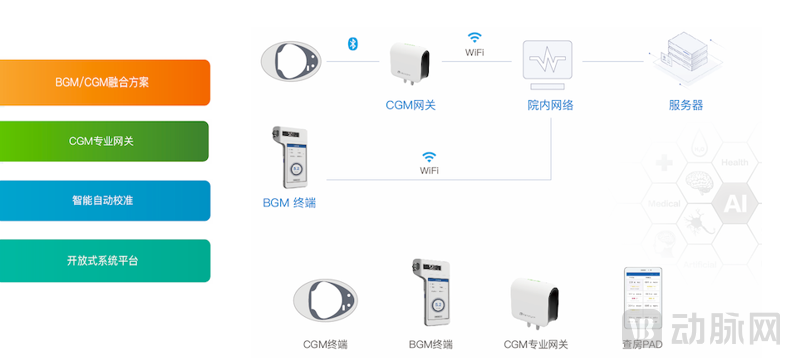
Hesicare BGM/CGM Integrated In-Hospital Solution
Building on this foundation, Hesicare has further developed an integrated "Software Platform - Hardware & Reagents - Data AI" tripartite system, establishing a dual-drive model powered by both technology and application.
Regarding the software platform, in addition to the Diabetes Management System (DMS), Hesicare has launched the AI-powered Chronic Disease Management System (AI-CDMS) for primary care settings. This system enables patient identification, precise measurement, intelligent follow-up, and automated report generation. Chronic disease data is shared in real-time with hospital HIS, public health systems, and family doctor systems. AI-CDMS is already commercially operational in several regions including Shanghai, Shandong, and Xinjiang. In Shanghai, the initial launch city, it covers 226 communities, achieving an 83% coverage rate.
In terms of hardware and reagents, Hesicare has established a comprehensive product line comprising blood glucose meters, continuous monitoring devices, and matching reagents. These products are highly integrated with the software platform, providing hospitals and communities with an end-to-end closed-loop solution spanning from testing to data analysis.
In data and AI, Hesicare is further integrating AI capabilities into the diabetes diagnosis and treatment workflow. Leveraging the robust data capabilities accumulated from its hospital-based diabetes management applications, Hesicare has collaborated with several leading Chinese hospitals to develop an AI-assisted diagnosis and treatment system for diabetes. This system is trained on large language models (LLMs), clinical knowledge graphs, and tens of millions of real-world medical records, resulting in a specialized vertical large model for diabetes.
Through the synergistic evolution of "Software + Hardware + AI," Hesicare has established a comprehensive chronic disease management chain covering data collection, diagnostic analysis, and intelligent decision-making. This achievement lays a solid foundation for creating a sustainable and scalable Chinese model for chronic disease management.
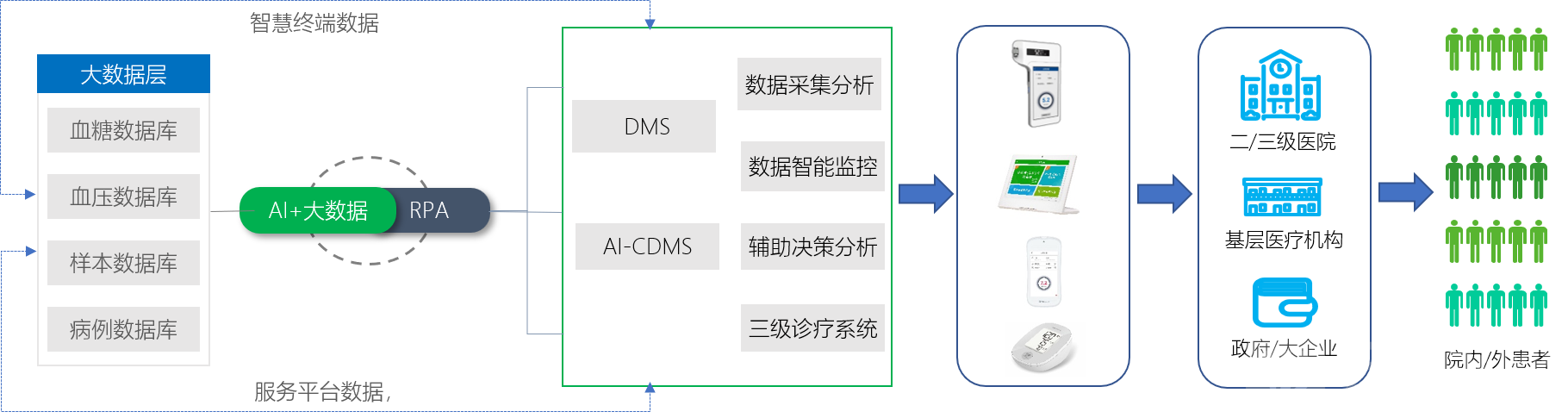 Hesicare Chronic Disease Software Platform - Hardware Reagents - Data AI Trinity System
China's diabetes management faces the practical challenges of a large patient population and uneven primary care capabilities. According to a latest report released in June 2025 by the National Center for Chronic and Non-communicable Disease Control and Prevention, China CDC, the number of diabetic patients in China reached 233 million in 2023. Although the management of type 2 diabetes has been included as a key disease in China's community-based essential health services, gaps remain in the standardized management, particularly in quality and capacity, at the primary care level. This situation also presents significant opportunities for digital management platforms.
Against this backdrop, Hesicare utilizes its DMS as the core to connect data loops across hospitals, communities, and homes, gradually building a B2B2C business model. While providing intelligent diagnostic support to hospitals, it also extends personalized health management to patients, facilitating the shift of chronic disease management digitization from "institutional management" towards "individual empowerment."
To date, Hesicare holds 31 intellectual property rights. In 2025, the company's revenue exceeded 100 million yuan, with a compound annual growth rate (CAGR) of over 50% in the past three years. Having been profitable for three consecutive years, Hesicare is projected to achieve revenue surpassing 250 million yuan by 2026. Its DMS and AI-CDMS systems, powered by the proprietary diabetes AI large model, are expected to cover over 3,500 hospitals.