

A Universal CAR-T Therapy for All Blood Cancers? Base-Edited CAR-T Enters Clinical Development

Verismo Therapeutics
Developer of Novel Chimeric Antigen Receptors
▎Edited by the WuXi AppTec content team
Recently, the global cell and gene therapy (CGT) field has seen a series of advancements. Among them: Beam Therapeutics' quadruple base-edited off-the-shelf CAR-T cell therapy has entered the clinical development stage. An innovative technology developed by a research team led by Professor Carl June, a pioneer in CAR-T cell therapy, holds the potential to treat most blood cancers with a single CAR-T therapy. This article will provide a brief introduction to some of these key advancements for readers' reference.

Image Source: 123RF
———✦R&DProgress✦———

Beam Therapeutics recently announced that its quadruple base-edited allogeneic CAR-T cell therapy, BEAM-201, has completed the phase 1/2 clinical trial for the treatment of relapsed/refractory T-cell acute lymphoblastic leukemia/T-cell lymphoblastic lymphoma.First Patient DosedThe press release noted that this is the first quadruple base editing, allogeneic CAR-T therapy to enter clinical development, and also the first base editing investigational therapy in the United States to enter clinical development. The multiple base edits of BEAM-201 are designed to eliminate the expression of the CD7, TRAC, PDCD1, and CD52 genes, reducing damage to healthy cells, graft-versus-host disease, and CAR-T cell exhaustion. Additionally, it enables BEAM-201 to avoid the harm caused by lymphodepletion pretreatment targeting CD52, while allowing the use of allogeneic cell sources.
Carisma Therapeutics recently announced the latest clinical trial results of its HER2-targeted chimeric antigen receptor macrophage therapy (CAR-M) CT-0508. The trial results support a single high-dose infusion administered in one day.CT-0508 demonstrated good safety with no dose-limiting toxicity observed. Biomarker analysis showed signs of CT-0508 altering the tumor microenvironment (TME).TME activation correlates with the amplification of tumor-infiltrating lymphocytes and patient response. Dr. Debora Barton, Chief Medical Officer of Carisma, stated at the 10th WuXi AppTec Global Forum that CAR-M has unique advantages in treating solid tumors because macrophages are already abundant in solid tumors. They are the most common cells in the tumor microenvironment, capable of phagocytosing and killing tumor cells. They can also process and present various neoantigens.
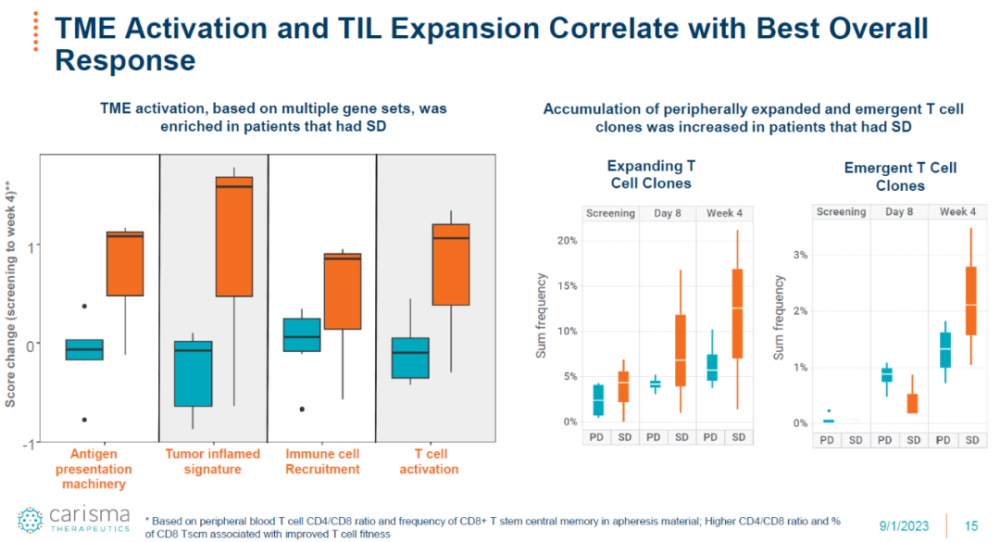
▲Phase 1 Clinical Trial Results of CT-0508 (Image Source: Carisma Therapeutics Official Website)

Verismo Therapeutics Announces First Patient Dosed in Phase 1 Clinical Trial of CAR-T Therapy SynKIR-110 for Advanced Ovarian Cancer, Developed Using Its Proprietary KTR-CAR Technology Platform. This CAR-T therapy’s chimeric antigen receptor consists of two parts: a membrane protein receptor that binds to mesothelin and a DAP12-mediated signaling component.When CAR-T cells are not in contact with cancer cells, the DAP12-mediated signaling is not activated. However, when CAR-T cells encounter cancer cells, the DAP12-mediated signaling pathway is activated, which in turn activates T cells. The purpose of this design is to avoid prolonged activation of CAR-T cells, thereby enhancing the persistence of CAR-T therapy.
▲Mechanism of Action of the KTR-CAR Technology Platform (Image Source: Verismo Therapeutics Company Website)

Opus Genetics Announces First Patient Dosed in Phase 1/2 Clinical Trial of Investigational Gene Therapy OPGx-LCA5 for the Treatment of Leber Congenital Amaurosis (LCA) Caused by LCA5 Gene MutationsOPGx-LCA5 uses the AAV8 vector to precisely deliver the functional LCA5 gene to the outer layer of the patient's retina. Preclinical studies show that using OPGx-LCA5 before the disease severity peaks can preserve retinal structure and visual function.
CAR-T Cell Therapy Pioneer Professor Carl June's Research Team Publishes in Science Translational MedicineResearchUsing a new technology called "epitope base editing," a "universal" CAR-T cell targeting the common leukocyte antigen CD45 has been developed. This CAR-T cell has the potential to combat most blood cancers, significantly expanding the application scope of CAR-T cell therapy.

Umoja Biopharma announced that the companyVerismo Therapeutics' VivoVec Technology Platform Effectively and Durably Generates CAR-T Cells with Good Tolerability in Non-Human Primate (NHP) StudyThe VivoVec technology platform uses a third-generation lentiviral vector technology known as VivoVec particles to directly generate CAR-T cells targeting tumors within the patient’s body. This "off-the-shelf" technology eliminates the complex processes associated with ex vivo manufacturing of CAR-T cell therapies, potentially improving the accessibility of CAR-T cell therapies.

Granite Bio recently announced the completion of a $60 million Series B financing round.This round of financing was led by CICC, and the funds obtained will be used to support the company's tumor-infiltrating lymphocyte (TIL) pipeline development, including the pivotal Phase 2 clinical trial of its investigational therapy GT101 and the next-generation gene-edited TIL products.GT101 is the company's genetically engineered TIL therapy, which enhances T cell survival and function by expressing membrane-bound cytokines.
Recently, Otsuka Pharmaceutical Co., Ltd. and Shape Therapeutics announced a research and development collaboration to design and develop innovative ophthalmic treatment options using Shape's proprietary AAV capsid discovery platform and transgene engineering technology.Shape's AI-driven AAV capsid discovery platform combines high-throughput screening of AAV variants with machine learning to discover innovative AAV capsids, which can directly proceed to in vivo bioselection in non-human primates, thereby maximizing clinical translation.According to the cooperation agreement, Shape is eligible to receive more than 1.5 billion US dollars in development, regulatory, and commercialization milestone payments.

Image Source: 123RF
Kriya Therapeutics Announces Acquisition of Tramontane Therapeutics, Gaining Gene Therapy for Nonalcoholic Steatohepatitis (NASH). Tramontane’s gene therapyUsing AAV as a vector to express the natural FGF21 protein, which can have beneficial metabolic effects on multiple organs, including the liver.Kriya plans to advance this gene therapy candidate into clinical trials in the first half of 2025.
In addition to the aforementioned developments, there were other advances in the cell and gene therapy field this week. Due to space limitations, this article will not introduce them one by one. We hope for more new progress and breakthroughs in this field to benefit more patients.