East China Medicine's First-in-Class GLP-1R/GCGR/FGF21R Triple Agonist DR10624 Granted New Clinical Approval in China for Type 2 Diabetes

Doer Biologics
Biological Drug Developer
On September 8, the CDE website showed that Zhejiang Doer Biologics Co., Ltd. (a subsidiary of Huadong Medicine) obtained clinical trial implied permission for the injectable DR10624, intended for the treatment of type 2 diabetes.

Source of the image: CDE official website
It is reported that DR10624 is a global first-in-class GLP-1R/GCGR/FGF21R long-acting triple agonist. The clinical trial for weight management in overweight or obese populations has already been approved by the CDE, and type 2 diabetes is the second indication for which the drug has been approved for clinical trials in China.
Triple Agonist in the Blue Ocean
DR10624 Holds Great Potential
Since the "miraculous weight loss" effect went viral, GLP-1 has become one of the hottest targets in drug research. The development of related drugs has evolved from single-target agonists to multi-target agonists, such as Eli Lilly's LY3437943, Minwei Bio's MWN-101, and Federal Pharmaceutical's UBT251, which recently received clinical approval. All three drugs are triple agonists targeting GLP-1R/GIPR/GCGR. In June this year, data presented by Eli Lilly at the 83rd Scientific Sessions of the American Diabetes Association showed that triple-target drugs may exhibit stronger efficacy compared to dual-target drugs.
DR10624 is also a GLP-1 triple agonist, with slight differences from the above three drugs in that its targets are GLP-1R, GCGR, and FGF21R. According to a previous announcement by Huadong Medicine, DR10624 is structurally a symmetric dimer. While possessing the biological activity of a GLP-1R, GCGR, and FGF21R triple agonist, it also incorporates a deglycosylated IgG1Fc modification to extend its half-life.
In China, apart from obesity and diabetes, Huadong Medicine has already submitted an IND for DR10624 for severe hypertriglyceridemia (HTG) in August this year. Additionally, the Phase I multiple ascending dose clinical trial of DR10624 for the treatment of obesity completed the first subject dosing in New Zealand in July.
DR10624 is not only expected to meet the clinical treatment needs for obesity, diabetes, and HTG, but also holds significant potential market space.
GLP-1 Pipeline is Extensive
Huadong Medicine Seizes the Opportunity
Huadong Medicine has taken the leading position in the GLP-1 field in China.
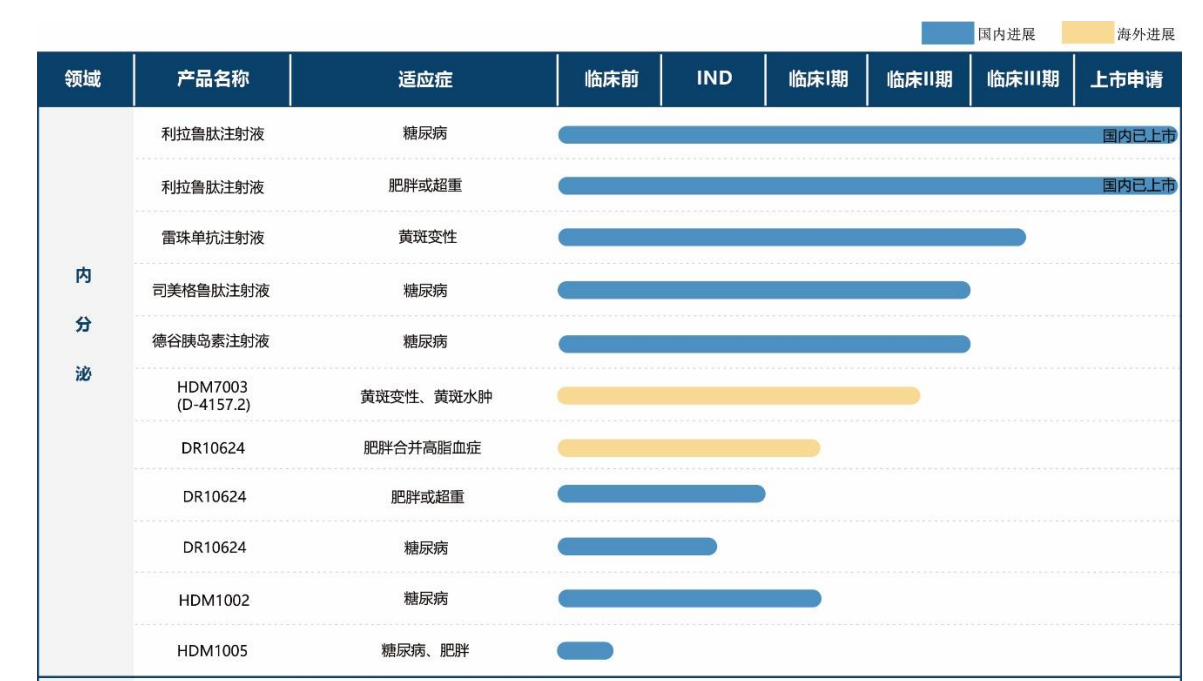
Source of the image: Huadong Medicine Semi-Annual Report
In March this year, Huadong Medicine's Lilupin® became the first domestically produced liraglutide injection to be approved for marketing by the NMPA. Shortly after, the indication for obesity or overweight was also granted marketing approval by the NMPA in early July, making Lilupin® the first GLP-1 drug in China to receive approval for this indication. Huadong Medicine has also taken the lead in challenging the original patent of semaglutide. Its semaglutide injection has completed Phase I clinical trials and achieved bioequivalence endpoints, and Phase III clinical research work has been initiated.
In terms of GLP-1 innovative drugs, Huadong Medicine's pipeline already includes HDM1002, an oral small-molecule GLP-1 receptor agonist, which has received dual IND approval in China and the U.S. for its diabetes indication. The GLP-1R/GIPR peptide-based long-acting dual agonist HDM1005 has entered IND studies. Additionally, SCO-094 and its derivative products, introduced by Huadong Medicine from Japan’s SCOHIA, are also GLP-1R/GIPR dual-target agonists similar to Eli Lilly's tirzepatide, and have already entered Phase I clinical trials in the UK.
Summary
Morgan Stanley once estimated that the market size of obesity drugs will reach 54 billion US dollars in 2030, which is expected to surpass PD-1/PD-L1 to become the largest drug market in the world. With liraglutide injection in hand, semaglutide is proceeding rapidly, and the clinical trials of multiple innovative drugs are accelerating. Huadong Medicine will consolidate its position in the GLP-1 field.

Editor: Mu Mian
Disclaimer: The views expressed in this article are solely those of the author and do not represent the position of PharmCube. We welcome exchanges and additional insights in the comment section; for reprints, please be sure to credit the author and source. If there are any issues regarding the content, copyright, or other aspects of the work, please leave a message on this platform, and we will address it promptly.