

9 Cutting-Edge Therapies for Late-Stage Lung Cancer: New Hope from WCLC2023

AstraZeneca
Biopharmaceutical Manufacturer
▎Edited by the WuXi AppTec content team
Recently, the 2023 World Conference on Lung Cancer (WCLC23) opened simultaneously online and in Singapore. Lung cancer is the leading cause of cancer-related deaths worldwide. In recent years, advancements in antibody-drug conjugates (ADCs), immunotherapy, and targeted therapies have provided patients with more treatment options. Today, the WuXi AppTec content team will share the latest research updates presented at WCLC23 with readers.
Unlocking the Potential of Antibody-Drug Conjugates in Lung Cancer Treatment
Antibody-drug conjugates (ADCs) combine cytotoxic payloads with antibodies targeting specific proteins, killing cancer cells while reducing toxic side effects on healthy cells. At the WCLC23 conference, companies such as Gilead Sciences, AstraZeneca, and Daiichi Sankyo reported the latest clinical trial results for several ADCs.
First-Line Treatment for Non-Small Cell Lung Cancer: Gilead's Trop-2 Antibody-Drug Conjugate Combination Shows Positive Phase 2 Clinical Results
Gilead Sciences announced the results of a Phase 2 clinical trial for the Trop-2-targeted ADC drug Trodelvy in combination with the PD-1 inhibitor Keytruda as a first-line treatment for metastatic non-small cell lung cancer (NSCLC).Trodelvy connects the topoisomerase inhibitor SN-38 to a monoclonal antibody through a hydrolysable linker. It has already received FDA approval for the treatment of triple-negative breast cancer, HR+/HER2- breast cancer, and urothelial cancer.
Preliminary analysis results show that the patient group with PD-L1 tumor proportion score (TPS) ≥50% (Cohort A, n=29)The objective response rate (ORR) was 69%, and the disease control rate (DCR) was 86%.. Patients with PD-L1 TPS <50% (Cohort B, n=32)ORR was 44%, DCR was 78%. Combining the data from the two cohorts, ORR was 56%, DCR was 82%.。
AstraZeneca/Daiichi Sankyo Trop-2 Antibody-Drug Conjugate Combination Shows First-Line Anticancer Activity
Trop-2-targeted antibody-drug conjugate jointly developed by AstraZeneca and Daiichi SankyoDatopotamab deruxtecan is a conjugate of a Trop-2-targeted monoclonal antibody linked to the topoisomerase I inhibitor DXd via a cleavable tetrapeptide-based linker.In the open-label, Phase 1b clinical trial named TROPION-Lung04, datopotamab deruxtecan is being evaluated in combination with the PD-L1 inhibitor Imfinzi (with or without platinum-based chemotherapy) as a first-line treatment for patients with advanced or metastatic NSCLC who do not harbor common targetable genomic alterations.
Preliminary results show,Datopotamab deruxtecan in combination with Imfinzi achieved an ORR of 50.0% and a DCR of 92.9% in treatment-naïve patients. In patients receiving the combination therapy plus platinum-based chemotherapy, the ORR was 76.9% and the DCR was 92.3%.Patients with different PD-L1 expression levels all achieved relief.
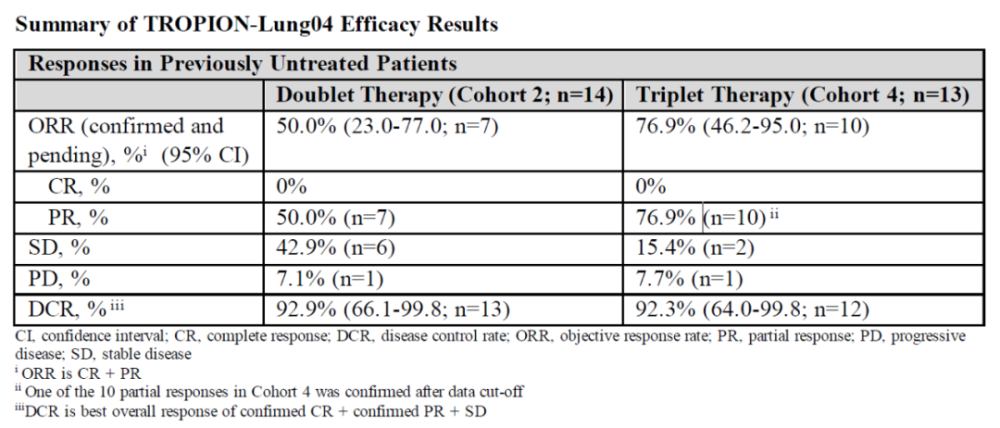
▲Datopotamab deruxtecan combination therapy as first-line treatment for NSCLC: Clinical trial results (Image source: Reference [4])
Enhertu Brings Deep and Durable Relief to Pretreated NSCLC Patients
AstraZeneca and Daiichi Sankyo also announced the primary analysis results of the phase 3 clinical trial DESTINY-Lung02 for the HER2-targeted ADC drug Enhertu as a monotherapy in treating patients with HER2-mutated previously treated NSCLC. The trial results showed,The ORR, median progression-free survival (PFS), and duration of response in the patient group receiving Enhertu at a dose of 5.4 mg/kg were 49%, 9.9 months, and 16.8 months, respectively; these values in the patient group receiving Enhertu at a dose of 6.4 mg/kg were 56%, 15.4 months, and not yet reached, respectively.Regardless of the type of HER2 mutation, patients can benefit from Enhertu treatment.
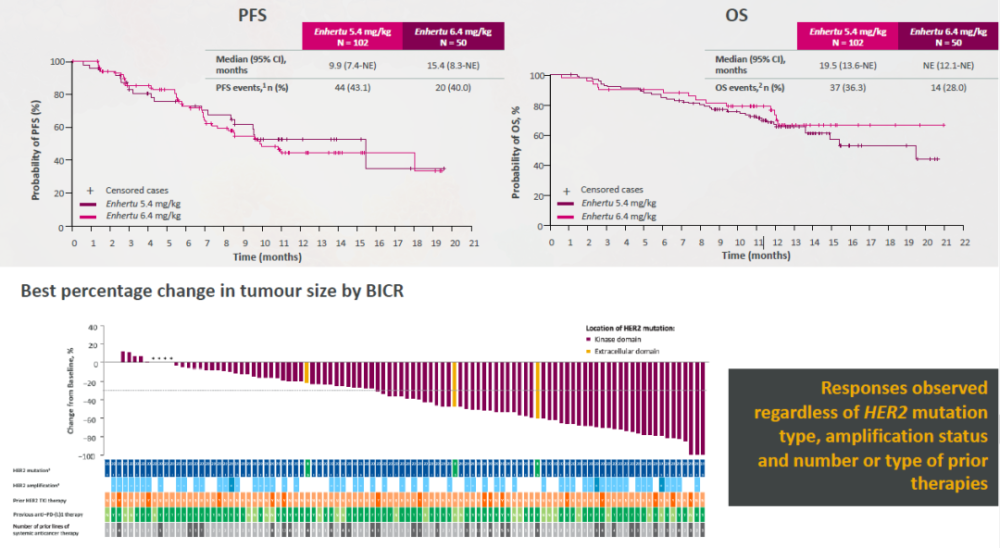
▲Clinical trial results of Enhertu (Image source: AstraZeneca official website)
Potential "First-in-Class" HER3-Targeted ADC Shows Positive Clinical Results; Regulatory Submission Planned
Daiichi Sankyo announced the results of a phase 2 clinical trial of patritumab deruxtecan, an antibody-drug conjugate targeting HER3, for the treatment of patients with EGFR-mutated previously treated NSCLC. Patritumab deruxtecan is a potential "first-in-class" ADC developed using the company's DXd ADC technology. The trial results showed,In patients with locally advanced or metastatic NSCLC who have received EGFR-targeted tyrosine kinase inhibitors and platinum-based chemotherapy, patritumab deruxtecan achieved an ORR of 29.8% and a DCR of 73.8%. The median progression-free survival was 5.5 months, and the median overall survival (OS) was 11.9 months.Based on these results, the company plans to submit a Biologics License Application (BLA) to the U.S. FDA in the second half of the fiscal year 2023.
Treatment of Small Cell Lung Cancer: Daiichi Sankyo's Next-Gen ADC Demonstrates Durable Activity
Daiichi Sankyo also announcedPotential "First-in-Class" ADC Drug Targeting B7-H3: Ifinatamab Deruxtecan (I-DXd)The results of the Phase 1/2 clinical trial. The results showed that, in the treatment of small cell lung cancer (SCLC) patients (n=21) who had received multiple prior therapies,I-DXd Achieves 52.4% ORR (95% CI: 29.8-74.3), including one patient with complete response and ten patients with partial response. The median PFS was 5.6 months (95% CI: 3.9-8.1), and the median OS was 12.2 months (95% CI: 6.4-NA). Tumor shrinkage was observed across a broad range of patients with varying levels of B7-H3 protein expression, and no significant correlation was found between efficacy endpoints and B7-H3 protein expression levels.
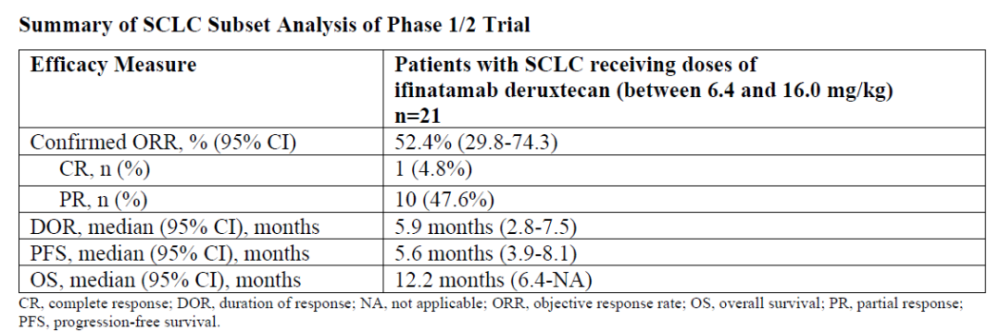
▲Phase 1/2 Clinical Trial Results of Ifinatamab Deruxtecan (Source: Daiichi Sankyo Official Website)
Innovative Therapy Combinations Further Enhance Anti-Cancer Efficacy
From targeted therapy to ADC, from chemotherapy to immunotherapy, lung cancer patients have multiple options across different treatment modalities. How to combine these various treatment options to enhance efficacy without increasing toxic side effects is one of the key directions in lung cancer research. At the WCLC23 conference, several teams reported the latest research results on combination therapies.
Immunotherapy/Angiogenesis Inhibitor Combination Sets New Survival Record for Extensive-Stage SCLC Patients
Professor Cheng Ying from Jilin Province Cancer Hospital orally presented the results of the Phase 3 clinical trial ETER701 study at WCLC23. In this randomized, double-blind clinical trial, 246 patients received a triple therapy consisting of the PD-L1 inhibitor benmelstobart, the tyrosine kinase inhibitor anlotinib (Anlotinib, which targets VEGFR2 and VEGFR3), and chemotherapy, while 247 patients received placebo plus chemotherapy.
At a median follow-up time of 14.0 months, the median PFS for the benmelstobart/anlotinib/chemotherapy group was 6.9 months, significantly better than 4.2 months in the control group. The median OS for the two groups were 19.3 months and 11.9 months, respectively. The ORR was 81.3% and 66.8%, respectively.
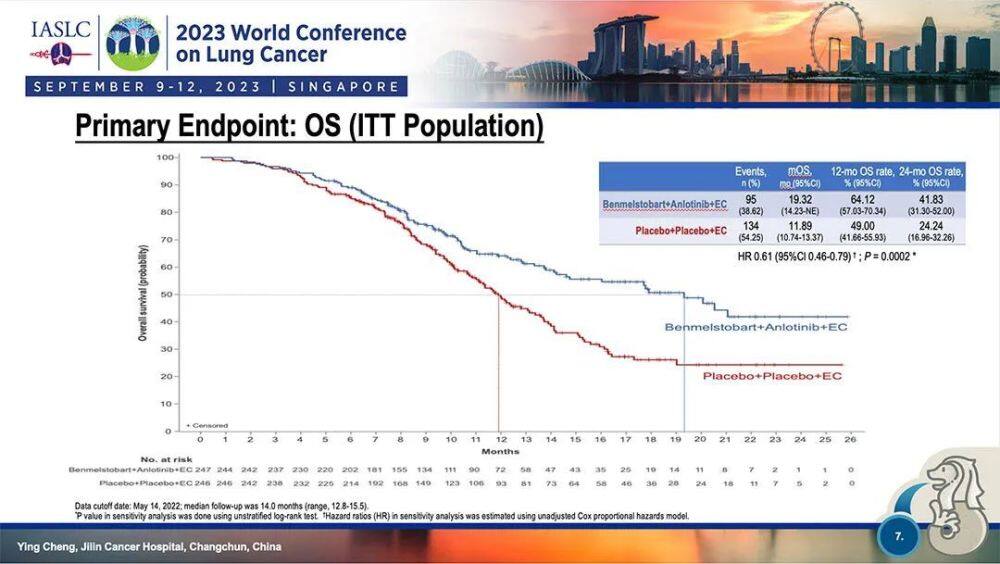
▲Benmelstobart/Anlotinib/Chemotherapy Combination Significantly Improves Overall Survival in SCLC Patients (Image Source: Reference [1])
Professor Cheng Ying said in the press release,Benmelstobart/Anlotinib/chemotherapy combination achieves the longest historical OS and PFS levels in treating extensive-stage SCLC patients, demonstrating significant potential to extend patient survival by combining angiogenesis inhibitors with immunotherapy.
Tagrisso/chemotherapy combination extends PFS in advanced lung cancer patients by nearly 9 months
AstraZeneca PLC announced the phase 3 clinical trial results of EGFR inhibitor Tagrisso (osimertinib) in combination with chemotherapy as a first-line treatment for patients with locally advanced or metastatic EGFR-mutated NSCLC. Tagrisso is a third-generation EGFR inhibitor developed by the company and is currently the standard treatment for these patients as a monotherapy.
The trial results showed that, compared with Tagrisso monotherapy,Tagrisso/chemotherapy combination reduces the risk of disease progression or death by 38% (HR=0.62, 95% CI, 0.49-0.79, p
According to the investigator assessment, the combination therapy extended median PFS by 8.8 months compared with Tagrisso monotherapy, and according to blinded independent central review (BICR), the median PFS extension was 9.5 months. Clinically meaningful PFS benefits were observed across all subgroups.
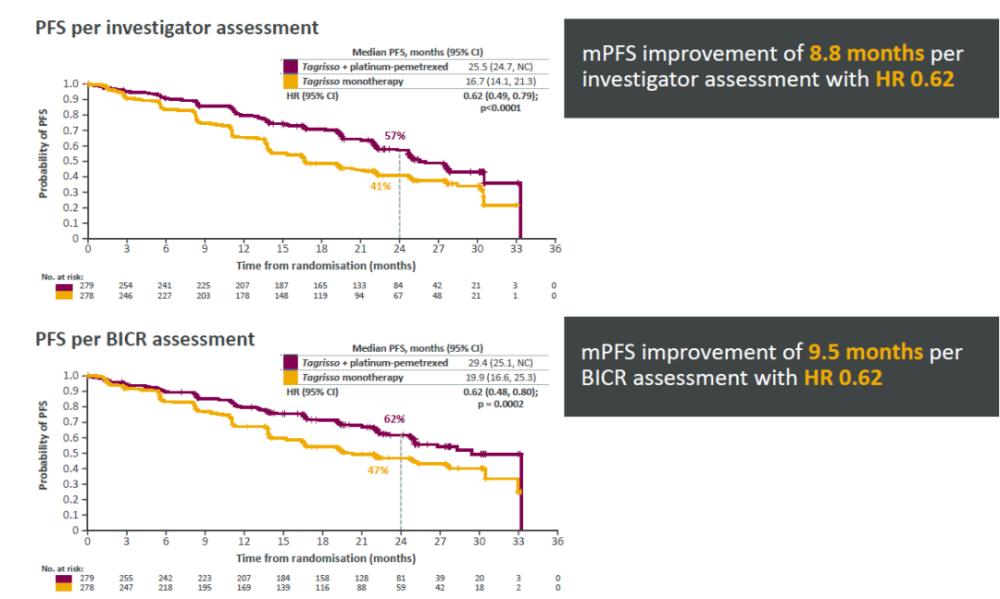
▲Tagrisso/chemotherapy combination significantly improves PFS in patients compared to Tagrisso monotherapy (Image source: AstraZeneca official website)
At the time of data analysis, the OS data were not yet mature, but a trend towards better efficacy with Tagrisso/chemotherapy combination was observed.
First-Line Treatment for NSCLC: KRAS Inhibitor Combination Achieves 100% Disease Control Rate
Amgen announced the results of a Phase 1b clinical trial for Lumakras, a KRAS G12C inhibitor, in combination with chemotherapy, for the treatment of patients with advanced NSCLC carrying the KRAS G12C mutation. The trial results showed,In the first-line treatment setting, the Lumakras/chemotherapy combination achieved a confirmed objective response rate (ORR) of 65% and a disease control rate (DCR) of 100%. In the second-line treatment setting, the ORR was 54% and the DCR was 85%.In patients with PD-L1 expression less than 1%, the ORR was 62% in the first-line treatment setting and 50% in the second-line treatment setting.
Bispecific Antibody Combination Therapy Shows Promise in Addressing Drug Resistance
Janssen announced itsEGFR/MET Bispecific Antibody Rybrevant in Combination with Third-Generation EGFR Inhibitor Lazertinib and Chemotherapy, the results of a Phase 1b/2 clinical trial for treating recurrent/refractory NSCLC patients with EGFR mutations. The trial results showed,In patients with a median number of prior treatments of two, this combination therapy achieved an ORR of 50%. At a median follow-up time of 13.1 months, the median PFS was 14 months, and among the 10 patients who achieved remission, 8 had a duration of response exceeding 6 months.