

Hangzhou's Aggressive Biopharma Policies: Fast-Track Funding from Day One of Company Registration
YOUJIA BIO
Nucleic Acid Drug Developer
In July 2023, the Hangzhou Economic and Information Bureau issued the "Several Measures to Support the High-Quality Development of the Synthetic Biology Industry (Draft for Comments)," which formulated multiple reward and subsidy policies for synthetic biology innovation research and development, industrialization, specialized parks, public service platforms, etc., with a maximum of 100 million yuan. In August, the Hangzhou Environmental Protection Bureau introduced the "Reform Plan for Environmental Impact Assessment System of the Hangzhou Biomedical Industry Lab-Level Production and Related Industries," simplifying the environmental impact assessment approval process for lab-level production.
In 2023, Hangzhou also released a重磅 venture capital document, proposing that the municipal government take the lead in integrating and establishing three major母funds: Hangzhou Science and Technology Innovation Fund, Hangzhou Innovation Fund, and Hangzhou Merger and Acquisition Fund. These funds will participate in investing in N industry母funds,子funds, special子funds, etc., ultimately forming a "3+N" industrial fund cluster with a total scale exceeding 300 billion yuan. The 300 billion yuan fund cluster will focus on supporting strategic emerging industries represented by the five major industrial ecosystem circles, including biomedicine.
"Good policies" have become the评价 of many participants in the biopharmaceutical field towards Hangzhou. As a core city in the Yangtze River Delta region with enormous growth potential in the biopharmaceutical industry, Hangzhou is using "swift, bold, and precise" policies as an entry point to accelerate the development of the biopharmaceutical sector.
In fact, the dense biomedicine industry policies in Hangzhou are not only seen in 2023 but have been in a high-density state in recent years. Within five years, the main policies have achieved a "three-level jump," with the industrial support continuously upgrading.
In 2018, the General Office of the Hangzhou Municipal Government issued the "Implementation Opinions on Promoting the Innovative Development of Hangzhou's Biomedical Industry" (hereinafter referred to as the 2018 "Implementation Opinions"), formulating support measures in various aspects such as new R&D institutions, innovative drugs, innovative devices, and overseas market expansion. In 2021, this document was upgraded to the "Several Opinions on Accelerating the High-Quality Development of the Biomedical Industry" (hereinafter referred to as the 2021 "Several Opinions"), which also proposed support methods for various innovative activities and products.
In 2022, the aforementioned policy was further upgraded with the introduction of the "Several Measures to Accelerate the High-Quality Development of the Biomedical Industry" (hereinafter referred to as the 2022 "Several Measures"). These measures proposed 25 encouraging and supportive policies covering innovative R&D, clinical research, industrialization, and other aspects. The upper limit of the single-item reward for innovative drugs was increased from 30 million yuan to 40 million yuan.
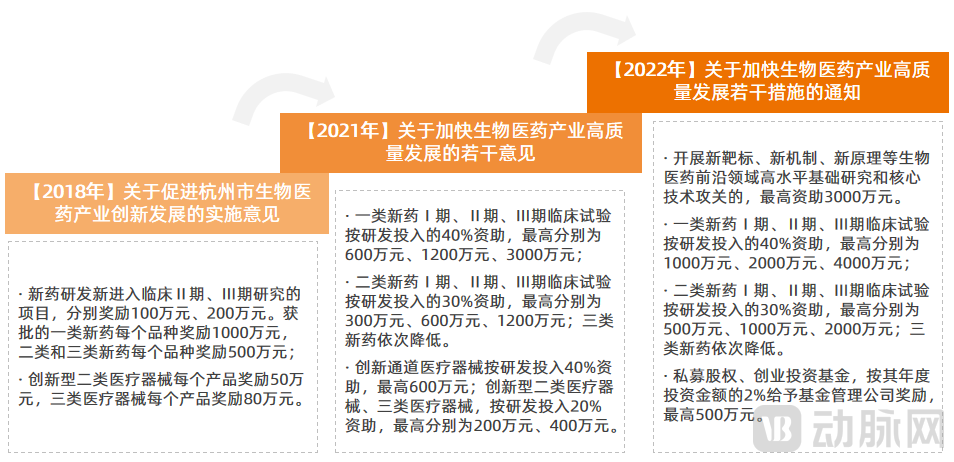 Key Contents of Hangzhou's Biomedical Industry Policy, Source: Official Website of Hangzhou Municipal Government
A comparison of several documents reveals that this main policy has been upgraded in several aspects.
First, the funding amount has increased, especially for drugs, medical devices, R&D services, and market expansion.
In addition to the previously mentioned single-payment rewards for innovative drugs, the reward for individual medical devices has increased from several hundred thousand yuan to up to millions of yuan. Important public service platforms such as GLP and GCP are key areas supported by Hangzhou. In 2022, the "Several Measures" increased the corresponding rewards from a maximum of 18 million yuan to a maximum of 20 million yuan.
Secondly, the funding scope has expanded, extending forward to include support for innovation platforms and scientific research projects, and backward to cover industrialization projects, market expansion funding, as well as infrastructure support such as factory construction.
In terms of innovation sources and achievement transformation, the 2022 "Several Measures" proposed that for the construction of national-level major innovation carriers, the municipal level will provide matching support at 50% of the actual amount of provincial funding received, with a maximum of no more than 30 million yuan.A maximum funding of no more than 30 million yuan will be granted, after evaluation, for high-level basic research and core technology breakthroughs in cutting-edge biopharmaceutical fields such as new targets, new mechanisms, and new principles.
In terms of market expansion, the 2022 "Several Measures" encourage companies to actively participate in national and provincial centralized bulk procurement of medicines and medical devices, rewarding them with 3% of the total winning bid price. The maximum reward for a single product does not exceed 3 million yuan. For overseas markets, drugs that obtain approval from institutions such as the FDA, EMA, or PMDA for the first time, gain overseas marketing qualifications, and achieve sales in relevant foreign markets will be rewarded with up to 1 million yuan per product.
In terms of infrastructure, if a recognized municipal characteristic park constructs standard factories exceeding 100,000 square meters, the municipal finance will provide funding of 20% of the total investment to the district or county (city) where it is located, and the local authorities will accordingly reward the investment entity.
Third, the funding projects are more segmented.
In order to better carry out clinical research and the transformation of results, policies encourage the establishment and operation of research-oriented wards. The 2022 "Several Measures" supports tertiary public hospitals in exploring the establishment of a "Big PI" program for clinical research, providing funding of up to no more than 15 million yuan for the introduction of "Big PIs."
In 2021, the policy proposed to reward MAH and the entrusted party, and in 2022, it specified the exact reward amounts for both parties.
Fourth, the scope of reward recipients has become more diversified. In addition to enterprises, research institutions, and industrial parks involved in industrial innovation, it has gradually expanded to include medical institutions, investment organizations, industry associations, and others, providing multi-dimensional support for industrial innovation.
The 2022 "Several Measures" proposed that medical institutions obtaining drug clinical trial qualifications can receive funding at different levels, approximately 500,000 to 3 million yuan, if they provide clinical trial services to enterprises within the city and reach a certain number of projects annually. Both leading units and participating units are eligible for such funding.
For private equity and venture capital funds, a certain reward will be given to the investment institutions based on a certain percentage of their annual investment amount in Hangzhou's biopharmaceutical enterprises, with a maximum of 5 million yuan.
In addition, 2022 saw the introduction of support for the development of alliances and other social organizations, with funding of up to 2 million yuan provided to a single organization.
Three documents and two updates within five years reflect the rapid pace of change in Hangzhou's biopharmaceuticals industry, while also demonstrating the speed at which government departments respond to industry development needs and promptly upgrade policies. The continuously increasing funding cap further underscores Hangzhou's strong support for the biopharmaceuticals sector.
Developing innovative industries, whether locally cultivated or attracting investments from other regions, involves a multitude of industrial elements. In Hangzhou's biomedicine-related policies, in addition to providing direct financial subsidies for various segments of the industry chain, a key breakthrough lies in talent policy.
Li Yiming (a pseudonym at the request of the interviewee) is the executive president of an investment firm in Hangzhou, which has invested in multiple biopharmaceutical projects in the city. In Li Yiming’s view, a regional biopharmaceutical industry must have a sufficient talent clustering effect to provide companies with recruitment convenience and make them more willing to establish operations there.
In recent years, Hangzhou has established a relatively comprehensive municipal talent identification and subsidy policy.
According to the latest edition of the "Hangzhou High-level Talent Classification Catalogue," high-level talents are divided into: top talents from China and abroad, national leading talents, provincial leading talents, municipal leading talents, and senior talents (corresponding to categories A, B, C, D, and E respectively). According to the subsidy standards, categories A, B, C, and D talents can receive maximum housing subsidies of 8 million yuan, 2 million yuan, 1.5 million yuan, and 1 million yuan respectively, with each category also eligible for a monthly rental subsidy of 2,500 yuan.
In addition, there are corresponding subsidies for fresh graduates. The subsidy standards released by the Hangzhou Human Resources and Social Security Bureau in 2023 are: 10,000 yuan for undergraduates, 30,000 yuan for master's degree holders, and 100,000 yuan for doctoral degree holders.
Several municipal districts in Hangzhou have also equipped themselves with specialized talent programs according to their own situations, such as the "5050" Plan in Binjiang District and the "5213" Project in Xiaoshan District, exploring the "synchronized" introduction of high-level talents and projects.
Thanks to the improvement of talent policies at all levels, Hangzhou has seen a considerable inflow of talent in recent years.
According to the "China City Talent Attractiveness Ranking 2023" jointly released by Zhaopin Recruitment and Zeping Macro, from 2018 to 2022, Hangzhou's net talent inflow ratio was 1.2%, 1.4%, 1.6%, 1.6%, and 1.3%, respectively, always remaining positive, with its talent attractiveness ranking consistently among the top in China. In 2022, Hangzhou ranked fifth among the top 100 most talent-attractive cities in China, following Beijing, Shanghai, Guangzhou, and Shenzhen.
Of course, the recognition criteria for high-level talents are also quite strict, with many requirements related to academic qualifications, alma mater, research projects or scientific research experience, academic papers, scientific and technological achievements, social contributions, etc. Moreover, the aforementioned talent policies cover the entire industry, of which the biomedical field is only a part.
However, in the wave of industrial innovation, similar to many other cities that focus on biomedicine as a key industry, Hangzhou also faces a scarcity of biomedicine talents, especially high-end talents and interdisciplinary compound talents.
Previously, the Hangzhou Talent Management Service Center released the "Hangzhou 2022 Key Industry Talent Shortage Directory," covering the top 30 positions in terms of scarcity across five major industry ecosystems.Among the 30 urgently needed positions in the biopharmaceutical industry, 26 positions are marked as "very urgent," including pharmaceutical R&D, clinical data analysis, and pharmacology/toxicology researchers.
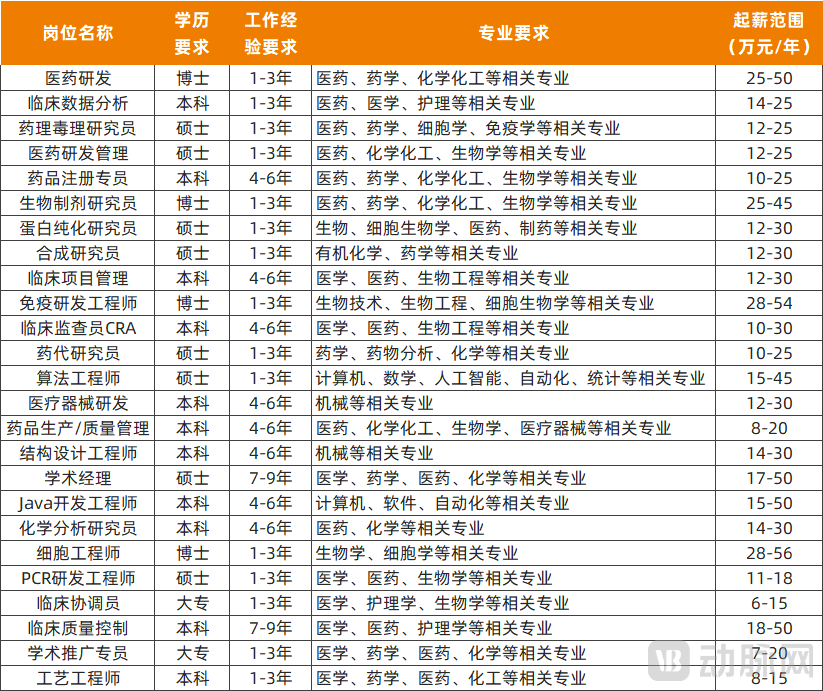
Biomedical Positions in "Very Short Supply" in Hangzhou, Source: Hangzhou Talent Management Service Center
To attract and retain more outstanding biomedicine talents, the 2022 "Several Measures" stipulates that it is necessary to explore a biomedicine talent evaluation standard with "Hangzhou characteristics" and provide support in the classification and evaluation of high-level talents. Key employers who meet the requirements will be authorized to pilot the classification and evaluation of high-level talents based on aspects such as position, capability, and performance.
Qiantang District is the core area of Hangzhou's biomedicine industry cluster planning and has also conducted more in-depth exploration in terms of biomedicine talent systems. In 2021, Qiantang District issued the "Detailed Rules for the Implementation of Talent Evaluation in the Biomedical Industry of Qiantang District, Hangzhou (Trial)".The new evaluation system breaks the common standards of "only papers, only titles, only education, only awards" and builds a multi-dimensional evaluation system for biopharmaceutical industry talents. This system mainly uses a seven-dimensional scoring assessment based on salary, work experience, innovation achievements or enterprise benefits, urgency, etc., supplemented by directory recognition and authorized recognition, increasing the proportion of market evaluation.
In other words, if some biopharmaceutical talents make outstanding contributions to industrial development but are unable to apply for recognition as high-level talents under the city-wide general talent policy due to their academic qualifications, awards, or other factors, they can still receive talent evaluation through the aforementioned new policy.
As of January 2023, 69 professionals in Qiantang District have been awarded QE-class talent status through the biopharmaceutical industry talent evaluation, enjoying corresponding talent benefits. Eligible researchers may also be given priority for housing support.
Attracting Overseas Talent: An Important Way to Quickly Supplement Local Industry Human ResourcesTo establish a channel for international professional qualification certification and domestic title recognition, Qiantang District has released two batches of the "Qiantang District Biomedical Industry International Professional Qualification Comparative Title Recognition Directory" since 2022. This includes over 30 types of professional qualifications from countries such as the United States, Australia, and Singapore, covering pharmacists, registered clinical research professionals, and international biomolecular technicians, among others. These efforts have made employment channels in China smoother for international high-end talent.
More precise talent policies in the biopharmaceuticals industry can not only attract high-level talents to establish or introduce projects, but also support projects with high-quality talents evaluated through market-oriented assessments, providing companies with a larger pool of excellent talents to recruit from.
Hangzhou Haibang Fenghua Investment Management Co., Ltd. established the Haibang Talent Fund in 2011, which initially focused on investing in various projects led by returned overseas talents. As an increasing number of biopharmaceutical professionals return to Hangzhou to start businesses, the talent fund has evolved into a healthcare fund.
"Generally speaking, Hangzhou's talent project policies cover the entire enterprise development cycle. Start-up funds can be applied for during the project incubation phase, entrepreneurial funds can be applied for after the project takes shape and the team is initially established, and there are talent echelon policies during the industrialization phase; the policies at different stages form a combination that can meet the needs of various talent projects," said Shan Jialiang, Managing Partner of Hangzhou Haibang Fenghua Investment Management Co., Ltd.
While the formulation and improvement of policies are important, the efficient implementation of these policies provides more practical support to the industry.
"The policy implementation efficiency in Hangzhou is very high." Li Yiming has a deep impression of the speed at which local policies are implemented. "In other parts, however, whether due to crowding-out effects or less-than-ideal local fiscal revenue, the consistency of subsequent policy enforcement and the conditions included in the policy itself may not necessarily align with what companies need most at this stage, and promises may not be fully delivered."
According to information released by the Hangzhou Economic and Information Technology Bureau, project applications were quickly initiated following the release of the 2018 "Implementation Opinions." In December 2018, 56 projects proposed for approval were publicly announced.
Since then, project applications and proposed funding announcements have been made each year based on the policies at the time. To date, a total of 289 projects have been announced, covering various types such as the approval and industrialization of innovative drugs, the first approval and industrialization of medical devices, and the construction of public service platforms.
In April 2023, based on the Several Measures published in 2022, Hangzhou has initiated a new round of special application work; projects are being solicited for various situations including the research and production of innovative drugs and improved new drugs, the research and production of medical devices, the industrialization and implementation of innovative projects, and industrial financial support. According to previous progress, the projects planned for funding in this round may be announced in the fourth quarter of 2023.
In addition to such unified funding, Li Yiming mentioned,Hangzhou also demonstrates genuine strength in the "case-by-case" policy, which can ultimately be fulfilled with substantial financial support. "The supporting measures are negotiable, relatively humanized, and very attractive to investors and enterprises."
YOUJIA BIO is one of the enterprises introduced to Hangzhou under the "special issue, special discussion" policy. General Manager Wang Meng stated that since the company settled in Hangzhou in 2019, over three years, all the policy funds promised during the investment attraction have been fully received.
"The funding we discussed at the time included investment promotion subsidies, relocation awards, talent awards, and full rent exemption for the first three years, and these subsidies or incentives were independent of each other, not overlapping," said Wang Meng, adding that overall, these funds were quite attractive to startups.
Another key factor that attracted YOUJIA BIO was the rapid implementation of funding policies. "From the issuance of the notice to the acceptance, it only took 3 or 4 months; we had just registered the company and opened a bank account when the first tranche of support funds arrived."
Wang Meng talked about that after the company settled down, if there were any problems during operation, they could report to relevant departments and get them resolved as soon as possible. "When the company first moved here, there was no bus service in the park. Multiple companies in the park reported this to higher authorities, and a few months later, bus services were launched. For other minor operational issues, if relevant departments could solve them on the same day, they generally wouldn't wait until the next day."The efficient problem-solving style of the competent authorities is also a reason that attracts enterprises.”
In February 2022, Yuhang District of Hangzhou released the "Golden 68 Articles" industrial new policy. In the biopharmaceutical field, it introduced the concept of "advance disbursement," providing up to 10 million yuan in support for projects that have entered clinical trials in China. For completing Phase I, II, and III clinical trials, additional top-up support is provided at a maximum total amount of 6 million yuan, 12 million yuan, and 30 million yuan respectively. In line with Yuhang's characteristics, MAH enterprises are encouraged to register their tax and sales within Yuhang District, with rewards of up to 8% based on their sales revenue.
High R&D investment and long cycles are characteristics of the biopharmaceutical industry. Any delay in funding at any stage could impact the progress of R&D, or even lead to total loss of prior efforts. Faster access to funds may be a bonus for startups, but more importantly, it can be a lifeline during difficult times. The efficient implementation of policies undoubtedly enhances Hangzhou's appeal to innovative companies.
In addition to the special policies for the biopharmaceutical industry, various science and technology innovation support policies issued by Hangzhou's departments also cover the biopharmaceutical field.
For example, in June 2023, the Hangzhou Science and Technology Bureau released the "Detailed Rules for the Implementation of Fiscal Subsidies for Enterprise R&D Expenditure in Hangzhou City," supporting the five key industrial fields developed in Hangzhou: intelligent IoT, biomedicine, high-end equipment, new materials, and green energy.
In February 2023, the "Ten Policy Measures of Hangzhou City to Support Disruptive Technology Innovation" were released, providing financial subsidies in areas such as basic research, major platforms, concept validation, large-scale R&D projects, leading teams, collaborative innovation, major equipment, innovation competitions, and social capital. The special fund for major scientific and technological innovation platforms is no less than 30 million yuan.
Municipal and district/county-level policies, specific and comprehensive policies, demonstrate Hangzhou's visible determination to develop the biopharmaceuticals industry. Despite...These policies are generally implemented according to the principles of "optimal, highest, and non-repetitive," meaning that the same company or project cannot receive overlapping funding for the same type of policy. However, due to the large number and detailed nature of the policies, for innovative companies, "there's always one that suits you."
In Shan Jialiang's view, the biopharmaceutical industry requires long-term incubation and accumulation, as well as policy support to build a foundational infrastructure and create an ecosystem. In recent years, Hangzhou has implemented strong policies, and some projects established years ago that secured investments are gradually going public. In the future, more companies will enter the secondary market. "After a company goes public, it can expand using its own capital and resources, further enriching the industry ecosystem."
However, Wang Meng also mentioned that with the gathering of outstanding enterprises, the policy threshold in Hangzhou has increased over the past two years. There are now higher requirements for the potential of the enterprise's sector, the innovative value of the enterprise, and the background of the team. "But one thing is certain: Hangzhou has a strong willingness to nurture enterprises in the biopharmaceuticals industry. Even knowing that biopharmaceutical R&D cycles are long and that there may be no output for 3-5 years or even 5-10 years, they are still willing to invest."
References:
Yuhang Morning Post: Interpretation of Yuhang's "Golden 68 Articles" Industrial Policy Innovations
Qiantang Pioneer: 69 Talents Receive the First Batch of Biomedical Industry Talent Certification
ZePing Macro: China City Talent Attractiveness Ranking 2023