

How Nearly 30 Medical Innovators Secured Multiple Rounds of Funding in 2026: Product Strength, Commercialization Power, and Execution Excellence
Puncture Robotic
Medical Robot Developer

Intalight
High-end Ophthalmic Equipment Developer

Horimed
OCT Imaging Equipment R&D and Manufacturer

MEIO MEDICAL
Developer of Cardiac Interventional Surgical Robots

Dessight Biomedical
Developer of Microsurgical Robotics Platform
At present, financing in the primary market is becoming increasingly difficult.
"We started reaching out to investors last year, but there aren't many institutions willing to engage in deep discussions. Those who are interested have not yet reached an agreement with us on issues like valuation adjustments and valuations," a co-founder of a dental healthcare enterprise, who wished to remain anonymous, told VCBeat. He frankly stated,Compared with the booming scene of the medical venture capital industry in 2021, the current financing environment is chilling, and investment institutions are increasingly treasuring the number of times they pull the "trigger."
Data also supports this trend. The "2023 H1 Global Healthcare Industry Capital Report" released by VCBeat shows that in the first half of this year, the total amount of financing in China's healthcare industry was approximately 41.051 billion yuan, a year-on-year decrease of up to 43%, nearly "halved".
However, in the face of a severe venture capital environment, some companies have still managed to raise funds against the trend and become the "darlings" that capital continues to bet on.
VCBeat statistics found that,From January to September this year alone, 28 medical innovation companies have received two or more rounds of financing: some are moving from the R&D stage to commercialization, embarking on a new journey; others have officially turned profitable and gradually entered the harvest period, rapidly growing into industry unicorns.
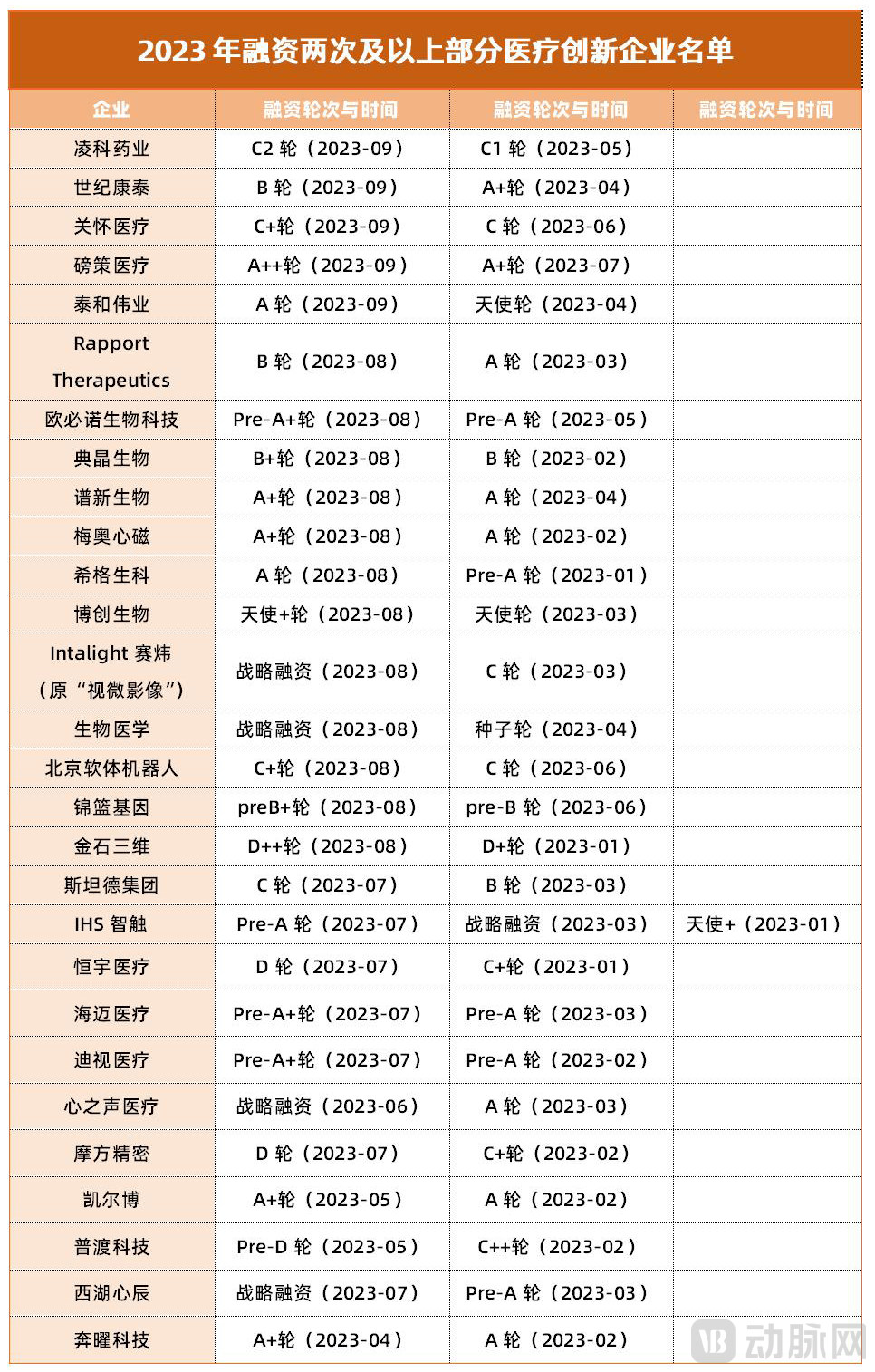
(Data source: VCBeat database, Qichacha VCBeat chart)
Being able to secure multiple rounds of financing during a capital winter demonstrates, to a certain extent, the strong capabilities of these companies. We have organized and analyzed the business operations and models of these representative enterprises to understand and learn from their journey of breaking the ice during this challenging period.
Start-up medical enterprises account for more than 60%.
How Did They Manage to Raise Funds Against the Trend?
Even in the depths of winter, there is warm sunshine.
In the current climate of lackluster overall investment performance, the fact that 28 medical innovation companies have completed two or more rounds of financing this year has undoubtedly injected a "booster shot" into the industry.
From the data, 28 medical innovation enterprises are statistically categorized into start-up enterprises (before Series B), growth enterprises (Series B to Series C, including Series C), and mature enterprises (after Series C) based on their latest financing round.The largest proportion of companies on this list are startups, accounting for 62%.
This is not difficult to understand. Startups are in a critical period of R&D, requiring the introduction of a large number of talents, advancing R&D progress, and therefore have a stronger willingness to raise funds. From the perspective of investment institutions, investing early and small has also become a common focus in the industry.
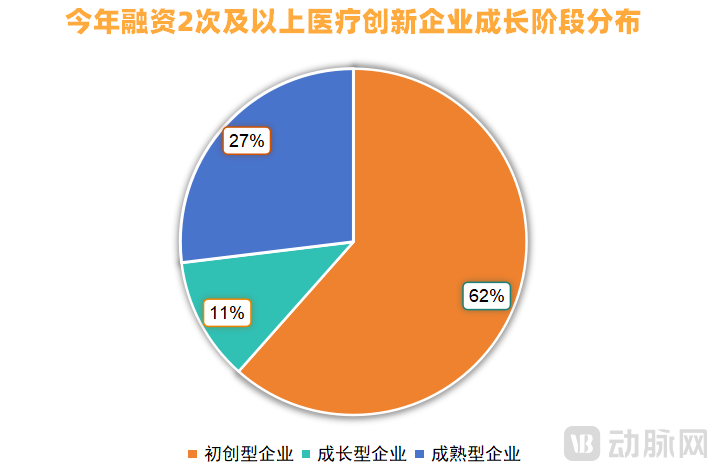
(Source: VCBeat Database, Chart by VCBeat)
Of course, the ability to quickly secure multiple rounds of financing is enough to prove the favor of investment institutions towards these startups.
In the specific细分赛道they are in, medical device companies account for about half of the total number.
In this regard, industry investor Shen Yi (a pseudonym at the request of the interviewee) believes that this is related to the characteristics of device companies themselves:Medical device products have relatively fast iterations, shorter R&D cycles, and focus mainly on incremental innovations. Therefore, the cycle for阶段性成果 is shorter, and the frequency of financing tends to be faster compared to other细分领域.
Besides, the support from policies is also an important reason for capital to focus on innovative devices. For instance, the "14th Five-Year Plan for the Development of Medical Equipment Industry" proposed that the medical equipment industry should focus on the development of seven key areas, including diagnostic and testing equipment, treatment equipment, monitoring and life-support equipment, traditional Chinese medicine diagnosis and treatment equipment, maternal and child health equipment, health care and rehabilitation equipment, and active implantable devices. This brings opportunities for innovative companies aiming to fill the gaps in China's medical equipment industry.
"It can be said that for innovative medical device companies,Strong independent R&D capabilities and clinical application scenarios aligned with national policy directions have become two key indicators for investors."Industry investor Shen Yi said."
Successfully secured A+ and A++ rounds consecutivelyPuncture RoboticFor example. As an innovative enterprise centered on surgical robots, Puncture Robotic has been focusing on providing specialized solutions for common clinical needs. It has now obtained nearly a hundred patents and owns products such as hair transplantation robots and surgical robot puncture navigation systems, covering fields like medical aesthetics and oncology.
From the perspective of the track being cultivated, one of the directions Puncture Robotic is currently focusing on—hair transplantation—is a vast field with high demand but low penetration. According to data from the National Health Commission, in 2022, more than 250 million people in China were troubled by hair loss, while the number of hair transplant surgeries was only about 630,000, with a penetration rate of just 0.25%. Additionally, the group experiencing hair loss is showing a trend toward younger individuals, and the demand for hair transplantation continues to grow.
Such as obtaining Series A, Series A+ roundsMayo Heart MagneticIt focuses on the independent innovation and development of intracardiac surgical navigation technology, energy ablation platforms, and flexible interventional consumables, providing clinical solutions for cardiac electrophysiology and structural heart disease surgeries. In March this year, Mayo Heart Magnetic's first product, the "TITIAN Tixian® Cardiac Electrophysiology Interventional Device Control System," was approved to enter the special review process for innovative medical devices in China, also known as the "Green Channel" for innovation.
In terms of application scenarios, the cardiovascular intervention field that Mayo Heart Magnetics focuses on holds significant clinical value. It is important to note that China has a large number of patients with arrhythmia, with over 12 million suffering from atrial fibrillation alone. Behind the high number of patients lies a low treatment penetration rate. According to the "Report on Cardiovascular Health and Diseases in China," the number of atrial fibrillation radiofrequency ablation procedures reached 150,000 in 2022, meeting the surgical needs of less than 2% of atrial fibrillation patients.
Next, look at the completion of the Pre-A round and Pre-A+ roundDessight BiomedicalFocusing on the robotics field, this company is accelerating the clinical trials of ophthalmic surgical robots in humans and the development of other pipeline products such as microsurgical robots. In terms of R&D capabilities, Dessight Biomedical is one of the teams that has achieved a motion precision of 3 micrometers for ophthalmic surgical robots.
Returning to clinical value, ophthalmology is a golden field that has seen a rush of capital in recent years, and Dessight Biomedical is making significant strides in this area. On one hand, with the acceleration of population aging, there is a large amount of unmet demand for retinal diseases in China, indicating a vast market space. On the other hand, retinal specialists on the clinical front are in urgent need of better and more advanced equipment to assist them in performing complex surgical procedures, showing a strong demand for such devices.
"Everyone is talking about the winter, but in fact, the Internet era has also gone through rapid explosions and several rounds of bubble removal. Now, the primary healthcare market is undergoing a similar process. For high-quality enterprises, such as those that can address clinical pain points, 'In China for Global,' possess strong commercialization capabilities, and have strong execution abilities, they remain sought-after targets for investment institutions. Therefore,The core is still that one must be strong oneself to forge ahead."Wang Yueyue, managing partner of Tianchao Capital, a boutique investment bank in the healthcare sector, told VCBeat."
Squeeze in more diverse investors,
The Key to Continuous Favor Lies in Commercialization and Implementation Capability
After getting through the R&D stage, enterprises gradually move into the growth and maturity phases, and the pace of financing tends to slow down compared to the start-up phase. However, this year, 10 companies, including Lingknot Pharma, CareMedical, Intalight, Horimed, Stanford Group, and BMF Precision, still secured financing at an ultra-fast pace, with several reaching Series D or beyond.
This is closely related to the company's ability to commercialize and implement its products.
Multiple medical investors told VCBeat that, generally speaking (the situation in the biopharmaceutical field is unique as many biopharmaceutical companies have not yet officially commercialized even after going public; this mainly refers to fields such as medical devices, life science tools, digital health, and medical services), the achievement of milestones for medical innovation companies that have progressed to Series B and beyond is tied to revenue and profitability.
Therefore, being able to secure two or more rounds of financing in a short period also indicates that these companies are advancing rapidly in the market and demonstrating excellent commercialization capabilities.
For example, Intalight, a high-end ophthalmology platform company that received two rounds of financing this year.Intalight(Originally "Intalight"), its commercialization is rapidly advancing. Currently, Intalight's OCT product sales and installations have exceeded 200 units, with over 75 units installed in leading hospitals nationwide and at the provincial level in China. More than 80% of these devices are used as the main equipment in benchmark hospitals.
It is reported that the terminal sales of Intalight's product, Ruyi Full-Eye OCT, approached 200 million yuan in 2022. In the first half of this year, Intalight's revenue has already exceeded the total revenue of last year.
It is worth mentioning that after completing over 300 million yuan in Series C financing and a strategic funding round earlier this year, the list of investors in Intalight has continued to grow. New additions include well-known institutions such as GD Life Science Fund, Qianhai Ark, CD Capital, Shenzhen Capital Group, CICC Convergence, Lingang Blue Bay, as well as industry-leading enterprises like Huaxia Eye.
It is important to know that a diversified lineup of investors can help the invested enterprises better integrate industrial chain resources, expand markets, and collaborate on research and development.
For instance, this year, it also secured two rounds of financing.HorimedAs an intelligent intravascular interventional endoluminal diagnosis and treatment platform enterprise, it focuses on the research and development of products such as intravascular ultrasound equipment and catheters, optical coherence tomography equipment and catheters, and IVUS/OCT integrated dual-catheter systems. It is currently maintaining a steady, phased certification process while continuously accelerating commercialization.
It is reported that in the 2023 sales inaugural year, Horimed's sales performance has exceeded expectations.
Beyond this, Horimed's research collaboration map is also expanding. Currently, Horimed has established deep cooperative relationships with more than ten hospitals, including the Second Affiliated Hospital of Harbin Medical University, the Second Affiliated Hospital of Zhejiang University, the General Hospital of the People’s Liberation Army, Sir Run Run Shaw Hospital of Zhejiang University, the Tenth Hospital affiliated to Tongji University, the First Affiliated Hospital of Xi’an Jiaotong University, Hangzhou First People’s Hospital, and Fuwai Hospital, and is engaged in strategic cooperation with institutions such as Tianjin University.
During the rapid financing process, Horimed has also introduced more diversified investors. Just this year, two rounds of financing have attracted well-known institutions and industry giants such as Tasly Capital, Alibaba, and Huatai Zijin. This undoubtedly provides new momentum for the rapid development of Horimed.
In the view of Wang Yueyue, managing partner of Tianchao Capital, whether it is a start-up, a growing enterprise, or a mature enterprise,In summary, the ability to secure multiple rounds of financing in a short period during the capital winter can be roughly summarized into three levels.
·First is product strength. The products of such enterprises have significant competitive advantages in the market, address clinical pain points, offer differentiation, and operate in markets with strong growth potential and international competitiveness.
· Second, existing or potential commercialization capabilities;
· Thirdly, enterprises have strong execution capabilities, developing rapidly from 0 to 1 and from 1 to N, outpacing their peers to form relative or absolute market advantages. They also possess strong financing capabilities, external cooperation abilities, talent attraction capacities, and the capability to leverage all resources for rapid business growth.
"If innovative companies have strong continuous financing capabilities, it can significantly enhance their risk resistance and provide them with enough 'ammunition' to face more competitors." Industry investor Shen Yi reminded: "However, financing is only a tool for value creation, not the end result. Therefore,After financing, it is important to focus on strategic consistency and operational efficiency to ensure the effective use of funds and the continuous creation of value.”
"Otherwise, when the next cold spell hits, companies won't have enough chips to stay in the game, and 'running out of ammunition and food' will become a high-probability event."
The most important thing right now is to survive first,
After the dormant period, the industry is bound to experience a major boom.
A Review of the Development History of Various Industries: Often, When the Capital Market is in Bad Shape, Those Well-Tempered and Truly High-Quality Enterprises Will Eventually Break Through the Ice and Emerge.
For instance, the Internet bubble around the year 2000 caused more than 90% of Internet companies to go bankrupt and exit the historical stage. In the face of such severe challenges, companies like Alibaba and Tencent, which were also hit hard, chose to lie low, accumulate strength, and iterate, eventually becoming industry giants that not only survived but thrived.
The same is true in the field of medical innovation. Today's globally renowned giants in medical innovation have all gone through at least two or more industry cycles.Most crucially, when faced with immense challenges, they all prioritized survival above all else and continued to accumulate innovation while lying low.
Take Medtronic, a global leader in medical technology, as an example. Since its founding in 1949, it encountered three major crises in 1960, 1976, and 1985, even facing the brink of collapse. However, under each crisis, it was always able to adjust its strategy in time and make the right decisions.
In the face of current financing difficulties, innovative companies are also actively seeking new solutions. For instance, mini-rounds of financing represented by + rounds and ++ rounds have become increasingly common recently.Among the companies that have received two or more rounds of financing this time, many have adopted the strategy of "+ round" or "++ round" financing, accounting for more than half.
Industry investor Shen Yi told VCBeat that a mini-round is a type of financing with a relatively small amount of capital, often used when a company is approaching a certain milestone. One scenario is when the company is short on funds and needs financing to achieve the milestone. Another scenario is when a new investment firm is very optimistic about the company and wants to invest. At this point, the financing round is usually designated by the company as + or ++ rounds.
"Financing is extremely difficult now, as evidenced by longer financing cycles and more dispersed funding amounts compared to the past," said industry investor Shen Yi. On one side, institutions struggling to raise funds are becoming increasingly cautious with their investments, while on the other side, there is a large number of innovative companies in need of financing.
Therefore, in this situation, smaller mini-wheels have become popular.
"I don't think this is a bad thing. Despite some negative voices in the market, I believe this is a high-quality choice for innovative companies in the current environment. After all, in the booming year of 2020 for innovative drugs, many companies raised funds at sky-high valuations.A company still in the B-round stage has reached a valuation typical of the D-round level, receiving funding disproportionate to its actual size at the time, and quickly overextending its resources. Once the money runs out without any tangible results, no one will dare to take over, and the collapse of the entire enterprise will follow in an instant.." Industry investor Shen Yi emphasized.
Another key reason lies in the fact that when the overall venture capital environment is not good,Innovative companies take small but rapid steps through mini-round financing, which not only demonstrates their ability to utilize funds and implement strategies but also builds confidence among investment institutions in the short term, thereby attracting them to continue betting.This is also an important factor why so many medical innovation companies have secured multiple rounds of financing this year.
"We are also advancing with round ++ financing. However, the target amount is 20% less than what we set at the end of last year," the co-founder of the aforementioned dental healthcare company told VCBeat, "After all, survival comes first; only then can we have the confidence to keep talking about our dreams."
"In the current environment, it is also necessary to have a good FA to assist companies in advancing financing accurately, efficiently, and with high quality," said Wang Yueyue, managing partner of Tianchao Capital. "Beyond financing,Innovative companies can also consider more diversified cooperation methods."For instance, product authorization can be transferred to large enterprises, or jointly developed with them. Startups can even be sold to large enterprises with strong registration and sales capabilities, relying on their resources for mutual benefit, which can multiply or even increase the commercial value and returns of the product several times over. Additionally, it facilitates shareholders' exit."
Of course, no matter how the environment changes, innovation-driven companies should still prioritize R&D as the foundation.
VCBeat found that, after reviewing the financing news of 28 innovative medical companies that received two or more rounds of funding this year, every company prioritized research and development as the most important use of funds, followed by market expansion.
It can be said that,"R&D Reigns Supreme: The Key to Survival and the Essence of a Medical Innovation Company"For example, the core competitiveness of multinational companies such as AstraZeneca, Eli Lilly, Johnson & Johnson, Sanofi, and Medtronic lies in their ability to maintain innovation and R&D capabilities, thereby continuously launching new products that meet clinical needs.
Believe that, as with the evolution of every industrial cycle, when the chill fades and sunlight gradually breaks through the clouds, those medical innovation companies that have endured hardships and traversed dormant periods will surely rise towards the light.