September 18,GSGSK Announces Senior Vice President and R&D Head John Lepore Has Departed to Pursue External Opportunities. Public information shows that John Lepore has worked at GSK for nearly 17 years and served as the head of GSK's R&D for over five years.Meanwhile, this British pharmaceutical company is restructuring its R&D team, perhaps with the aim of...To improve the efficiency of late-stage clinical development。When the cost-reduction effects from isolated layoffs and divestment of underperforming assets can no longer sufficiently meet pharmaceutical companies' development needs, improving R&D efficiency from a fundamental logic has become the latest strategy for the world's top pharmaceutical enterprises.GSK: R&D Team "Split into Three"
Respiratory and Immune System, Vaccines and Infectious Diseases, Cancer: "Divide and Conquer"
GSK has split its R&D department into three independent teams, each focusing onRespiratory and Immunology、Vaccines and Infectious DiseasesAndOncologyResearch,All the persons in charge are in place.Kaivan KhavandiWill leave BenevolentAI, rejoin GSK to leadRespiratory and ImmunologyR&D Team.Prior to this, he worked at GSK for nearly three years, responsible for clinical development in the cardiovascular, neurology, and emerging therapeutic areas. Before joining GSK, he served as the head of clinical R&D for inflammation and immunology at Pfizer.Current GSK Senior Vice President andVaccinePhil Dormitzer, Global Head of R&D, will expand his responsibilities to include oversight ofInfectious DiseasesResearch and Development.Phil Dormitzer joined GSK in December 2021. Prior to that, he worked at Novartis for 8 years as the head of vaccine research and development, and at Pfizer for 6 years as the Chief Scientific Officer responsible for RNA and viral vaccine research and development.CurrentHesham Abdullah, Senior Vice President of GSK and Head of Global Oncology R&D, will continue to serve in his role.TumorR&D Director.Hesham Abdullah joined GSK in June 2019. Prior to that, he worked at AstraZeneca for over 8 years, leading the immuno-oncology R&D.
A GSK spokesperson stated that, currently, these splits only apply to the R&D teams, forming three major independent teams.Responsible for various initial drug target researchAnd early clinical development, ifA certain R&D pipeline has entered Phase III clinical trials and will be further managed by the company's clinical development team for late-stage clinical research.。
GSK Chief Scientific Officer Tony Wood said in an internal company email,Respiratory and ImmuneIt is a field where GSK has made remarkable achievements in scientific research and will usher in significant new breakthroughs, especially with the long-acting anti-IL-15 monoclonal antibody.Depemokimab(Treatment of Asthma) andCamlipixant(A highly selective P2X3 receptor antagonist with best-in-class potential, currently in Phase III clinical trials for the first-line treatment of refractory chronic cough patients).When asked whether these changes would lead to layoffs or project cuts, a GSK spokesperson said that the vast majority of positions in the R&D department remained unchanged.And added that since the current CEO Emma Walmsley took office, GSK's R&D investment has increased by 40%, with last year's R&D investment exceeding £5 billion (approximately $6.2 billion).The top priority now is to accelerate the commercialization of R&D products and improve the return on investment in R&D.Coincidentally, Roche recently announced its R&D strategy, which also focuses on the "control" of Phase III clinical trials.
Roche: For Phase III Clinical Development
"Install an Extra Door"
How to Improve R&D Efficiency and Minimize R&D "Losses"?
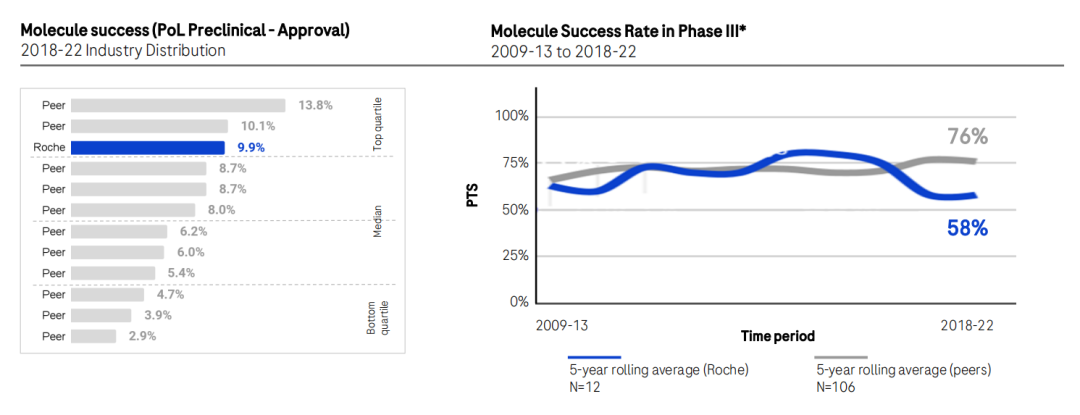
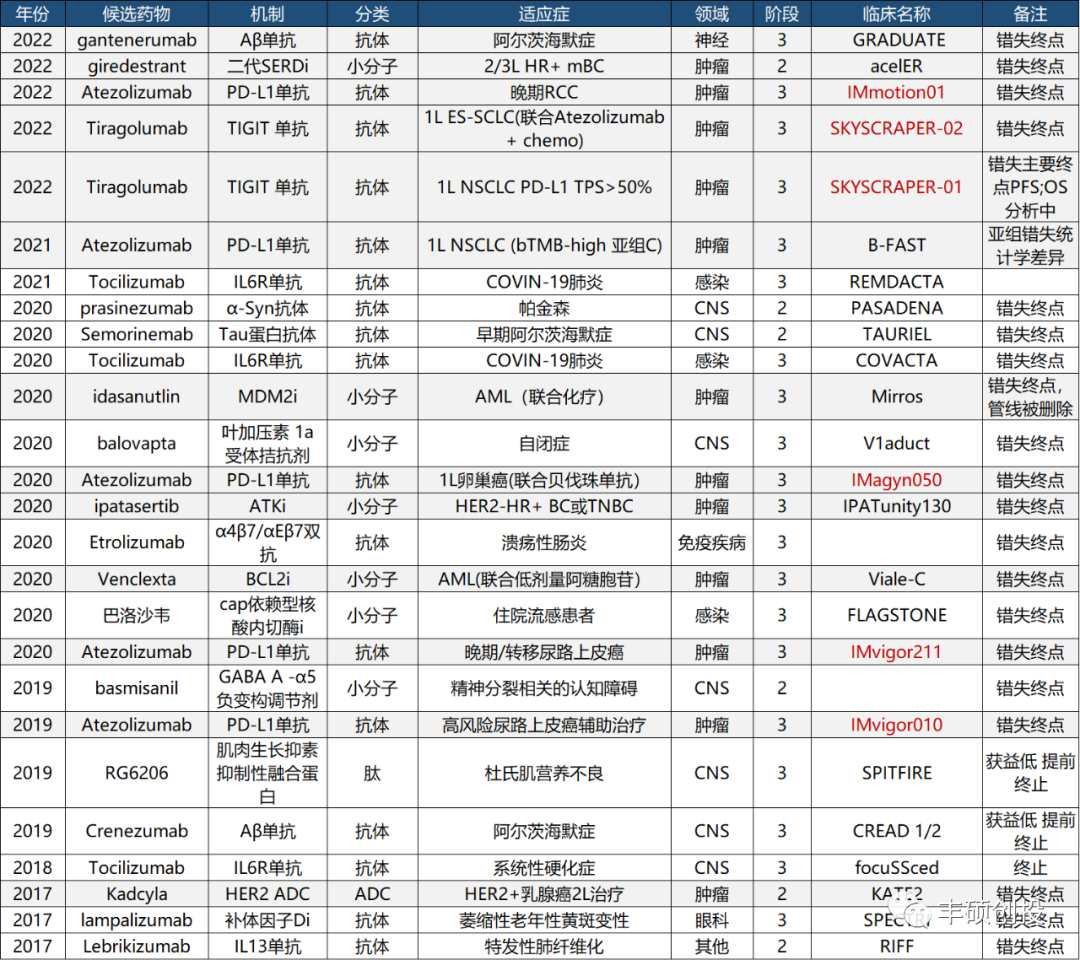
Roche's Phase III Clinical R&D Success Rate Has Declined in Recent YearsIn the past five years, Roche's Phase III clinical trial success rate has been lower than the industry average. In the five-year rolling average from 2018 to 2022, Roche's Phase III success rate was only 58%, while the industry average was 76%.Repeatedly hit by a series of Phase III clinical trial failures, including TIGIT antibody combination therapy (NSCLC), Tecentriq/Cabometyx (renal cell carcinoma), and an Alzheimer's disease Aβ monoclonal antibody.Roche's Failed Clinical Projects from 2017 to 2022 Q3 (Source: Roche, organized by Fruitful Venture Capital)At last week's R&D Day,Roche CEO Thomas Schinecker stated, "This shows that we have shifted too much of the risk from Phase II clinical trials to Phase III. Some of these projects should perhaps have been stopped earlier in the Phase II stage."He attributed part of the decline in Phase III clinical success rates to Tecentriq (T drug), "In order to catch up with the PD-(L)1 trend, Roche accelerated its push into Phase III clinical trials."Despite the significant success of Drug T in the field of cancer treatment, there have been some Phase III failures along the way, including a major setback in 2017 for second-line bladder cancer treatment, which nearly cast doubt on the future of this PD-L1 inhibitor.Therefore,Roche Pharmaceuticals announced a new strategy to enhance R&D efficiency. CEO Thomas Schinecker revealed that Roche has set "stronger checkpoints" to ensure that candidate drugs can only enter phase three trials if they are highly likely to succeed.
"This standard includes multiple factors; how persuasive is the data? What is the probability of success, and how high is the value? Because you may adopt different risk-reward ratios based on these factors."
Roche Chief Medical Officer Levi Garraway stated that there is currently stricter oversight of its Phase III pipeline.“Pioneer”PlanHas been implementedA period of time, the effect is highly anticipated.Pfizer: Oncology Division Independence,
Designate a dedicated R&D leader
"Pfizer, the 'number one pharmaceutical company in the universe,' is also a practitioner of transforming its R&D team strategy."July 2023,Pfizer Reorganizes Its Global R&D Team, Oncology Division to Become Independent Business Unit; Chief Development Officer Position Eliminated。Executive Vice President and Chief Development Officer William Pao will leave the company to pursue other opportunities. The former head of oncology and rare disease research and developmentChris Boshoff will join Pfizer's senior management team as Executive Vice President andChief Oncology R&D Officer, responsible for the R&D of all Pfizer's oncology product lines, and directly reports to CEO Albert Bourla.。In addition, the responsibilities of Mikael Dolsten, Pfizer's Chief Scientific Officer and President of Global Research, Development and Medical, will be expanded to lead all non-oncology therapeutic areas, where he will serve as the Chief Scientific Officer and President of R&D operations.A recent series of announcements highlights Pfizer's ambitious drive to deeply establish itself in the oncology field, including the previous $43 billion acquisition of ADC star biotech company Seagen to bolster its ADC oncology pipeline.Pfizer has stated that, following the successful completion of the deal, Seagen's pipeline will double Pfizer’s early-stage experimental cancer therapy portfolio.▲Gene Therapy Brings New Hope to Patients with Genetic Disorders--Featured Recommendations--