

Novartis and Sandoz Part Ways, Unveiling the Challenges Facing Global Generics Giants

Novartis
Drug Development and Manufacturing

Sandoz
Global Supplier of Novel Patent Medicines

Novartis and Sandoz Officially Announce Split.
On September 15, Novartis and Sandoz announced the spin-off plan on their respective official websites. The Novartis Board of Directors passed the resolution with 99.7% support, and willNovartis to spin off its generics and biosimilars subsidiary, Sandoz, on October 4。
The breakup plan, which has been rumored in the industry for several years, has officially been initiated. Novartis stated that after the spin-off, Sandoz will be listed on the SIX Swiss Exchange. Novartis, on the other hand, will fully focus on its high-risk but high-reward innovative drug business.
Sandoz has deep roots with Novartis. In 1886, Sandoz was established as a chemical factory, and after transitioning to the pharmaceutical industry, it gave rise to what is now Novartis in 1996. UntilIn 2003, Sandoz appeared in front of the public as an independent part of Novartis' generics and biosimilars division with a completely new image.。
Sandoz did not disappoint Novartis.In the generic drug field, Sandoz is undoubtedly a giant, alongside Teva and Viatris, occupying the top three global positions.。
So why is Novartis still splitting Sandoz? A comparison can explain the issue:In 2022, the revenue of Novartis' innovative drugs was $41.296 billion., accounting for 82% of its total revenue;Sandoz's revenue was $9.249 billion, the former being more than four times the latter.。
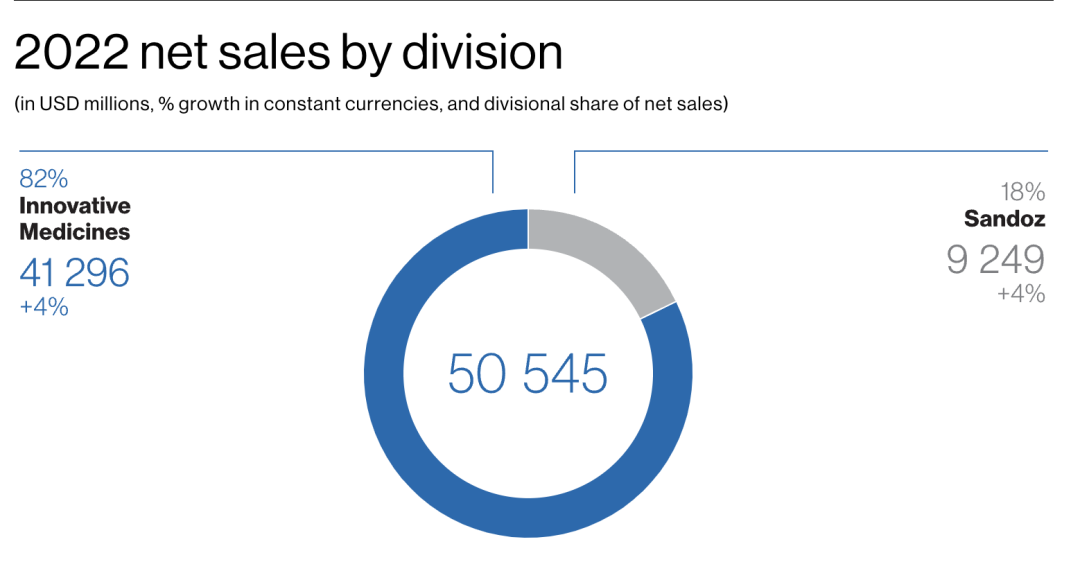
Source: Novartis Annual Report
Novartis' innovative drug sector is not perfect, with a rich pipeline layout but always lacking a blockbuster drug to drive the company's performance. The most promising products currently are the heart failure drug Sacubitril/Valsartan and the autoimmune drug Secukinumab, but their combined sales still fall short of a $10 billion molecule. In the coming years, they will also face the crisis of patent expiration.
Sandoz had already experienced consecutive declines in performance in 2017 and 2018, which had already raised concerns for Novartis at the time.However, Novartis still left some room for Sandoz by only selling its dermatology and generic oral solid dosage forms in the U.S. to Indian generics company Aurobindo, allowing Sandoz to focus on more complex generic drug businesses. But this plan ultimately failed due to lack of approval from the U.S. FTC.
As innovative pharmaceutical companies普遍 face funding difficulties, Novartis has undergone multiple rounds of streamlining, divesting its ophthalmology business. Generic drugs, which could potentially拖累 company performance, are naturally being separated.
Sandoz, Teva, and Viatris are giants in the generic drug industry. But looking around, the world has already changed.
At the end of the 20th century, generic drug companies in India and Japan began to emerge, such as Sawai, Nihon Medical, Sun Pharmaceutical, and Dr. Reddy's. Most of the generic drugs in the United States already came from India. After the millennium, China also joined the ranks of generic drug production and gained increasing recognition from the international community.
The pharmaceutical market in the Third World is no longer the era of lacking doctors and medicines as it used to be., but rather a landscape of competing factions and fierce rivals. The cheaper labor in Asia and the more intense production pace have made generic giants feel uneasy.
However, Sandoz's dilemma is one that all generic drug companies face. The whole world is pushing down drug prices.The United States, Europe, Japan, and China are all implementing bulk procurement or price-limiting policies., the purpose is the same, only the specific forms are different. Taking the United States as an example, the average price of the top 30 generic drug varieties has been halved over the past seven years.
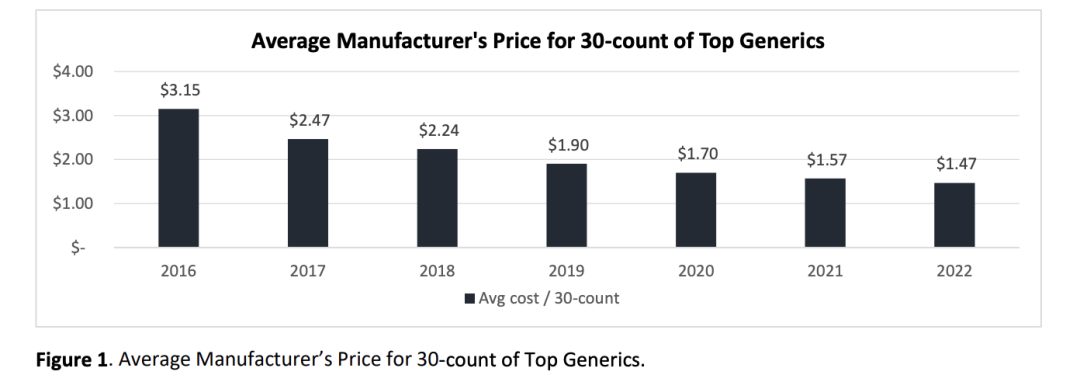
Source: Paper "US Generic Pharmaceutical Industry Economic Instability"
The first-tier companies, Teva, Sandoz, and Viatris, have seen repeated declines in their generic drug revenues; in the second tier, Indian pharmaceutical companies like Sun Pharma and Dr. Reddy's have managed to maintain double-digit revenue growth, while others are struggling at the edge of positive or negative growth.
Japan has the lowest average price for generic drugs among developed countries, forcing Japanese pharmaceutical companies to either transform or seek new opportunities overseas. After round after round of bulk procurement in China, drug prices have been continuously pushed down.
As generic drugs enter an era of low profit margins, pharmaceutical companies have already made their choices: either adopt a more streamlined approach, strengthening more competitive and closely integrated product portfolios, or focus on the development of products with higher entry barriers, such as biosimilars or complex formulations.
Whether or not they can escape the quagmire of meager profits still depends on themselves.
Author: Yang Xixia
Editor | Jiang Yun, Jia Ting
Operation | Zhu Ying
Statement: Original content by Jian Shi Ju, please do not reprint without permission.




Scan to add me: Join group discussions, share insights, and authorize reprints
If there are any issues with the content, please contact us by email:
jianshiju@boyamedia.com
For business cooperation, please contact: 13288688512