

PeptiDream and Genentech Announce $1 Billion Collaboration to Develop Novel Macrocyclic Peptide-Radioisotope Conjugates
PeptiDream
Drug Developer
Genentech
Pharmaceutical R&D Manufacturer
Roche
Oncology Drug Research, Development, and Manufacturing
▲October 21, General Cell Drug Development Forum · Free for a Limited TimeRegistration ongoing
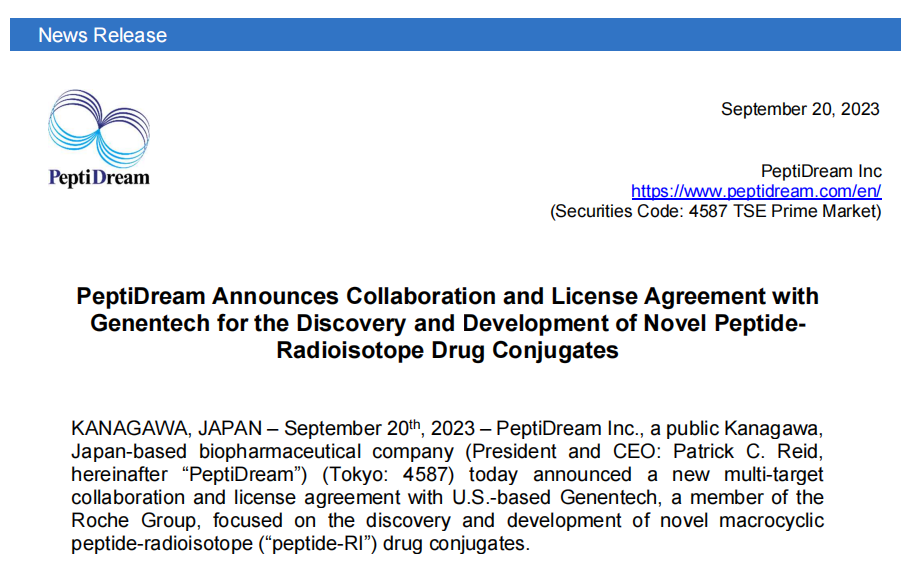
September 24, 2023 / eMedClub News /--On September 20, PeptiDream announced a collaboration with Genentech, a subsidiary of Roche.Novel Macrocyclic Peptide-Radioisotope (Peptide-RI) ConjugatesPeptiDream and Genentech have reached a collaboration and licensing agreement for the discovery and development. According to the terms of the agreement, PeptiDream will receive from Genentech$40 million upfront payment, and is eligible to receive potential payments based on the achievement of specific development, regulatory, and commercial milestones.Payments of up to $1 billion。In addition, PeptiDream is entitled to receive royalties on net sales of any such products arising from the collaboration in regions outside Japan.
The Founding History of PeptiDream:
The "Peptide Dream Factory" Founded by a Guitarist with a Market Value of Over 100 Million
eMedClub

Hiroaki Suga, one of the founders of PeptiDream and currently a professor in the Department of Chemistry at the Graduate School of Science, The University of Tokyo, specializes in bioorganic chemistry, chemical biology, and biotechnology related to RNA translation and peptides. He obtained his Bachelor of Engineering (1986) and Master of Engineering (1989) degrees from Okayama University in Japan, earned his Ph.D. in Chemistry from the Massachusetts Institute of Technology (1994), and completed postdoctoral research at Massachusetts General Hospital. He began his independent career at the University at Buffalo, State University of New York (1997-2003). In 2003, he moved to the Research Center for Advanced Science and Technology at The University of Tokyo. Although Hiroaki Suga studied chemistry throughout his undergraduate studies and during his graduate and doctoral programs abroad, he had firmly dreamed of becoming an outstanding electric guitarist. However, he later realized this grand dream could not be achieved, which was a significant blow. After a period of confusion, he ultimately decided to explore the essence of life—"I want to study the origin of life."Thus, Professor Hiroaki Suga resolutely stepped into the field of biological research.
In 1997, Professor Hiroaki Suga, then an assistant professor in the Department of Chemistry at the State University of New York at Buffalo, found himself amidst a surge of academic interest in "ribozymes," RNA molecules with enzymatic activity capable of catalyzing various biochemical reactions. While others were focused on studying the fundamental properties of ribozymes, Professor Hiroaki Suga shifted his attention to their practical applications. He aimed to use ribozymes to accelerate the establishment of peptide libraries during the new drug development process. After ten years of painstaking effort, he successfully utilized ribozymes to incorporate non-natural amino acids into tRNA.Incorporating more than 400 non-natural amino acids into expressed peptides, spontaneously forming macrocyclic peptides, this major technology is called“Flexizyme”, meaning"Flexible Enzymes", greatly expanding the potential of genetic code reprogramming.
In 2006, Professor Hiroaki Suga and his friend Kiichi Kubota co-founded"Peptide Dream Factory"——PeptiDream, headquartered in Kawasaki, Japan, has partnerships with the University of Tokyo and the State University of New York.Flexizyme TechnologySign an exclusive sublicensable license agreement. Later, Professor Hiroaki Suga further expanded the Flexizyme technology, establishing a system for translating and synthesizing special peptides containing non-natural amino acids and cyclic structures.FIT System, as well as rapid screening through in vitro display methodsRaPID System, used to search for binders that disrupt protein-protein interactions, can produce billions of macrocyclic peptides, paving the way for a new generation of drugs, and proprietary technologies were developed and established in 2010.Peptide Drug Discovery Platform PDPS(Peptide Discovery Platform System) system, development based on peptides, small molecules orPeptide-Drug Conjugates (PDC)Therapeutic and diagnostic candidates based on multifunctional peptide conjugates (MPC) can compress the workload of three-day high-throughput screening into four hours, identifying lead candidates with extremely high efficiency, setting an industry-leading standard. In the same year, PeptiDream signed a collaborative research agreement with Bristol-Myers Squibb.Listed on the Tokyo Stock Exchange in 2013, with a current valuation exceeding 1.4 billion USD.。On February 7, 2023, Professor Hiroaki Suga was awarded for pioneering the RaPID system.Known as the "Nobel Prize barometer," the Wolf Prize (Wolf Prize))。
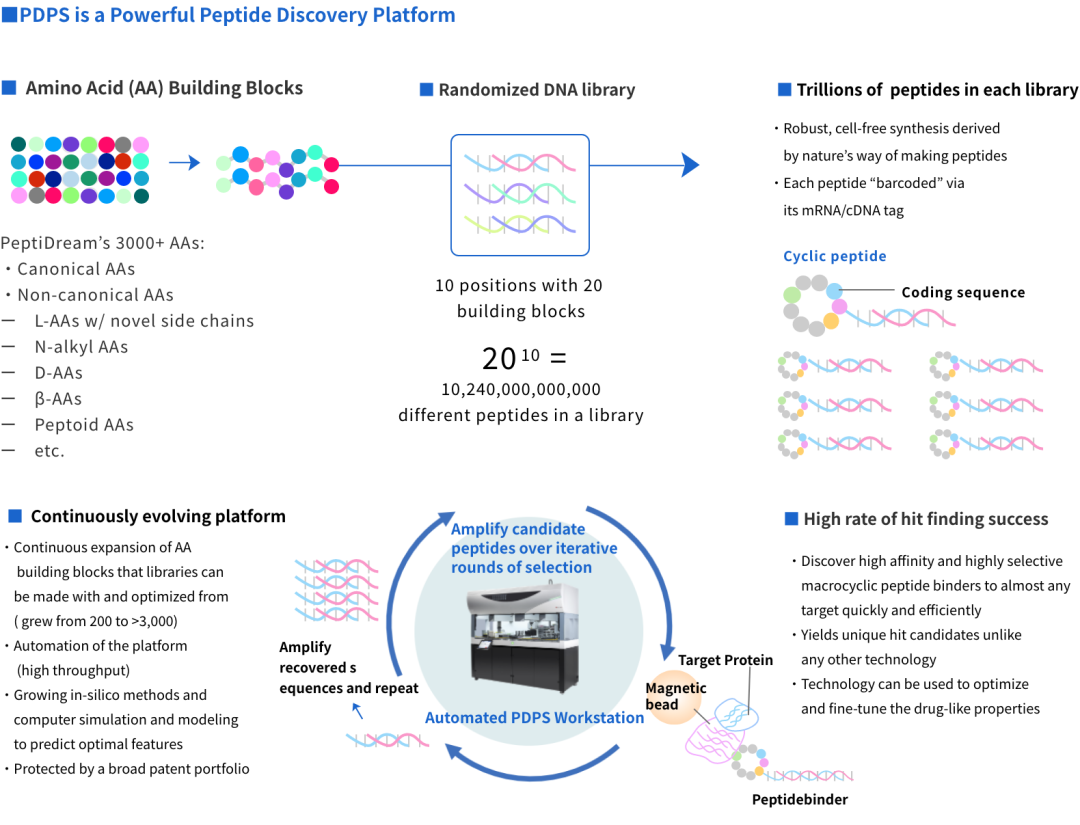
PDPS Platform, ▲ Image Source:PeptiDream Official Website
PeptiDream Inc. has numerous subsidiaries.Such as the wholly-owned subsidiary PDRadiopharma, which is responsible for the sales of radiopharmaceuticals and radio-diagnostic products in Japan. On September 15, PeptiDream established a joint venture subsidiary responsible for the development of radiopharmaceuticals.RayzeBio Goes Public on Nasdaq, with the stock code "RYZB," completed its initial public offering and updated the GPC3 program. Before RayzeBio's IPO, PeptiDream held 5.5% of RayzeBio's shares and sold half of its stock in the IPO for a gain of $20.934 million, which will be used for the collaboration between both parties on macrocyclic peptide-radioisotope (peptide-RI) conjugate drugs.RYZ801 and RYZ811Development in Japan. RYZ801 is a new proprietary peptide that targets GPC3 to deliver Ac-225 for the treatment of liver cancer; RYZ811 is a paired diagnostic imaging agent, sharing the same peptide binder and chelator as RYZ801 but using Ga-68 as the radioisotope. The two companies plan to submit INDs for both products in the first half of 2024, with PeptiDream responsible for product development in Japan and RayzeBio responsible for development outside of Japan.
eMedClub
PeptiDream and Genentech have had a partnership lasting eight years.In December 2015, the two companies signed a multi-target collaboration and licensing agreement. In 2016, Genentech licensed PeptiDream's PDPS technology, and in 2018, they expanded their partnership. Under this agreement, PeptiDream will use targets of interest to Genentech to develop peptide-RI conjugate drugs and will lead early preclinical development. The resulting peptide-RI conjugate drug products from the collaboration will then be handed over to Genentech for further development and commercialization. PeptiDream will retain the rights to develop and commercialize such peptide-RI drug conjugate products in Japan.
Besides Genentech,PeptiDream has well-known partners worldwide, including MNCs such as BMS, Eli Lilly, Merck, Astellas, and Novartis.As the leader in the PDC field, PeptiDream onceTwo cooperation agreements were reached within three days, with a total amount of 5.7 billion US dollars.On July 27 and 29, 2021, PeptiDream signed collaboration agreements worth $3.5 billion with Takeda and $2.2 billion with Alnylam, respectively. The former aims to expand cooperation in the field of neurodegenerative disease treatments, while the latter focuses on co-developing peptide-siRNA conjugate drugs. Among the two oncology drugs developed in collaboration with BMS, one is a PD-L1 inhibitor peptide, and the other is a radiopharmaceutical diagnostic agent used to evaluate patients' PD-1/PD-L1 expression, both of which are currently in Phase 1 clinical trials.
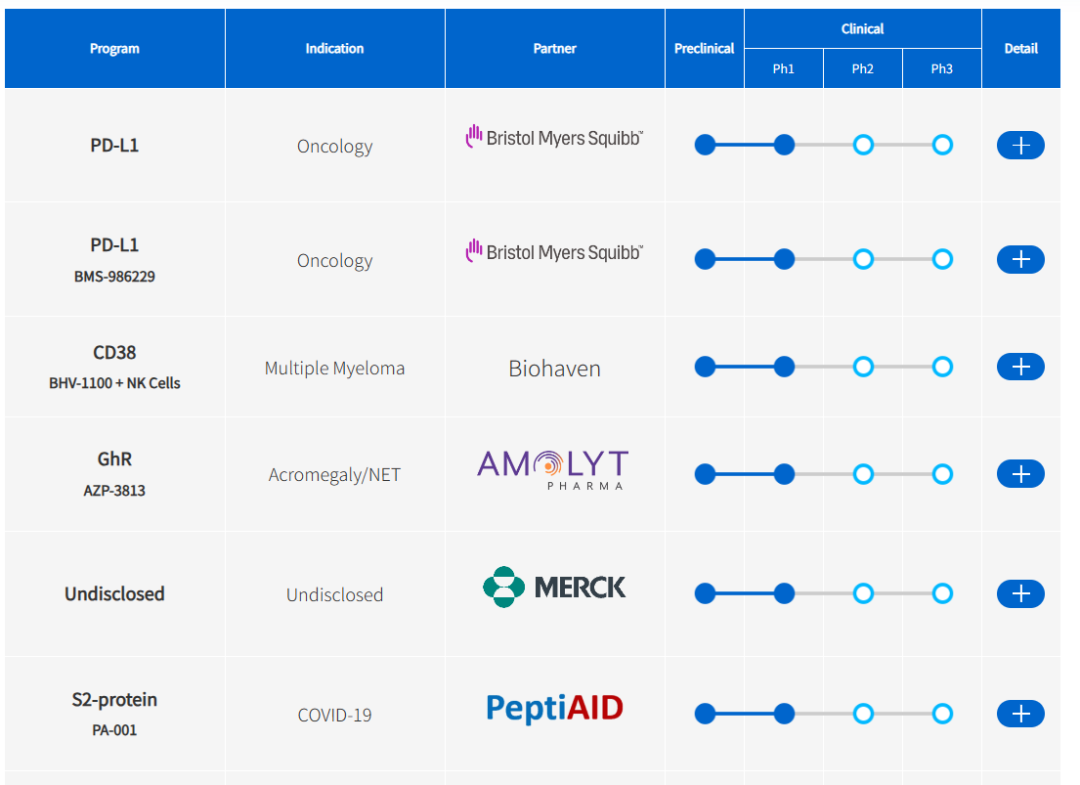
2.https://www.chem.s.u-tokyo.ac.jp/users/bioorg/English/member/Suga.html
Exciting Live Broadcast Preview
Press and hold to scan the QR code and participate immediately ↓
Recommendation
1
September 26 (Tuesday) 19:00-21:00
Process Development and Critical Quality Control Analysis of ADC Drugs

DianDian "Share”、“Like" and "In view", charge me up a bit~"