

BMS Shifts from TIGIT Monoclonal to Bispecific Antibody: A Strategic Pivot Mirrored by Chinese Biotechs

Bristol-Myers Squibb
Biopharmaceutical and Nutritional Product R&D and Sales
Welcome to follow Asymchem Pharma News
Recently, Bristol-Myers Squibb ("BMS") held its 2023 R&D Day event, providing a systematic introduction to the progress of its R&D pipeline and the layout of its technology platforms. The company announced the termination of the development of several new drugs, including the CD20/CD47 bispecific antibody, RIPK1 inhibitor, GSPT1 molecular glue, etc.… However, although BMS announced the termination of the TIGIT antibody, it has chosen to further develop the TIGIT/CD96 bispecific antibody BMS-986442 (AGEN1777).
Co-inhibitory or immune checkpoint receptors, such as PD-1 and CTLA-4, are expressed on immune cells to limit immune responses and prevent immunopathology. Drugs targeting these receptors have been successfully developed for the treatment of various tumors; however, many cancer patients do not respond to these therapies, prompting researchers to explore new co-inhibitory receptors. TIGIT (T cell immunoglobulin and ITIM domain), as a co-inhibitory receptor, is highly expressed on the surface of immune cells in cancer patients. By inhibiting immune cell function, it contributes to immunosuppression and enables tumor immune escape, showing promising prospects in cancer immunotherapy.
Unlike the clinical benefits achievable with PD-1 antibody monotherapy, previous studies suggest that TIGIT itself lacks standalone druggability and requires combination with PD-1/PD-L1 monoclonal antibodies. As early as 2020, Roche's published results on the TIGIT antibody tiragolumab as a monotherapy for NSCLC included cases of failure; in Phase 1a clinical trials, among 24 patients, the ORR (objective response rate) was 0. In the Annals of Oncology, Niu et al. published the first Phase I clinical study results of a humanized IgG1 monoclonal anti-TIGIT antibody (vibostolimab), either as monotherapy or in combination with pembrolizumab. In Part A of the study, which included 76 patients (15 with NSCLC), the objective response rate (ORR) for the vibostolimab monotherapy group was 0%, almost definitively determining the bleak prospects of TIGIT as a monotherapy. The clinical breakthrough can only come from enhancing the efficacy of immunotherapy through combination therapies.
Specifically, TIGIT is a target that may have a synergistic effect with the PD-1 pathway, as it can simultaneously block multiple immune suppression pathways and enhance anti-tumor immunity. Preclinical studies have shown that dual blockade of PD-(L)1 and TIGIT may trigger tumor rejection in the treatment of various cancers, especially tumors resistant to immune checkpoint inhibitors. PD-1 or PD-L1 inhibitors combined with novel TIGIT inhibitors (such as tiragolumab) can further amplify the inhibitory effects of the PD-L1/PD-1 signaling pathway. Scientists believe it might produce a synergistic effect with PD-1 drugs, achieving an effect greater than the sum of its parts (1+1>2). In this instance, BMS has chosen to focus on developing TIGIT/CD96 bispecific antibodies. According to previous research, TIGIT and CD96 can competitively bind to PVR; this binding is expected to further expand the efficacy of TIGIT antibodies.
One
Development and Mechanism of Action of TIGIT
TIGIT was discovered by Genentech and made its debut in *Nature Immunology* in 2009. The article confirmed that TIGIT possesses an immunoglobulin-like (IgV) domain and an immunoreceptor tyrosine-based inhibitory motif (ITIM). Therefore, scientists named it TIGIT (T-cell immunoreceptor with Ig and ITIM domains). It wasn't until the rise of PD-1 that TIGIT gradually came into the public eye.
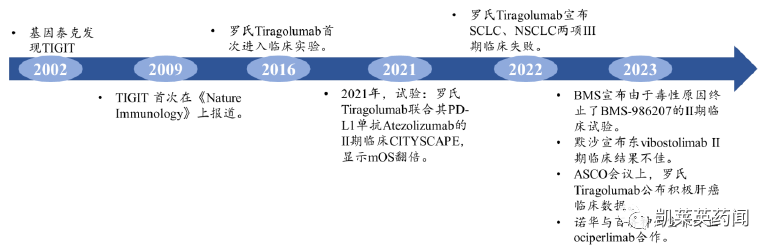
TIGIT is an inhibitory immune receptor expressed on lymphocytes that binds with high affinity to its ligand PVR and inhibits T-cell activation through three mechanisms: direct inhibition of T cells, induction of PVR signaling on antigen-presenting cells, and suppression of stimulatory CD226 signaling. It has the following characteristics: 1) It is the first checkpoint inhibitor to produce positive randomized data in combination with PD-1/L1 in non-small cell lung cancer; 2) It is the only negative regulator expressed on Tscm cells in addition to PD-1, and Tscm cells are a key target of aPD-1/L1; 3) It is expected to play a complementary role with PD-1-mediated co-stimulation regulation of CD226 and CD28; 4) Antibodies targeting TIGIT may modulate the activation of dendritic cells, NK cells, and Treg cells.
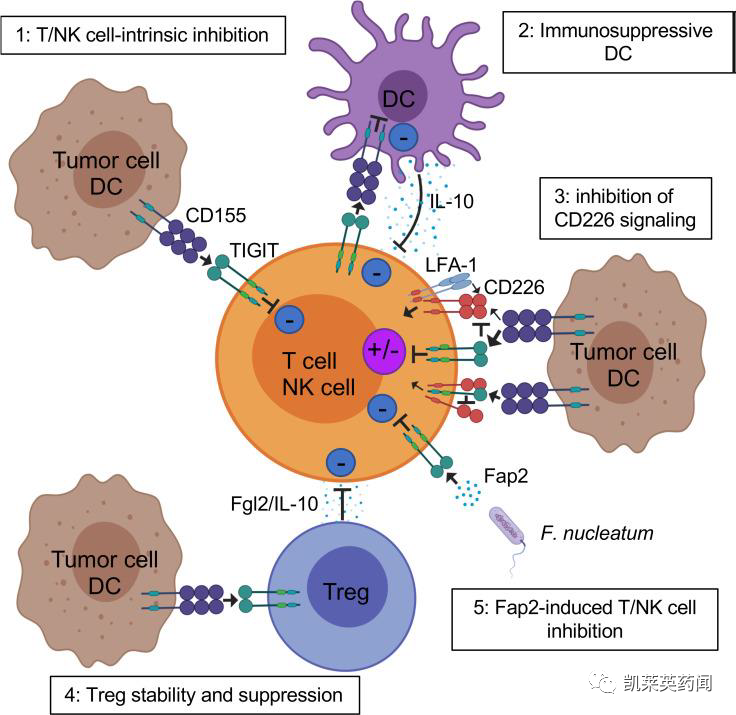
Blocking negative regulation with anti-TIGIT antibodies can restore anti-tumor immune responses. However, due to the complexity of the TIGIT pathway itself, it remains unclear exactly how TIGIT blockade promotes anti-tumor immunity. Some researchers emphasize that TIGIT signaling limits the effector functions of cytotoxic T cells and NK cells, thereby reducing both innate and adaptive immune responses. Others point out that the immunosuppressive effects of TIGIT enhance regulatory T cell activity or inhibit DC cells from releasing pro-inflammatory cytokines. Currently, the significant difference among clinical TIGIT monoclonal antibodies lies in their Fc functionality. However, in August 2023, the second interim analysis of SKYSCRAPER-01 indicated positive signals in OS for the combination therapy of Tiragolumab + Atezolizumab, prompting the market to reassess the TIGIT target.
Two
Pipeline and Market Forecast of TIGIT Bispecific Antibodies
According to incomplete statistics, there are currently over 80 TIGIT drugs under research, with nearly half of them in the preclinical research stage.
Among these investigational drugs, 20 are bispecific antibodies, with targets including PDL1/PD1, CD112R, CTLA4, CCR8, LAG3, and CD96 for those binding to TIGIT.
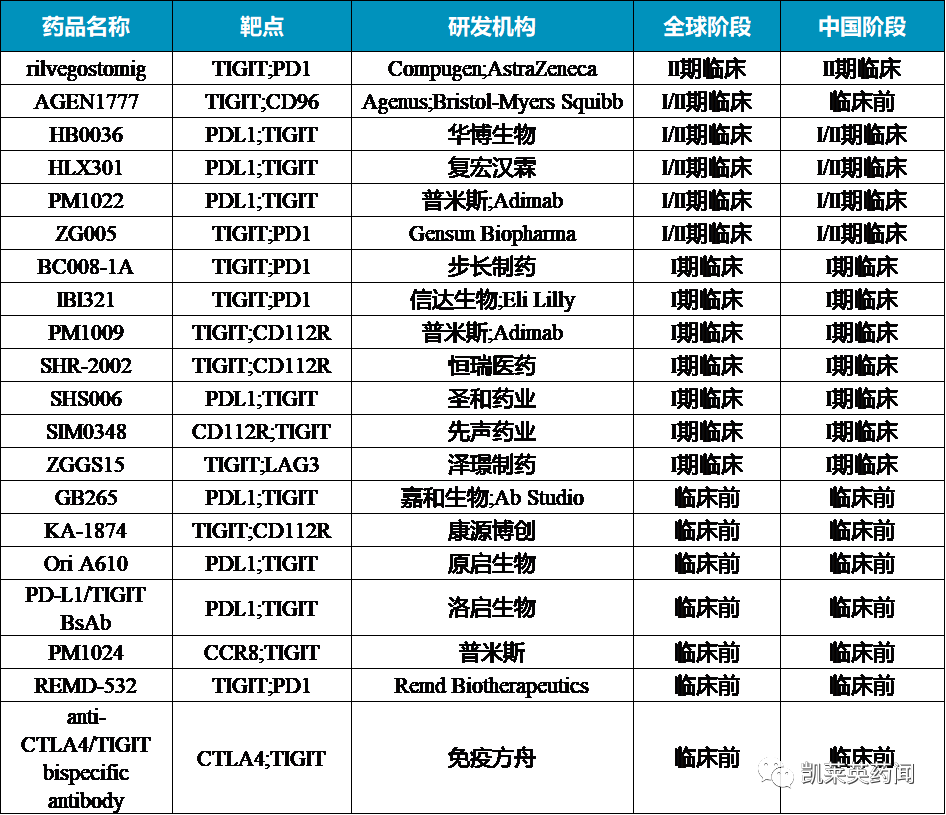
InOf the 20 pipelines above, 16 are being developed with the participation of companies in China.These include Huabio Biotech, Henlius, Promab, Buchang Pharmaceutical, Innovent, Hengrui, Sunho, Simcere, Zelgen, and others, with all the aforementioned companies’ drugs having entered the clinical stage.
The general view is that the combination of TIGIT monoclonal antibody with PD-1 monoclonal antibody and PD-L1 monoclonal antibody can enhance the effects of PD-1 monoclonal antibody and PD-L1 monoclonal antibody. In 2022, the global PD-(L)1 market size was approximately USD 38.764 billion, increasing by 19% year-on-year. This marks the 8th consecutive year of expansion for the PD-(L)1 market. It is speculated that TIGIT is expected to become the next blockbuster drug worth tens of billions of dollars.
Three
Introduction to Some Key Drugs
1、rilvegostomig
Rilvegostomig (AZD2936) is a bispecific antibody targeting PD-1/TIGIT, developed based on Compugen's investigational anti-TIGIT antibody COM902. Like COM902, rilvegostomig is designed to reduce Fc effector function and has the potential to enhance anti-tumor activity.
In 2018, Compugen and AstraZeneca reached a revised agreement under which Compugen granted AstraZeneca an exclusive license to use Compugen's monospecific antibody targeting TIGIT (including COM902) for the development of bispecific and multispecific antibody products. To date, Compugen has received a $10 million upfront payment, an additional $15.5 million in milestone payments, and is entitled to receive up to $200 million in development, regulatory, and commercial milestones, as well as tiered royalties on future product sales.
According to data presented at the 2023 ASCO, in the phase 1/2 ARTEMIDE-01 trial, rilvegostomig demonstrated tolerability and efficacy in patients with advanced or metastatic PD-L1-positive non-small cell lung cancer (NSCLC) who had progressed after receiving at least one prior checkpoint inhibitor treatment. This included: an overall response rate (ORR) of 4.0% (95% CI, 0.5%-13.7%) with 750 mg rilvegostomig, entirely comprised of partial responses (PR); additionally, 44.0% of patients achieved stable disease. At weeks 9 and 27, the disease control rates (DCR) were 48.0% and 12.0%, respectively. In terms of safety, rilvegostomig was well-tolerated, with no dose-limiting toxicities observed and no grade 4 or 5 treatment-related adverse events (TRAEs) reported.
2、BMS-986442(AGEN1777)
AGEN1777 is a bispecific antibody targeting TIGIT/CD96, which can specifically target TIGIT while also featuring an enhanced Fc region. It aims to improve anti-tumor activity by targeting the major inhibitory receptors expressed on T cells and NK cells. In May 2021, Bristol-Myers Squibb entered into an agreement with Agenus, through which Bristol-Myers Squibb obtained the global exclusive license for AGEN-1777.
According to BMS's 2023 R&D Day event, BMS-986442 is under development for non-small cell lung cancer and gastric cancer. The Phase I monotherapy trial has been completed; the Phase 1/2 dose-escalation combination therapy trial (e.g., PD-1±chemotherapy) is expected to release data next year.
3、HB0036
HB0036 is a bispecific antibody developed by Huaotai Biologics that targets both PD-L1 and TIGIT. It can simultaneously bind with high specificity to these two key immune checkpoints, PD-L1 and TIGIT, blocking the signal transduction of the PD-1/PD-L1 and TIGIT/CD155 pathways, thereby relieving their mediated immunosuppressive effects and reactivating the cytotoxic T lymphocytes and NK cells to kill tumor cells. In addition, HB0036 retains the antibody-dependent cell-mediated cytotoxicity (ADCC) effects mediated by PD-L1 and TIGIT, which can further kill tumor cells and Treg cells through ADCC effect, enhancing anti-tumor efficacy.
Preclinical studies show that HB0036 has better anti-tumor effects compared to single-agent groups of PD-L1 inhibitors and TIGIT inhibitors, and is comparable to the combination of these two single agents. In non-human primates, HB0036 exhibits linear pharmacokinetic characteristics, with a long half-life and favorable pharmacokinetic properties; additionally, HB0036 demonstrates good safety and tolerability.
4、HLX301
HLX301 is an innovative PD-L1/TIGIT bispecific antibody independently developed by Henlius for the treatment of various advanced solid tumors. The TIGIT binding domain originates from a VHH fragment with high affinity and high specificity for TIGIT, selected from the company's humanized alpaca heavy-chain variable region single-domain antibody (VHH) phage display library. In December 2022, Henlius announced that the first patient had been dosed in the Phase I clinical trial (NCT05394168) of HLX53 in patients with advanced/metastatic solid tumors and lymphoma.
5、PM1022
PM1022 is a bispecific antibody against PD-L1/TIGIT developed by Promab. Preclinical studies have shown that PM1022 can bind with high affinity to PD-L1 and TIGIT in humans and rhesus monkeys, while efficiently blocking the PD-1/PD-L1 and TIGIT/CD155/CD112 immune inhibitory signaling pathways. In mouse models, PM1022 inhibited tumor growth in a dose-dependent manner, with significantly superior antitumor activity compared to the Keytruda treatment group.
6、ZG005
ZG005 is a humanized anti-PD-1/TIGIT bispecific antibody developed by Zelgen Pharmaceuticals. It effectively blocks the binding of PD-1 and TIGIT on immune cells, as well as the binding of their specific ligands PD-L1 and PVR on tumors, achieving dual blockade of the PD-1/TIGIT immune checkpoints.
Preclinical animal studies have shown that ZG005 has effective anti-tumor efficacy and good tolerability. Within the dose range of 20-180mg/kg, there were no significant toxicities or adverse reactions. Currently, the IND application for ZG005 has been approved by the FDA and NMPA and is currently in Phase I clinical trials for advanced solid tumors.
References
1. Company Official Website
2. Northeast Securities, Huachuang Securities, Tianfeng Securities, Pacific Securities


"Views"Click once