On September 25, Novartis announced that the Phase III NETTER-2 trial of its radioligand therapy Lutathera had met its primary endpoint. Compared with high-dose long-acting octreotide alone, the combination of Lutathera and long-acting octreotide as a first-line treatment significantly improved progression-free survival (PFS) in newly diagnosed patients with somatostatin receptor (SSTR)-positive, grade 2 and 3 advanced gastroenteropancreatic neuroendocrine tumors (GEP-NETs). According to the press release, Lutathera is the first radioligand therapy to demonstrate clinically meaningful benefit in first-line treatment.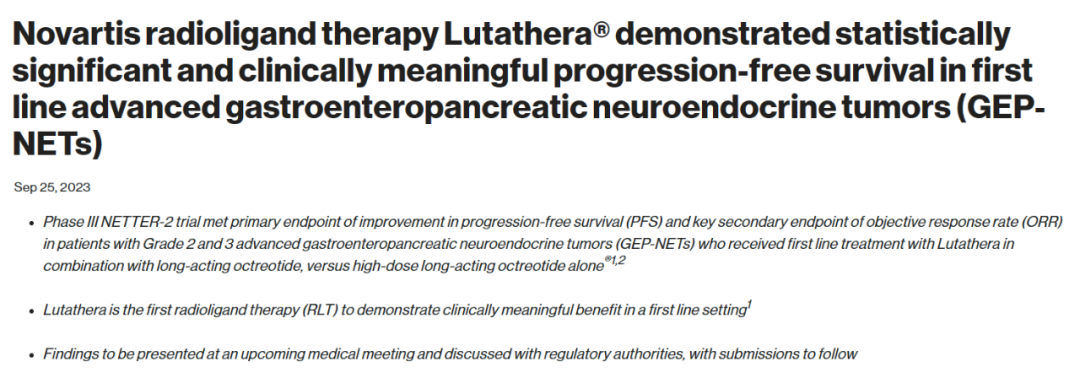 Neuroendocrine Tumors (NETs) are cancers that originate from neuroendocrine cells throughout the body and are generally considered slow-growing malignancies. However, some NETs progress rapidly with poor prognosis, and in many cases, are not diagnosed until the disease has advanced to a late stage. Although NETs are rare diseases, their incidence has increased by more than 500% over the past 30 years, creating an urgent need for more treatment options for newly diagnosed patients with inoperable or advanced stages.NETTER-2 is the second Phase III trial of Lutathera, bringing clinically meaningful results to patients. Lutathera was approved by the FDA for marketing in 2018, primarily based on the pivotal NETTER-1 trial.NETTER-1 Trial Shows that Compared with High-dose Long-acting Octreotide Treatment, Lutathera Combined with Long-acting Octreotide Treatment Significantly Improves PFS with Clinical Significance in SSTR-positive, Inoperable Midgut Neuroendocrine Tumor Patients Whose Disease Progressed After Standard Therapy."These positive results from Lutathera are remarkable, representing the potential for radioligand therapy to have a significant impact on newly diagnosed advanced GEP-NET patients," said Jeff Legos, Executive Vice President and Head of Global Oncology Development at Novartis. "Exploring the use of radioligand therapy in earlier treatment of cancer patients is part of our broader collaborative efforts, with the goal of delivering new therapeutic modalities directly and precisely to cancer cells to improve patient outcomes."
Copyright © 2023 PHARMCUBE. All Rights Reserved.
Welcome to forward, share, and reasonably cite. When citing, please clearly indicate the source of the article.For reprint, please leave a message or send a message to the WeChat Official Account backend, and indicate the name and ID of the official account.
Disclaimer: The information in this WeChat article is for general reference only and should not be directly used as decision-making content. PharmaCube assumes no responsibility for any loss incurred by any party due to the use of the content herein.
PharmaCube Reader Survey Questionnaire
Thank you for your companionship and we look forward to your feedback.
Scan the QR code to provide valuable suggestions