

Chinese Biotech I-Mab's Innovative CD47 Antibody Lemzoparlimab Partnership Terminated by AbbVie, Regains Global Rights

NovaBridge Biosciences
Biological Agent Developer

AbbVie
Innovative Drug Developer
▲ Click on the blue above"Medicine Valley"Follow Us

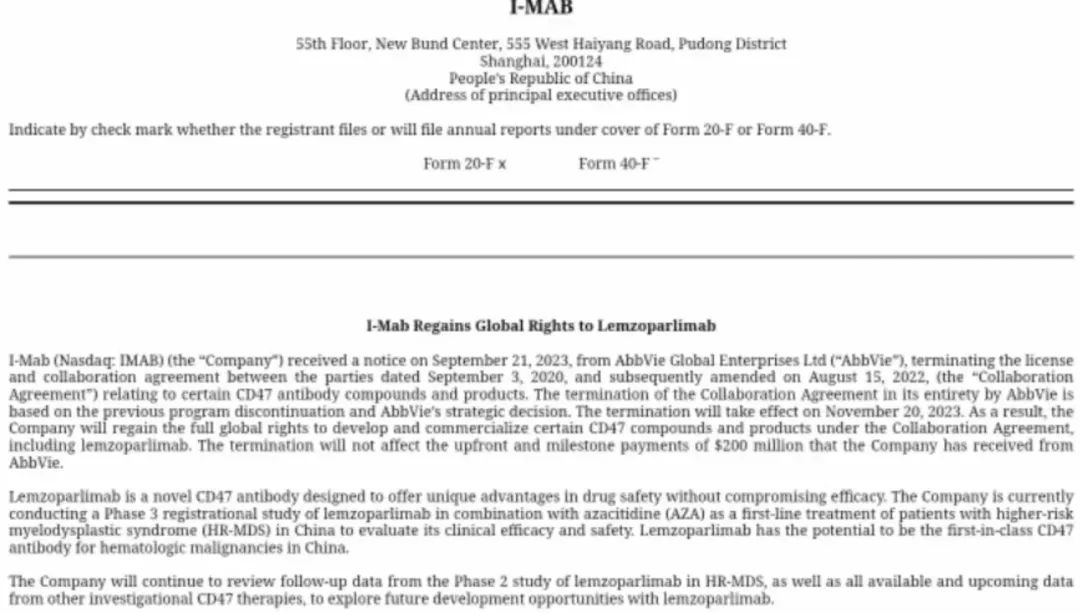
Recently, a public document released by Tianjing Biotechnology (Shanghai) Co., Ltd. showed that the company received a notice from AbbVie to terminate the agreement between the two parties.The licensing and collaboration agreement for the CD47 antibody Lemzoparlimab, signed on September 3, 2020, signifies that AbbVie will fully withdraw from the project. The termination agreement will take effect on November 20, 2023. Meanwhile, according to the agreement, Tianjing Biotechnology (Shanghai) Co., Ltd. will regain full global rights to develop and commercialize the CD47 compounds and products. The termination will not affect the $200 million upfront and milestone payments Tianjing Biotechnology received from AbbVie.
Once Reached a $3 Billion Collaboration
Lemzoparlimab is TianjingNovaBridge Biosciences' Self-Developed Highly Differentiated CD47 Monoclonal Antibody. CD47 is a glycoprotein widely expressed on the surface of various cancer cells. By binding to SIRPα on the surface of tumor phagocytes, it sends a "don't eat me" signal, preventing macrophages from engulfing the cancer cells. CD47 antibodies can block this signal, enabling macrophages to attack tumor cells, making CD47 another popular target in tumor immunotherapy following PD1. However, while attacking tumor cells, CD47 antibodies also bind to normal red blood cells, causing hematological side effects such as severe anemia, which has hindered the research, development, and clinical application of CD47 antibodies as a cancer treatment.
It is reported that Tianjing Biotechnology has discovered a unique epitope recognizing the CD47 antigen through differentiated design and targeted screening. This can retain the anti-tumor activity of the CD47 monoclonal antibody while minimizing its binding with normal red blood cells, thereby avoiding severe anemia and other toxic side effects commonly seen in clinical trials of similar CD47 antibodies.
In September 2022, data from the Phase II study exploring the efficacy and safety of lefitolimab in combination with azacitidine for the treatment of newly diagnosed HR-MDS (higher-risk myelodysplastic syndromes) was released. The results showed that among 15 patients who were six months or more from the first dose, the objective response rate was 86.7%, and the complete response rate was 40%. Among 29 patients who were four months or more from the first dose, the objective response rate was 86.2%, and the complete response rate was 31%. Additionally, lefitolimab does not require priming dosing, and the combination therapy with azacitidine demonstrated good tolerability with a safety profile comparable to azacitidine monotherapy.
In April this year, the first patient was dosed in the Phase 3 registrational clinical trial in China for the treatment of HR-MDS (higher-risk myelodysplastic syndromes) using lefitolimab in combination with azacitidine.
The collaboration between Tianjing Biotechnology and AbbVie began in 2020, when both parties jointly announced a partnership regarding Lemzoparlimab. AbbVie will obtain the rights to develop and commercialize Lemzoparlimab in countries and regions outside of Greater China. Meanwhile, AbbVie will pay Tianjing Biotechnology an upfront payment of $180 million and a $20 million milestone payment for Phase I clinical trials. The total value of the agreement can reach up to $3 billion.
In July 2022, AbbVie terminated an early-stage study of the CD47 antibody Lemzoparlimab in collaboration with Tianjing Biotechnology (Shanghai) Co., Ltd. In August 2022, AbbVie halted the Phase I clinical trial of Lemzoparlimab + azacitidine + venetoclax for the treatment of myelodysplastic syndromes (MDS)/acute myeloid leukemia (AML). The specific reasons were not disclosed, but it was confirmed that no safety issues were involved.
This time, AbbVie has completely withdrawn from the project, and Tianjing Biotechnology has regained full global rights to develop and commercialize CD47 compounds and products. The announcement stated that AbbVie's complete termination of the cooperation agreement was based on the prior termination of the project and AbbVie’s strategic decision. Tianjing Biotechnology said it will continue to review the Phase 2 study data of Lemzoparlimab in HR-MDS, as well as all available and upcoming data for other investigational CD47 therapies, to explore future development opportunities for Lemzoparlimab.
CD47 in the Eye of the Storm
CD47: Another Hot Target in Cancer Treatment Following PD-1CD47 has become another highly sought-after target in the field of cancer treatment following PD-1. In March 2020, Gilead spent $4.9 billion to acquire Forty Seven, a pioneer in CD47 research, gaining access to its core pipeline product, the CD47 antibody Magrolimab. This acquisition sparked a wave of enthusiasm for CD47 within the industry, prompting companies like AbbVie, Pfizer, and Boehringer Ingelheim to enter the field. However, safety concerns regarding "hematological toxicity," such as anemia and thrombocytopenia, have somewhat impacted the development of CD47.
In January 2022, due to "hematological toxicity" issues, the FDA partially placed a hold on Gilead's CD47 antibody Magrolimab in combination with azacitidine. However, in April, after reviewing comprehensive safety data from each trial, the FDA lifted the related clinical hold. In July 2023, as the interim analysis of Magrolimab did not show significant therapeutic efficacy, Gilead announced the early termination of the Phase III clinical trial of Magrolimab combined with the chemotherapy drug azacitidine for MDS. Gilead's Chief Medical Officer, Merdad Parsey, stated that this was a disappointing outcome, but moving forward, the company will continue exploring the potential of Magrolimab for treating other cancers.
In addition, in January 2023, Arch Oncology, which focuses on CD47 development, announced that it had terminated its research and development work on anti-CD47 antibodies, and currently, most of the company's employees have left. In August 2023, ALX Oncology announced that it would terminate two clinical studies of the CD47 inhibitor Evorpacept: the ASPEN-02 study, which combines azacitidine for the treatment of MDS, and the ASPEN-05 study, which combines azacitidine and venetoclax for the treatment of AML. ALX Oncology stated that although Evorpacept was well-tolerated, its combination with azacitidine did not show significantly better treatment effects compared to azacitidine alone.
However, there is also good news from some companies. In December 2022, Innovent Biologics announced the Phase Ib clinical trial data of its CD47 monoclonal antibody IBI188 for the treatment of frontline newly diagnosed MDS at the 2022 American Society of Hematology Annual Meeting. The results showed that: among the 30 subjects who received more than six cycles of treatment, the objective response rate (ORR) was 100% (30/30), and the complete remission rate (CRR) was 63.3% (19/30). In June this year, Innovent Biologics announced the Phase I clinical trial data of its CD47/PD-L1 bispecific antibody IBI322 for the treatment of anti-PD-(L)1 monoclonal antibody-resistant classical Hodgkin lymphoma at the 28th European Hematology Association Annual Meeting. The results indicated that IBI322 monotherapy demonstrated favorable antitumor activity and manageable safety. Among 23 patients, the ORR and disease control rate (DCR) were 47.8% and 91.3%, respectively. In seven primary resistant patients, the ORR reached 57.1%, with three patients achieving complete remission.
In addition, in December 2022, the full research findings on the mechanism of action of Akeso Biopharma's CD47 monoclonal antibody AK117 were published in the core journal of tumor immunology, the *Journal for ImmunoTherapy of Cancer*. This publication was also seen by the industry as full recognition by the international authoritative academic community of AK117's innovation, safety, and efficacy.
Currently, there are no drugs targeting the CD47 checkpoint approved globally. Over 120 drug candidates, including monoclonal antibodies, bispecific antibodies, and SIRPα fusion proteins, are in clinical research. In China, more than 20 CD47-targeting products have entered clinical trials, developed by companies such as Tianjing Biotechnology (Shanghai) Co., Ltd., Innovent Biologics, Immune-Onc Therapeutics, and Hengrui Medicine.Pharmaceuticals, Zai Lab, Akeso Biopharma, etc.
Text | MedValley

Recommended Reading

Zhangjiang Cell and Gene Industry Park — Zhangjiang Gene Island
Fully Open for Business, Welcome to Visit >>

Distinguished Experts Gather, You Are Cordially Invited



For advertising, conference cooperation, corporate communication, etc., please contact 400-689-7892.