September 26,The First "Drug Price Negotiation" in the U.S. Has Made Recent Progress.Bristol-Myers Squibb and AstraZeneca agreed to the terms of the drug price negotiation before the official start date of the negotiations.
Although these two companies told reporters that their agreement was made under duress, more pharmaceutical companies may join the ranks of those "agreeing" in the future. Globally, the trend of "price reduction" for high-cost drugs may be irreversible.
From taking legal action to agreeing to negotiate,
BMS, AZ Take the Lead"Compromise"?
The first "drug price negotiation" in the United States encountered major obstacles before it even began.June 6,Merck & Co.First to file a lawsuit against the U.S. government demanding the halt of the Medicare drug price negotiation program included in the Inflation Reduction Act (IRA), the company argues that the act violates the Fifth and First Amendments of the U.S. Constitution, constituting "theft and infringement of private property."Thereafter,BMS, Johnson & Johnson, Boehringer Ingelheim, Astellas, AstraZeneca, NovartisCompanies such as [Company Names] have also filed lawsuits for the same reason.September 11,The U.S. Department of Health and Human Services (HHS) argued in a new filing that the drug companies are not entitled to challenge Medicare drug price negotiations in court.It believes that,If pharmaceutical companies are unwilling to provide a certain drug to Medicare patients at a negotiated price, they can completely withdraw the product from the Medicare and Medicaid markets, thus avoiding penalties.。October 2 is the most recent time node.According to the negotiation rules, pharmaceutical companies with drugs listed on the CMS Top Ten Drugs List for 2026 can submit data and information on their selected drugs to CMS before then. Afterwards, each participating pharmaceutical company will receive one hearing per selected drug to discuss the submitted data.Before February 1, 2024,CMS willPreliminary offers with the highest fair price for each selected drug will be issued along with a concise rationale, and each company will have 30 days to respond.In the first batch of the list, Bristol-Myers Squibb's thrombosis drug Eliquis (apixaban) and AstraZeneca's type 2 diabetes drug Farxiga (dapagliflozin) will both undergo price negotiations.What is the reason behind BMS and AstraZeneca's unusual change of position to participate in negotiations with CMS before the deadline?"Except for signing the agreement, we have no other choice."If we don't sign, the company will be required to pay unimaginably high fines, unless all our products are withdrawn from Medicare and Medicaid., this is an无奈之举." BMS spokesperson told the media via email.According to Politico, AstraZeneca also said yesterday that it reluctantly agreed to participate in the negotiations.AstraZeneca spokesperson via emailTold the media: "We will participate in CMS drug price negotiations, forEnsureThe beneficiaries of medical insurance can normally obtain Farxiga.
Currently, except for BMS and AstraZeneca,Other companies selected in the first round of negotiations have remained silent on whether to participate.For example, Amgen and Novo Nordisk did not directly comment on the deadline or their compliance."We will explore the transformative solutions and strive to continue bringing innovative drugs to the market while helping those in need gain better access to medications," a Novo Nordisk spokesperson told the media via email. "In light of our products being listed by CMS, we will decide on the next steps to address these significant developments."Top 3 Pharmaceutical Companies Affected by U.S. Drug Price Negotiations:
Amgen, Johnson & Johnson, BMS
The price of medicines has always been the Sword of Damocles hanging over the heads of all stakeholders. And when the United States, the "most profitable" and "most freely priced" pharmaceutical market globally, initiates drug price negotiations, a new war among multinational pharmaceutical companies has begun.Moody's analysts previously said in their latest report that the overall impact of "US drug price negotiation" would be "moderate."But for some pharmaceutical companies, this may be a painful start.According to the drug price negotiation process, in October 2023, the United States will negotiate the prices of the first batch of 10 drugs (to be implemented in 2026).Thereafter, 15 Part D plans will be selected in 2025, 15 Part B/D plans in 2026, and 20 Part B/D plans in 2027. Those selected in 2023 will take effect in 2026, and those selected after 2025 will take effect two years after selection.
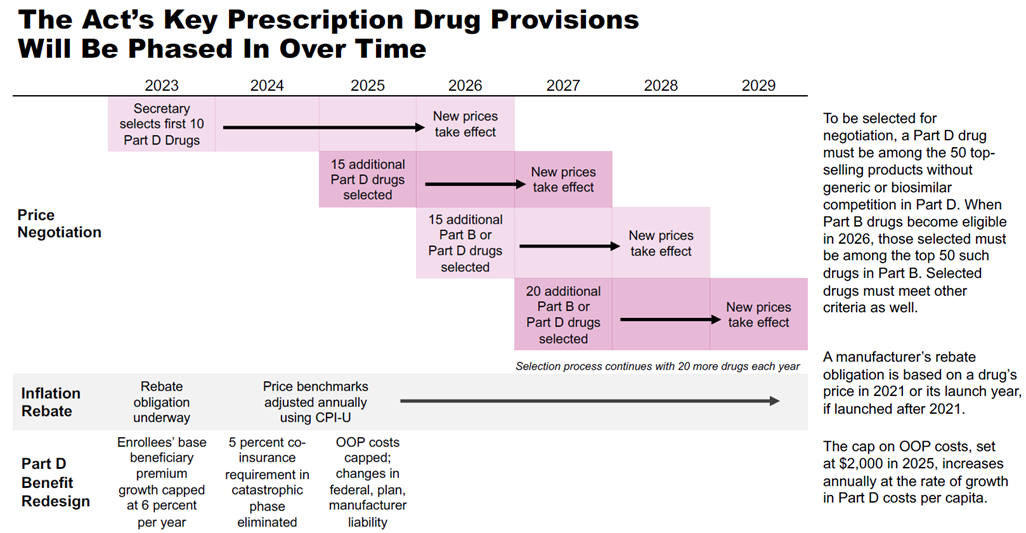
This means that each year, 15 drugs will be added to the price negotiation list until 2031, by which time a total of 100 drugs will have been affected by price negotiations.
Taking the first batch of negotiated drugs as an example:- Bristol-Myers Squibb/Pfizer:Anticoagulant drugsEliquis (Apixaban);
- Lilly/BI:Diabetes, Heart Failure DrugsJardiance (Empagliflozin);
- Johnson & Johnson:Anticoagulant DrugsXarelto (Rivaroxaban);
- MSD:Diabetes MedicationsJanuvia (Sitagliptin);
- AstraZeneca:Diabetes, Heart Failure, Chronic Kidney Disease DrugsFarxiga (Dapagliflozin);
- Novartis:Heart Failure DrugsEntresto (Nuo Xintuo);
- Amgen:RA, Psoriasis, Psoriatic Arthritis DrugsEnbrel (Etanercept);
- AbbVie/Johnson & Johnson:Hematological Tumor DrugsImbruvica (Ibrutinib);
- Johnson & Johnson:Psoriasis, Psoriatic Arthritis, Crohn's Disease, Ulcerative Colitis DrugsStelara (Ustekinumab);
- Novo Nordisk:Insulin Fiasp。
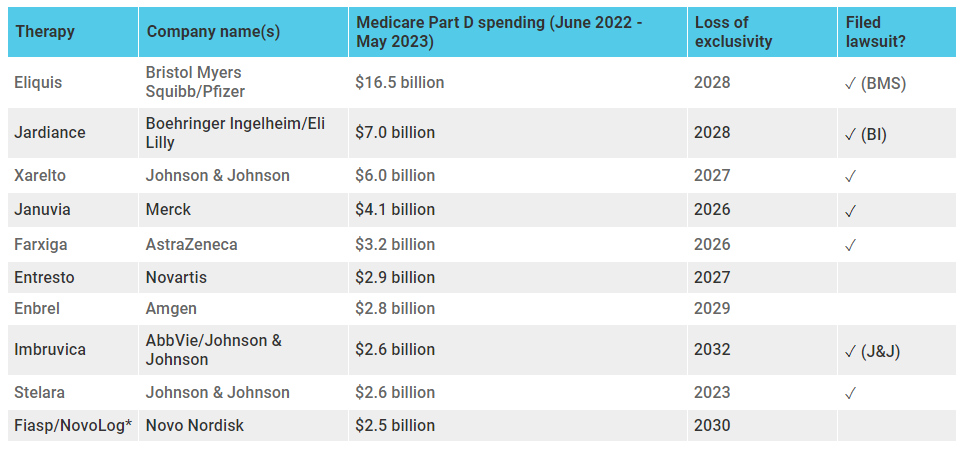 Analysts predict that the product most affected in 2026 is likely to be BMS's anticoagulant drug, Eliquis. From June 2022 to May of this year, its expenditure under Medicare Part D reached $16.5 billion, more than double that of other drugs.However, the actual U.S. net sales of Eliquis in 2022 were only $7.8 billion. Why is there such a gap? Moody's analysts explained that the reason is a large number of rebates and discounts.Moreover, according to Moody's data, pharmaceutical companies that may be significantly impacted by price negotiations in 2026 could includeAmgen, as high as 15%. AndJohnson & Johnson(The Impact of 3 Drugs on the List) May Reach 13%.For Johnson & Johnson, the biggest blow came from Stelara, an immunosuppressant that generated $6.4 billion in sales in the U.S. last year. Slightly lower were the sales of Xarelto, Johnson & Johnson's blood thinner, which reached $2.5 billion in the U.S., and Imbruvica, a blood cancer drug co-marketed by Johnson & Johnson and AbbVie, with $3.4 billion in sales in 2022. Due to fierce competition from BeiGene’s Brukinsa and AstraZeneca’s Calquence, Imbruvica’s revenue is expected to significantly decline by 2026.Other drugs on the CMS list did not reach 5% of their companies' revenue in U.S. sales last year, so their impact from price negotiations will be less significant. These products include Novartis' Entresto, Merck's Januvia, AstraZeneca's Farxiga, and Novo Nordisk's NovoLog.Background of the Inflation Reduction Act:Since 2021, persistently high inflation in the United States has repeatedly set new historical records, forcing the Federal Reserve to raise interest rates multiple times to curb inflation.In August 2022, the White House introduced the Inflation Reduction Act of 2022, which was passed by both the Senate and the House of Representatives. On August 16, Biden signed it into law, and it officially took effect in 2023. One of the core components of expenditure reduction is the drug price negotiation plan.It can be seen that, under the many global changes, the traditional business models of pharmaceutical companies will be difficult to sustain. The previous product values will be reshaped, and only continuous transformation will lead to success.CR:Bristol Myers joins AstraZeneca in agreeing to drug price negotiation terms ahead of first deadline
· END ·
--Video Dynamics--
▲Gene Therapy Brings New Hope to Patients with Genetic Diseases
--Featured Recommendations--