


Urothelial carcinoma is most commonly found in the bladder (90%). According to the United StatesCancerAccording to the association's statistics, about 79,000 people in the United States will be diagnosed with bladder cancer in 2017, and nearly 17,000 people will die from this disease.Patients diagnosed with metastatic disease have a poor prognosis,5The 5-year survival rate%。
Six months after Pfizer acquired Seagen for a hefty sum, a pivotal victory was achieved in the trial of Seagen and Astellas' collaborative anticancer drug Padcev (enfortumab vedotin-ejfv) combined with Merck's Keytruda for previously untreated metastatic bladder cancer.
Enfortumab vedotin uses Seagen's proprietary linker technology to connect the microtubule-disrupting agent MMAE with an anti-Nectin-4 monoclonal antibody. Enfortumab vedotin can target Nectin-4, a cell adhesion molecule expressed in various solid tumors.
On September 22, Seagen and Astellas respectively issued press releases announcing positive preliminary results from the Phase III EV-302 clinical trial of Padcev in combination with K medicine for the treatment of previously untreated patients with locally advanced or metastatic urothelial carcinoma (la/mUC).

Source: businesswire official website
The EV-302 trial enrolled previously untreated la/mUC patients, and results showed that regardless of PD-L1 status, these patients were eligible to receive cisplatin or carboplatin chemotherapy.
Positive data from a cohort in the previously disclosed Phase 1b/2 trial of urethral cancer showed that treatment with Padcev in combination with Keytruda in la/mUC patients ineligible for cisplatin chemotherapy achieved an ORR of 64.5%.
Regarding this positive data, some have pointed out that the experiment lacks crucial details, the most important of which is the monotherapy efficacy of Padcev. This has sparked numerous negative speculations within the industry. Among them, Andrew Berens, a senior biotechnology analyst at SVB, also questioned in a statement: due to the lack of monotherapy data for Padcev, it is speculated that the activity and duration of Padcev as a monotherapy may be significantly lower than in combination therapy, and it is highly likely that the efficacy in combination therapy still mainly relies on Keytruda.
In response to this质疑, the results of the EV-103 trial from the critical patient group "K cohort" presented more clearly at the 2022 ESMO,The combination therapy showed good results, with Padcev playing an indispensable role. Specifically, among the 76 patients who received the combination therapy, 64.5% experienced tumor shrinkage, and 10.5% achieved a complete response. Among the 73 patients treated with Padcev alone, 45.2% had tumor shrinkage, including 4.1% with a complete response.
The data results from Group K show that, considering Keytruda's monotherapy response rate of 28%, Padcev played a significant role in terms of response rate.Scot Ebbinghaus, M.D., Vice President of Clinical Research at Merck, also mentioned in an interview that the response rate of Padcev as a single agent is slightly higher than that of Keytruda, but both drugs are important for combination therapy.
These findings are significant as they not only help accelerate the approval of this drug combination as a first-line treatment but also quickly address the clinical needs of this indication, while helping Padcev realize its clinical value potential.
Roger Dansey, M.D., Chief Medical Officer at Seagen, also stated in the press release: "This study has the potential to change clinical practice and provide a new treatment standard for first-line metastatic bladder cancer."
Additionally, on April 3, 2023, the FDA granted accelerated approval to enfortumab vedotin-ejfv (brand name Padcev) in combination with pembrolizumab (brand name Keytruda) for the treatment of patients with locally advanced or metastatic urothelial cancer who are not eligible for cisplatin-containing chemotherapy.
Efficacy was evaluated in the EV-103/KEYNOTE-869 multi-cohort (dose-escalation cohort, Cohort A, Cohort K) study. Patients had not previously received systemic treatment for locally advanced or metastatic disease and were ineligible for cisplatin-based chemotherapy. A total of 121 patients received enfortumab vedotin-ejfv plus pembrolizumab.
The primary efficacy outcome measures were objective response rate and duration of response, as determined by blinded independent central review using RECIST v1.1. The objective response rate was 68% among 121 patients, with a complete response rate of 12%. The median duration of response was 22 months for the dose-escalation cohort + Cohort A, and not reached for Cohort K.
The most common adverse reactions (including laboratory abnormalities) occurring in more than 20% of patients were hyperglycemia, increased aspartate aminotransferase, rash, decreased hemoglobin, increased creatinine, peripheral neuropathy, lymphopenia, fatigue, increased alanine aminotransferase, hyponatremia, increased lipase, decreased albumin, alopecia, hypophosphatemia, weight loss, diarrhea, pruritus, decreased appetite, nausea, dysgeusia, hypokalemia, neutropenia, urinary tract infection, constipation, hyperkalemia, hypercalcemia, peripheral edema, dry eye, dizziness, arthralgia, and dry skin.
In addition, a 2021 study found that Enfortumab vedotin also had quite good therapeutic effects on PD-1 resistant bladder cancer patients.
Researchers enrolled 608 bladder cancer patients who had progressed after receiving platinum-based chemotherapy and PD-(L)1 inhibitor immunotherapy. Of these, 301 received Enfortumab vedotin treatment, while 307 received chemotherapy with paclitaxel or vinflunine.
After a median follow-up of 11.1 months,The median overall survival in the Enfortumab vedotin group reached 12.88 months, significantly longer than the 8.97 months in the chemotherapy group, with a 30% reduction in the risk of death and a longer progression-free survival as well.The incidence of adverse reactions was similar in both groups, and the incidence of grade 3 or higher adverse reactions was also similar.

Seagen, as the pharmaceutical company that has long ranked first in the global ADC drug original research company list, its strong ADC drug development capability is indeed formidable. From Seagen's current pipeline layout, it covers multiple new target ADCs at different stages of development. As of now, Seagen has up to 33 clinical development projects underway.
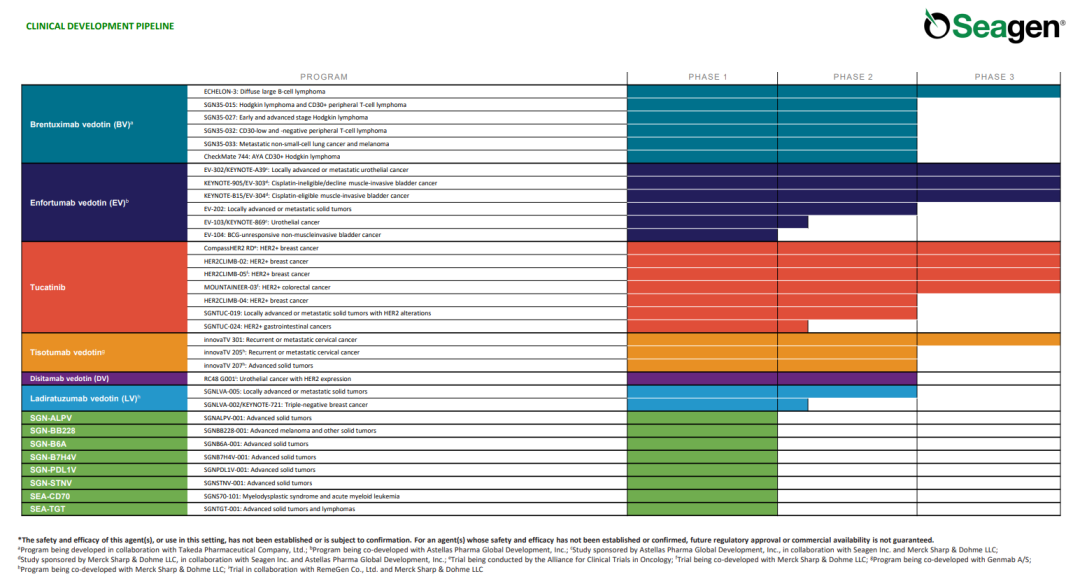
Source: Seagen Official Website
Such an extensive pipeline layout and robust technology make it no exaggeration to call Seagen a "pioneer" in ADC. From the perspective of Seagen's business landscape, there are currently four approved drugs: Adcetris, Padcev, Tivdak, and Polivy.