

Filterlex Medical Submits IPO Prospectus for CAPTIS, a Next-Generation Global Embolic Protection System for TAVI

Filterlex Medical
Cardiovascular Medical Device Developer
Transcatheter Aortic Valve Implantation (TAVI) is a recommended therapy for patients with symptomatic aortic stenosis who are at higher surgical risk. It can reduce patient trauma, shorten recovery time, and significantly decrease patient mortality.
Nevertheless, for patients, it remains a "double-edged sword" treatment option. While TAVI brings good news to patients, it also carries the risk of "stroke," a severe potential complication.
"Chinese Expert Consensus on Perioperative Cerebral Protection in Cardiac Surgery (2019)" disclosed that the incidence of perioperative stroke in cardiac surgery is significantly higher than in other types of surgery. The incidence of stroke in non-cardiac, non-neurological, and non-major vascular surgeries is less than 1%. However, the stroke incidence rate after complex and severe valvular replacement surgery is 9.7%, for isolated mitral valve surgery it is 8.8%, for valvular surgery combined with coronary artery bypass grafting (CABG) it is 7.4%, for isolated aortic valve surgery it is 4.8%, and for isolated CABG it is 3.8%. The disability rate among surviving patients exceeds 50%.
Therefore, significant efforts have been devoted to developing strategies for stroke prevention, including novel embolic protection devices. These devices aim to reduce stroke risk by deflecting and capturing emboli, diverting them away from cerebral circulation. Scholar Yash Jobanputra and others once envisioned an innovative blueprint for a cerebral embolic protection device: it would maximize the prevention of emboli from entering cerebral circulation, be easy to insert and remove, function continuously throughout the TAVI procedure, not interfere with valve deployment equipment, and not significantly prolong the duration of the TAVI surgery, among other features.
Filterlex Medical is turning this concept into reality.
Located in Caesarea, Israel, the company is dedicated to developing a new generation of embolic protection systems aimed at reducing the risk of stroke and other complications associated with transcatheter minimally invasive structural heart procedures. Based on insights and expertise into TAVI procedures and the existing gaps in demand, Filterlex Medical has developed CAPTIS, a next-generation full-body embolic protection system for TAVI, designed to reduce the flow of embolic material into the bloodstream during left-heart procedures.
Many scholars believe that during the TAVR procedure, embolic debris released from the stenotic aorta is the cause of the vast majority of early or acute perioperative stroke events. A 2016 study based on neuroimaging findings (magnetic resonance imaging before and after TAVI) showed that 94% of subjects had new imaging evidence of embolic cerebral infarction post-TAVI.
During transcatheter left-heart procedures such as TAVI, embolic materials often enter the bloodstream. If these emboli migrate to the brain, they may cause a range of neurological deficits, from cognitive impairment to severe stroke. If they migrate to distal organs, they may lead to acute kidney injury and ischemia.
Based on the potential risk of TAVI, founder and CEO Sigal Eli invented the Filterlex patented cerebral embolic protection system CAPTIS. She is an interventional cardiology imaging expert who previously served as a clinical and training specialist at Paieon Medical, providing technical support for over 300 TAVI procedures across 20 medical centers worldwide. Chief Technology Officer Eyal Teichman is a mechanical engineer with 15 years of R&D experience in implantable devices within the cardiovascular field.
The deployment and retrieval of CAPTIS are simple and intuitive, with a process identical to that of a conventional catheter, requiring no additional punctures or operational skills. During deployment, the device enters the aorta through the catheter from the femoral artery and unfolds at the aortic arch. For retrieval, the device exits the aorta through the catheter and is closed at the femoral artery. In brief, its workflow can be summarized in three words: deflect, capture, remove.
CAPTIS is able to capture and remove embolic debris, rather than merely deflecting or filtering it. The CAPTIS system consists of three main components: the aortic arch deflector, the aortic surface protector, and the embolic debris capturer. The deflector diverts embolic debris from the aortic arch to the surface protector, which separates the debris from the aortic wall and directs it toward the capturer, where the debris is collected and removed upon retrieval.
Before the surgery begins, the clinician introduces CAPTIS into the aorta via femoral artery puncture and advances it to above the aortic arch. Then, the deflector is released above the aortic arch and secured to the aortic wall. Next, the capturer is released above the descending aorta and expanded to an appropriate diameter. Here, the deflector is positioned tightly against the upper part of the aortic wall and seamlessly connected to the capturer, forming a complete pathway that conforms to the vessel wall, ensuring embolic materials flow directly along the deflector into the capturer.
After the full expansion of CAPTIS, the doctor will perform transcatheter structural heart surgery (such as TAVI) and monitor the flow and capture of embolic materials. Upon completion of the procedure, the operator will contract the capturer and retract it along with the deflector back into the catheter. Meanwhile, the embolic materials captured inside CAPTIS will be withdrawn from the body through the femoral artery access site.
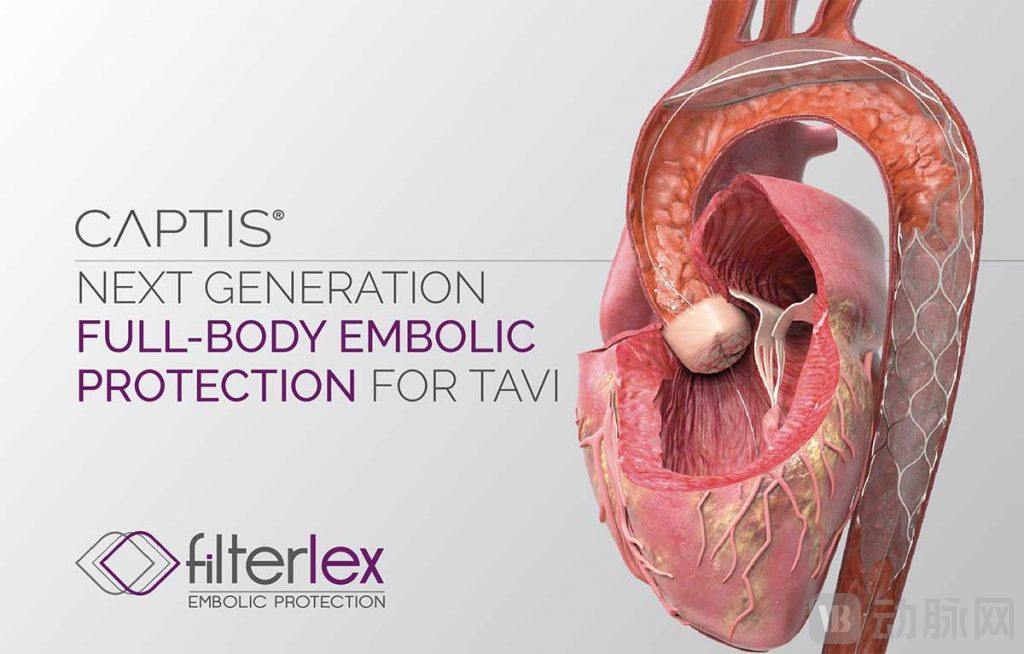
CAPTIS System Image Source: Filterlex Medical Official Website
CAPTIS prevents emboli from migrating to the brain, kidneys, and other organs, causing complications such as stroke, acute kidney injury, and ischemia, by deflecting, capturing, and removing them. The system's aortic arch deflector is highly stable with a semi-circular structure, effectively diverting emboli from the aortic arch to the surface protector. The shape and size of the deflector can cover all branches of the aortic arch, preventing emboli from entering the carotid or subclavian arteries and causing cerebral ischemia. It provides full-body embolic protection, with an embolism prevention range that includes not only the brain but also many other organs.
CAPTIS Aortic Surface Protector
In addition, the CAPTIS system has stable anchoring capabilities. Its anchoring mechanism adopts a self-adaptive tapered structure that can firmly fix at the aortic arch, preventing device migration or slippage. The design also considers anatomical variations of the human aorta, including the angle, curvature, diameter, and length of the aortic arch. Each part of the device can be adjusted or selected according to different anatomical features to achieve optimal matching and performance, enhancing the adaptability and stability of the device.
Moreover, the CAPTIS system is fully compatible with the surgical workflow and does not interfere with surgical equipment or procedures.
CAPTIS Design and Application in Structural Heart Disease Surgery
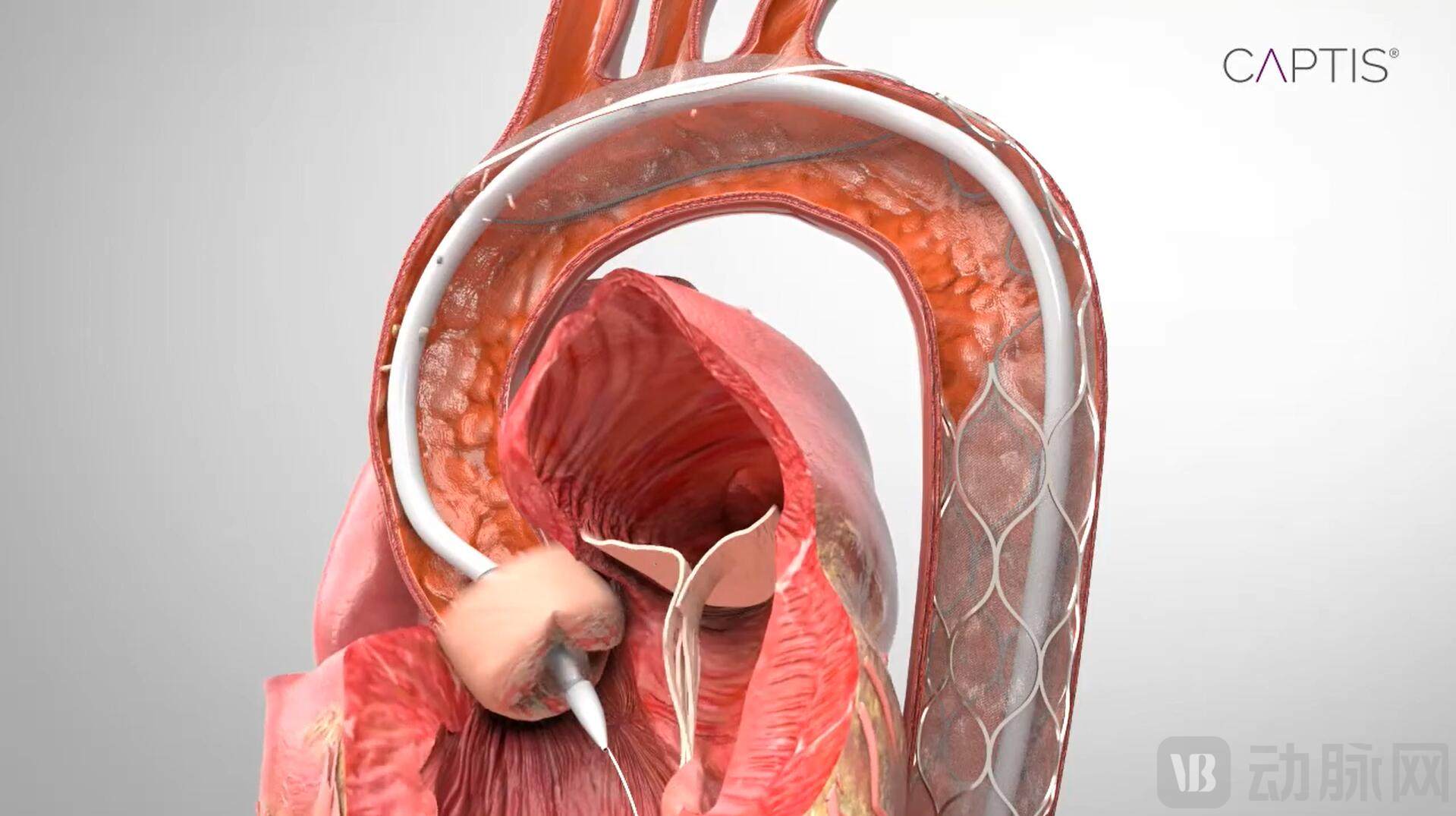
The CAPTIS system is capturing embolic material. Image source:Filterlex Medical Official Website
The CAPTIS system can be fully integrated into the surgical workflow without requiring additional access or procedural steps. The system can be deployed before the surgery begins and retrieved after the surgery ends, without interfering with the use of surgical instruments or affecting the surgical outcome.
On May 31, 2022, Filterlex Medical announced the results of its First-in-Human (FIH) study, demonstrating the safety, feasibility, and performance of the CAPTIS system. The trial was a prospective, single-arm study, including 20 patients who successfully underwent TAVI procedures with the CAPTIS embolic protection device. Study data were presented by Professor Ran Kornowski, Director of the Cardiology Department at Rabin Medical Center in Israel, at the EuroPCR 2022 conference.
The main results of the study showed that the technical success rate of the CAPTIS system reached 100%, with successful deployment and retrieval in all patients without interference to the TAVI procedure. No device-related complications occurred in any patient during the trial period. Moreover, no cerebrovascular events were observed in any patient following objective examination by independent neurologists. Professor Haim Danenberg, head of interventional cardiology at Wolfson Medical Center and principal investigator of the study, stated: "Safe and effective cerebral protection during percutaneous cardiac procedures addresses an unmet clinical need, and the CAPTIS system developed by Filterlex Medical effectively protects the brain and kidneys of TAVI patients by intercepting embolic debris."
In the rigorous selection process of the "Horizon 2020" project, Filterlex stood out among more than 1,000 companies from 21 countries to become one of the 99 winning companies, thus securing funding from the European Innovation Council (EIC). Participants had to meet the EIC's criteria for excellence, impact, and risk level, and be recognized as world-class, highly impactful, and innovative in the final evaluation stage.
On December 21, 2021, Filterlex Medical announced that the company had been selected by the European Innovation Council (EIC) to receive €7 million in equity financing. This funding will be used to expand clinical projects, obtain regulatory approval, and promote the commercialization of the CAPTIS full-body embolic protection system. This round of financing follows the company's previous grant of €2.1 million under the EU’s "Horizon 2019" program and marks the second time Filterlex Medical has received EIC funding. Being chosen twice for EIC funding demonstrates that the company’s technological innovation, market potential, and social impact have gained recognition and support from the EU.
Next, Filterlex Medical will continue to advance the clinical trials of CAPTIS to verify its effectiveness and safety in reducing the risk of stroke and other complications during transcatheter left-heart structural cardiac procedures such as TAVI. The company will further develop and optimize the technology and design of its embolic protection device to accommodate different anatomical structures and hemodynamics, while exploring its potential applications in other areas of structural heart disease surgeries.
References:
[1] Hood R , Budd A , Sorond FA , et al . Peri - operative neurological complications [J]. Anaesthesia ,2018,73 Suppl 1:67-75.
[2]Toeg HD , Nathan H , Rubens F , et al . Clinical impact of neurocognitive deficits after cardiac surgery [ J ]. J Thorac Cardiovasc Surg ,2013,
[3] Cropsey C , Kennedy J , Han J , et al . Cognitive dysfunction , delirium , and stroke in cardiac surgery patients [J]. Semin Cardiothorac Vasc 145(6):1545-1549. DOI :10.1016/j. jtevs .2013.02.061.Anesth ,2015,19(4):309-317.
[4] Han Hongguang. Chinese Expert Consensus on Perioperative Neuroprotection in Cardiac Surgery (2019)[J]. Chinese Critical Care Medicine, 2019, 31(2): 129-134.
[5]Cormican D S. Judgment Reserved: The Evolving Development of Cerebral Embolic Protection Devices in Transcutaneous Aortic Valve Replacement[J]. Journal of Cardiothoracic and Vascular Anesthesia, 2023, 37(2): 195-197.
[6]Jobanputra Y, Jones B M, Mohananey D, et al. Cerebral protection devices for transcatheter aortic valve replacement[J]. Expert Review of Medical Devices, 2017, 14(7): 529-543.