

Diabetes Tech Heats Up: Abbott, Dexcom, and Medtronic Intensify Competition Through Strategic Acquisitions and Innovations

Abbott
Provider of Health Diagnostic Products and Health Diagnostic Management Solutions

Bigfoot Biomedical
Diabetes Management System and Medical Device Developer

Medtronic
Chronic Disease Medical Device and Therapy Developer

EOFlow
Developer and Manufacturer of Wearable Insulin Patch Pumps

Dexcom
Blood Glucose Monitoring System Developer
In the diabetes sector, several major players have made moves, sparking a wave of mergers and acquisitions in recent months.
At the beginning of this year, Insulet announced the acquisition of Automated Glucose Control, which focuses on insulin infusion, kicking off this year's mergers and acquisitions activities.
Medtronic Acquires Korean EOFlow for $738 Million, a Company that Manufactures Wearable Insulin Patch Pumps, Sparking Widespread Attention in the Industry. At the Same Time, Novo Nordisk Is in Exclusive Negotiations with Biocorp for a Potential $165 Million Acquisition. Biocorp, a French Pharmaceutical Delivery Device Manufacturer, Produces Products Including Insulin Pen Accessories. Additionally, Tandem Diabetes Care First Acquired Infusion Technology Developer Capillary Biomedical and Then Completed the Acquisition of AMF Medical, the Manufacturer of the Sigi Insulin Patch Pump.
Just in the past September, Abbott announced the successful acquisition of Bigfoot Biomedical, as if making a declaration to the industry. Perhaps from these mergers and acquisitions, we can see the trend judgment of giant companies on the technological development in the diabetes field.
To address the rapid expansion of the diabetic patient population, Medicare in the United States has expanded its reimbursement coverage, and the diabetes market continues to grow.
According to a study published in The Lancet, it is predicted that by 2050, more than 1.31 billion people worldwide will have diabetes, with the rise in prevalence driven by an increase in type 2 diabetes. It is estimated that by 2045, global healthcare spending related to diabetes will rise to $1.054 trillion. The International Diabetes Federation (IDF) predicts that by 2045, the global population will increase by 20%, while the number of people with diabetes will rise by 46%.
For diabetic patients, blood glucose monitoring is a precondition for disease management. Traditionally, fingertip blood tests or glycated hemoglobin have been the commonly used methods. With the introduction of Continuous Glucose Monitoring (CGM) systems, which provide continuous, reliable, and comprehensive blood glucose data, it has become easier to accurately assess the condition and develop scientific blood sugar reduction plans. These systems have gained recognition from patients, leading to an expanding market share.
In April this year, the US Centers for Medicare & Medicaid Services updated its policy to expand the insurance reimbursement scope for CGM. In addition to patients with type 1 diabetes and those with type 2 diabetes on intensive insulin therapy, Medicare will now cover patients with type 2 diabetes using basal insulin therapy as well as patients who do not use insulin but experience hypoglycemic events.
According to a research report by J.P. Morgan, policy changes will double the U.S. CGM market within the next one to two years. A research report from the investment bank William Blair shows that the current CGM market in the U.S. is about $4 billion in size, but with the inclusion of more patients using basal insulin and type 2 diabetes patients who do not use insulin, the market size is expected to expand to $10 billion by 2025.
At the same time, some real-world studies have shown that smart insulin pumps can provide long-term improvement in blood glucose control for people with diabetes. For example, a study was published this year in *Clinical Diabetes*, a journal of the American Diabetes Association (ADA). The study followed 58 patients (84.5% of whom had type 2 diabetes) over six months. Among them, patients with prior experience using CGM had an average baseline HbA1c of 8.2%, which decreased to 7.3% after six months; for those without prior CGM experience, these figures were 9.0% and 7.1%, respectively. The data suggests that smart insulin pumps may offer better blood glucose control compared to multiple daily insulin injections.
The increase in the patient population, the expansion of insurance coverage, and better clinical outcomes are all pointing to one fact — CGM is not only limited to blood glucose monitoring. More effective blood sugar control solutions can be developed around it. Designing CGM-centered solutions is the next step for leading CGM companies such as Abbott, Dexcom, and Medtronic.
The company with the "first and only" product has ultimately landed in Abbott.
Diabetes business plays a significant role in Abbott's medical device revenue. In Q2 this year, the global sales of Abbott's FreeStyle Libre series CGM reached $1.3 billion, increasing by 24.7% year-over-year. According to data from the prospectus of WeTai Medical, Abbott had already captured half of the global CGM market share as early as 2020. For such a core business, Abbott is bound to expand and develop around it, continuously enhancing product competitiveness. The acquisition of Bigfoot Biomedical is an essential part of this strategy.
Bigfoot Biomedical (hereinafter referred to as Bigfoot) has established cooperative relationships with several leading enterprises in the field of diabetes care by leveraging its own technological advantages. For instance, Bigfoot collaborated with Abbott six years ago to develop connected diabetes solutions. It also maintains a strong partnership with Dexcom. Additionally, Bigfoot has worked with Insulet, another leader in diabetes management, and in February this year, sold its pump-based automated insulin delivery technology to Insulet.
What several leading companies are eyeing is Bigfoot Biomedical's technological accumulation.
Bigfoot Unity, developed by Bigfoot Biomedical, is a smart insulin management system. According to PR Newswire, this product is currently the "first and only" FDA-approved connected insulin pen cap globally. The pen cap reads CGM data and insulin recommendations provided by doctors, displaying the corresponding dose on its digital screen to help patients use insulin accurately.
Notably, in order to cater to a wide range of patients, Bigfoot Unity has made significant efforts in compatibility, essentially adapting to mainstream insulin pen brands in the U.S. market. From a payment perspective, Bigfoot Unity meets the needs of insurance companies, as payers largely determine which brand of insulin is used. Since its approval in 2021, Bigfoot Unity is still in the early stages of commercialization but has already started to gain support from commercial insurers, and the product rollout is expected to accelerate.
In terms of product categories, blood glucose monitoring and insulin therapy belong to two细分的fields in the diabetes care market. Senior Vice President of Abbott's diabetes care business stated regarding this acquisition: "The acquisition of Bigfoot Biomedical will combine two leading companies in different aspects of diabetes care: continuous glucose monitoring and insulin dosing support."
Abbott's acquisition this time will help to improve its own product pipeline, making its diabetes management more personalized and precise, thereby consolidating its market position.
From a commercialization perspective, the combination of the two can even be said to be a natural progression. First, from a technical standpoint, due to the six-year-long collaboration between the two parties, Abbott's FreeStyle Libre series of CGMs have already been adapted to work with Bigfoot Unity, connecting via a mobile app to the cloud to enable functionality. Second, from a market perspective, Bigfoot needs a giant like Abbott to help open up the market for its products.
Bigfoot's CEO publicly stated: "In the second half of 2021, after the product was approved, we faced a favorable market situation. However, constrained by our scale, our financing and operational support capabilities have limited the commercialization process. This is Abbott’s strength, and we need Abbott’s power to promote the widespread adoption of the product."
At the same time, the CEO of Bigfoot Biomedical also shared his perspective on the development of diabetes care technology: "Digital closed-loop blood glucose management is undoubtedly the future direction, but there is still much room for improvement. For example, the Omnipod closed-loop system is an excellent product, but the pump comes from Insulet, and the sensor comes from Dexcom. Patients need to place orders from two different sources, receive support from two separate companies, and use two different apps. This creates a certain barrier for users. If all these components could be integrated into a single solution, it would be more conducive to the promotion of the product."
In August 2022, Abbott announced an investment of 440 million euros to expand its diabetes care business. In April this year, the construction of Abbott's base for producing the FreeStyle Libre 3 continuous glucose monitoring system began, followed by the acquisition of Bigfoot in September. Abbott’s determination to strengthen its diabetes care business is resolute.
Medtronic, which has struggled in the diabetes care market for nearly three years, is now making a strong push to reclaim its lost share.
Medtronic's development route in the diabetes management field has always focused on insulin pumps, with CGM as a supplement. However, following a warning letter from the FDA regarding the previous generation of products, Medtronic’s diabetes business in the U.S. has stagnated in recent years. According to financial report data, Medtronic's diabetes business shows completely different trends between the U.S. market and the international market.
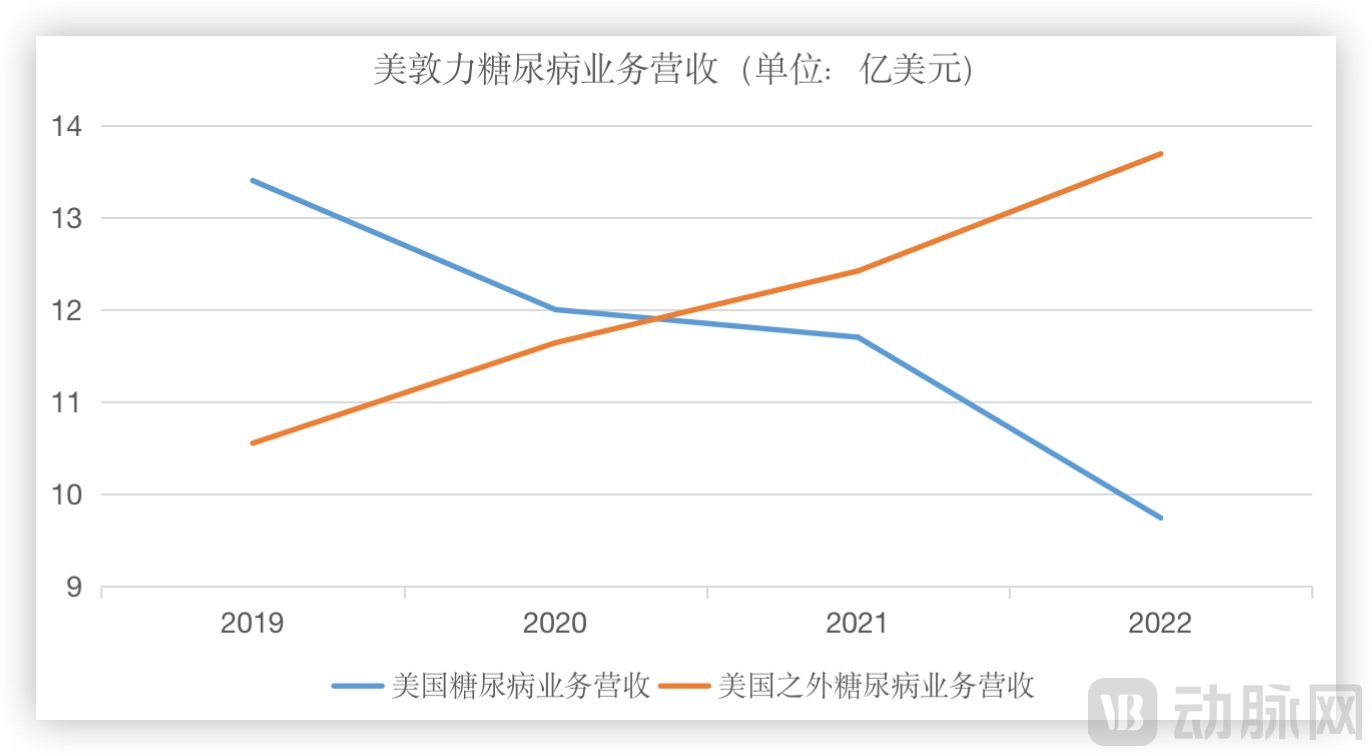
Medtronic's Diabetes Business Revenue in Recent Years, Data from Corporate Financial Reports
With the launch of the new product MiniMed 780G, Medtronic's revenue in the international market has continued to rise, but it has been declining in the U.S. domestic market. Meanwhile, Medtronic's competitors have not slowed down. Abbott reported $4.76 billion in revenue from its diabetes business in 2022, while Dexcom reported revenue of $2.91 billion. Even insulin pump manufacturers Insulet and Tandem Diabetes Care reported revenues of $1.3 billion and $801.2 million, respectively.
With the approval of MiniMed 780G in the U.S. in Q2 this year, Medtronic, as one of the few companies on the market possessing the three key elements of a closed-loop system (CGM, insulin pump, and algorithm), must inevitably start striving to regain market share, or risk being marginalized.
Like Abbott, Medtronic has also set its sights on the insulin infusion field.
Medtronic Acquires Korean Diabetes Technology Company EOFlow for $738 Million in MayMedtronic, plc. acquired EOFlow Co., Ltd., a Korean diabetes technology company, for $738 million in May this year. Founded in 2011, EOFlow’s core product, EOPatch, is the world’s second tubeless, disposable patch insulin pump following Insulet Corporation's OmniPod. EOPatch has received regulatory approval in Europe, parts of Asia, and the Middle East, and has been granted Breakthrough Device Designation by the FDA. The product comes with an app that allows for precise control and monitoring of the patch.
Medtronic's acquisition of EOPatch undoubtedly provides the key to entering the smart patch pump market. In the future, Medtronic will integrate EOPatch's technology into its own products to prepare for the next phase of competition.
Another CGM giant, Dexcom, has also invested heavily to compete.
In July this year, Dexcom announced that it would invest 300 million euros in building its first production base in Europe, located in Ireland, which will be the company's third production base following those in the United States and Malaysia. The annual output of the future Irish plant is expected to reach several million.
At the end of last year, Dexcom's new generation CGM product, Dexcom G7, received FDA approval for market launch. In Q1 this year, the G7 also obtained CE certification. The Dexcom G7 will compete head-to-head with Abbott's latest generation product, FreeStyle Libre 3, in the global market.
According to Dexcom's Q2 financial report this year, it achieved 38% sales growth in international markets outside the United States and raised its full-year revenue growth forecast from 17% to 21%. During the earnings call, Dexcom attributed the reasons to the upgrade of G7 itself and the market strategies implemented in advance around G7.
Compared with the previous generation G6, the volume of the G7 sensor has been reduced by 60%, with a Mean Absolute Relative Difference (MARD) value of 8.2. It is more tightly integrated with the app, enabling more precise alerts for users. Meanwhile, Dexcom is also preparing to enable independent connectivity between the G7 and Apple Watch to enhance user experience.
Dexcom has also partnered with Insulet and Tandem Diabetes Care in the United States. Dexcom G6 has already integrated with their automated insulin delivery platforms to form a closed-loop system, and the integration work for G7 is underway, which will expand the user base for G7's promotion.
Abbott, Dexcom, and Medtronic, these three giants are all working around the integration of CGM with smart insulin pumps to create more convenient and user-friendly blood sugar control solutions. Whether it's Abbott and Medtronic’s direct acquisitions or Dexcom’s extensive collaborations, they are all moving towards this goal.
As a "cornerstone" product, CGM itself is still evolving, with companies leveraging related technologies to continuously expand application boundaries.
Taking Dexcom as an example, at this year's American Diabetes Association (ADA) annual scientific meeting, Dexcom announced the development of a new generation of sensors for type 2 diabetes patients not receiving insulin treatment. These sensors can not only monitor blood glucose levels but also track the impact of diet, medication, and exercise on the body. The new sensor is expected to be launched in 2024, with a designed service life of 15 days, surpassing the 10 days of G7, and will also come with a completely new companion app.
Another giant, Medtronic, announced at the end of September that its next-generation CGM product, Simplera, which has been under development for many years, has received CE certification.
From a product perspective, Simpler is suitable for people aged 2 and above, including children and adults with Type 1 and Type 2 diabetes. Compared to the cumbersome wearing process of the previous generation product Guardian, Simpler has finally achieved the same level of simplicity and ease of use as its competitors. Additionally, Simpler's size is only about half that of Guardian, making it more comfortable to wear. However, Simpler's current lifespan is only 7 days, which still lags behind its competitors.
From a market perspective, over the past period, Medtronic was the only one among the CGM giants to possess a CGM + insulin infusion closed-loop system. However, limited by the performance of its CGM, the user experience has drawn considerable complaints from the patient community. An opportunity that should have allowed Medtronic to expand its market share through the closed-loop system was missed due to its own shortcomings. The launch of Simpler this time is a signal of Medtronic's counterattack.
What has prompted Medtronic to act so urgently is undoubtedly the expansion and development by Abbott and Dexcom based on CGM technology, which might be the root cause of Medtronic's anxiety.
Like Dexcom, Abbott also announced a new sensor development plan for type 2 diabetes patients not receiving insulin therapy, but Abbott has gone further. In July this year, Abbott launched a new wearable device and introduced the Lingo service in the UK. This product suite, developed based on CGM technology, is designed to help users adjust their metabolism to achieve optimal health. Although Lingo currently only measures blood glucose, Abbott plans to gradually add monitoring functions for biochemical indicators such as ketones, lactate, and alcohol.
Expanding CGM from medical applications to the broader health and wellness field is Abbott's goal, which aligns with Dexcom's strategy. During this year's Q2 earnings call, Abbott stated that after completing Lingo's testing in the UK, it would be rolled out to other markets. Abbott also noted that it would be a crucial component in achieving $10 billion in CGM business revenue by 2028.
This competition, driven by medical insurance and fueled by the three giants in a battle of internal CGM rivalry, continues to unfold. Whether it’s expanding CGM from the traditional Type 1 diabetes market into the broader Type 2 diabetes market, or Abbott and Dexcom steering it toward the consumer market, the goal remains to unlock a larger market space. For patients, the finish line of this race is a precise and personalized solution that is also simple and easy to use.
References:
https://www.businesswire.com/news/home/20230621408146/en/Real-World-Data-Demonstrate-the-Potential-for-Rapid-and-Durable-Improvement-in-Glycemic-Control-for-People-with-Insulin-requiring-Diabetes-Using-the-Bigfoot-Unity®-System
https://www.medtechdive.com/news/bigfoot-ceo-abbott-acquisition-diabetes/693818/