Medtronic announced on September 21 that its new Simplera Continuous Glucose Monitor (CGM) has received CE mark approval.This disposable CGM is designed for simplicity, allowing for easy use in just two steps, making it particularly suitable for diabetic patients who require multiple injections.
Medtronic's new sensor not only eliminates the hassle of fingerstick blood sampling but also requires no additional tape for fixation. Moreover, it can be paired with the InPen smart insulin pen to provide real-time, personalized injection recommendations for diabetes patients, making diabetes management more convenient.
"Although the use of CGM has become widespread, many patients who require MDI therapy still cannot monitor their blood glucose. Our new technology aims to help more people achieve their blood glucose control goals," said Que Dallara, leader of Medtronic's Diabetes Division. The Smart MDI system mentioned by Dallara integrates real-time CGM and the InPen smart insulin pen, providing users with personalized dosing recommendations and simplifying diabetes management.
Simplera is suitable for use by individuals over the age of two and supports both iOS and Android systems. It is still under research in the United States, while Medtronic is applying for the CE mark for its system integrated with Simplera. Medtronic CEO Geoff Martha mentioned,The new Simplera CGM is half the size of the existing Guardian 4 and can compete with products from companies like Abbott and Dexcom.
Medtronic Launches New CGM at an Opportune Time as the Popularity of New GLP-1 Drug Classes May Benefit Its Growth. Analysts Believe These Drugs Could Drive Expansion in the CGM Market. This New Product Gives Medtronic the Ability to Compete with Abbott. Abbott and Bigfoot Have Already Partnered to Launch the FreeStyle Libre CGM and the Bigfoot Unity Smart Insulin Pen Cap System, andAbbott announced on September 22 that it had completed the acquisition of Bigfoot.
Recently,Medtronic also announced plans to acquire insulin delivery technology developer EOFlow for $738 million.Medtronic's diabetes business has also continued to grow, recently receiving FDA approval for its new insulin delivery system andA 6.8% year-over-year growth was achieved in the first quarter of 2024.At last month's company earnings conference call, Martha emphasized the continued success of the once-criticized diabetes division transformation.
Other leaders in this field — Abbott and Dexcom
Abbott and Dexcom are the two major manufacturers of continuous glucose monitors (CGM). Both giants are solidifying their advantages in the diabetes sector in their own ways, aside from the striking "Abbott's acquisition of Bigfoot Medical" event.On September 22, Dexcom also announced a partnership with RxFood to provide digital diabetes solutions for Canadians.The pioneering partnership combines Dexcom's Continuous Glucose Monitoring (CGM) with RxFood's AI-driven personalized nutrition assessment, aiming to introduce improved digital health solutions for people with diabetes. This combination will enable the integration of food data with insulin dosing, exercise, and glucose information.RxFood Launches Next-Generation App Featuring Integration with Dexcom CGM Data, Now Available to Canadian Healthcare Plan Stakeholders. This includes clinics, hospitals, health authorities, pharmacies, insurance companies, and employers. Through these programs, Canadians using Dexcom G6 or G7 (once available) can access consolidated data on food and glucose. It provides them with a more comprehensive and personalized understanding of their health and glucose control.Eye-catching M&A in the Diabetes Sector
Recent M&A news in the diabetes sector has been frequent. Insulet attempted to acquire the assets of Automated Glucose Control, a developer focused on insulin delivery technology.Medtronic has agreed to acquire South Korea's EOFlow, a company that manufactures wearable insulin patch pumps, for $738 million. This news has drawn widespread attention in the medical technology community.Meanwhile, Novo Nordisk is in exclusive talks with Biocorp to acquire a controlling stake. Biocorp is a French manufacturer of pharmaceutical delivery devices, including add-ons for insulin pens.In addition, Tandem Diabetes Care has recently completed two major acquisitions. First, it acquired Capillary Biomedical, a developer of infusion technology, for an undisclosed amount. Subsequently, Tandem completed the acquisition of AMF Medical, the manufacturer of the Sigi insulin patch pump.With the advancement of technology and growing consumer attention to health management, CGM has gradually evolved from a single medical device into part of wearable medical devices. In today’s market, we can see products like smartwatches and health trackers that incorporate CGM functions. These devices not only monitor blood glucose levels but also track various health metrics such as heart rate, sleep quality, and physical activity.Global Wearable Medical Device Market Size
On August 29, Research and Markets released statistics: The global wearable medical device market is estimated at $27.838 billion in 2023 and is expected to reach $3,584 billion by 2033, with a compound annual growth rate of 26.34% during the forecast period of 2023-2033.North America is expected to account for the highest revenue share during the forecast period, while the Asia-Pacific region is expected to experience the fastest compound annual growth rate.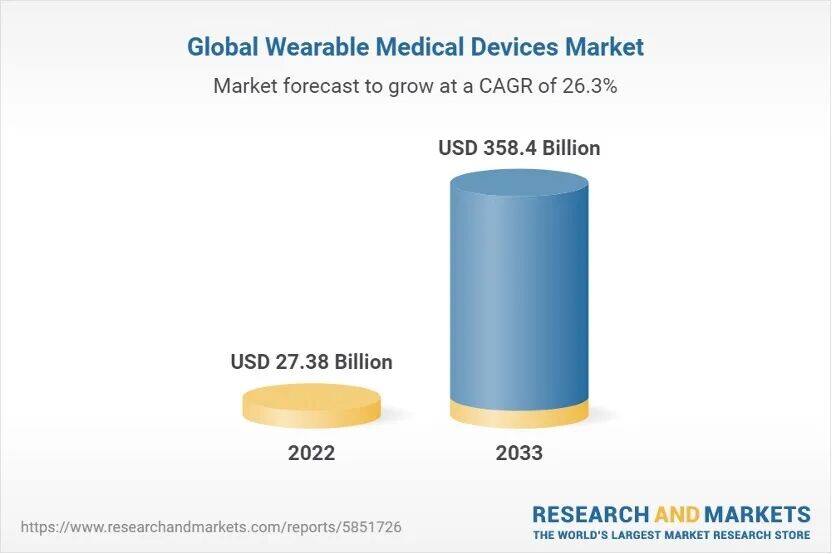
Image Source: Research and MarketsAccording to the product function statistics:Diagnostic devices were the highest revenue segment of the global wearable medical device market in 2022, attributed to the growing prevalence of neurological disorders and increased use of neuromodulation devices for diagnosing/treating migraines. Additionally, therapeutic devices are expected to grow the fastest during the forecast period, driven by the rising number of therapeutic devices and the growing prevalence of diabetes.According to the statistics of product installation locations:Straps/Clips/Bracelets were the highest revenue segment in the global wearable medical devices market in 2022, attributed to the increasing adoption of smartwatches that can monitor various signs, including movement, respiratory rate, and pulse rate. Additionally, handheld devices are expected to grow the fastest during the forecast period, driven by the rising use of advanced smartphone devices and technological progress.According to the application statistics:Home healthcare was the highest revenue segment in the global wearable medical devices market in 2022, attributed to the growing elderly population and the increasing prevalence of target diseases. Additionally, remote patient monitoring is expected to grow at the fastest rate during the forecast period, driven by the rising prevalence of cardiovascular diseases and the growing demand for personalized care.According to the production area statistics:North America is expected to account for the highest revenue share in the global wearable medical device market in 2022, attributed to the increasing prevalence of chronic diseases such as cardiovascular diseases, diabetes, and cancer, along with the growing adoption of remote patient monitoring and home healthcare devices. The Asia-Pacific region is projected to experience the fastest compound annual growth rate during the forecast period, driven by increased government initiatives in the region to promote the use of wearable medical devices, a growing elderly population, a surge in healthcare expenditure, rapid technological advancements, and rising demand for home healthcare devices and routine monitoring.The global wearable medical device market is experiencing a period of rapid growth, primarily driven by the increasing prevalence of chronic diseases, advancing technology, and growing attention to health monitoring. North America is expected to continue leading the market, while the Asia-Pacific region will experience the fastest growth. With technological advancements and an increase in partnerships and collaborations among market players, the market outlook appears highly optimistic.Source: Mass Device, compiled by Medical Device Innovation Network
Disclaimer: This article is intended solely for the purpose of information transmission and is for reference only. It does not constitute any advice on investment or treatment; please exercise caution. If the content, copyright, or other issues of the work are involved, to protect the rights and interests of both parties, please contact us and we will handle it immediately. If this article is reprinted by other platforms, they must take responsibility for the content themselves; the Medical Device Innovation Network is not responsible for any secondary dissemination caused by reprints.PAST/ISSUE/REVIEW