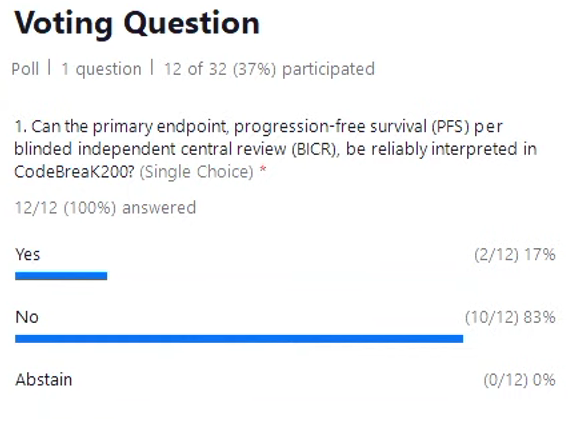
On October 5, the FDA ODAC (Oncologic Drugs Advisory Committee)2 votes in favor, 10 votes againstThe result suggests that Amgen's KRAS inhibitor Lumakras (sotorasib) The progression-free survival (PFS) results of the Phase III CodeBreaK 200 studyCannot be reliably explained。Unlike most ODAC meetings that focus on the benefit-risk assessment of study results, this meeting concentrated on the design and implementation process of clinical trials.Systematic Bias IssueThe FDA's pre-meeting materials clearly stated: The FDA did not seek the committee's opinion on whether CodeBreaK 200 could support the conversion of sotorasib from Accelerated Approval (AA) to regular approval. Instead, it hoped to discuss whether its results could be reliably interpreted and whether it was an adequate and well-controlled trial.
Previous Recap:October ODAC Preview | Has Sotorasib Truly Cracked the KRAS G12C Morse Code?
Regarding the discussion topics and voting results of this ODAC, the pharmaceutical cube Med official account and DeepMed database jointlyGCP Center, Cancer Hospital, Chinese Academy of Medical Sciences, will be held onOctober 17 (Tuesday) 17:00Live Discussion on the Current Treatment Status and R&D Landscape of Advanced Non-Small Cell Lung Cancer (NSCLC) with KRAS G12C Mutation – Welcome to Reserve and Watch.
· Background Review
KRAS mutations, as one of the most common drivers of human tumors, have long been considered an "undruggable target." The discovery of the KRAS protein switch pocket II made it possible to target the KRAS G12C mutation. Approximately 13% of NSCLC patients carry the KRAS G12C mutation. Currently, the first-line standard treatment is immune checkpoint inhibitors ± platinum-based chemotherapy. Most patients experience disease progression during or after treatment. Before the approval of the KRAS G12C inhibitors sotorasib and adagrasib, docetaxel ± ramucirumab was the standard second-line treatment regimen. Real-world data shows that the mPFS for second-line treatment of advanced NSCLC with the KRAS G12C mutation is approximately 4.0 months, and the mOS is about 9.5 months, indicating a significant unmet clinical need.
In May 2021, sotorasib was approved by the FDA based on the single-arm, multi-center, Phase I/II CodeBreak 100 study.Accelerated Approval,For patients with KRAS G12C-mutant NSCLC who have received at least one prior systemic therapy. With a median follow-up of 15.3 months, among 124 evaluable patients, the ORR was 37.1% (3.2% CR), the median DOR was 11.1 months, the median PFS was 6.8 months, and the median OS was 12.5 months. In terms of safety, 69.8% of patients experienced treatment-related adverse events (TRAEs), 19.8% (25 patients) had grade 3 AEs, and 0.8% (1 patient) had grade 4 AEs.
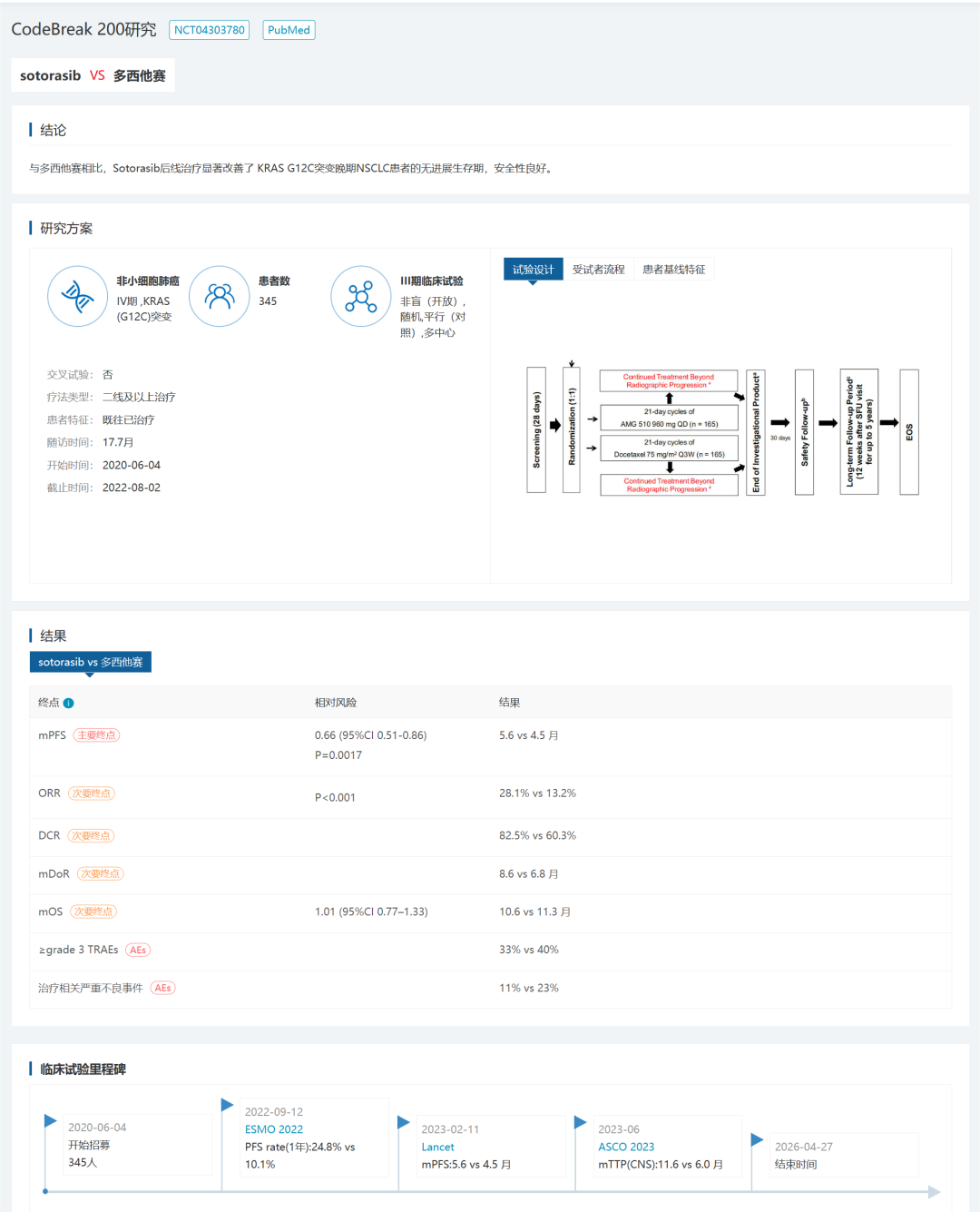
As part of the post-marketing requirement to verify the clinical benefit of sotorasib, Amgen conducted an open-label, randomized, multicenter, Phase III CodeBreaK 200 study to evaluateSotorasib (960mg, orally, once daily) or docetaxel (75mg/m², intravenously, every 3 weeks)345 casesEfficacy and safety in patients who have progressed after prior platinum-based chemotherapy and PD-1 or PD-L1 inhibitor treatment. The primary endpoint of the study is PFS in the intent-to-treat (ITT) population.By BICR Evaluation)。With a median follow-up of 17.7 months, the sotorasib group (n=171) and the docetaxel group (n=174)The median PFS was 5.6 months and 4.5 months, respectively.(HR=0.66,95%CI:0.51-0.86,P=0.0017),Reached the primary endpoint,But there was no significant difference in the key secondary endpoint OS.(10.6 vs 11.3 months, HR=1.01, 95%CI:0.77-1.33, P=0.53).(CodeBreaK 200 Study Design and Results: DeepMed Database by PharmaCube)
February 2023, AmgenBased on the results of the CodeBreaK 200 studySubmission of a supplemental New Drug Application to the FDA for sotorasib in KRAS G12C-mutated NSCLC patients who have previously received at least one systemic therapy.
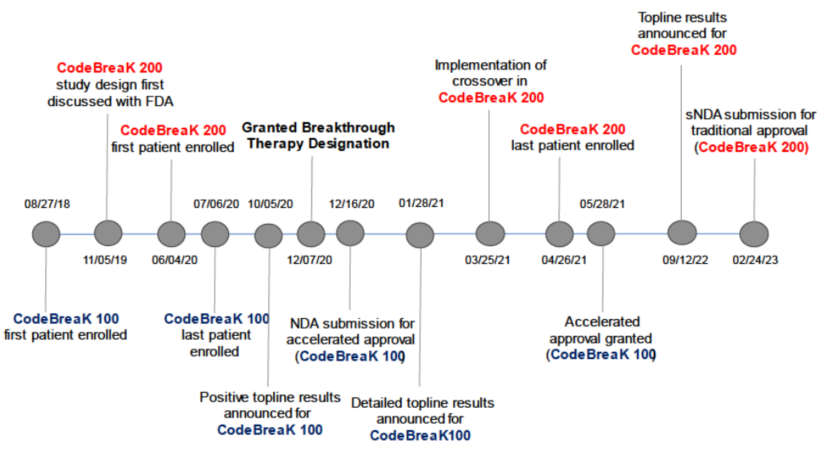
(Sotorasib Clinical Development Process: FDA Materials)
· Soul-searching questions from the FDA
FDA: CodeBreaK 200 StudyIs it a well-controlled and adequate trial??
Although CodeBreaK 200 reached its primary endpoint, the FDA noted that the sotorasib groupMedian PFS benefit (~5 weeks) is less than the imaging follow-up interval (6 weeks)., considering the inherent error in PFS assessment at the end of the imaging follow-up interval, as progression could actually occur at any time point within the interval, the FDA is based onInterval Censoring(interval censoringFor patients assessed as having disease progression during the follow-up interval, assuming events could occur at any time within the interval, further analysis showed that the mPFS in the sotorasib group was 4.47 months (95% CI 3.9-7.8), compared to 4.3 months (95% CI 2.9-4.8) in the docetaxel group, although a statistically significant difference was still observed (HR=0.71, 95% CI 0.54-0.95).But the difference between the two groups was only about 5 days.。Moreover, there was no statistically significant difference in OS between the two groups., which has raised concerns from the FDA regarding the actual clinical benefit of the sotorasib group.
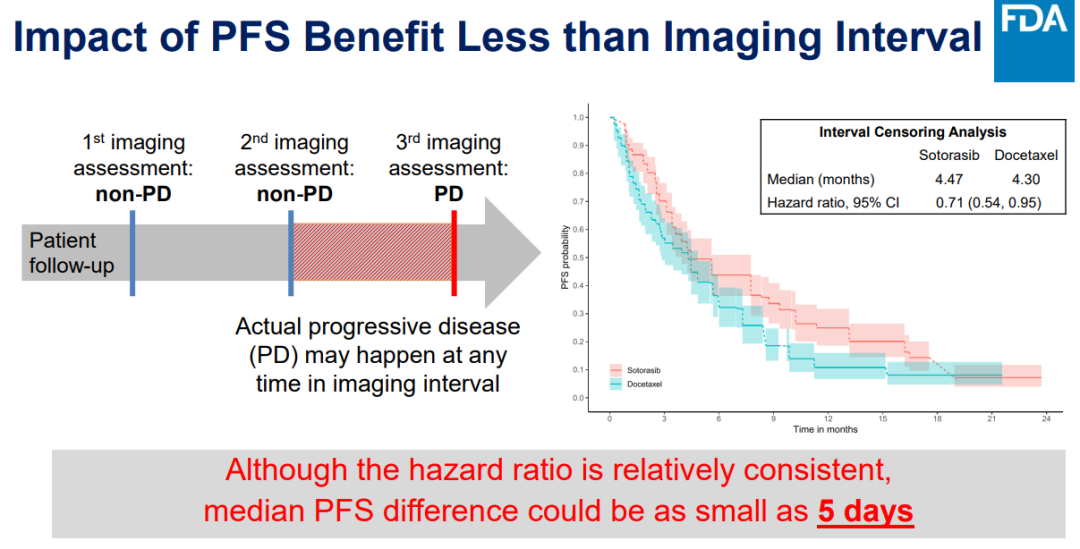
(Interval-Censored Analysis of PFS by BICR: FDA Material)
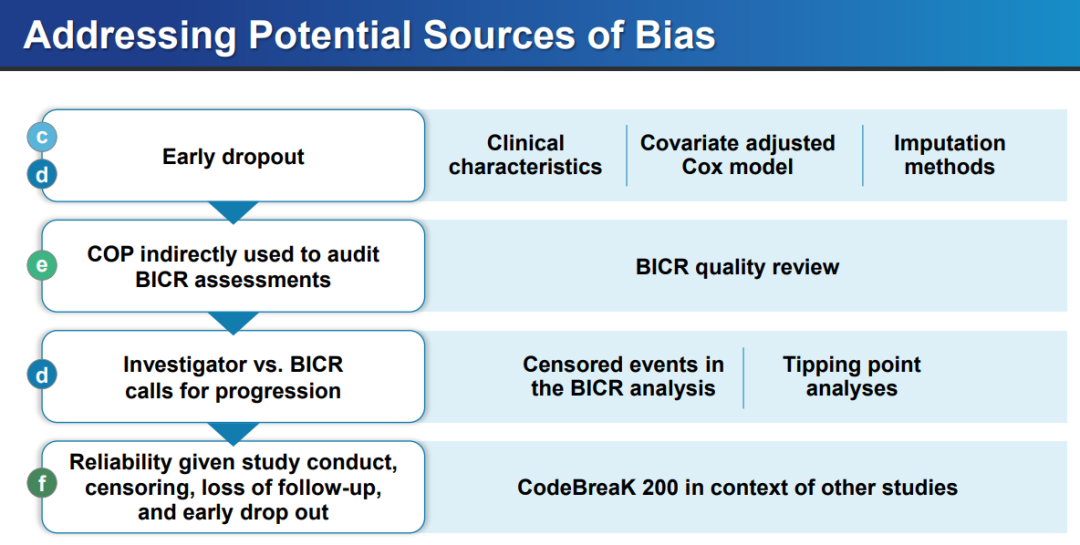
Further analysis shows that the CodeBreaK 200 results are affected byImpact of Systematic Bias from Multiple Sources, which has raised FDA's concerns about whether it can be considered an adequate and well-controlled clinical study. The FDA acknowledges that due to differences in administration methods (intravenous vs. oral) and toxicity profiles, the study adopted an open-label design. However, knowing the treatment assignments—especially given the known lower efficacy of docetaxel—may systematically bias the attitudes and actions (treatment adherence, patient management, disease assessment, and other trial-related activities) of both investigators and patients. Although such bias exists in any trial,However, the marginal PFS benefit and non-differential OS results of the CodeBreaK 200 study may struggle to overcome the potential overall bias of the study, thereby making it difficult to reliably establish the superiority of sotorasib over docetaxel.
In this regard, the FDA pointed out that a sufficient and well-controlled study must meet the following characteristics:
a) Clearly stated research objectives and analytical methods
b) A study design that allows for effective comparison with the control group
c) Adopt adequate measures to minimize bias in the allocation of subjects to different treatment groups to ensure comparability between groups.
d) Adopt adequate measures to minimize bias among subjects, observers, and data analysts.
e) Clear and reliable methods for assessing relief
f) Fully analyze the research results to evaluate the drug's effects· Amgen's Response
Amgen:The results of CodeBreaK 200 are robust and can withstand a variety of sensitivity analyses to account for potential sources of bias.
CodeBreaK 200 is a clinical study designed in consultation with multiple regulatory authorities, including the FDA, strictly adhering to relevant regulations and guidelines. In the initial design, consensus was reached with the FDA on an open-label study design, patient population, sample size, control group medication (docetaxel), statistical analysis methods and testing strategies (primary endpoint PFS and key secondary endpoints OS and ORR), as well as the overall approach for measuring patient-reported outcomes (PRO).
In response to several questions raised by the FDA, Amgen conducted further sensitivity analyses on PFS to explain potential sources of bias in the primary analysis dataset. The results showed that the trend of PFS benefit in the sotorasib group was consistent compared with docetaxel, confirming the robustness of the primary endpoint.
For more details on the discussion between the FDA and Amgen, see the MedCube Med WeChat Official Account.
· Conclusion
After nearly 5 and a half hours of discussion, the ODAC expert committee's 12 experts voted 2 in favor and 10 against, concluding that the primary endpoint PFS of CodeBreaK200 could not be reliably interpreted.
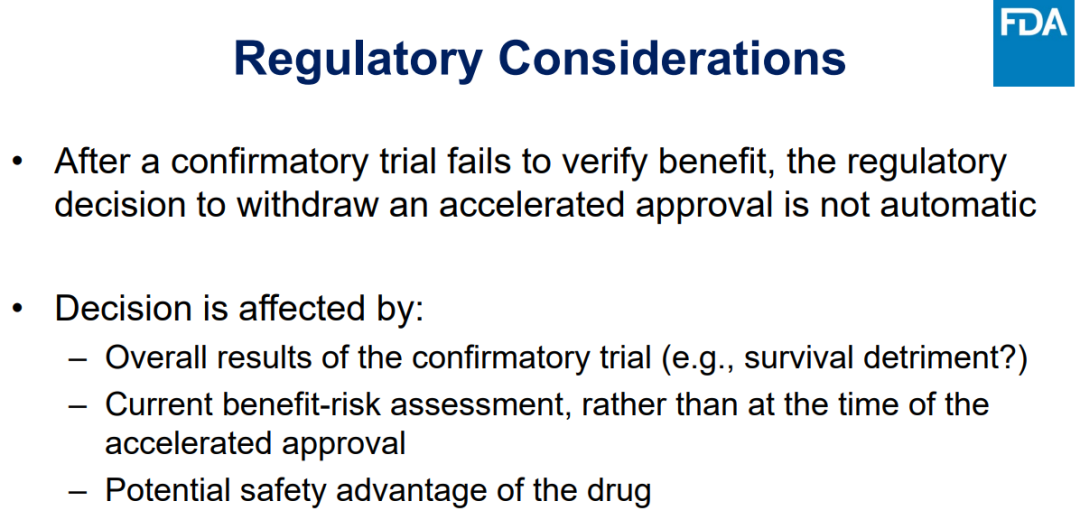
The experts who voted against the proposal acknowledged that no one expects a perfect RCT, but hoped that greater benefits could outweigh the uncertainty caused by minor issues. However, in the CodeBreaK 200 study, a series of problems rendered the small PFS benefit unclear. As Professor Ravi A. Madan, Chair of the committee and from the U.S. National Cancer Institute, stated, data integrity begins on the date the study protocol is established. Notably, at the end of the meeting, FDA officials reiterated that drugs failing confirmatory studies would not be immediately withdrawn. Instead, decisions would be based on overall outcomes and the current treatment landscape.
This ODAC meeting was highly engaging, addressing the issue of systematic bias in the design and implementation of clinical trials—a topic that has received less attention in the past—especially the discussion on studies recognized by regulators as being adequately and well-controlled. This not only provides guidance for the subsequent development of treatments for KRAS G12C mutated advanced non-small cell lung cancer but also serves as a reference for the design and implementation of research across the entire oncology field. The PharmaCube DeepMed database will continue to monitor these developments closely.
ODAC Special Topic Review
1. The Clash of Minds between Clinical Experts and Statisticians! Interpretation of the ODAC Meeting on Olaparib's First-Line Indication for Advanced Prostate Cancer (with Downloadable Materials)
2、Just Now! 11:1 Defeat, ODAC Recommends Olaparib Combination for Late-Stage Castration-Resistant Prostate Cancer Be Limited to "BRCA Mutations"
3. Polivy Successfully Passes ODAC "Major Test," Answers to Popular Questions Released!
4. Just Now! 11:2 Victory, Polivy Successfully Passes ODAC's Life-and-Death Test
5、ODAC Review: A "Leap Forward" in the Treatment Concept for dMMR/MSI-H Locally Advanced Rectal Cancer | Attachment: Data Download Link
6. Just Now! 8:5 Vote in Favor, ODAC Supports Dostarlimab for Accelerated Approval Based on Two Single-Arm Trials for First-Line Treatment of dMMR/MSI-H Locally Advanced Rectal Cancer
7. The Role of the Oncologic Drugs Advisory Committee (ODAC) in FDA Decision-Making
8, A Comprehensive Overview! The 2022 ODAC "Judgment" List
Copyright © 2023 PHARMCUBE. All Rights Reserved.
Welcome to forward, share, and reasonably cite. When citing, please clearly indicate the source of the article; if you need to reproduce it, please leave a message on the WeChat Official Account backend or send a message, and include the name and ID of the official account.Disclaimer: The information in this WeChat article is for general reference only and should not be directly used as decision-making content. PharmaCube assumes no responsibility for any loss incurred by any party due to the use of the content herein.