Major NASH Drug Data Set for Release: BI, Eli Lilly, and Ascletis Lead the Pipeline

Madrigal Pharmaceuticals
Developer of Fatty Liver Disease Treatment Drugs
Eli Lilly
Global Pharmaceutical R&D and Production Company

Ascletis
Biopharmaceutical company specializing in the R&D, production, and sales of treatments for hepatitis and AIDS
What comes to mind when you think of liver disease?
"Hepatitis B," "Hepatitis C," or "Alcoholic Liver Disease?"
But non-alcoholic fatty liver disease (NAFLD) is the most common yet silent "killer" to human health.
NAFLD refers to a chronic liver disease characterized by excessive fat deposition in hepatocytes, excluding alcohol consumption and other clear liver-damaging factors. Nonalcoholic steatohepatitis (NASH) is the second stage of NAFLD, presenting with hepatocyte injury and inflammatory cell infiltration. If it progresses to the third stage, hepatic fibrosis or even cirrhosis will occur.
According to a Frost & Sullivan report, the number of NASH patients globally and in China reached 350 million and 38.7 million respectively in 2020, and is expected to rise to 490 million and 55.5 million by 2030. However, there are currently no globally approved new drugs for NASH on the market, representing a typical unmet clinical need.
The good news is that perhaps next year will welcome the first treatment drug for this disease!
First NASH Drug Expected to Launch in 2024
Recently, Madrigal Pharmaceuticals announced that the U.S. FDA has accepted the New Drug Application (NDA) for its investigational drug resmetirom, intended for the treatment of adult patients with NASH and liver fibrosis, granting it Priority Review. The PDUFA date is set for March 14, 2024.
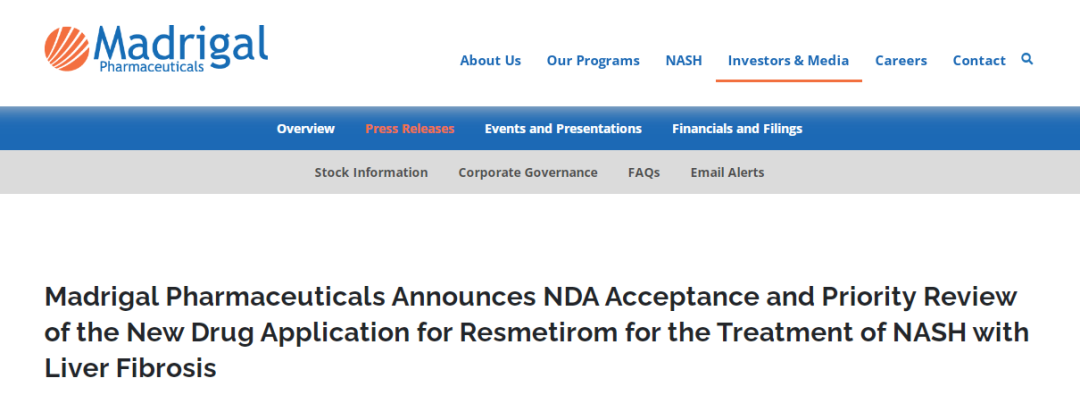
Image Source: Madrigal Official Website
According to a Madrigal press release, resmetirom is a once-daily, oral, thyroid hormone receptor (THR)-β selective agonist. In NASH, thyroid hormone β activity in the liver is impaired, leading to reduced mitochondrial function and β-oxidation of fatty acids, which in turn causes inflammation and liver fibrosis. Resmetirom aims to target this underlying cause.
Madrigal is conducting multiple clinical trials for resmetirom, including the Phase 3 clinical trials MAESTRO-NASH, MAESTRO-NAFLD-1, MAESTRO-NAFLD-OLE, and MAESTRO-NASH-OUTCOMES.
In December last year, Madrigal announced that the MAESTRO-NASH study had met its primary endpoints. Compared with placebo, daily oral administration of 80 mg or 100 mg of Resmetirom resulted in a reduction of ≥2 points in the Nonalcoholic Fatty Liver Disease Activity Score (NAS) without worsening of liver fibrosis; and an improvement of at least one stage in liver fibrosis without worsening of NAS.
Resmetirom also met the key secondary endpoint, significantly reducing low-density lipoprotein cholesterol (LDL-C) at 24 weeks of treatment.
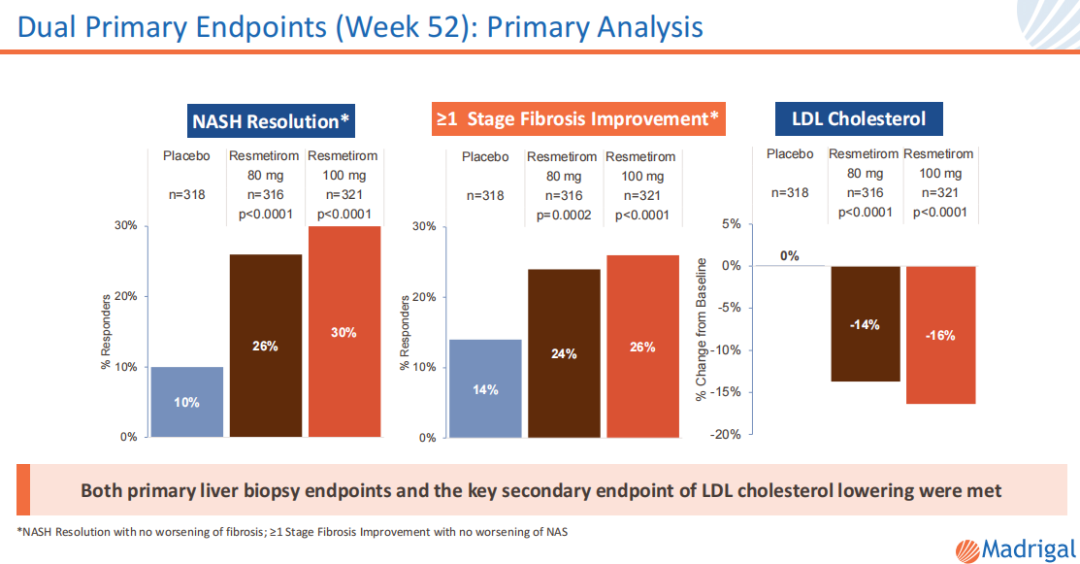
Image Source: Madrigal Official Website
Moreover, resmetirom demonstrated good safety and tolerability at both doses.
If approved smoothly in March next year, resmetirom will become the first NASH drug approved by the U.S. FDA, breaking the dilemma of having no available treatments in this field.
Moreover, based on the current global pharmaceutical companies' R&D progress, several new NASH drugs are expected to be approved for marketing in the coming years.
A Large Amount of New NASH Drug Data to Be Released Soon
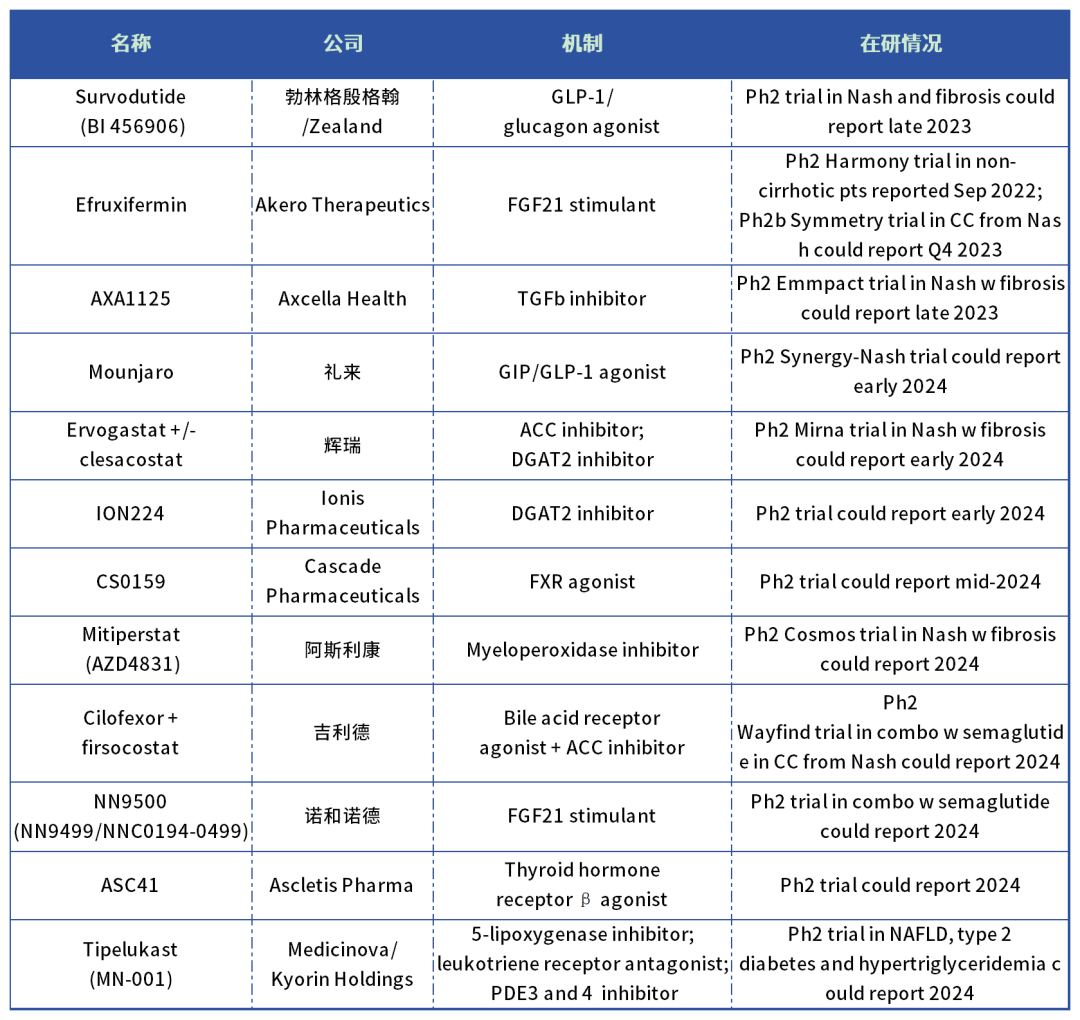
In addition to resmetirom, more new drug clinical data in the NASH field is worth looking forward to in the second half of this year and next year.
For example, Boehringer Ingelheim's Survodutide, Akero's Efruxifermin, and Eli Lilly's Mounjaro Phase II clinical data.
Table 1. NASH Pipeline Expected to Announce Interim Data in 2023-2024
Source: Reference 3
THR-β Agonist
The success of Resmetirom demonstrates the feasibility of the THR-β agonist approach.
Viking's VK2809 is another highly anticipated THR-β agonist.
In May this year, Viking announced that the Phase IIb Voyage study of VK2809 for the treatment of non-alcoholic steatohepatitis (NASH) had met its primary endpoint.
Results showed that, compared to the placebo group, the proportion of patients in the VK2809 group with at least a 30% reduction in liver fat content reached up to 84.9%. In terms of safety, 94% of treatment-related adverse events were reported as mild or moderate.
The success of VK2809 has once again raised expectations for this mechanism.
Many Chinese pharmaceutical companies have also laid out plans for THR-β agonists. ASC41 from Ascletis Pharma Inc., HSK31679 from Haisco, and TERN-501 from Terns Biopharma have all entered phase 2 clinical trials, while ECC4703 from ChasingBio is in phase 1 clinical trials.
GLP-1 Analogues
Incretins are another important research area in NASH, and GLP-1 drugs have shown promising efficacy in clinical trials for NASH.
Table 2. Research Progress of GLP-1 Drugs in NASH Treatment
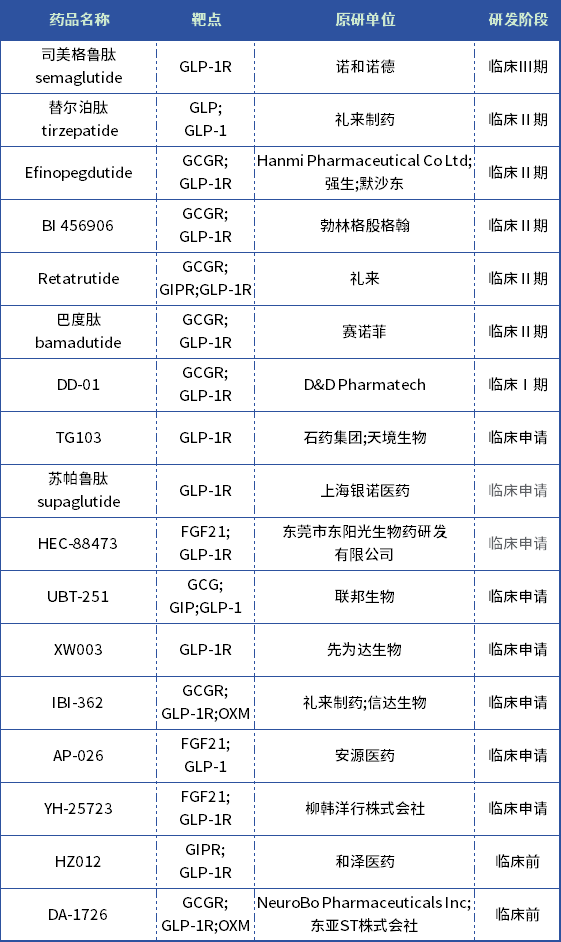
Data Source: Pharma Intelligence Data
Among them, semaglutide is the most advanced, currently in Phase 3 clinical trials.
In addition, Boehringer Ingelheim's survodutide and Eli Lilly's Mounjaro have attracted significant attention.
Survodutide (BI 456906), a GCGR/GLP-1R dual agonist, is currently in Phase 2 trials for adult patients with NASH and liver fibrosis (F1/F2/F3 stages), with the study expected to be completed in the fourth quarter of this year.
Mounjaro is a GIP/GLP-1 receptor dual agonist, and its Phase 2 clinical trial is ongoing, with data expected to be available next year.
In addition, Eli Lilly has also developed Retatrutide, a GCGR/GIPR/GLP-1R triagonist. Exploratory efficacy and safety data from a subgroup of 98 patients with NASH showed that Retatrutide at all dose levels demonstrated a strong effect in reducing liver fat, with significant improvements also observed in NASH-related biomarkers.
In addition, many pharmaceutical companies in China are conducting clinical trials of GLP-1 receptor agonists for NASH, including CSPC Pharmaceutical Group, Innovent Biologics, Fapon Biopharmaceuticals, and Xianwenda.
So far, the research results of GLP-1 analogs in the treatment of NASH have been mixed, and Phase 3 clinical trials remain a major challenge.
In the research on diabetes and obesity, Novo Nordisk's Semaglutide successfully reduced the Nonalcoholic Fatty Liver Activity Score (NAS) in中期 trials but missed the improvement in fibrosis. The top-line data of the drug's pivotal NASH study is expected to be released in 2024.
Other Mechanisms
Efruxifermin, an FGF21 analog developed by Akero, has also shown positive efficacy in the NASH field.
Last September, Akero announced the successful results of the Phase IIb HARMONY study of Efruxifermin in pre-cirrhotic NASH (fibrosis F2-F3). The data showed that at week 24, both the 28mg and 50mg dose groups of once-weekly subcutaneous Efruxifermin injections met the primary endpoint of improving liver fibrosis, with 39% and 41% of patients achieving ≥1 stage improvement in fibrosis without NASH worsening, compared to 20% in the placebo group.
89Bio's Pegozafermin is also an FGF21 analog, and the positive results of its Phase IIb ENLIVEN study for the treatment of NASH were announced in the first half of this year.
In addition, AstraZeneca, Pfizer, and Ionis are exploring NASH treatments with other mechanisms.
AstraZeneca's Mitiperstat (AZD4831) is an orally available myeloperoxidase (MPO) inhibitor. The drug's indication for heart failure with preserved ejection fraction has entered Phase 3 clinical trials, while the indication for non-alcoholic steatohepatitis with liver fibrosis is in Phase 2 clinical stage. The interim analysis results are expected to be reported early next year.
Pfizer is developing a combination therapy ervogastat/clesacostat for NASH. Ervogastat is a diacylglycerol O-acyltransferase 2 inhibitor (DGAT2i), and clesacostat is an acetyl-CoA carboxylase inhibitor (ACCi). Based on Pfizer's non-clinical studies and Phase 2a clinical study results, the U.S. FDA has granted this combination therapy Fast Track designation.
ION224, an ASO therapy developed by Ionis, aims to reduce the production of diacylglycerol acyltransferase 2 (DGAT2) for the treatment of NASH patients and is currently in Phase 2 clinical trials.
Summary
Intercept Pharmaceuticals' obeticholic acid was once the world's first NASH drug to enter Phase 3 clinical trials. However, in June 2023, the FDA rejected the NDA for obeticholic acid for patients with pre-cirrhotic liver fibrosis caused by NASH.
Looking ahead, 2024 could become a significant milestone.
If Resmetirom can successfully pass FDA approval, it is expected to become the first drug for the treatment of NASH. In addition, key clinical data on various NASH drugs with different mechanisms are about to be released, which may soon fill this clinical gap.
References:
1. https://ir.madrigalpharma.com/news-releases/news-release-details/madrigal-pharmaceuticals-announces-nda-acceptance-and-priority
2. https://ir.madrigalpharma.com/static-files/223c5a4b-9d69-48ae-9798-c72e8b6c5baa
3. https://www.evaluate.com/vantage/articles/analysis/spotlight/spotlight-nash-2023-and-beyond

Editor: Liuli
Disclaimer: The views expressed in this article are solely those of the author and do not represent the position of Pharma Intelligence. We welcome discussions and additional insights in the comment section; for reprints, please be sure to credit the author and source. If there are any issues regarding the content, copyright, or other aspects of the article, please leave a message on this platform, and we will address it promptly.