Recently, Novartis announced Lutathera®(Lutetium Lu 177 dotatate Injection, Lutetium[177 Lutathera (Lutetium-177 dotatate) Phase III Clinical Trial NETTER-2 Met Primary Endpoint. Compared with high-dose long-acting octreotide alone, the combination of Lutathera and long-acting octreotide significantly improved progression-free survival (PFS) in newly diagnosed patients with somatostatin receptor (SSTR)-positive, grade 2 or 3 advanced gastroenteropancreatic neuroendocrine tumors (GEP-NETs) as first-line treatment.1,2。No new or unexpected safety issues were observed in the study, and the data aligns with Lutathera's existing profile.Consistent safety has been established.
Patients with advanced grade 2 and 3 gastroenteropancreatic neuroendocrine tumors (GEP-NETs) who received Lutathera combined with long-acting octreotide as first-line treatment achieved the primary endpoint of improved PFS and the key secondary endpoint of objective response rate (ORR), compared to high-dose long-acting octreotide alone.
Lutathera has been proven to be a radioligand therapy (RLT) with clinical benefits in first-line treatment, and the clinical study results will be announced at an upcoming medical conference. Novartis has established a broad RLT product portfolio, exploring their therapeutic potential in a series of advanced cancers beyond prostate cancer and GEP-NET, including lung cancer, breast cancer, pancreatic cancer, and colon cancer. Novartis will continue to support the growing demand for RLT through the expansion of existing production facilities and new plants.
Lutathera was approved in the United States in 2018.FDA Approved for Marketing, Used forProgression of SSTR-Positive GEP-NET After Standard Treatment: Successful Phase III Clinical Trial NETTER-2 Indicates Further Expansion of Lutathera's Clinical Use.Lutathera is the first radiopharmaceutical approved by both the EMA and FDA for radioligand therapy (RLT). It specifically binds to somatostatin receptors on the surface of tumor cells, enters the cells, and releases radionuclides to generate radiation that kills tumor cells. The active ingredient is lutetium Lu 177 dotatate.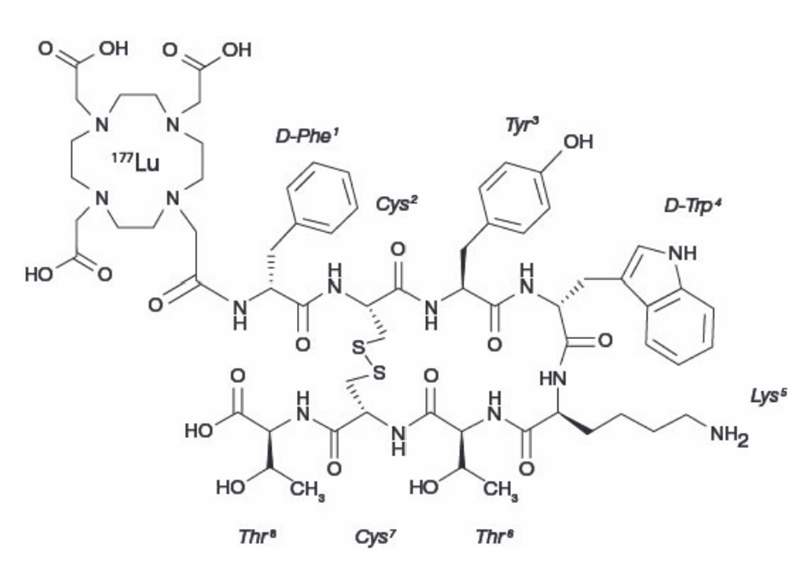
Lutetium [177 Lu] Octreotide Structure
Novartis launched two acquisitions totaling nearly $60 billion in 2017 and 2018, acquiring two radiopharmaceuticals, Lutathera and Pluvicto. In the first half of 2023, Lutathera's sales reached $291 million, a year-on-year increase of 57%; Pluvicto's sales were $415 million, and Novartis expects its annual sales to exceed $1 billion. In its first full year of commercialization, Pluvicto has joined the ranks of "blockbuster" drugs.Bayer is also a proponent in the field of nuclear medicine. On September 25, Bayer registered a Phase I clinical trial for the radiopharmaceutical Actinium-225-macropa-pelgifatamab (BAY3546828) on clinicaltrial. BAY3546828 is a PSMA antibody radionuclide conjugate for the treatment of advanced prostate cancer. This product originated from Progenics (later acquired by Lautheus), which partnered with Bayer back in 2016. After nearly seven years of collaboration, the product has finally entered the clinical stage.
In addition to BAY3546828, Bayer also has a small-molecule targeted radiopharmaceutical therapy called BAY3563254, which is an Actinium-225 (Ac-225) labeled PSMA-targeted small molecule acquired through the company's 2021 acquisition of Noria and PSMA Therapeutics. It is being developed for prostate cancer radiotherapy. In May this year, Bayer further entered into a $1.75 billion collaboration with Bicycle Therapeutics to develop bicyclic peptide-based targeted radiopharmaceutical therapies.According to Insight statistics, there are currently 57 nuclear medicines approved for marketing and not withdrawn in the United States, including 49 diagnostic, 6 therapeutic, and 1 diagnostic/therapeutic drug; while in China, there are currently 19 approved nuclear medicines on the market, including 12 diagnostic, 6 therapeutic, and 1 diagnostic/therapeutic drug.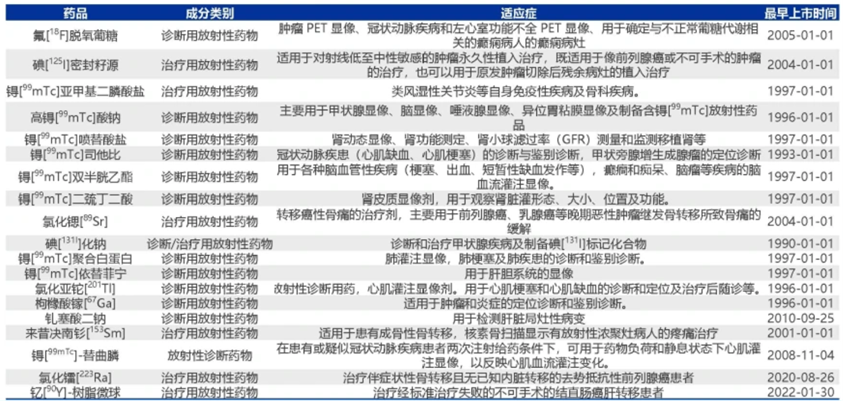
Approved Nuclear Medicine in China (Source: Insight, Shenwan Hongyuan)
According to statistics from Vascular Network, there are at least 49 radiopharmaceutical pipelines under development in China, including 17 products in clinical stages and 32 preclinical products. In therapeutic radiopharmaceuticals, products from Hengrui Medicine, Xiantong Medicine, and Grand Pharmaceutical have entered Phase III clinical trials.In recent years, the global radiopharmaceuticals field has witnessed a surge in investment and transactions. Meanwhile, overseas radiopharmaceutical products have demonstrated potent efficacy and strong market performance. Given the critical role of nuclear medicine in clinical diagnosis and treatment, the development of radiopharmaceuticals in China is still in its early stages, indicating vast growth potential in the future.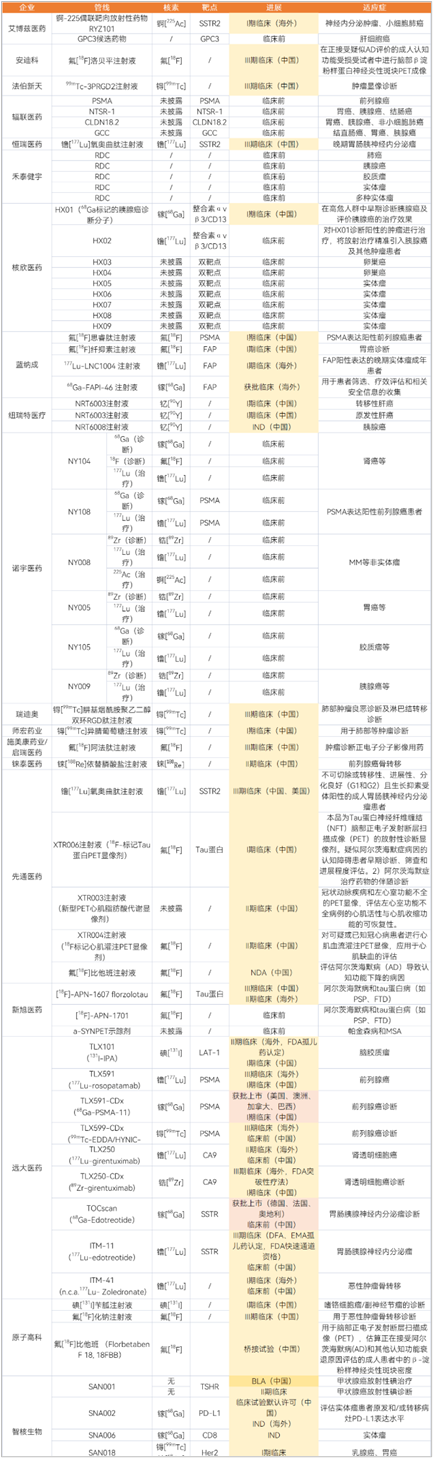
Status of Nuclear Medicine under Research in China (Data Source: Arterial Network)
All original content rights in this official account are owned by Jiuzhou Pharmaceutical. Without authorization, it cannot be used or licensed to others for use. If you need to obtain authorization, please contact Jiuzhou Pharmaceutical in advance. Those who have obtained authorization should use it within the authorized scope, indicate the source, and must not further authorize others either wholly or partially.This official account remains neutral regarding the legality, accuracy, reliability, or completeness of the content reproduced, shared, stated, or viewed herein and does not provide any express or implied guarantees. The content is owned by the original author and is intended solely for study and reference purposes. If there are any questions regarding the rights related to the reproduced or shared content, please contact Jiuzhou Pharmaceutical.
Care for Life | Protect Health