

Amgen Completes $27.8 Billion Acquisition of Horizon Therapeutics

Amgen
Developer of Treatment Drugs for Serious Diseases

Horizon Therapeutics
Biopharmaceutical Manufacturer
On October 6, 2023, Amgen announced the completion of its acquisition of Horizon Therapeutics, with a total transaction equity value of $27.8 billion.
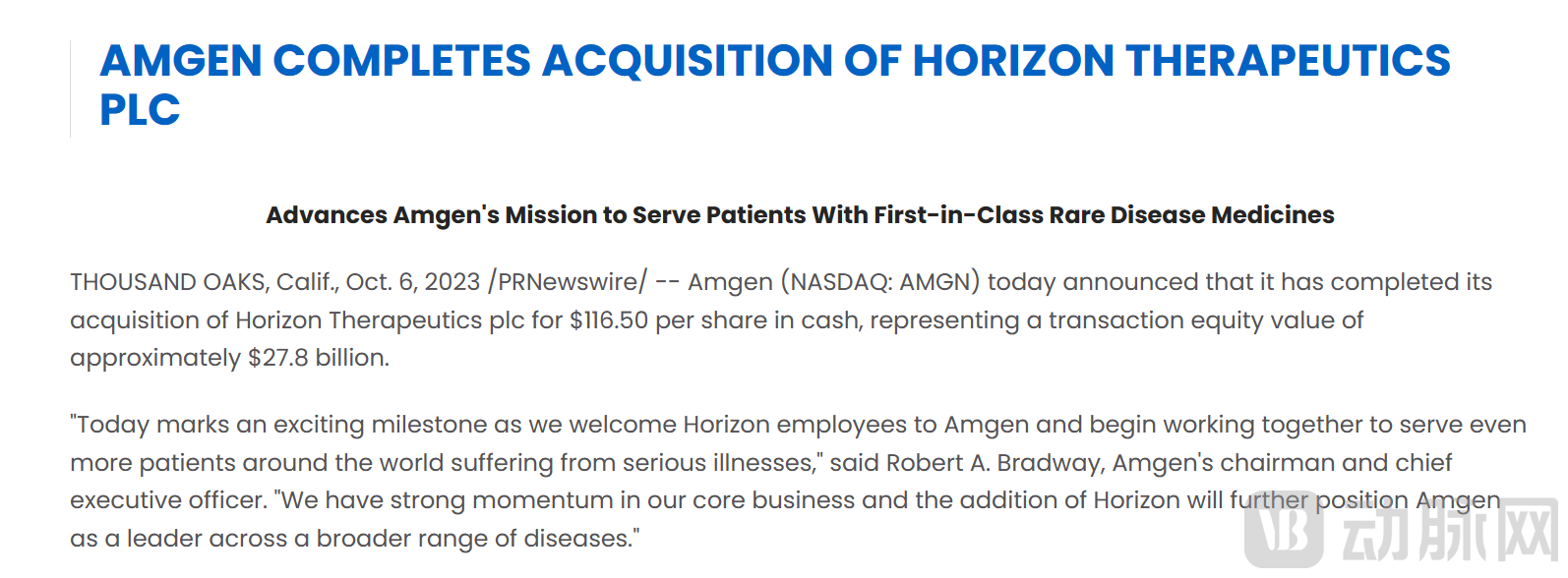
At the end of 2022, Amgen emerged victorious from its competition with Johnson & Johnson and Sanofi, announcing the acquisition of Horizon Therapeutics for $27.8 billion, setting a record for the largest M&A deal in the pharmaceutical industry that year. After 10 months, this acquisition was successfully completed.
The US "Antitrust Police" FTC Aggressively Enforces Regulations
In May this year, in order to block Amgen's acquisition of Horizon Therapeutics, the U.S. Federal Trade Commission (FTC) took Amgen to court, stating that the deal would "stifle" competition in the pharmaceuticals industry. The FTC argued that the transaction would allow Amgen to use its existing product portfolio to reinforce Horizon’s monopoly position for treating thyroid eye disease (Tepezza) and chronic gout (Krystexxa). Specifically, the FTC stated in the lawsuit that Amgen might offer rebates or discounts on its existing mature drugs, such as Enbrel, to secure favorable insurance coverage for Horizon drugs like Tepezza and Krystexxa.
Horizon's blockbuster drug Tepezza is a thyroid eye medication targeting IGF-1R. It is the first thyroid-associated ophthalmopathy drug approved by the FDA and has been designated as an "orphan drug," achieving sales of $820 million in its first year on the market. Similarly, Krystexxa, also granted "orphan drug" designation, is the first drug approved by the FDA for treating uncontrolled gout.
In August, the FTC suddenly announced the suspension of its lawsuit against Amgen's acquisition of Horizon Therapeutics. The document submitted to the court, requesting a pause in its internal administrative objections, suggested that the FTC was open to settlement negotiations. Of course, in antitrust issues, it is not the first time that the FTC has withdrawn a lawsuit or lost a case. Since Lina Khan was appointed as the FTC Chair by U.S. President Biden in 2021, the agency has pursued an aggressive enforcement strategy of "opening new horizons in antitrust legislation through litigation," and has not hesitated to take on major corporations.
From May to August, Amgen repeatedly stated that they had no reason, capability, or intention to bundle Tepezza or Krystexxa with any of their products for competitive sales and committed not to do so.
Amgen also stated that, compared to Horizon's assets, its drugs target different diseases and are suitable for different patient populations, with no overlap of competitive products.
Moreover, Amgen stated that the only reason Tepezza and Krystexxa currently have no direct competition in their respective markets is that no other participants have successfully completed clinical development so far. It is highly unlikely that the FTC's concern — "Amgen’s cross-market bundling will monopolize the competitive positions of Tepezza and Krystexxa" — will occur.
On September 1, the FTC reached a settlement with Amgen and announced that it would allow Amgen to proceed with its $27.8 billion acquisition of Horizon Therapeutics.
According to the FTC settlement agreement:
1. Amgen, Inc. shall not bundle any of its products with Tepezza or Krystexxa for sale, nor shall it attach any product rebates or contractual terms related to Amgen products when selling Horizon Therapeutics’ products.
2. Prohibit Amgen from acquiring any other products, biosimilars for thyroid eye disease or chronic refractory gout, or participating in the production or sale of such products without the permission of the FTC.
3. If Amgen wishes to acquire any product nearing commercialization that has completed FDA clinical trials for the treatment of thyroid eye disease or chronic refractory gout before 2032, it must seek approval from the FTC.
After months of legal disputes, the acquisition of Horizon by Amgen has finally been settled. Amgen stated that this settlement agreement will not impact its business.
Big fish eat small fish, small fish eat shrimp.
Horizon, founded in 2005 by George F Tidmarsh, an adjunct professor at Stanford University School of Pharmacy and a serial entrepreneur, is a biopharmaceutical company developing new drugs in the field of mild to moderate pain and arthritis. Horizon embarked on a high-speed growth path after Tim Walbert, the second CEO, took office in 2008 and fully assumed leadership of Horizon.
Under Tim Walbert's leadership, Horizon Therapeutics plc moved away from a purely self-research and development path, starting to leverage capital to accelerate corporate growth and expansion.
In 2010, Horizon merged with Nitec Pharma AG, a company spun off from Merck of Germany, to form the new Horizon.
In 2011, Horizon Therapeutics plc successfully went public on NASDAQ, raising $49.5 million through its IPO.
If Amgen's acquisition of Horizon Therapeutics is described as "big fish eating small fish," then with the low-cost fundraising brought by the public market, Horizon Therapeutics has also embarked on a "buy-buy-buy" path of "eating shrimp."
In March 2014, Horizon announced the acquisition of Irish specialty pharmaceutical company Vidara Therapeutics for $660 million.
In October 2014, Horizon Therapeutics acquired the distribution rights of Pennsaid (diclofenac sodium), a Nuvo Research osteoarthritis drug in the United States, for $45 million.
In March 2015, Horizon acquired Hyperion Therapeutics for $1.1 billion to expand its orphan drug portfolio.
In December 2015, Horizon Therapeutics plc announced the acquisition of Crealta Holdings for $510 million.
In September 2016, Horizon Therapeutics acquired Raptor Pharmaceutical, a rare disease drug development company, for $800 million, adding Procysbi (cysteamine bitartrate delayed-release capsules) and Quinsair (levofloxacin inhalation solution) to its rare disease drug portfolio.
In 2017, Horizon announced that it would acquire River Vision Development Corp for $145 million, obtaining the company's ophthalmic product under research, Teprotumumab, known as TEPEZZA.
In early 2021, Horizon Therapeutics acquired Viela Bio, a biotechnology company, for $3.05 billion, gaining access to its pipeline of autoimmune disease drugs.
Horizon's two key "orphan drug" star products — TEPEZZA and Krystexxa, the former acquired through acquisition, while the latter, Krystexxa, was licensed-in by Horizon Therapeutics from Duke University and Mountain View Pharmaceuticals.
Currently, Horizon Therapeutics plc has more than 10 marketed drugs and over 20 ongoing research projects, including two key areas: Orphan drugs and inflammation. The Orphan drug portfolio includes Tepezza, Krystexxa, Ravicti, Procysbi, Actimmune, Buphenyl, and Quinsair, while the inflammation portfolio includes Duexis, Rayos, Vimovo, and others.
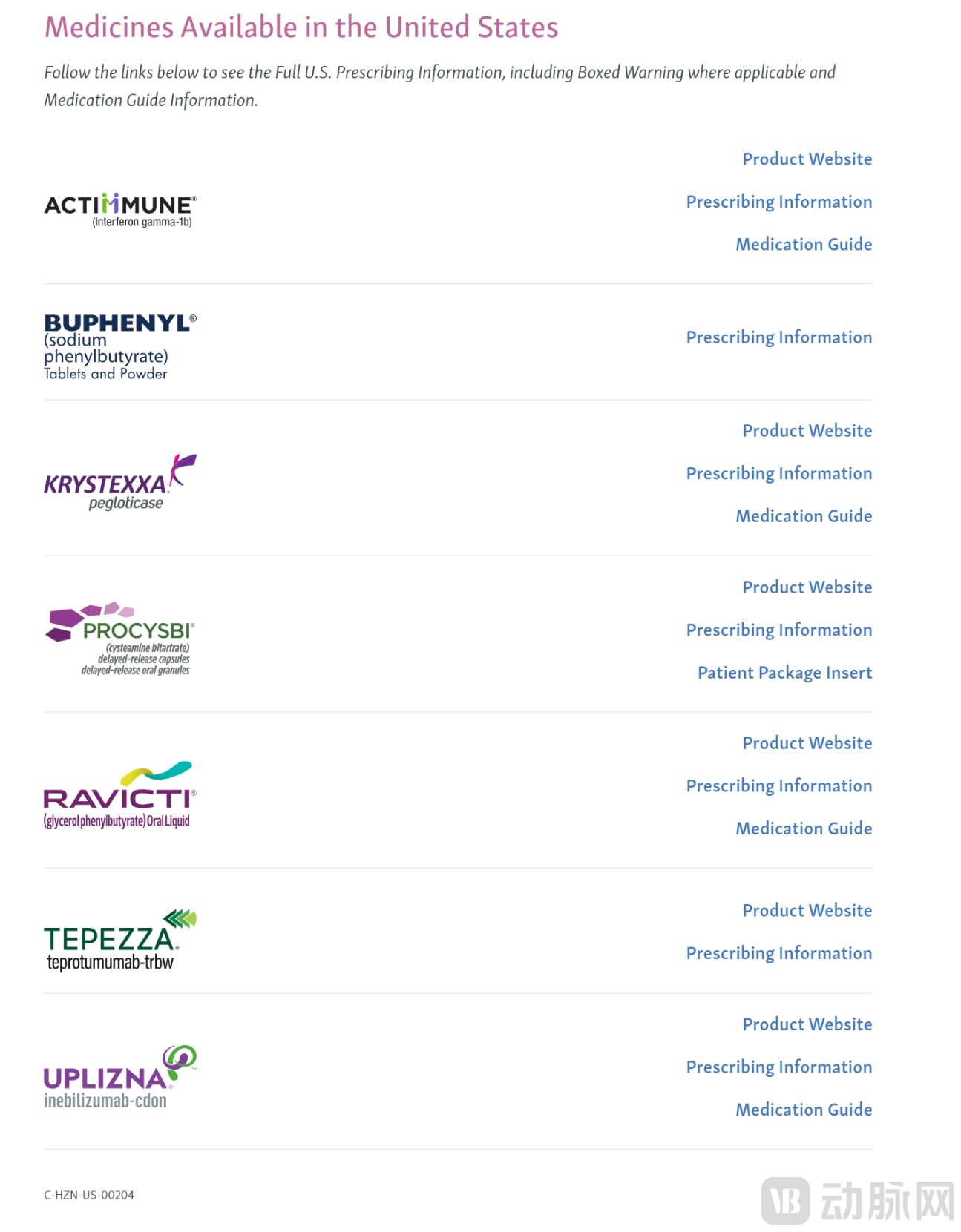 Horizon Therapeutics plc's Drug Launched in the U.S. Market Source: Horizon Official Website
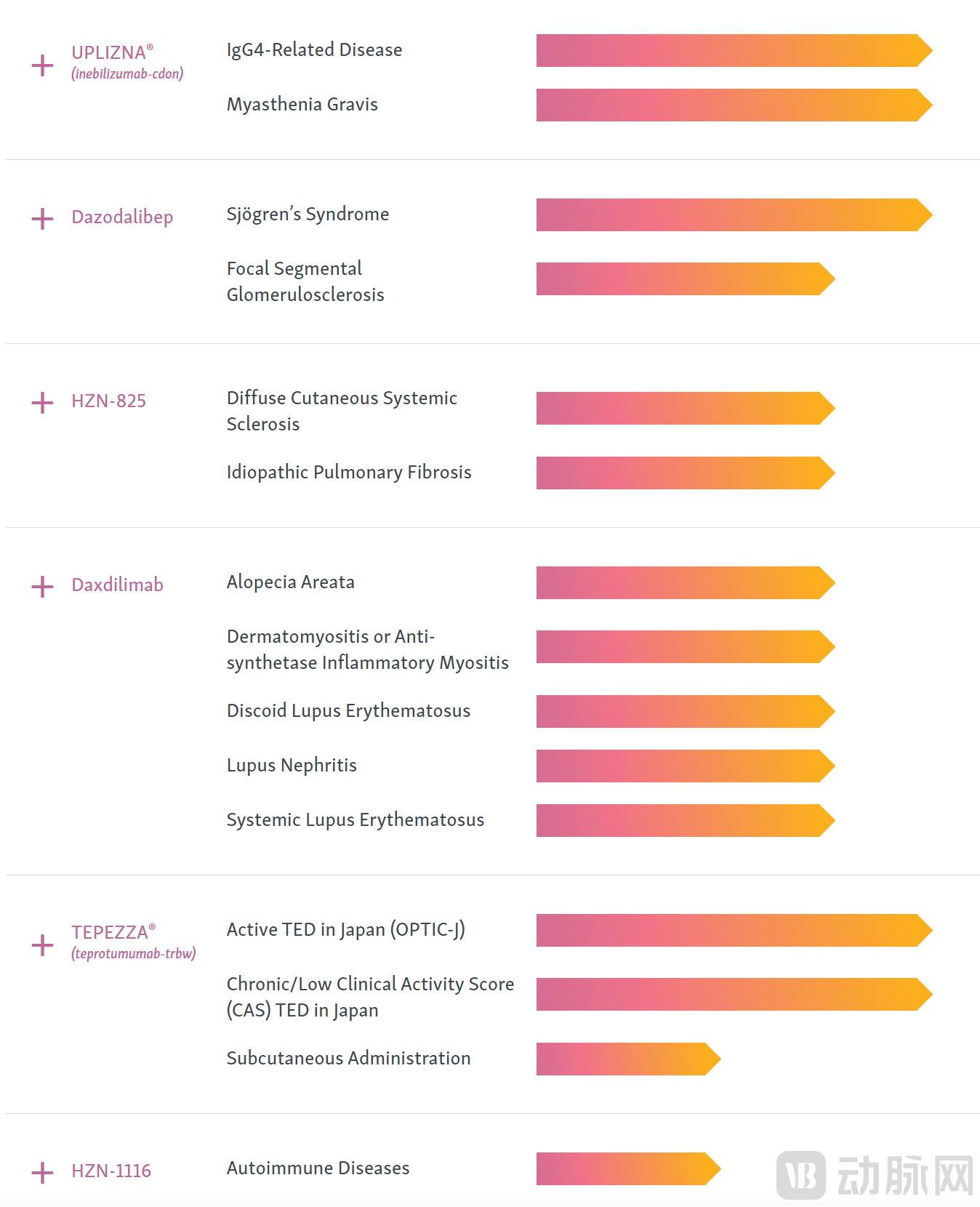 Horizon Product Pipeline Source: Horizon Official Website
Where Will M&A Turn After Amgen?
Amgen’s Acquisition of Horizon Therapeutics Sets Record as Largest Deal in Amgen’s M&A History, Strengthens Position in Inflammatory Diseases and Ensures Continuous Cash Flow; Meanwhile, Amgen’s Expertise in Biologics R&D, Process Development, Manufacturing, and Global Operations Will Further Unlock the Commercial Potential of Horizon’s Products.
Analysts at Mizuho Bank believe that one of the strategic significances of the acquisition lies in alleviating the competitive pressures on Otezla and Enbrel. As blockbuster drugs like Otezla, used for treating psoriasis, and Enbrel, for arthritis, are approaching the "patent cliff" (Otezla in 2028; Enbrel in 2029), Amgen is increasingly facing competition from generic drugs in the market. In 2023, biosimilars of its competitor Humira began entering the market on a large scale, posing a certain threat to Enbrel, which has enjoyed 34 years of patent protection.
Some analysts believe that Horizon's two blockbuster drugs, Tepezza and Krystexxa, may help Amgen offset the losses caused by the "patent cliff." In this case, Amgen's acquisition of Horizon is imperative.
On the other hand, the FTC's lawsuit against Amgen's acquisition is "not without reason." In June this year, the U.S. Department of Justice (DOJ) and the Federal Trade Commission (FTC) will reform the Hart-Scott-Rodino (HSR) filing process, which was formulated to combat illegal mergers and acquisitions. Under the new rules, companies are required to submit more transaction-related information than before, potentially extending the completion time of merger deals by 2-3 months. In practice, the transaction cycle could be even longer, and sensitive deals are likely to fall through during this period.
This is "the first review reform in 45 years." The DOJ and FTC expressed that they hope this move will enable "more effective and efficient screening" of merger and acquisition deals with antitrust issues. This review reform also signifies that antitrust agencies are intensifying their scrutiny of transactions in the pharmaceuticals industry. The underlying rationale is that experts from the DOJ and FTC believe that scale expansion does not drive innovation in the biopharmaceutical field.
But due to the continuous impact of factors such as the patent cliff, pricing pressures, and evolving regulations on the pharmaceutical industry's future, strategic expansion and consolidation through M&A play a central role in the transformation of pharmaceutical companies. It can be said that technology transactions are as important as scientific breakthroughs, as reflected in the development process of Horizon Therapeutics plc. Without M&A, many influential drugs, especially promising "orphan drugs" like TEPEZZA, which was developed from Roche's discarded oncology drug and became a beacon for TED treatment, might not have been applied in clinical treatment so quickly.
In the past few years, M&A transactions have been fairly stable with little fluctuation. From Amgen's $27.8 billion acquisition of Horizon Therapeutics to Pfizer's $43 billion purchase of Seagen in 2023, as well as AstraZeneca’s $39 billion acquisition of Alexion Pharmaceuticals in 2020. Following the disclosure of several large-scale M&A deals, the number of M&A transactions has started to decline. By the end of last year, the biopharmaceutical industry was holding $1.4 trillion on its balance sheets, the highest level since 2014.
Objectively speaking, for MNCs, relying solely on M&A for continuous expansion can only provide temporary relief. Deeper issues require joint efforts from all parties to avoid the simplistic "big fish eating small fish" approach amidst substantial investments.