Takeda Withdraws Flagship Lung Cancer Drug Mobocertinib from China, Reshaping EGFR Exon20ins Targeted Therapy Landscape

Takeda
Biopharmaceutical Manufacturer
October 2nd, the fourth day of the National Day holiday,Takeda Pharmaceutical Company LimitedA statement released on the global official website did not attract much attention, but the content was quite significant —Takeda to Voluntarily Withdraw Mobocertinib in the U.S. Following Discussions with FDA(EXKIVITY®, mobocertinib, Chinese trade name: Anweili), and announced that it is cooperating with regulatory authorities in other countries to take follow-up measures.
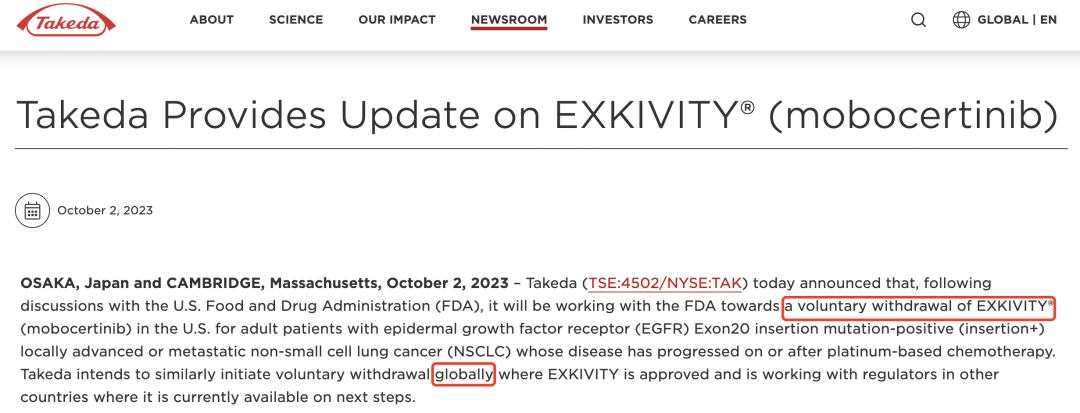
After the holiday, a document about the "Compliance Guidelines" for Aweili was circulated in the industry, mentioning in the NOT DO section that "As of October 3, 2023, all promotional meetings and visit activities for Enweili will be suspended.", in other words, in Takeda's decision toMobocertinib WithdrawalFollowing the United States, the drug's voluntary withdrawal from the Chinese market was initiated the very next day, demonstrating an undeniably swift action.
It is uncommon for innovative drugs to be voluntarily withdrawn from the market after launch; the main reason for this incident isMobocertinib failed a confirmatory trial last summer, not reaching the primary endpoint of progression-free survival.。
Mobocertinib is considered the fourth-generation targeted drug for non-small cell lung cancer (NSCLC). It was approved in China earlier this year and was once regarded as a "leading candidate" for the year-end national medical insurance negotiations.This withdrawal is not only a significant loss for Takeda but also an important warning for the entire track.
"Challenge 'One"Line" Regrets Defeat
The withdrawal of a new drug from the market is a significant event and is never accidental; this incident began to unfold three months ago.
In July this year, while announcing its Q1 financial results, Takeda also disclosed the progress of the Phase III EXCLAIM-2 trial for Mobocertinib, the results of which were regrettable —Terminated due to not reaching its primary endpoint。
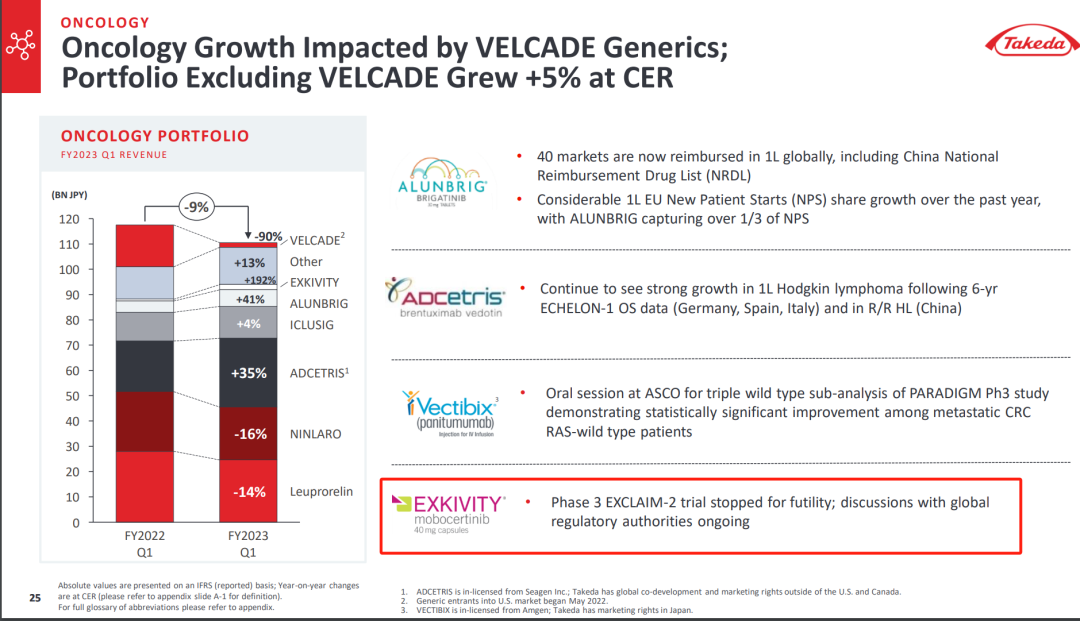
PreviouslyIn September 2021, Mobocertinib received FDA accelerated approval for the treatment of adult patients with locally advanced or metastatic non-small cell lung cancer (NSCLC) who have progressed during or after platinum-based chemotherapy and whose tumors have epidermal growth factor receptor (EGFR) exon 20 insertion mutations (EGFR ex20ins).The product received FDA accelerated approval and NMPA conditional approval based on the excellent results of the EXKIVITY 1/2 second-line single-arm trial.
ThisThe trial enrolled a total of 114 patients with EGFR exon 20 insertion-mutant NSCLC who had previously received platinum-based therapy, demonstrating excellent efficacy data.Data presented at the 2021 ASCO showed that the median OS (Overall Survival) in the platinum-based chemotherapy group (PPP) reached an impressive 24 months.
However, in the followingIn the EXKIVITY Phase 2 trial, Takeda did not continue with second-line applications but instead sought toMobocertinib monotherapy inEGFR ex20insMutant NSCLCFirst-line Treatment, resulting in undesirable outcomes. Not only that, but industry insiders have analyzed,This study also undermined the confirmatory evidence for mobocertinib as a single-agent second-line treatment, leading to this withdrawal event.
This incident also reveals a harsh reality — drugs granted accelerated approval are not foolproof, and if they fail to withstand the ultimate test, they face the risk of being withdrawn from the market.
Similar cases this year also include:
July 21,GileadIt was announced that the Phase III ENHANCE study of magrolimab, a CD47 monoclonal antibody, in combination with azacitidine for the treatment of high-risk myelodysplastic syndrome (MDS), was terminated due to futile results in the planned analysis. Gilead recommended that MDS patients discontinue magrolimab treatment.
September 11,NovartisAnnouncement of the discontinuation of GT005 (PPY988), which had received FDA Fast Track designation for the treatment of geographic atrophy (GA) secondary to dry age-related macular degeneration (dry-AMD), as the Phase II trial met futility criteria.
Failed Clinical TrialsFor a drug, it is a cruel endpoint, but for the entire industry, it is a valuable asset.
Takeda stated that it will present the full data of the trial at an upcoming medical conference or in a peer-reviewed journal.Awny Farajallah, M.D., Head of Global Medical Affairs Oncology at TakedaSaid: "We hope the results of the EXCLAIM-2 study will inform future research and development for this disease."
Takeda Exits, the Landscape of Fourth-Generation Lung Cancer Targeted Drugs Changes
Takeda's aggressive strategy is not without reason, as clinical development is like a race, especially when there are strong competitors in the same field, which can be particularly nerve-wracking.
Lung cancer is the most concentrated "battlefield" for pharmaceutical companies' R&D efforts, with non-small cell lung cancer (NSCLC) accounting for 85% of all lung cancer cases, becoming the "fortress that holds the key to the kingdom," and EGFR gene mutations being...NSCLC MainlyOne of the driver genes, accounting for 50.3%, is the main competitive area for pharmaceutical companies.
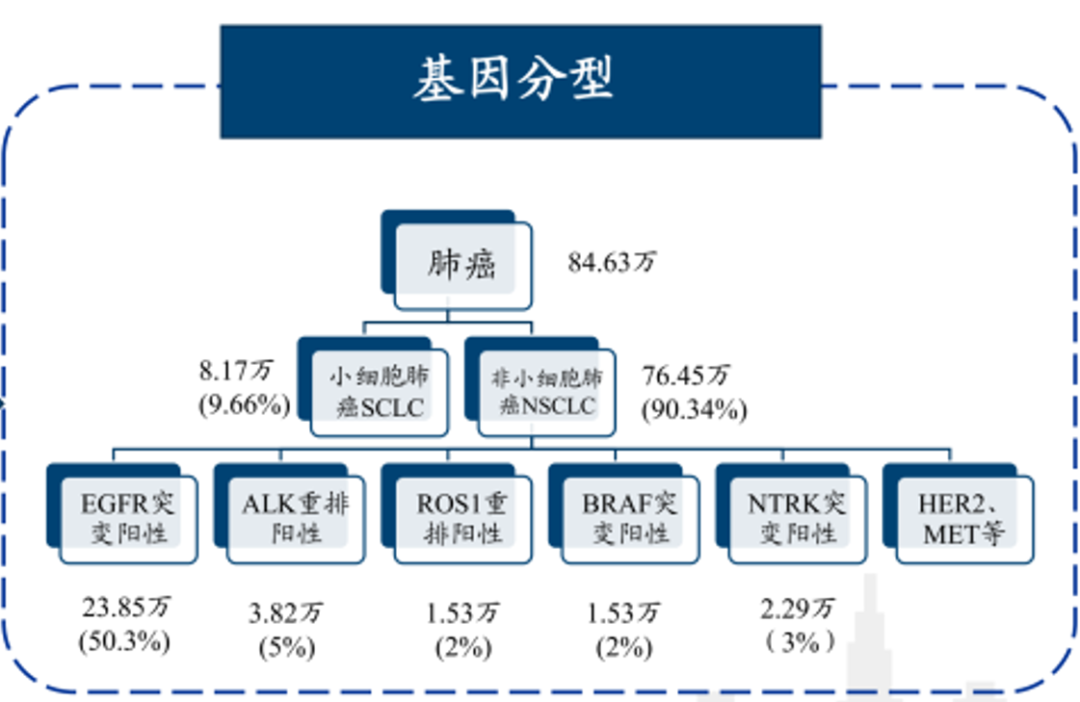
Genotyping of Asian Lung Cancer Patients
In 2002, the world's first EGFR mutation-targeted drug was launched.As of now, globally approved7 ProductsEGFR-Targeted Drugs Approved in China9 Products, the market is already a red ocean. New entrants can only break through in areas such as rare mutations, combination therapies, and pricing.
EGFR ex20ins is one of the rare mutation types, accounting for approximately 1-2% of all NSCLC patients.At this year's launch event for Mobocertinib hosted by Takeda, experts noted that for many years, patients with EGFR exon 20 insertion-mutated NSCLC have struggled to find an appropriate treatment plan and are in urgent need of effective therapeutic strategies.
As early as May 2021, FFDA granted accelerated approval to another drug targeting the EGFR ex20ins mutation ——Johnson & Johnson EGFR/c-MET Bispecific Antibody Rybrevant, this is the third bispecific antibody drug approved by the FDA, which was approved four months earlier than Mobocertinib. Compared withMobocertinibReplaceThe difference is: one is a monoclonal antibody, and the other is a bispecific antibody.。
From the progress this year, Johnson & Johnson has obviously been more successful.
Therefore, the storyline of this incident is roughly:MobocertinibThe phase II clinical data as a second-line treatment was excellent, leading Takeda to place high hopes on the drug. Under competitive pressure, Takeda decided to take the risk and push for first-line treatment. However, things did not go as planned, and the disappointing data...MobocertinibThe successive delistings in the United States and China once again confirm the high level of uncertainty in the late-stage clinical trials.
However, this is an excellent opportunity for innovative drugs in China to seize the market.
EGFR mutations have been discovered for nearly 20 years, yet patients with Exon20 insertions have not had targeted therapeutic drugs. Amid the rising tide of China's innovative drug development, this opportunity will certainly not be missed.
August 2023,Dizhe Medicine ShuwotinibApproved by NMPA for second-line treatment of NSCLC patients with EGFR ex20ins mutations.InUnder the "stepping down" of Mobocertinib,Duvoretinib hasAn Opportunity to Become the First Exon20ins EGFR New Drug Included in the National Medical Insurance Catalog.
Takeda's Oncology Business Faces Another Blow, Transformation Breakthrough Continues on the Way
In view of this incident,Takeda stated: It will evaluate and may update its revenue forecast for the fiscal year 2023 (which ends on March 31, 2024).
Gastrointestinal (GI):Accounting for 21% of total revenue, +25%.
Rare Diseases:Accounting for 18%, +18%.
Plasma-Derived Therapy (PDT) Immunity:Accounting for 17%, +34%.
Neuroscience:Accounting for 16%, +32%.
Tumor:Accounting for 11%, -6%。
Obviously, in the fiscal year 2022, the oncology business was not only the smallest segment of Takeda but also the only core business that declined, showing less-than-ideal performance.
InTakedaIn tumor products, although there are many innovative drugs, most of them lack the potential to become blockbusters. Not only that, but there are also constantly looming threats, such asThe Pillar of the PipelineVelcade (Bortezomib), due to the patent cliff, had sales of only 27.8 billion yen in 2022, a year-on-year decrease of -74.8%.
ForThis time's “"Main Character" Mobocertinib,2022Annual sales reached 3.7 billion yen (Approximately USD 26 million), was onceTakedaIt was highly anticipated and considered one of the main growth drivers in its oncology portfolio. However, now, itsPredicted$300-600 millionPeak sales unfortunately turned to nothing, and the oncology business suffered another blow.
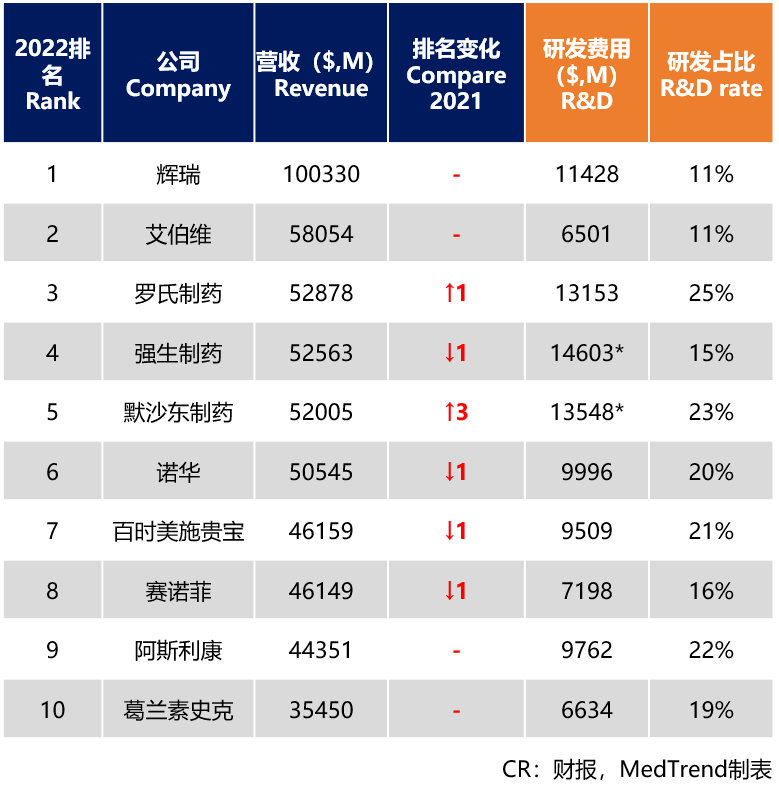
On a broader level, Takeda also faces significant overall growth pressures. According to the 2022 global pharmaceutical company revenue rankings,Takeda has been pushed out of the TOP 10, with a gap of over 5 billion USD from the 10th place GSK, and the gap is showing a tendency to widen.
Signed a licensing agreement with Innate Pharma to develop ADC drugs for the treatment of abdominal diseases. Takeda Pharmaceutical Company Limited willAcquire Global Exclusive Rights to a Group of Drugs, Including R&D, Manufacturing, and Commercialization. Takeda Pharmaceutical Company Limited Pays InnatePaid $5 million upfront, with future milestone payments potentially reaching up to $410 million.
Globalization is the inevitable path for innovative pharmaceutical companies to grow stronger and larger. To walk this path steadily, it is essential to...Take on the huge risks brought by FIC/BIC. Investment may not necessarily lead to returns, but without investment, one is sure to be excluded from the game.Forward-looking pipeline layout and venturing into uncharted territoryCourage is a lesson that all Chinese innovative drugs must learn.


Pharmaceutical | Biological Drugs | ADC | mRNA | CAR—T | PD-1 | Medical Device | Imaging | IVD | Cardiovascular | Orthopedics | Oral Cavity | Ophthalmology | Surgical Robot | Internet Healthcare| Hospital | CXO | Life ScienceStudy
Deep Original | Annual Review | Trend Analysis | Cross-Cycle Series | Stock Market Dynamics | Enterprise Dynamics | Executive Movements | Pharmaceutical Financial Reports | Medical Device Financial Report | Major M&A | Strategic Split | Executive Interview | Compensation | Policy Analysis | Medicare Negotiation | DRG/DIP | Centralized Procurement | JPM | Latest News | CIIE | CMEF
Medical Device Rankings | Medtronic | Abbott | Johnson & Johnson Medical | Siemens Healthineers | BD | Stryker | GE Healthcare | Roche Diagnostics | Philips | Boston Scientific | Mindray Medical | United Imaging Healthcare | Minimally Invasive Medical | Lepu Medical | Weigao | Danaher | Thermo Fisher
Pharmaceutical Rankings | Pfizer | AbbVie | Roche Pharmaceuticals | Johnson & Johnson Pharmaceutical | Merck & Co. | AstraZeneca | Bristol-Myers Squibb | Sanofi | Novartis | GSK | Hengrui | BeiGene | ShiYao | Innovent Biologics | Junshi Biosciences | Legend Biotech | I-Mab Biopharma | CStone Pharmaceuticals | Rongchang Bio | Zai Lab | WuXi AppTec | Qiming Venture Capital | Lilly Asia
--Industry Community--