AbbVie, Calico, and Broad Institute Unveil First-in-Class Oral PTPN2/PTPN1 Inhibitor ABBV-CLS-484 with Potent Anti-Tumor Immunity in Nature

AbbVie
Innovative Drug Developer

Calico Life Sciences
Compound Developer
▎WuXi
Edited by the Kant Content Team
Immune checkpoint blockade therapy targeting PD-1/PD-L1 has brought transformative breakthroughs in cancer treatment. However, many cancer patients do not respond to this type of therapy, creating an urgent need to develop new treatments that overcome resistance. Recently, scientists from AbbVie, Calico Life Sciences, and the Broad Institute have developedA Potential “First-in-Class” Oral PTPN2/PTPN1 Inhibitor ABBV-CLS-484 (AC484) Induces a Potent Antitumor Immune Response in Mouse Models Resistant to PD-1 Blockade, the relevant experimental results were published in the top journal *Nature*. The inhibitor has now entered phase 1 clinical trials under review, according to the authors of the paper.AC484 is the first inhibitor targeting the phosphatase active site to enter clinical evaluation for cancer immunotherapy.
Protein tyrosine phosphatases PTPN2 and PTPN1 are core regulators of inflammatory responses, and their genetic deletion in tumor or immune cells can promote anti-tumor immunity.Through in vivo CRISPR screening, previous studies have found that when PTPN2 or PTPN1 is inhibited, tumor cells become more sensitive to immune checkpoint blockers. However, phosphatases have been considered challenging targets in the past because their binding sites are positively charged, allowing them to only bind with negatively charged molecules. Yet, negatively charged molecules typically cannot cross the outer membrane to enter cells, making the active sites of phosphatases considered undruggable.
Through the process of structure-based drug design and optimization, researchers have discovered a small molecule, AC484, with oral bioavailability that can bind to the active sites of PTPN2 (IC50 of 1.8 nM) and PTPN1 (IC50 of 2.5 nM) proteins with high affinity. In vitro experiments have confirmed,AC484 can make mouse or human tumor cells more sensitive to interferon γ (IFNγ), a key cytokine that promotes cellular immune responses, and enhance the activation and function of various immune cell subsets.
In a mouse model of cancer resistant to PD-1 blockade, monotherapy with AC484 promoted effective antitumor immunity in mice. Scientists discovered,AC484 can enhance pro-inflammatory responses in the tumor microenvironment by augmenting JAK-STAT signaling and reducing T cell dysfunction, while simultaneously promoting the functions of natural killer cells and CD8+ T cells.These results suggest that PTPN2 and PTPN1 may be potential targets for cancer immunotherapy. In addition, this study also shows that small molecule inhibitors targeting key intracellular immune regulatory proteins can achieve efficacy comparable to or higher than that of immune checkpoint antibody therapies in preclinical models. Currently, AC484 is being evaluated in a Phase 1 clinical trial in patients with advanced solid tumors.
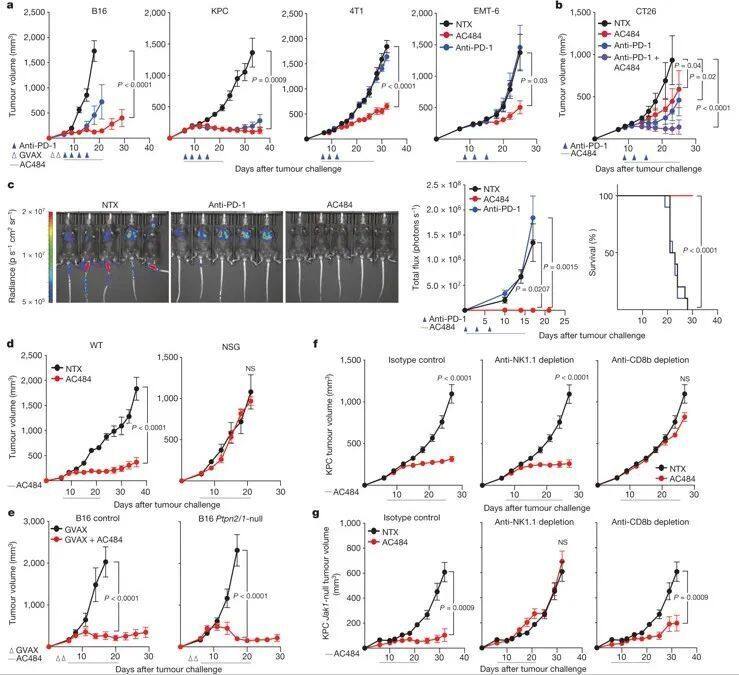
▲ AC484 systemic administration induces immune-dependent tumor regression in various syngeneic and metastatic mouse models (Image source: Reference [1])
Calico is a research and development company focused on creating interventions for age-related conditions, founded by Alphabet, Google's parent company. Its mission is to leverage advanced technologies and model systems to deepen the understanding of the biology that governs human aging. AC484 is an investigational therapy that emerged from the collaboration between AbbVie and Calico, which began in 2014 (with the partnership being extended twice since then) to develop treatments for age-related diseases.