Thirteen Pharmaceutical Giants Collaborate on Landmark Nature Study Linking Plasma Proteomics, Genetics, and Human Health

Biogen
New Drug Developer

Pfizer
Pharmaceutical R&D Developer

Novo Nordisk
Insulin Developer and Manufacturer

Genentech
Pharmaceutical R&D Manufacturer

Amgen
Developer of Treatment Drugs for Serious Diseases

GSK
Pharmaceutical R&D Manufacturer

Bristol-Myers Squibb
Biopharmaceutical and Nutritional Product R&D and Sales

Johnson & Johnson
Healthcare Product Manufacturers, Health Service Providers

AstraZeneca
Biopharmaceutical Manufacturer

Regeneron
Biopharmaceutical Manufacturer

Takeda
Biopharmaceutical Manufacturer

Alnylam Pharmaceuticals
RNA Interference (RNAi) Innovative Drug Developer

Calico Life Sciences
Compound Developer


Population genetics research in humans is increasingly being used as a research tool for drug discovery and development.These studies can promote the identification and validation of therapeutic targets, help predict the long-term outcomes of pharmacological interventions, and improve patient stratification in clinical trials.And old drugs for new uses. Recently, several pharmaceutical giants have invested inUK Biobank(UK Biobank), through comprehensive multi-omics analysis of their biological samples, to accelerate based onGenetic Drug Discovery, Enhancing Large-Scale Phenotype-to-Genotype ResearchStudy。
Drugs developed based on human genetic evidence are at least twice as likely to gain approval and reach the market.Nevertheless, human genetics remains an imprecise tool in biopharmaceutical research and development because genome-wide association studies(GWAS)The genetic variations discovered often lack clear causal relationships, or potential drug target genes are identified but with limited understanding of their biology or regulatory mechanisms.
Combining human genetics with high-throughput, population-scale proteomics can help bridge the gap between the human genome and human diseases.Circulating proteins can also provide insights into the current state of human health and partially capture the impact of lifestyle and environment on disease onset.
On October 4, 2023, research teams from 13 pharmaceutical companies, including Biogen, Pfizer, Novo Nordisk, Genentech, Amgen, GSK, Bristol-Myers Squibb, Johnson & Johnson, AstraZeneca, Regeneron, Takeda, Alnylam, and Calico, collaborated.NatureThe journal published an article titled:Plasma proteomic associations with genetics and health in the UK BiobankResearch Paper.
The studyMore than 14,000 associations between common genetic variants and circulating blood proteins have been identified, over 80% of which were previously unknown.Scientists around the world will be able to access the UK Biobank in the coming weeks.(UK Biobank)Access these proteomics data.
This landmark study was conducted in collaboration with 13 leading biopharmaceutical companies.UK Biobank Pharma Proteomics Project(UKB-PPP)The research team analyzed the data, demonstrating the great potential of using this study for future research.
To date, large-scale proteogenomic studies have confirmedDetermined genetic variants and plasma protein quantitative trait loci(pQTLs)Among the 12,000 independent associations, the samples used often come from studies that lack participant-level access or are associated with deep phenotyping.
LikeUK Biobank(UK Biobank)Such long-term development of open-access frameworks, deep phenotypic characterization, and population-scale studies provides unique opportunities for large-scale expansion of proteogenomics, increased utilization of high-throughput proteomics data, establishment of broader pQTL databases, and acceleration of biomarker, diagnostic, and drug discovery.。
In order to achieve these goals, 13 pharmaceutical companies formed an alliance——UK Biobank Pharma Proteomics Project(UKB-PPP)`, to provide funding for the generation of diverse, population-scale proteomics data.`
Here, we provide a detailed summary of the program, including technical and biological validation, insights into proteomic disease signatures, and predictive models for various demographic and health indicators.
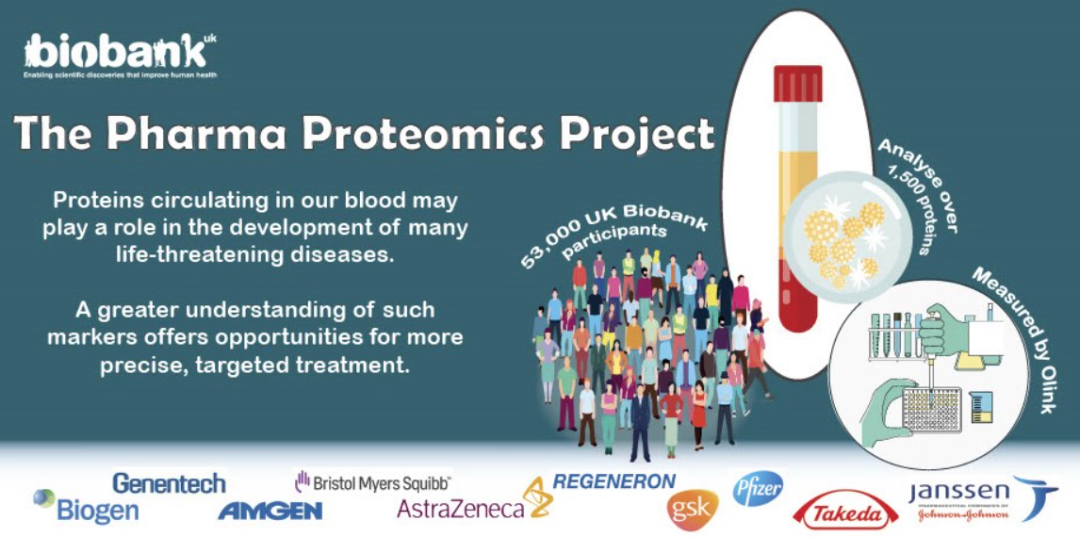
In this study,The research team described the use of antibody-basedProximity Extension Analysis(PEA)Technology, inUK Biobank(UK Biobank)54,219 participantsPlasma proteomics characteristics were analyzed.。
The study proposed a comprehensive set of 2923 proteinsProtein Quantitative Trait Loci(pQTLs)Mapping identified 14,287 major genetic associations, 81% of which were previously undescribed, as well as ancestry-specific pQTL mapping in non-European individuals.This study provides the latest characterization of the genetic architecture of the plasma proteome and contextual analysis with the predicted pQTL discovery rate over time, as sample size and proteome assay coverage increase.。
This study delved into trans-pQTLs across multiple biological domains, highlighting the influence of genes on ligand-receptor interactions and pathway disruptions in various cytokine and complement networks, while also elucidating the ABO blood type andFUT2Long-term upstream effects of secretory states on proteins highly expressed in gastrointestinal tissues. Research teamBy targeting proteins(e.g., PCSK9)The genetic proxy effects extend to other endpoints, and the specific genes and proteins disrupted at loci associated with COVID-19 susceptibility are unraveled, demonstrating the utility of these data in drug discovery.
The Significance of This Study:
Through genome-wide association studies, an open-access library has been established that contains all common genetic variants affecting protein levels in the blood. This can be used to study complex biological processes, such as the immune system, identify proteins that play a key role in disease causation, discover new drug targets, and potentially shorten the development time for early drug candidates, improving the success rate of clinical trials. For the UK Biobank(UK Biobank)Analysis of Blood Protein Levels in China's 20 Most Common Health Conditions. For example, inflammatory proteins that have long been thought to contribute to mental health conditions were found to be significantly elevated in patients with depression. Train machine learning models to determine how blood proteins can successfully predict demographic factors. The analysis found that blood proteins can predict age, gender, and body mass index with high accuracy.(BMI)In the future, this technology can be used to compare chronological age with biological age and determine its relationship with the risk of future diseases.
This public-private partnership provides the scientific community with a fairly extensive and in-depth open-access proteomics resource to help elucidate proteogenomics.Now BehindThe biological mechanisms, and accelerate the development of biomarkers, predictive models, and treatment methods.
It is worth mentioning that,NatureTwo research papers were also published in the same period, respectively fromAstraZenecaAnddeCODE(A subsidiary of Amgen).
AstraZenecaThis study revealsUK Biobank(UK Biobank)Rare genetic variants associated with plasma protein levels in China,StrongRare Genetic Variants Modulating Plasma Protein Abundance and the Value of Proteogenomics in Therapy Discovery
deCODEThis study`, showing`UK Biobank(UK Biobank)These two most commonly used in the Icelandic populationThe Value of Information Provided by High-Throughput Proteomics Platforms, and demonstrated the differences between them, which sometimes provide useful complementarity.
https://www.nature.com/articles/s41586-023-06563-x