AbbVie Advances TCR/CD3 Bispecific Antibody ABBV-184 Targeting HLA-A*02:01/BIRC5 for Solid and Hematologic Malignancies

AbbVie
Innovative Drug Developer
Bispecific antibodies have achieved great success in hematological tumors, with two bispecific antibodies recently receiving approval for marketing. However, in solid tumors, targeted activationTThe bispecific antibody for cells, however, has been progressing slowly, and one of the main reasons isTCEDouble AntibodyOn Target off TumorSide effects prevent it from fully exerting its efficacy, so it is necessary to seek tumor-specific antigens rather than tumor-associated antigens, and intratumoral tumor-specific antigens may be an ideal target.2022Year1Month26Day,FDAApprovedTebentafuspFor treatmentHLA-A*02:01Positive unresectable or metastatic uveal melanoma (mUM) Adult patients.TebentafuspIs targetedgp100/CD3The bifunctional antibody, which targetsgp100The engineered and screened for high affinityTCR, which can specifically bind to containinggp100TheHLA-gp100Complex, the other end of the drug is targeted bindingCD3ThescFv, can activateTCells kill tumors. Recently, AbbVie also published an article announcing itsTCRRelevant bispecific antibody construction strategies.
TCR/CD3Structure
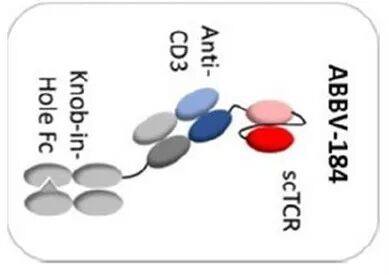
The TCR/CD3 bispecific antibody structure developed by AbbVie is shown in the figure below. In targeting the HLA/peptide complex, it adopts the same strategy as Tebentafusp — the TCR protein. In terms of targeting and activating T cells, it uses the Fab format. Additionally, to increase the antibody's half-life, a heterodimeric Fc (Knob-In-Hole to prevent mismatch) is fused at the C-terminus. The TCR fusion protein targets the (HLA)-A*02:01/BIRC5 peptide complex (LTLGEFLKL). BIRC5 is a member of the apoptosis protein family and is highly expressed in various cancers such as lung, colon, breast, and hematological tumors. Increased intracellular BIRC5 expression is associated with shorter survival times and poor prognosis in patients with lung adenocarcinoma, DLBCL, pancreatic cancer, glioblastoma, and AML.
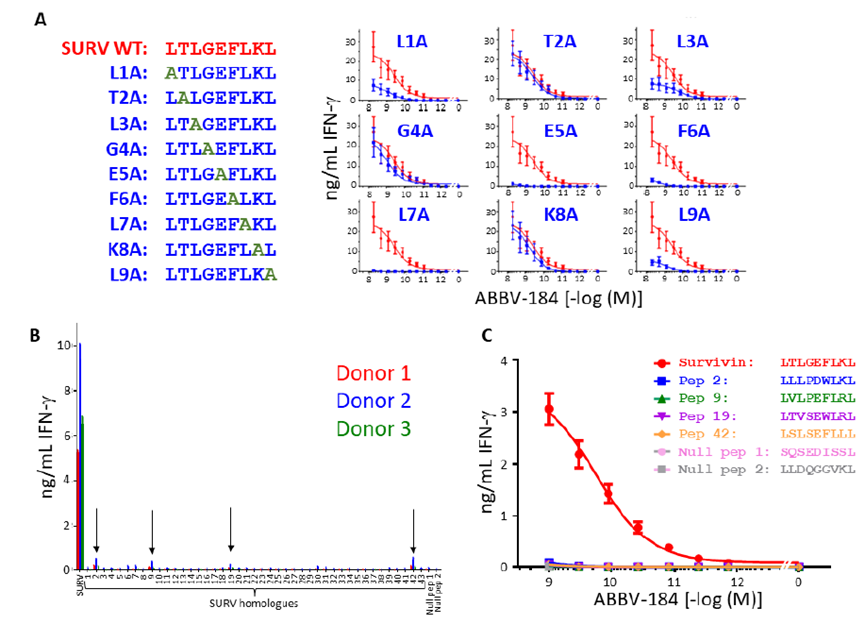
Specificity is a major challenge for TCR-related bispecific antibodies. Higher affinity may lead to non-specific binding of the drug to other HLA/peptides, potentially causing related side effects. Researchers first identified key sites of the ABBV-184 complex through amino acid point mutations. Studies have shown that positions P1, P3, P5, P6, P7, and P9 of the peptide are critical amino acids, consistent with previous research findings. Meanwhile, researchers also used computer simulations to identify 43 peptides from the human proteome that could potentially bind to ABBV-184. In vitro binding activation verification was performed, and the results demonstrated that ABBV-184 specifically binds to the LTLGEFLKL/HLA complex and activates T cells.
In in vitro activity studies, ABBV-184 specifically killed both hematologic tumor cell lines (AML) and solid tumor cell lines (NSCLC), while it only activated T cells in the presence of target cells.
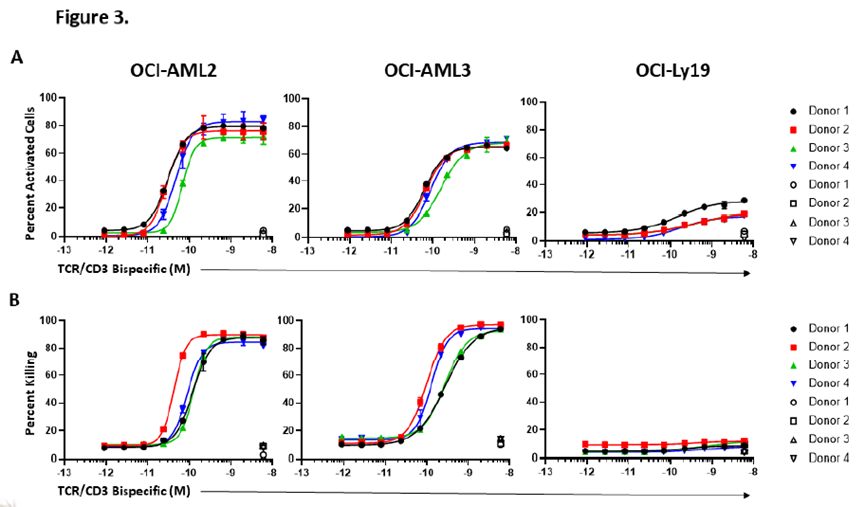
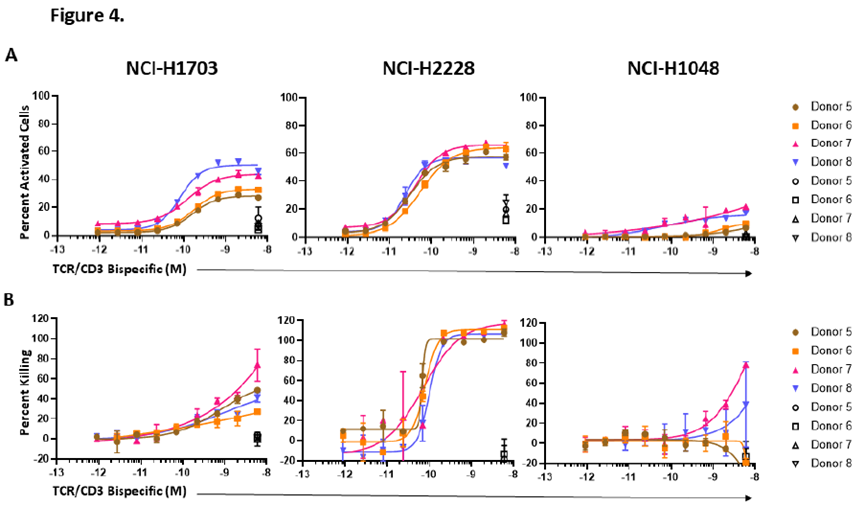
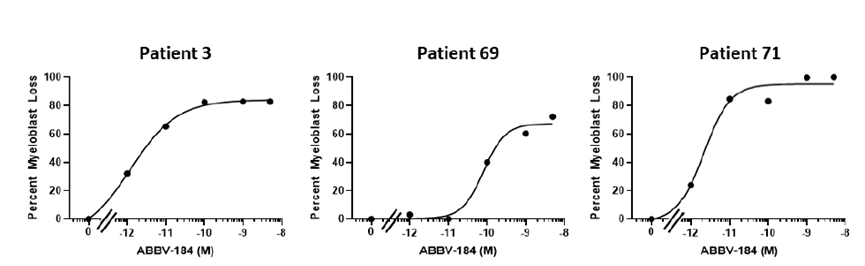
For HLA-A2 positive AML patients, ABBV-184 can effectively eliminate myeloblasts derived from PBMCs, demonstrating that ABBV-184 can activate T cells in AML patients and kill tumor cells.
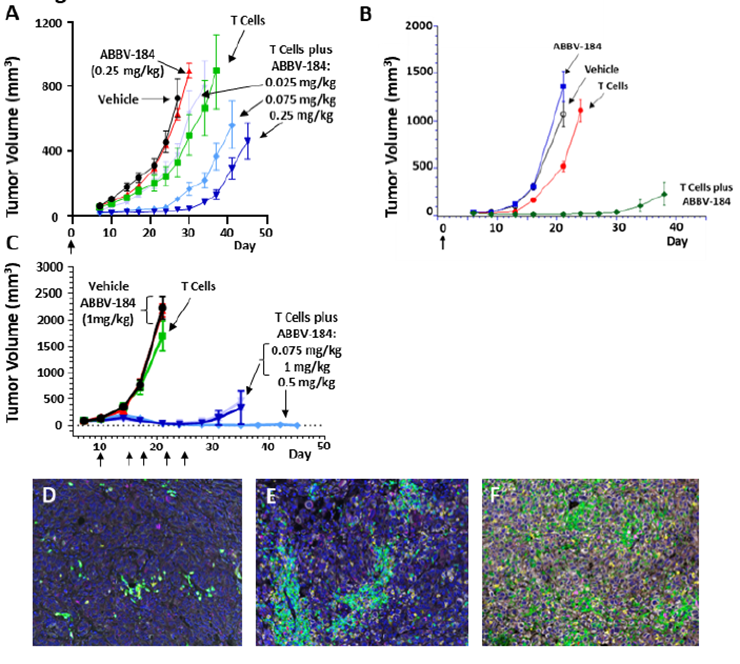
Of course, research has also been conducted on the efficacy of ABBV-184 in animal models. In the HLA-A*02:01-positive prostate tumor model PC3M-A2/β2m (Figure A below) and the AML animal model OCI-AML2 (Figure B below), ABBV-184 effectively inhibited tumor growth. In the AML animal model OCI-AML2, even when the tumor grew to 150mm³, ABBV-184 was still able to completely inhibit tumor growth (Figure C below).。
In the solid tumor model (PC3M-A2/β2m), treatment with ABBV-184 recruited immune cells into the tumor, increased the proportion of CD4+ (green) and CD8+ (yellow) T cells, and reduced the content of FoxP3+ Treg cells (orange).
Summary
TCR Therapy Greatly Expands the Boundaries of Antibody Treatment, Extending Targeting to Intracellular Antigens. Moreover, Compared with Traditional Tumor Targets, Some HLA-Presented Tumor Antigens Exhibit Higher Specificity, Which Can Partially Address the On-Target Off-Tumor Toxicity of TCE Bispecific Antibodies. Currently, Pharmaceutical Giants Such as Roche, BMS, and Regeneron Have Been Strategically Positioning Themselves in TCR Bispecific Antibodies Through Acquisitions, Strategic Collaborations, or Internal Development.
ABBV-184: A novel survivin-specific TCR/CD3 bispecific T cell engager is active against both solid tumor and hematological malignancies.
The tweet is used to convey knowledge. If you have any questions about copyright, etc., please contact PharmaExpress within 30 days of the publication of this article.
Original content is prohibited from being reproduced on other platforms without authorization.
Questions can be sent.Email to yong_wang@pku.edu.cn for more information.
©2021 Pharma Express All rights reserved